
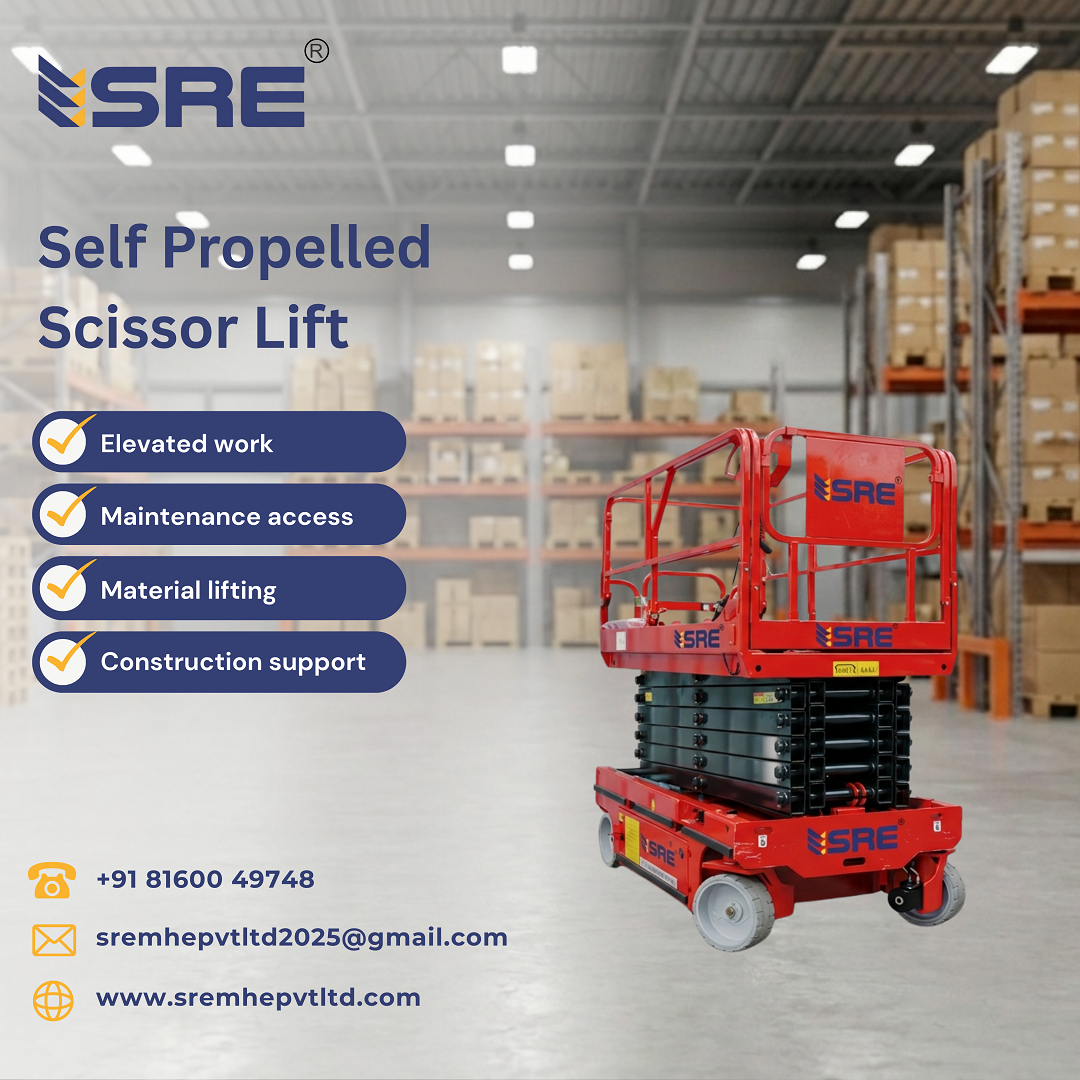
6 meter – 500 kg (All Size Available)
Rs. 690000
(Taxes to be paid extra)
Brand: SRE
SKU: SRE 150
Min Order Qty: 1
Expert Buying Guide for Self Propelled Scissor Lifts: SRE Material Handling Equipment Pvt. Ltd.
Self Propelled Scissor Lift Manufacturer Buying Guide – In daily warehouse and factory operations, the pace of work has increased dramatically. Order volumes are higher, delivery windows are tighter, and safety expectations are far stricter than they were a decade ago. Yet, many sites still try to meet these demands using tools and workflows designed for a slower era.
Supervisors frequently observe recurring issues on the shop floor:
- Teams are pushing hard to hit shipping schedules.
- Workers need to reach elevated areas using ladders or temporary staging.
- Energy levels are dropping significantly midway through longer work periods.
This is precisely where a Self-Propelled Scissor Lift emerges as a sensible, day-to-day asset instead of a specialised acquisition. It slots naturally into existing procedures—for upkeep, order picking, checks, and setup—without forcing teams to alter their methods. The aim isn’t personnel replacement; it’s about decreasing strain, enhancing uniformity, and making routine work at height more secure.
Evolving Demands of Contemporary Industrial Spaces / Facilities
Today’s industrial and manufacturing environments face constant demands. Expansion in online retail, faster production flows, and lean supply chains mean less allowance for delays.
Frequent operational hurdles include:
- Tight delivery timeframes leave little room for corrections.
- Increased item counts require more frequent work at elevated positions.
- Multi-purpose zones where repairs, picking, and installations occur alongside active processes.
In practice, this creates tension between safety compliance and speed. Teams know ladders and manual lifts slow progress, yet taking shortcuts raises accident potential. Facility leaders seek machinery that keeps pace without adding complexity.
What Defines a Self-Propelled Scissor Lift?
On the operational level, a self-propelled scissor lift is a small, movable work platform that retains mobility while elevated. Users employ it to access overhead racking, lighting, ventilation, signage, or machinery parts without the constant need to ascend and descend.
Unlike lifts that need towing or manual positioning, this unit moves under its own power. This is significant in actual operations because users can shift their location within an aisle or along a production line without pausing the task. Across a shift, these minor adjustments yield substantial time savings and lessen physical stress.
Why Self-Propelled Scissor Lifts Are Superseding Older / Manual Gear?
Older methods—ladders, temporary scaffolding, and manually pushed platforms—persist in many locations. While functional, they introduce friction:
- Ladders necessitate repeated climbing and repositioning.
- Scaffolds require time to erect and often obstruct pathways.
- Manual platforms rely on assistance for movement.
A Self Propelled Scissor Lift eliminates these inefficiencies. Operators remain on the platform and adjust their position as the job evolves. Over time, this reduces exhaustion and helps teams maintain a steady tempo throughout shifts.
From an operations standpoint, this consistency is more valuable than bursts of peak speed. When output is predictable, scheduling is simpler and the need for overtime decreases.
Productivity Gains in Routine Tasks
The impact on output is evident in minor, practical ways:
- Maintenance crews can travel along a series of fixtures without dismounting.
- High-level stock counts can be completed in one continuous sweep.
- Installers can make fine positional adjustments without calling for help.
In daily facility tasks, these efficiencies accumulate. A few saved minutes per job accumulate into hours weekly. More importantly, output remains uniform across shifts because the equipment lessens physical wear on the workers.
Enhanced Workplace Security
Most elevated-work-related incidents stem from overreaching, unstable footing, or hurried repositioning. Controlled movement and steady platforms mitigate these dangers.
Tangible safety enhancements include:
- Robust guardrails and stable decks that lower the chance of falls.
- Smooth, measured movement that prevents sudden jarring.
- Better body positioning allows operators to work at a comfortable height rather than stretching.
Safety managers frequently observe fewer incidents when teams are equipped with tools appropriate for the job. When workers don’t feel stressed or rushed, they adhere to protocols more reliably.
To see how the industrial sector and manufacturing companies are making progress lately, it is a good idea to follow fast-paced news networks. Visit The Quick Update for the latest stories and reports from the material handling world.
Managing Heavier Loads with Ease
Modern facilities frequently handle heavier tools, parts, and fixtures at height. Light fixtures, conveyor sections, sensors, and safety barriers are not light items.
A solid lifting platform enables teams to transport tools and materials to the required working elevation safely. This stability is crucial for precision work. Operators can concentrate on alignment and fitting rather than balancing on a ladder while holding an object.
Technology & Operational Streamlining
Battery-driven mechanisms and efficient drive systems are now standard in contemporary lifting platforms. For operational groups, this means dependable operating time and fewer interruptions.
Key operational factors include:
- Battery capacities are adequate for a full shift.
- Straightforward recharging routines that fit existing schedules.
- Reduced need for mechanical adjustments during normal use.
The value here lies not in advanced tech for its own sake, but in dependability. Equipment that is ready every shift and requires minimal attention cuts down on unplanned outages.
If you want to keep up with the new developments and business activities in the industrial equipment market, checking out online news portals is a good choice. Visit India Latest News Feed to stay in the loop with the news that impacts the manufacturing world.
Space Efficiency & Agility
Space is perpetually scarce in busy industrial settings. A compact size and small turning radius allow the equipment to operate in tight aisles without disrupting neighbouring activities.
In areas used for multiple purposes, manoeuvrability surpasses maximum platform size. The capability to quickly adjust position and fit between racking or machinery keeps work flowing without mandated shutdowns.
Value Over the Long Term
The initial purchase cost is only one aspect of the total expense. Over time, true costs manifest in accidents, rework, and lost operational time.
Sustained value arises from:
- Fewer incidents resulting in missed workdays.
- Reduced physical strain on personnel, lowering absence rates.
- Decreased time needed for routine elevated tasks.
Operations leaders frequently find that predictable performance and reduced interruptions justify the investment over several years, even if the upfront expense exceeds that of manual tools.
For more information about our industrial access solutions, feel free to contact us and our team will assist you with the best equipment options for your operations.
Environmental Responsibility & Adherence to Rules
Cleaner operations and regulatory compliance are now baseline expectations. Electric lifting platforms diminish indoor emissions and conform to workplace safety mandates.
From a compliance viewpoint, utilising purpose-built access equipment supports internal reviews and safety certifications. It also signals to the workforce that management is prioritising safer working methods.
Fitting into Facility Operations
Equipment adoption falters when it clashes with established workflows. A self-propelled scissor lift integrates into maintenance routines, picking paths, and inspection cycles without demanding major process overhauls.
Practical integration examples:
- Scheduled maintenance blocks where one unit serves several sections.
- Shared equipment pools managed by the operations staff.
- Standard work rules that incorporate steps for elevated access.
The smoother the reconciliation with current processes, the quicker teams embrace the equipment.
If you want to keep track of new business moves and activities in the industrial equipment sector, checking out local news feeds is a great way to stay informed. Visit Mizoram News Voice to see what’s happening in the manufacturing world today.
Simplicity of Use, Instruction, & Servicing
User-friendliness is often undervalued during procurement. Simple controls and predictable operation cut down on training duration and mistakes.
Field supervisors note that basic operator instruction is usually adequate for common tasks. Servicing is generally uncomplicated, involving regular checks and planned upkeep rather than constant repairs. This predictability aids planners in scheduling downtime instead of reacting to failures.
Why Selecting a Dependable Manufacturer is Crucial?
Not all machinery maintains performance identically over time. Build quality, after-sales support, and certification records influence long-term reliability more than just the technical data sheet.
When evaluating manufacturers, operations teams should look for:
- Established track record in industrial settings.
- Accessibility of repair support and replacement components.
- Adherence to local safety benchmarks and necessary paperwork.
A reliable manufacturer minimises lifecycle risk. This matters when the equipment becomes integral to daily procedures rather than occasional utilisation.
Summary:
In real-world warehouse and plant scenarios, decisions are driven by safety statistics, operational uptime, and how equipment fits into daily tasks. A Self-Propelled Scissor Lift isn’t a productivity hack; it’s a pragmatic device that lessens fatigue, boosts consistency, and supports safer work aloft.
If you are evaluating access options, focus on how well the solution suits your current operation and how dependably it will support your teams in the years ahead. Subtle enhancements in safety and uniformity often yield the strongest long-term returns.
For enterprises looking into reliable industrial access solutions, vendors such as SRE MATERIAL HANDLING EQUIPMENT PRIVATE LIMITED (https://www.sremhepvtltd.com/) belong to the expanding network supporting safer and more efficient industrial undertakings.
Get in touch with us today to discuss your requirements for self-propelled scissor lifts and improve safety and efficiency in your workplace.
Key Takeaways
- Productivity: Reduced time spent repositioning supports stable output across shifts.
- Safety: Stable decks and controlled movement decrease accident probability.
- Load Capacity: Better support for tools and materials at elevated levels.
- Cost Effectiveness: Long-term savings due to fewer incidents and less stoppage.
- Industry Movement: Modern facilities are transitioning away from manual access techniques.
FAQS
Q1: Is a Self-Propelled Scissor Lift good for narrow aisles?
- Affirmative, numerous models are made for compact navigation in warehouse lanes, though aisle width and turning radius need verification before acquisition.
Q2: How much instruction do users generally require?
- Most users can rapidly learn basic operation of a Self-Propelled Scissor Lift, with added guidance necessary for site-specific safety protocols.
Q3: Can a single unit serve multiple departments?
- In many settings, a shared equipment model like a Self-Propelled Scissor Lift functions well, provided it is scheduled and maintained appropriately.
Q4: How does this gear affect maintenance planning?
- Predictable servicing schedules allow planners to sync upkeep with existing non-operational periods when using equipment such as a Self-Propelled Scissor Lift.
Q5: What characteristics should procurement personnel seek in a manufacturer?
- Service access, compliance documentation, and prior experience in similar industrial contexts are more important than primary specification figures. Trusted providers like SRE Material Handling Equipment Pvt. Ltd. ensure reliable support, safety compliance, and long-term equipment performance.
#SelfPropelledScissorLift #WarehouseSafety #IndustrialEquipment #MaterialHandling #SREMaterialHandlingEquipment