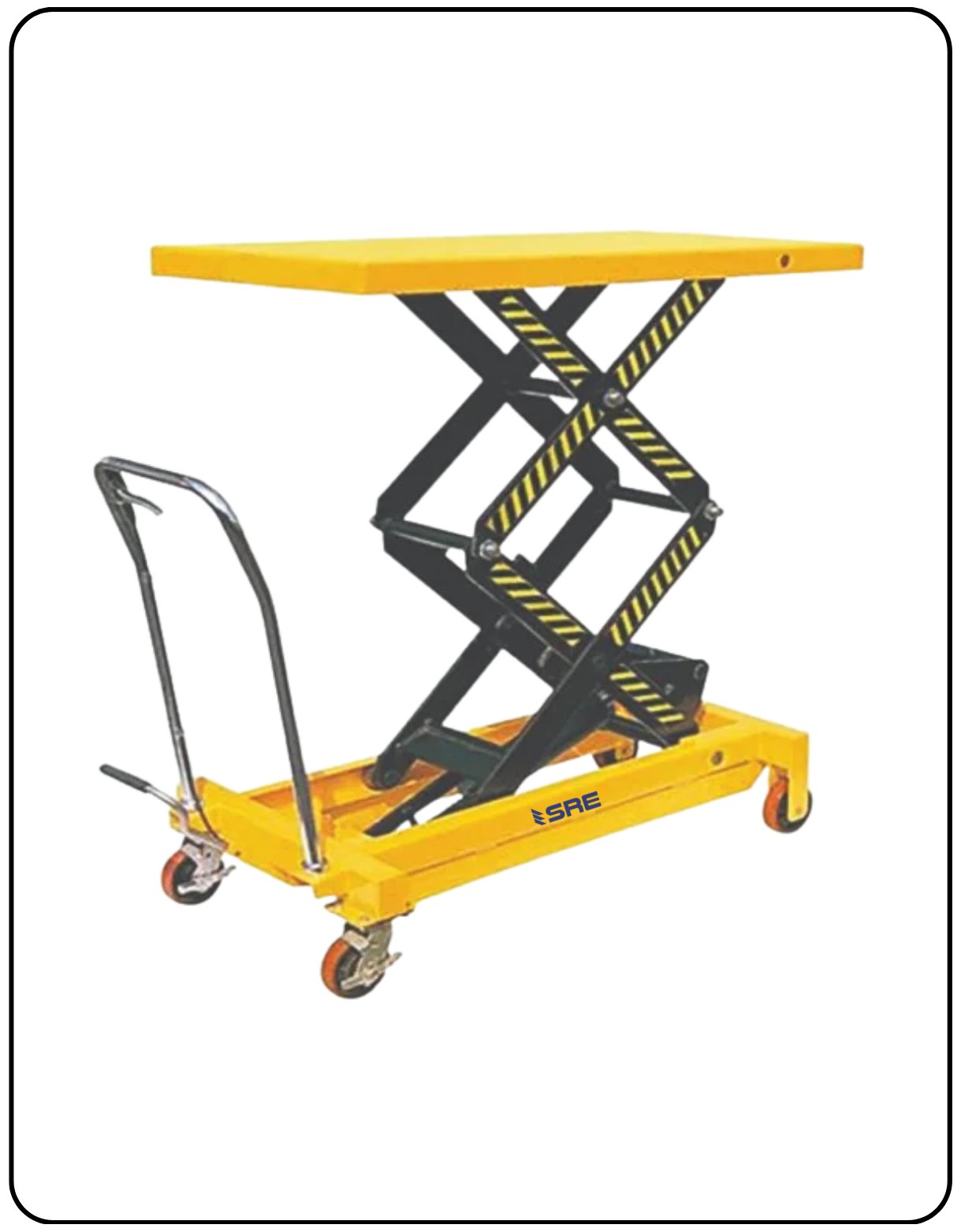
Scissor Lift
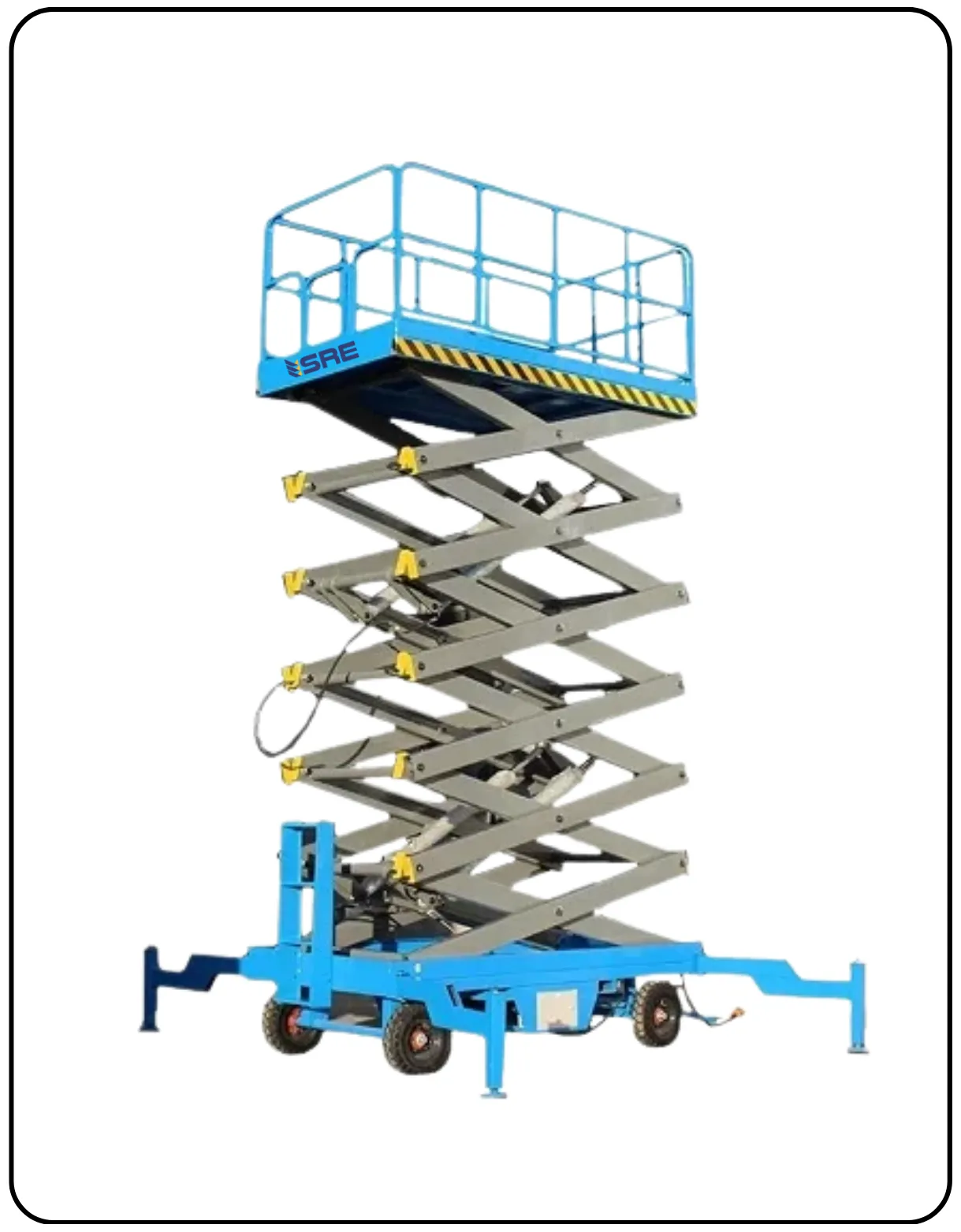
Scissor Lift Manufacturer and Supplier
500 kg-900 mm (All Size Available)
Rs. 26000
(Taxes to be paid extra)
Brand: SRE
Min Order Qty: 1
Over the last decade, warehouses and manufacturing facilities have undergone dramatic transformation. Faster order cycles, tighter delivery schedules, and a rapidly expanding range of SKUs have pushed floor teams to operate at a speed that manual processes can no longer sustain. Workers are now required to cover greater distances, handle heavier loads, and perform tasks at elevated heights—often under strict time constraints and increasing safety pressure. This shift has significantly increased the demand for a reliable Scissor Lift Manufacturer and Supplier to ensure safer access, improved productivity, and efficient high-level operations. In this environment, a scissor lift isn’t a luxury upgrade. It’s a practical answer to a daily operational problem — getting people and materials to working height safely, consistently, and without burning out your workforce.
The Changing Needs of Modern Warehouses and Industries
Warehouse managers and factory floor supervisors face a set of pressures that continue to compound. Storage density has increased as businesses stack inventory higher. Assembly lines now require workers to access components at multiple height levels. Maintenance teams need reliable access to elevated equipment without relying on makeshift ladders or unstable platforms.At the same time, labor costs are rising and experienced workers are harder to retain — especially when the job involves physical strain and safety risk. A single workplace injury doesn’t just affect one person; it disrupts scheduling, triggers compliance reviews, and creates unplanned downtime that ripples across operations.The practical result: operations teams need height access equipment that’s reliable, easy to use, and built for daily industrial use — not occasional use.What Is a Scissor Lift?
In straightforward terms, a scissor lift is a work platform that raises vertically using a crossed, linked support structure — the mechanism looks like stacked X-shapes, which gives the equipment its name. The platform lifts straight up, providing a stable working surface at height for personnel, tools, and materials.Unlike boom lifts that extend outward, scissor lifts are designed for vertical elevation in defined work areas — ideal for warehouses, production floors, maintenance bays, and loading operations where you need height, not reach.To understand the full range of scissor lift types available, you can explore our dedicated pages on Electric Scissor Lift and Hydraulic Scissor Lift — each built for different operational environments.Why Scissor Lifts Are Replacing Traditional Methods?
Manual methods — ladders, step stools, fixed scaffolding — are still common in many facilities. They’re also among the leading contributors to workplace injury. Ladders require constant repositioning. Scaffolding takes time to erect and dismantle. Neither is efficient for recurring daily tasks at height.A hydraulic scissor lift or electric scissor lift changes the workflow fundamentally. The operator moves the platform to position, elevates to the required height, and works. No repeated climbing. No fatigue from carrying materials up and down. No safety compromise from rushed ladder use.For operations teams that measure productivity in shifts, not hours, that difference is significant. You can read more about how this technology has evolved in our detailed guide: Scissor Lift Manufacturer in India.Product Description – Scissor Lift Models
SRE Material Handling Equipment Private Limited offers a complete range of scissor lift platforms engineered for industrial-grade performance. Each model is built for consistent daily use under real operating conditions.All standard models carry a 500 kg rated load capacity. The range covers platform heights of 6 metres, 8 metres, 9 metres, 10 metres, 11 metres, 12 metres, 14 metres, and 16 metres — giving procurement teams a clear option across virtually every facility height requirement.The 500kg x 6mtr scissor lift suits mid-level warehouse racking and indoor maintenance work. As requirements grow, the 500kg x 10mtr and 500kg x 12mtr scissor lift models handle taller storage bays and double-height production floors with equal stability. For high-ceiling facilities — large manufacturing plants, aircraft hangars, or high-rack distribution centres — the 500kg x 14mtr and 500kg x 16mtr scissor lift models provide the elevation needed without compromising platform stability or load rating.For facilities with non-standard height requirements, pit dimensions, or specialized load needs, customised scissor lift solutions are available on request. SRE’s engineering team works directly with facility planners to design platforms that fit actual floor and civil constraints.Also explore our Die Loader — a related material handling solution widely used alongside scissor lifts in press shops and tool rooms.Technology & Operational Efficiency
The majority of SRE’s industrial scissor lifts use hydraulic power systems with electric drive motors. This combination delivers smooth, controlled elevation without the noise or emissions of diesel alternatives — important for enclosed warehouse and factory environments.Consistent lift cycles with predictable cycle times are maintained across shifts. Low-noise operation makes these units suitable for indoor use near personnel. A hydraulic overload protection system prevents use beyond rated capacity, and battery-powered scissor lift models are available for facilities without fixed power access at point of use.For a deeper look at electric-powered options specifically, visit our Electric Scissor Lift Table Manufacturer in Gujarat page. For hydraulic configurations, our Hydraulic Scissor Lift Table Manufacturer in Gujarat page covers specifications and use cases in detail.Uptime is the real measure of any piece of equipment. These systems are designed with minimal moving parts in the hydraulic circuit, which means fewer failure points and more predictable maintenance scheduling.Cost Efficiency Over Time
The business case for a scissor lift for warehouse use isn’t built on the purchase price. It’s built on what changes once it’s in operation.Reduced manual handling means fewer musculoskeletal strain injuries — which in Indian industrial facilities remain one of the top causes of lost work days. One serious injury can cost more in medical expense, compliance review, and schedule disruption than the equipment itself.Beyond safety, there’s the time factor. A task that takes two workers 30 minutes with a ladder and scaffold setup might take one operator 8 minutes with a scissor lift platform. Across hundreds of lifts per month, that time compounds into measurable labor savings.Maintenance is predictable. Hydraulic scissor lift systems, when properly serviced, have long operational lives. Many facilities run the same scissor lift for 10–15 years with scheduled preventive maintenance.Key Features of SRE Scissor Lifts
- Heavy-duty structural steel construction for sustained load cycles
- Anti-skid platform surface for operator safety at height
- Safety guardrails on all platform edges as standard
- Hydraulic lowering valve for controlled descent even during power interruption
- Toe guards and safety skirts on platform edges
- Limit switches for upper and lower travel positions
- Emergency stop accessible from platform level
- Smooth, single-button elevation control for minimal operator training
- Custom platform dimensions available for pit-mounted scissor lift or flush-floor installations
- Overload protection built into hydraulic circuit
Applications of Scissor Lifts
In daily warehouse and industrial operations, scissor lifts are used across a wider range of applications than most teams initially anticipate.Warehouse order picking and stock replenishment at elevated racking levels is one of the most common uses. Manufacturing assembly lines use them where components are accessed at multiple heights. Maintenance teams rely on scissor lift platforms for servicing overhead machinery, conveyors, and lighting.Loading dock operations benefit from scissor lifts for levelling between vehicle and floor heights. Cold storage facilities use them for safe elevated access in restricted environments. The printing, packaging, and paper industry relies on them for machine-level maintenance access. Automotive plants use them for underbody work and assembly line access, and construction and infrastructure sites use them for interior elevated access during fit-out.Training, Ease of Use & Maintenance
One of the practical advantages of a scissor lift platform over more complex aerial work platforms is the minimal training requirement. Most operators can be trained on basic operation, load limits, and safety procedures within a few hours.Controls are intentionally simple — raise, lower, emergency stop. There are no complex manoeuvring systems or extended reach functions to manage.Routine maintenance checks cover hydraulic fluid levels, cylinder seals, electrical connections, and platform hardware. A well-documented preventive maintenance schedule — typically at 250-hour intervals — keeps the equipment running without unplanned failures. Spare parts for hydraulic scissor lifts are widely available, and with an experienced manufacturer, lead times on components are short.Why Choosing a Reliable Scissor Lift Manufacturer Matters?
Equipment quality in this category varies significantly. Structural steel thickness, weld quality, hydraulic component ratings, and electrical protection standards all determine how long a scissor lift performs reliably and safely in demanding conditions.A manufacturer with direct industrial experience understands the real-world conditions these platforms face — uneven floors, dusty environments, continuous shift operation, and the need for equipment that works when workers need it.Compliance with applicable IS standards and CE-equivalent design principles matters not just for regulatory reasons but for genuine operational safety. When evaluating a scissor lift manufacturer in India, look for documented load testing, proper CE or IS marking, and the availability of after-sales service in your region.SRE Material Handling Equipment Private Limited has built its product range around these principles — focusing on structural reliability, straightforward maintenance, and practical performance for industrial buyers.Conclusion
A scissor lift is a straightforward piece of equipment that solves a persistent operational problem: getting workers and materials to height safely and efficiently, shift after shift. For warehouses, factories, and logistics facilities facing rising throughput pressure and tightening safety standards, it’s one of the more practical investments available.If you’re evaluating options for your facility — whether it’s a standard model or a customised scissor lift configuration — the best starting point is a conversation about your specific height, load, and floor constraints.Contact SRE Material Handling Equipment Private Limited to discuss the right scissor lift solution for your operation.Key Takeaways
- Productivity: Scissor lifts reduce time-per-lift task significantly compared to manual alternatives, improving throughput on repetitive elevated-work cycles.
- Safety: Stable, guardrailed platforms with hydraulic safety systems reduce fall and injury risk versus ladders and temporary scaffolding.
- Load Handling: 500 kg rated capacity across the full model range supports both personnel and material handling requirements.
- Cost Efficiency: Long operational life, predictable maintenance, and injury reduction deliver clear long-term value over total cost of ownership.
- Industry Trend: Height-access mechanisation is growing across Indian warehousing, manufacturing, and logistics as facilities expand vertical storage and automate ground-level workflows.
Trending FAQs – Scissor Lift
Q1. What is the maximum height a scissor lift can reach?
- SRE’s standard range goes up to 16 metres. For requirements beyond this, customised high-rise scissor lift configurations are available. Explore our full range →
Q2. What is the load capacity of your scissor lifts?
- All standard models carry a 500 kg scissor lift capacity, suitable for one to two operators plus tools and materials.
Q3. Are your scissor lifts suitable for indoor use?
- Yes. Electric-hydraulic scissor lift models produce no emissions and operate at low noise levels, making them well-suited to indoor scissor lift applications in warehouses and factories. See Electric Scissor Lift →
Q4. How long does installation take for a pit-mounted scissor lift?
- For standard pit-mount scissor lift models, installation typically takes one to two days depending on civil work. SRE’s team provides technical drawings for civil preparation in advance.
Q5. What maintenance does a scissor lift require?
- Routine maintenance covers hydraulic fluid, seals, electrical connections, and platform hardware — typically at 250-hour service intervals. Most facilities handle this with an internal maintenance team following the provided schedule. See Hydraulic Scissor Lift →
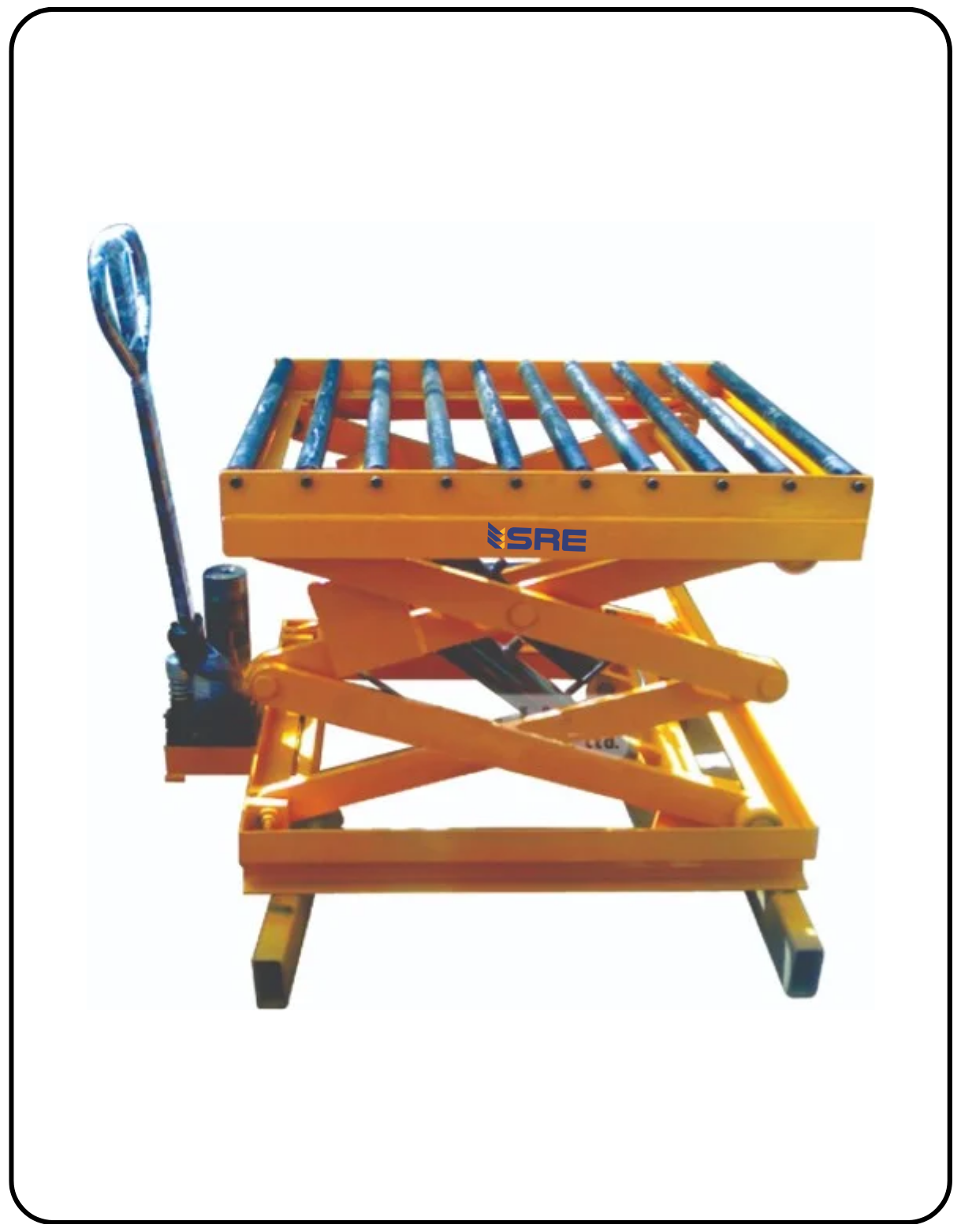
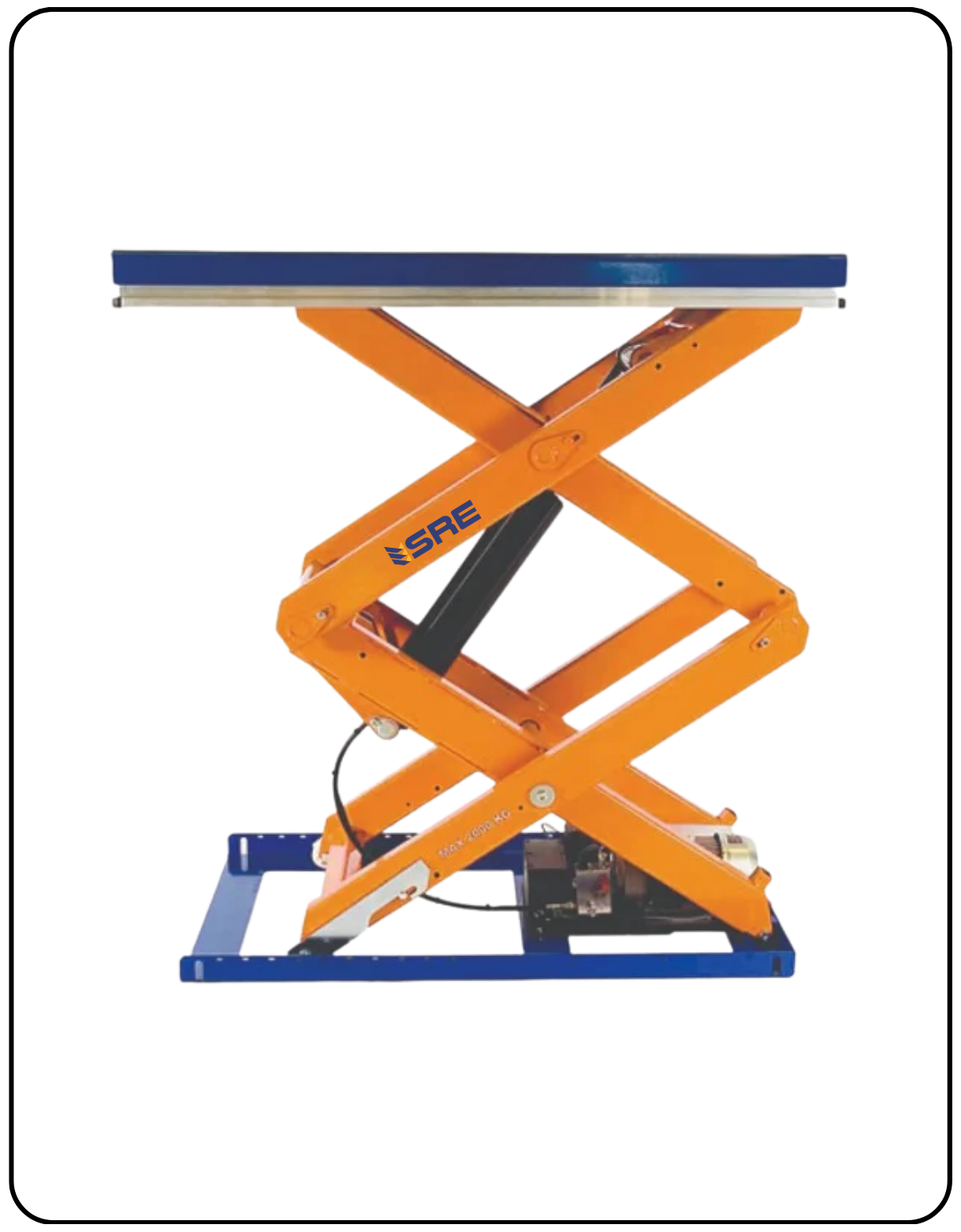
“SRE Material Handling Equipment Pvt. Ltd. ka Scissor Lift use kar rahe hain factory mein. Height work ab kaafi safe aur smooth ho gaya hai. Overall performance excellent hai.”

“Warehouse operations kaafi easy ho gaye hain. SRE Material Handling Equipment Pvt. Ltd. ka Scissor Lift safety aur control dono mein bahut achha hai.”
“Build quality strong hai aur machine reliable hai. SRE Material Handling Equipment Pvt. Ltd. ka Scissor Lift daily industrial use ke liye perfect hai.”