
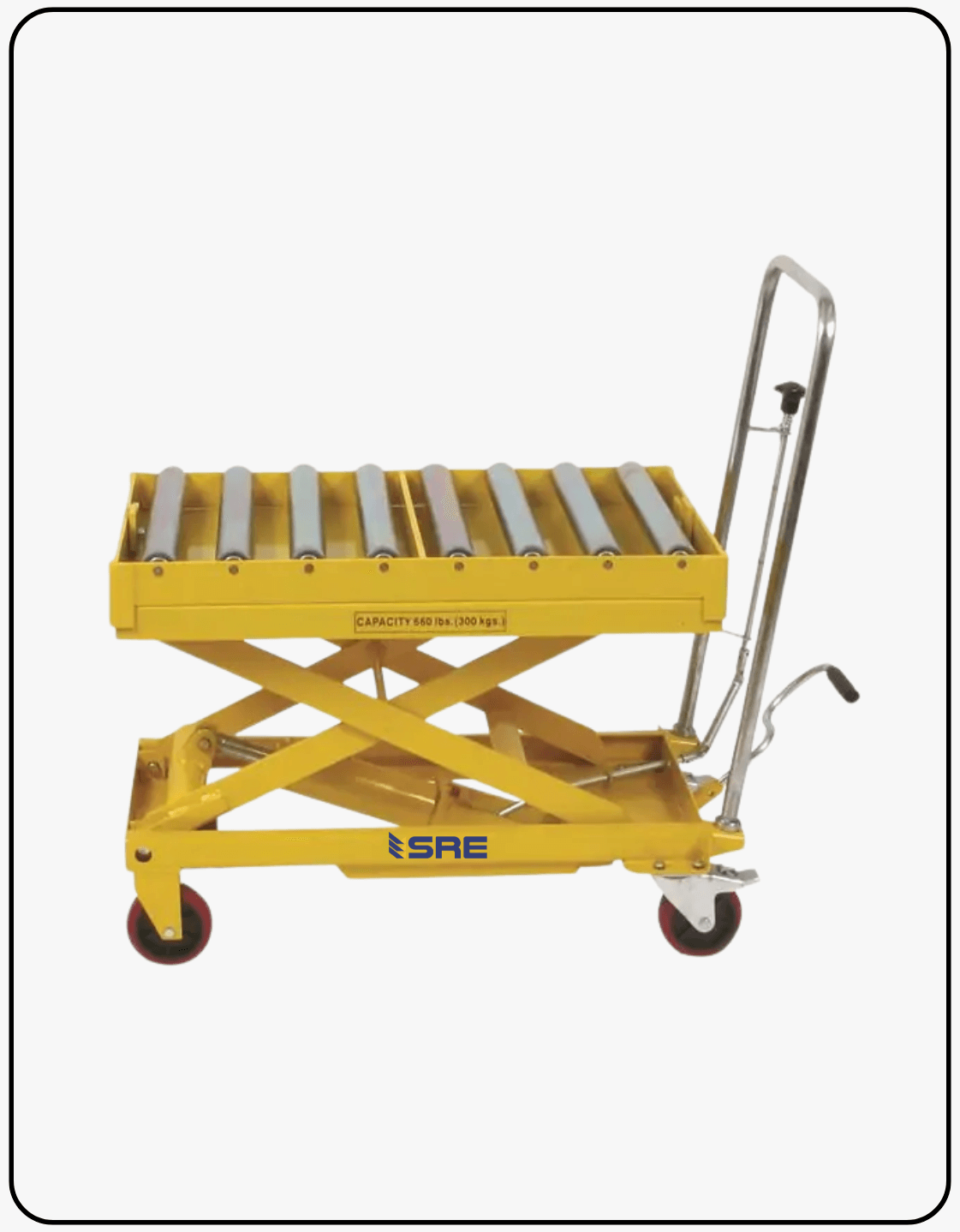
Applications Of Roller Scissor Lift Table And Key Features Of Roller Scissor Lift Table In Bhosri
500 kg-900 mm (All Size Available)
Rs. 26000
(Taxes to be paid extra)
Brand: SRE
Min Order Qty: 1
Industrial engineers and plant layout designers at manufacturing facilities in Bhosri MIDC — especially those running lean production systems where in-process inventory must flow smoothly between workstations at different heights with zero manual lifting — face a specific infrastructure gap when specifying workstation lift equipment: a standard flat-top scissor lift table requires workers to manually drag or push loads onto and off the platform at each height transfer, adding 5–10 seconds of physical effort per transfer event. Across a production line completing 200 height transfers per shift, this hidden manual effort adds up to 15–30 minutes of non-value-added physical work per shift per station. The integrated solution that lean production engineers and plant procurement heads at Bhosri, Pune, and across Maharashtra now install at lean production line transfer points is a Roller Scissor Lift Table in Bhosri — a 500 kg rated hydraulic scissor lift with an integrated steel roller conveyor surface enabling load gravity-transfer on and off the platform, available from SRE Material Handling Equipment Pvt. Ltd. at Rs. 26,000 (taxes extra), ISO 9001:2015 certified and delivered PAN India from Ahmedabad.
Key Features Of Roller Scissor Lift Table That Support Lean Flow Production At Bhosri And Pune Manufacturing Lines
Gravity-Flow Roller Surface — Zero Operator Effort Load Transfer at Every Height Position
Lean production engineers and VSM practitioners at automotive and FMCG manufacturing facilities in Bhosri MIDC and Chakan who map value stream flows at workstation level identify manual load push and pull movements as a consistent source of Type 1 waste (necessary but non-value-adding motion) that is the hardest to eliminate when using flat-top lift tables at height transfer points. The SRE Roller Scissor Lift Table specifically addresses this: the 38 mm diameter galvanised steel roller surface at 100 mm pitch allows loads to roll on and off the platform under gravity or light manual push — contact force requirements drop from the 15–25 kg push required on a flat-top table to under 2–3 kg on the roller surface. For a production line worker completing 200 transfer events per shift, this reduces total manual transfer force from approximately 3,000–5,000 kg aggregate push effort to 400–600 kg — a reduction of more than 85% in transfer-related musculoskeletal loading. SRE Material Handling Equipment Pvt. Ltd., an ISO 9001:2015 certified Make in India manufacturer, provides factory load test certification with every unit dispatched from Ahmedabad to Bhosri, Pune, and PAN India.
500 kg Capacity With 255–900 mm Height Range — Covers All Standard Bhosri MIDC Production Workstation Heights
Production line planners and ergonomics engineers at Bhosri MIDC automotive component manufacturers and Pune pharmaceutical packaging plants know that the working height range of a roller scissor lift table determines which inter-station height transfer combinations it can service without additional equipment. A unit with a maximum height of 700 mm cannot service transfers to raised conveyor heights at 800–900 mm — the most common standard in modern lean production line design. The SRE Roller Scissor Lift Table covers a height range of 255 mm (minimum) to 900 mm (maximum), with a rated platform capacity of 500 kg — correctly specified for component trays, sub-assemblies, and small pallet loads common in Bhosri MIDC assembly and packaging line operations. The hydraulic scissors mechanism uses MS steel IS 2062 heavy box-section arms with sealed NTN/NSK bearings at all pivot points, providing a rated mechanism life of 200,000 full lift cycles at rated load — approximately 5–7 years at 100 lifts per shift, 2 shifts daily.
Applications Of Roller Scissor Lift Table Across Industries In Bhosri, Maharashtra, And PAN India
Production engineers, lean manufacturing consultants, and plant procurement teams in Bhosri, Pune, Ahmedabad, and Bangalore deploy a roller scissor lift table at lean production line transfer points, workstation height-matching positions, and inter-cell material flow transfer locations. Proven applications include:
- Lean assembly line workstation transfer at Bhosri MIDC automotive plants: Component tray and sub-assembly transfer between lean cell workstations at different ergonomic working heights — roller surface enables single-operator smooth transfer without assistance
- Packaging line infeed accumulation in Bhosri and Nashik FMCG packaging: Carton case accumulation at packaging machine infeed — roller surface allows natural gravity flow accumulation from upstream conveyor to infeed lift table and into packaging machine at raised height
- Pharmaceutical blister pack and carton transfer in Hyderabad and Ahmedabad GMP plants: GMP-compliant roller surface (zinc or SS 304 option) for carton transfer between blister packing output and cartoning machine infeed at different heights
- Electronics test and inspection line transfer in Bhosri MIDC electronics plants: PCB and electronic unit carrier tray transfer between test stations at different heights — ESD-safe carrier compatible with 38 mm roller pitch
- Automotive seat and interior trim sub-assembly transfer in Pune and Chakan: Seat frame and trim panel sub-assembly lateral transfer between lean cell stations at different ergonomic heights
- Steel coil processing line height transfer in Ahmedabad, Vatva, and Kathwada: Coil-end pallet and slit coil transfer between uncoiling station conveyor and processing line infeed at different floor heights
- Dairy and beverage carton transfer in Gujarat (Mahesana, Himmatnagar) food plants: SS 304 roller option for dairy carton transfer in GMP-compliant liquid food manufacturing facilities
- Corrugated box and packaging material transfer in Pune and Nashik paper plants: Corrugated sheet bundle and blank transfer between printing/cutting conveyor and packaging assembly station at different heights
- Apparel and textile roll goods transfer in Surat and Bhavnagar: Fabric roll and garment carton transfer between sewing line output conveyor and packing station at different heights
- Construction material bag packing line in Jaipur, Rajasthan: Cement and powder bag transfer from bag filling conveyor to palletising station at different heights — roller surface handles PP and HDPE bag base without damage
Specifying A Roller Scissor Lift Table For Your Bhosri Production Line — Key Decision Parameters
Production engineers and procurement teams in Bhosri, Gujarat, and Maharashtra evaluating a roller scissor lift table for a specific production line application need to confirm five key parameters at the inquiry stage to ensure the correct specification.
| Parameter | Standard SRE Roller Scissor Lift Table | When to Specify Custom |
|---|---|---|
| Platform Rated Capacity | 500 kg | Above 500 kg — custom up to 2,000 kg |
| Height Range | 255–900 mm | Below 255 mm or above 900 mm — custom available |
| Platform Size | 820 × 500 mm standard | Larger pallets — custom up to 1,500 × 1,000 mm |
| Roller Material | 38 mm zinc-plated galvanised steel | SS 304 for food/pharma GMP; nylon for ESD |
| Drive System | Foot-pedal hydraulic pump | Electric hydraulic for PLC/automated line integration |
| Roller Pitch | 100 mm standard | Custom pitch for specific carrier tray slot spacing |
SRE Material Handling Equipment Pvt. Ltd., an ISO 9001:2015 certified manufacturer, supplies the Roller Scissor Lift Table in both standard and custom configurations to buyers across Bhosri, Pune, Ahmedabad, Bangalore, and PAN India. Standard delivery: 7–15 working days; custom configurations: 20–30 working days. For related production line and lean manufacturing equipment: Mobile Scissor Lift, Scissor Lift, and Electric Stacker. Related blog reading: Electric Scissor Lift Table in Mumbai and Self Propelled Scissor Lift Table Pune. Submit an inquiry online with production line height requirements and roller material specification.
Eliminate 85% of manual transfer effort at your Bhosri production line height transfer points — Rs. 26,000.
📞 Get Quote — Call +91 9316 208879 or +91 97247 2240438 mm rollers · 500 kg · 255–900 mm · 200,000 cycle mechanism · ISO 9001:2015 certified · PAN India delivery
For the quality management standard applicable to roller scissor lift table manufacturers, see ISO 9001:2015 Quality Management System. For IS standards governing hydraulic lifting platforms and lift tables in India, visit Bureau of Indian Standards (BIS) — IS 3521. For lean production and ergonomic workstation height guidelines applicable to Bhosri and Maharashtra manufacturing facilities, refer to OSHA Ergonomics guidelines.
Frequently Asked Questions — Roller Scissor Lift Table For Bhosri And Maharashtra Buyers
Q1. How does the SRE Roller Scissor Lift Table reduce manual transfer effort compared to a flat-top scissor lift table at Bhosri MIDC lean production lines?
A flat-top scissor lift table requires 15–25 kg push force per load transfer event. The SRE Roller Scissor Lift Table‘s 38 mm galvanised steel rollers at 100 mm pitch reduce transfer contact force to under 2–3 kg per transfer. At 200 transfer events per shift, this reduces aggregate manual transfer force from 3,000–5,000 kg to 400–600 kg per shift — an 85%+ reduction in musculoskeletal loading at Bhosri and Pune production line workstations.
Q2. What is the rated mechanism cycle life of the SRE Roller Scissor Lift Table at a high-frequency Bhosri MIDC lean production line?
The SRE Roller Scissor Lift Table hydraulic scissor mechanism uses MS steel IS 2062 heavy box-section arms with sealed NTN/NSK bearings at all pivot points, rated at 200,000 full lift cycles at 500 kg rated load. At 100 lifts per shift × 2 shifts × 250 days per year = 50,000 cycles per year, this provides approximately 4–5 years of mechanism service life before bearing inspection is required at a high-frequency Bhosri MIDC lean production line application.
Q3. What custom roller material and roller pitch options are available for the SRE Roller Scissor Lift Table for food, pharma, and ESD-sensitive production lines in Bhosri and Gujarat?
SRE Material Handling Equipment Pvt. Ltd. supplies the Roller Scissor Lift Table with three roller material options: standard 38 mm zinc-plated galvanised steel (100 mm pitch) for general production; SS 304 stainless steel rollers for food-grade and pharmaceutical GMP hygiene compliance at Bhosri, Gujarat, and Hyderabad facilities; and nylon rollers for ESD-sensitive electronics assembly lines. Custom roller pitches (50 mm, 75 mm, 150 mm) are available for carrier tray slot spacing requirements — confirm at inquiry stage.
Q4. What is the delivery lead time, custom configuration availability, and warranty for the SRE Roller Scissor Lift Table in Bhosri and Maharashtra?
Standard SRE Roller Scissor Lift Table (500 kg, 820 × 500 mm, zinc roller, foot-pump) is delivered to Bhosri and Maharashtra in 7–15 working days. Custom configurations — larger platform, SS 304 rollers, electric hydraulic drive, or higher capacity — are fulfilled in 20–30 working days. SRE Material Handling Equipment Pvt. Ltd. provides a 12-month structural warranty and 6-month hydraulic warranty with every unit, plus spare parts support from the Ahmedabad plant.
Q5. Bhosri ya Pune ke lean production line mein Roller Scissor Lift Table ki delivery aur installation mein kitna time lagta hai?
Bhosri aur Pune ke lean production lines ke liye standard SRE Roller Scissor Lift Table ki delivery 7 se 15 working days mein hoti hai. Unit ready-to-use condition mein deliver hota hai. Production line integration — roller height alignment check, castor lock, aur load function test — 1–2 hours on-site. Electric drive automated version ke liye 20–30 working days aur electrical drawings included. SRE Material Handling Equipment Pvt. Ltd. technical support guidance provide karta hai at no additional cost.
Q6. Ahmedabad ya Gujarat ke pharmaceutical packaging line mein Roller Scissor Lift Table ki GMP compliance requirements kya hain?
Ahmedabad aur Gujarat ke pharmaceutical packaging lines ke liye GMP compliance requirements: SS 304 stainless steel roller option — corrosion resistant, cleanable surface meeting WHO GMP Annex 9 production equipment standards. Platform surface SS 304 chequer plate option also available for full GMP deck. Roller gap spacing 100 mm — does not allow product accumulation. Annual cleaning validation: wipe test on roller surface with IPA to confirm no chemical migration. SRE Material Handling Equipment Pvt. Ltd. provides material certificates for SS 304 components on request.
Q7. Kya Roller Scissor Lift Table ki roller replacement aur mechanism service Noida, Faridabad, ya Chennai mein available hai?
Haan. SRE Material Handling Equipment Pvt. Ltd. ke Ahmedabad facility se spare parts — 38 mm galvanised roller sets, NTN/NSK bearing kits, foot pump cylinder assemblies, descent valve units, PU castor sets, aur scissor arm pin replacement kits — Noida, Faridabad, Chennai, aur PAN India ke liye 2–5 working days mein courier dispatch hote hain. Annual maintenance: roller bearing lubrication, hydraulic oil check, aur scissor arm pivot pin inspection — estimated Rs. 800–2,000 per service.