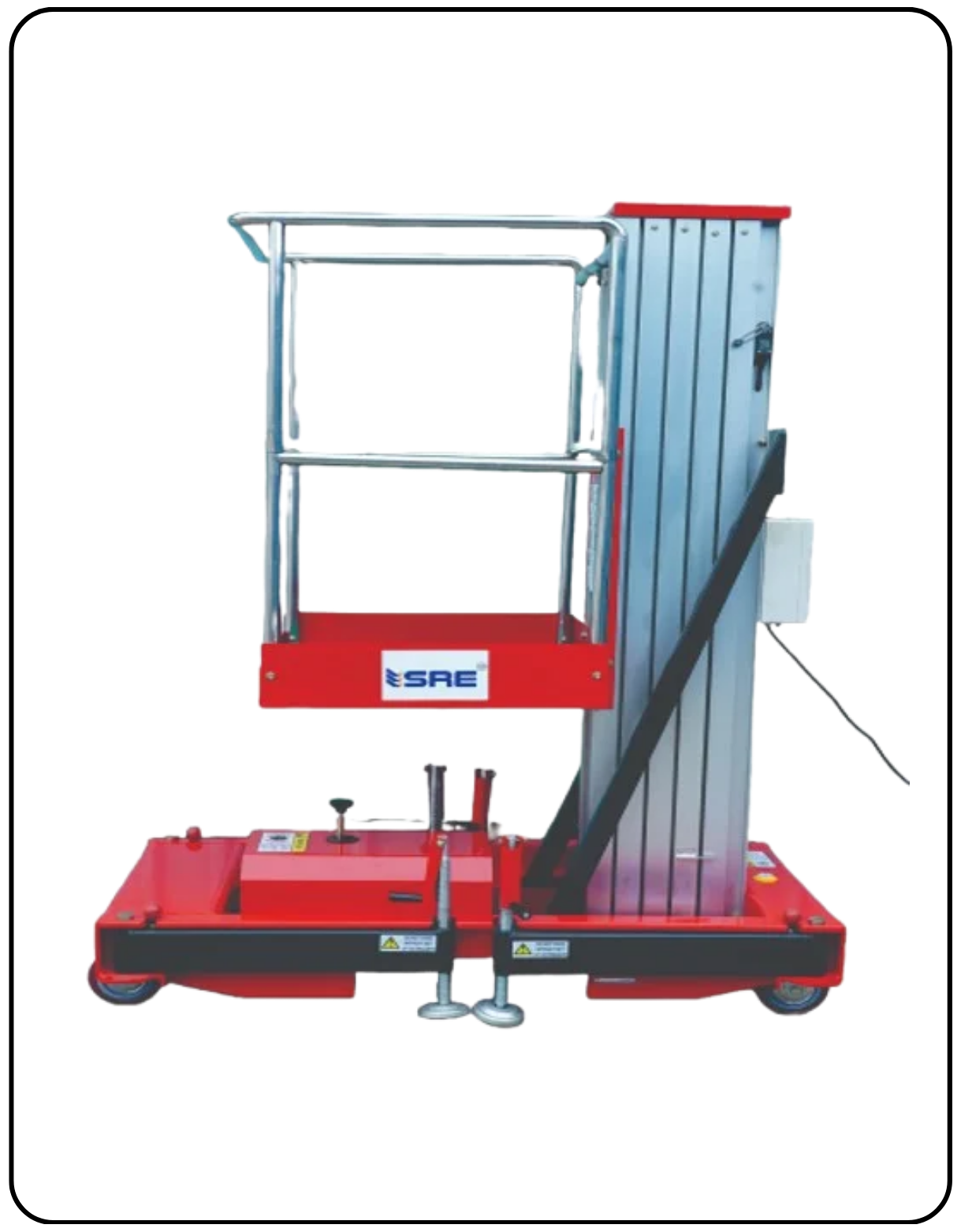
130 Kg-6 Meter (All Size Available)
Rs. 175000
(Taxes to be paid extra)
Brand: SRE
SKU: SRE 151
Min Order Qty: 1
Maintenance teams and civil contractors working at heights above 4 metres in Ahmedabad, Vadodara, Pune, and Bangalore face a persistent operational problem: conventional ladders and fixed scaffolding are slow, unstable, and repeatedly flagged in safety audits. Workers waste 20–40 minutes per task on ladder repositioning, and every shift spent on scaffolding erection adds non-productive hours to project cost. The practical answer is a purpose-built Aerial Lift — a self-contained elevated work platform that positions a worker safely at height within minutes, without scaffolding or fixed structure. SRE Material Handling Equipment Pvt. Ltd.‘s aerial lift (SKU: SRE 151) carries 130 kg to a working height of 6 metres, making it the go-to choice for maintenance, installation, and inspection tasks across Gujarat, Maharashtra, and Rajasthan.
👨🔧 Field Note — Technical Team, SRE Material Handling Equipment Pvt. Ltd.
“A facility maintenance contractor in Gandhinagar was using bamboo scaffolding for ceiling-level electrical maintenance — three hours of setup for a 45-minute task. After switching to our 6-metre aerial lift, the same task now takes under 15 minutes from entry to completion. Scaffold erection cost has dropped to zero.” — Applications Engineer, SRE Material Handling Equipment Pvt. Ltd.
Key Features of Aerial Lift for Industrial and Commercial Applications in Ahmedabad and Gujarat
Hydraulic Mast with Controlled Lift Speed and Platform Stability
Facility managers in Ahmedabad, Bangalore, and Noida routinely ask whether an aerial lift provides the same stability as scaffolding at 6-metre height. The answer lies in the mast design. SRE Material Handling Equipment Pvt. Ltd.‘s aerial lift SRE 151 uses a precision-guided hydraulic mast system — single or dual mast depending on model — with a telescoping action that maintains vertical alignment within ±3 mm throughout the lift stroke. The work platform is mounted on an anti-tilt base frame with four outrigger stabilisers that are deployed before the lift cycle begins, providing a ground contact footprint of up to 2.4 metres × 2.4 metres for maximum stability at full working height.
Compact Footprint — Designed for Narrow Aisle and Indoor Use
Procurement heads in Pune, Hyderabad, and Chennai managing warehouse or production facility maintenance budgets need equipment that fits within existing aisle widths without disrupting operations around it. The SRE 151 aerial lift has a base width of approximately 850 mm in stowed position, allowing it to pass through standard 900 mm service doors and navigate between racking lanes in warehouses across Kathwada, Vatva, and Gurugram. The self-propelled electric variant (available on request) eliminates manual pushing entirely, with a battery-powered traction system that enables single-operator movement across level concrete floors with a gradient tolerance of up to 3 degrees.
| Model / SKU | Capacity | Working Height | Platform Size | Drive Type | Power |
|---|---|---|---|---|---|
| SRE 151 (Standard) | 130 kg | 6 metres | 600 × 800 mm | Manual Push | Single Phase 230V |
| SRE 151-SP | 130 kg | 6 metres | 600 × 800 mm | Self-Propelled Electric | 24V Battery |
| SRE-AL-8M | 130 kg | 8 metres | 700 × 900 mm | Manual / Self-Propelled | Single Phase / Battery |
| SRE-AL-10M | 130 kg | 10 metres | 800 × 1000 mm | Self-Propelled Electric | 24V / 48V Battery |
| SRE-AL-CUSTOM | Up to 200 kg | Up to 12 metres | As Per Requirement | As Per Requirement | As Per Requirement |
Get a Quote for Aerial Lift — Bulk Orders Welcome
Factory-direct pricing for contractors, warehouse operators, and facility managers across Ahmedabad, Vadodara, Pune, Bangalore, Gujarat, Rajasthan and PAN India. Delivery in 7–15 working days.
📞 Get Bulk Order Quote 📋 Send InquiryApplications of Aerial Lift Across Industries in Ahmedabad, Jaipur, Bangalore, and Beyond
Operations managers and safety officers in Ghandinagar, Kalol, Faridabad, and Bhopal deploying aerial lifts for the first time want to know upfront which tasks this equipment handles best. The SRE 151 aerial lift is validated in the following real-world applications across the SRE Material Handling Equipment Pvt. Ltd. client base:
- Industrial Facility Maintenance — Routine access to ceiling-mounted HVAC equipment, electrical conduit, lighting fixtures, and fire suppression systems in factories across Ahmedabad, Vadodara, and Vatva GIDC at heights between 4–6 metres.
- Warehouse Racking Installation & Repair — Assembly, alignment, and inspection of high-bay storage rack structures in distribution centres across Gurugram, Noida, and Pune; the compact base fits within standard 900 mm aisle widths.
- Construction & Civil Fit-Out — False ceiling installation, curtain wall glazing support, and MEP (mechanical, electrical, plumbing) rough-in work in commercial construction projects across Bangalore, Chennai, and Hyderabad.
- Pharma & Cleanroom Maintenance — Accessing overhead services in GMP manufacturing environments; available with non-marking polyurethane wheels and powder-coated surfaces compatible with cleanroom cleaning protocols in facilities in Hyderabad and Ahmedabad.
- Signage and Display Installation — Retail and commercial signage fitting at height in malls, airports, and showrooms across Jaipur, Udaipur, Indore, and Ahmedabad.
- Shipbuilding and Engineering Yards — Hull inspection and overhead welding access in engineering yards near Kutch and Bhavnagar; robust MS frame withstands outdoor and semi-outdoor environments.
- Telecom Tower Maintenance — Aerial access for equipment inspection and cable routing in telecom facilities across Rohtak, Ambala, and Gurugram.
How Aerial Lift Compares to Scaffolding and Boom Lifts for Maintenance Operations in Pune and Bangalore
Safety officers and procurement heads in Bangalore, Pune, and Chennai frequently ask for a direct comparison before approving capex for aerial lifts. Bamboo scaffolding and steel scaffolding systems remain common across Gujarat and Rajasthan — but they carry significant hidden costs: erection and dismantling time (typically 2–4 hours per setup), labour cost for scaffold crew, and a persistent audit risk since Indian factory safety regulations require formal scaffolding inspection records. The SRE 151 aerial lift eliminates all three: deployment takes under 5 minutes, a single operator manages both positioning and the work task, and the equipment comes with a load test certificate and compliance documentation ready for factory safety files.
Compared to boom lifts, the aerial lift excels for indoor vertical-access tasks. Boom lifts offer horizontal reach but require wider aisles, higher floor load capacity, and are typically diesel-powered — making them unsuitable for enclosed factory environments due to exhaust emissions. The electric aerial lift produces zero emissions, operates quietly enough for production-adjacent maintenance, and fits in spaces where boom lifts cannot physically enter. For facilities in Ahmedabad, Himmatnagar, Mahesana, and Chattral where indoor maintenance at 6–10 metres is the primary need, the aerial lift is consistently the better engineering choice — lower cost of ownership, simpler operation, and no emission compliance concerns.
🎯 Client Experience — Plant Manager, Pharma Facility, Vadodara
“Our GMP audit required us to replace bamboo scaffolding with certified elevated work platforms. We sourced three units of SRE’s aerial lift SRE 151 for our Vadodara facility. The non-marking wheels mean no floor damage in our classified areas, and the load test certificates satisfied our auditors on the first review.” — Plant Manager, Pharmaceutical Manufacturer, Vadodara
For additional height-access solutions across your facility’s operational needs, explore related product ranges: Mobile Scissor Lift for shop-floor height access up to 4 metres, Electric Scissor Lift Table for workstation height adjustment, and Electric Order Picker for warehouse racking retrieval. For outdoor and loading dock applications, the Mobile Ramp complements aerial lift deployment at dock heights. External reference: OSHA Aerial Lift Safety Standards and ISO 9001:2015 Quality Management Certification for product compliance benchmarks.
SRE Material Handling Equipment Pvt. Ltd. — Aerial Lift Supply, Certification, and Delivery Across Gujarat, Maharashtra, and PAN India
SRE Material Handling Equipment Pvt. Ltd., an ISO 9001:2015 certified manufacturer and supplier headquartered in Ahmedabad, Gujarat, manufactures the aerial lift SRE 151 with direct supply capability to clients across Ahmedabad, Vadodara, Gandhinagar, Mahesana, Kutch, Bhavnagar, Kalol, Kathwada, Vatva, Himmatnagar, Chattral, and Ghandhidham with reduced freight lead times due to proximity to the Ahmedabad manufacturing unit. Every aerial lift dispatched undergoes a pre-shipment functional test — hydraulic pressure check, platform level verification, and outrigger deployment test — before issue of the delivery note.
For purchase managers in Rajasthan (including Jaipur and Udaipur), Bhopal, Indore, Faridabad, Rohtak, Ambala, and Gurugram, SRE Material Handling Equipment Pvt. Ltd. coordinates pan-India delivery through established freight partners with typical transit times of 3–7 working days. Supply documentation includes: load test certificate, operation and maintenance manual, warranty card, and GST invoice. The company’s MSME registration and Make in India certification also make it eligible for government procurement empanelment requirements in applicable tendering processes.
Ready to Replace Scaffolding with a Safer, Faster Solution?
Get factory-direct pricing, technical specifications, and delivery timeline for aerial lifts across Ahmedabad, Pune, Bangalore, Vadodara, Jaipur, Hyderabad and all of PAN India.
📞 Call Now — Get QuoteFrequently Asked Questions — Aerial Lift in Ahmedabad
What is the working height and rated capacity of the SRE aerial lift SRE 151, and is it suitable for indoor industrial use?
The SRE 151 aerial lift carries 130 kg to a maximum working height of 6 metres, making it suitable for ceiling-level maintenance, racking installation, and MEP fit-out in industrial and commercial environments. It operates on a compact base of approximately 850 mm width, enabling access through standard service doors and narrow aisles in factories and warehouses across Ahmedabad, Pune, and Bangalore. The electric hydraulic lift system produces zero emissions, suitable for enclosed spaces.
How does an aerial lift compare to traditional scaffolding for maintenance tasks in a factory in Ahmedabad or Pune?
Traditional scaffolding requires 2–4 hours of erection time and a dedicated erection crew, adding significant non-productive cost per maintenance task. An aerial lift deploys in under 5 minutes and is operated by a single worker. For a facility in Ahmedabad or Pune with 3–5 maintenance tasks per week at heights between 4–6 metres, switching from scaffolding to an aerial lift typically saves 6–12 man-hours per week and eliminates ongoing scaffold hire or erection costs entirely.
What safety features does SRE’s aerial lift include to meet Indian factory and construction site safety requirements?
Every aerial lift from SRE Material Handling Equipment Pvt. Ltd. includes: four outrigger stabilisers for ground stability before lift, platform guardrail (1.1 metre height) with mid-rail and toe-board, hydraulic overload protection set at 110% of rated 130 kg load, emergency lowering valve for controlled descent in power failure, and an emergency stop button on the platform control panel. All units ship with a load test certificate as standard documentation for safety file compliance.
Can SRE supply aerial lifts for bulk procurement to contractors and facility management companies across Maharashtra and Rajasthan?
SRE Material Handling Equipment Pvt. Ltd. actively supplies aerial lifts in bulk to facility management companies, construction contractors, and industrial maintenance firms across Maharashtra (including Pune and Mumbai), Rajasthan (including Jaipur and Udaipur), Gujarat, and all PAN India locations. Bulk order pricing (5+ units) includes dedicated project support, consolidated dispatch, and installation guidance. Lead time for bulk orders is typically 15–25 working days depending on configuration and quantity.
Ahmedabad aur Gujarat ke factories mein aerial lift SRE 151 ki delivery kitne din mein hoti hai?
Ahmedabad, Gandhinagar, Vatva, Kathwada, Kalol, Mahesana, aur Gujarat ke baaki industrial areas mein SRE Material Handling Equipment Pvt. Ltd. ke manufacturing facility se aerial lift SRE 151 ki delivery 7–10 working days mein ho jaati hai. Custom size ya special configuration ke liye lead time 15–20 working days hoti hai. Delivery ke saath load test certificate aur operation manual bhi provide kiya jaata hai.
Pune aur Bangalore ke construction contractors ke liye aerial lift ka maintenance schedule kya hota hai?
Aerial lift SRE 151 ka maintenance bahut straightforward hai. Hydraulic oil level har 250 operating hours ya 3 mahine mein check karna chahiye. Outrigger rubber pads har 6 mahine mein inspect karein. Complete hydraulic oil change har 12 mahine mein recommended hai. SRE Material Handling Equipment Pvt. Ltd. ke Annual Maintenance Contract (AMC) ke through Pune, Bangalore, Ahmedabad, aur Gujarat mein on-site service support available hai.
Kya SRE aerial lift Rajasthan aur Jaipur ke government tenders aur MSME procurement ke liye eligible hai?
Haan, SRE Material Handling Equipment Pvt. Ltd. MSME registered aur Make in India certified company hai, jo Rajasthan, Jaipur, Udaipur, aur baaki states ke government procurement tenders mein eligible hai. ISO 9001:2015 certification bhi hai jo quality standard proof ke taur par tender documentation mein use hoti hai. Aerial lift SRE 151 ke liye complete tender documentation — specifications, load test certificate, GST invoice — available hai on request.