
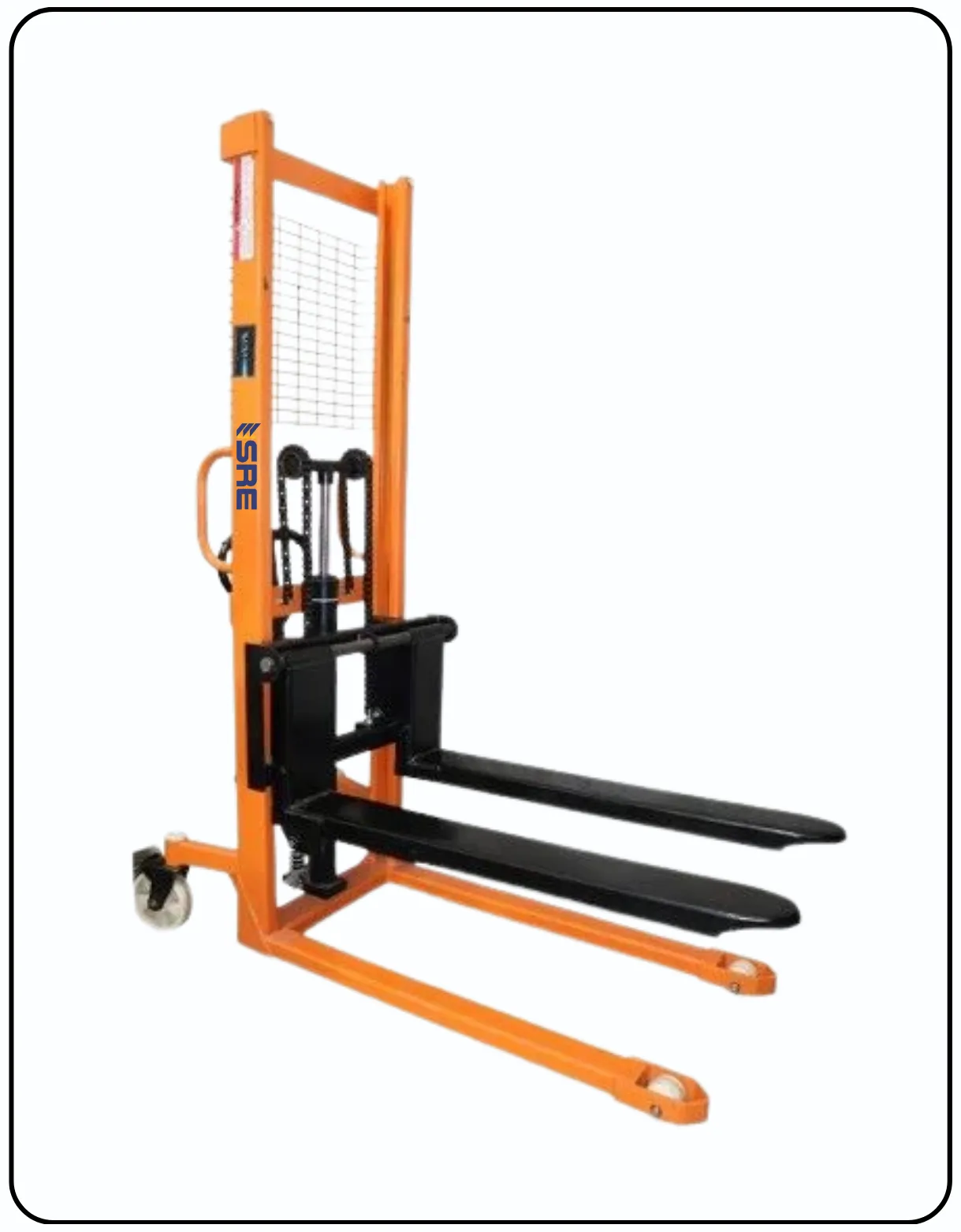
Stores managers and materials handling supervisors at Bhosri MIDC light manufacturing, chemical processing, and food production facilities where the primary pallet stacking and retrieval requirement is occasional — 15–40 pallet movements per shift rather than continuous high-cycle operation — face a practical procurement challenge when evaluating vertical pallet stackers: a battery-powered electric or semi-electric stacker at Rs. 85,000–1,40,000 requires overnight battery charging infrastructure, periodic battery maintenance, and a designated charging station, all of which add operational overhead that is disproportionate to a modest daily stacking requirement. The correct specification for this application profile — where 500 kg load capacity, 1.6 metre rack height, and occasional-to-moderate daily stacking frequency define the requirement — is a Hydraulic Stacker in Bhosri — the SRE 111 from SRE Material Handling Equipment Pvt. Ltd., a foot-pump hydraulic mast stacker that lifts 500 kg to 1.6 metres using the operator’s foot pump effort alone — no battery, no charging station, no electricity connection — priced at Rs. 30,000 (taxes extra) and manufactured under ISO 9001:2015 in Ahmedabad.
Key Features Of SRE 111 Hydraulic Stacker That Make It The Zero-Infrastructure Vertical Lifting Solution For Bhosri And Pune Facilities
Foot-Pump Hydraulic Mast Lift — 500 kg to 1.6 Metres With No Battery, No Charging, No Electricity
Procurement managers and store supervisors at Bhosri MIDC small manufacturing units, pharmaceutical stores, and food processing facilities in Gujarat who have previously operated battery-powered stackers know the operational maintenance burden they create: the battery must be charged every night (even if only partially used), water must be topped in non-sealed lead-acid batteries weekly, the charger and charging station must be kept operational, and battery replacement at 4–5 year intervals costs Rs. 15,000–25,000 per unit. The SRE 111 Hydraulic Stacker eliminates all of this: it uses a foot-operated double-acting hydraulic pump that pressurises the lift cylinder using the operator’s body weight on the foot pedal. Each foot pump stroke lifts the 500 kg rated load approximately 40–50 mm, reaching 1,600 mm in approximately 30–40 pump strokes over 60–90 seconds per lift cycle. There is no electrical connection at any stage. The hydraulic system uses standard ISO VG 46 hydraulic oil — readily available at any hardware or industrial supply outlet in Bhosri, Pune, or Gujarat. Maintenance requirement: annual oil check and possible top-up — total annual service cost approximately Rs. 200–500. SRE Material Handling Equipment Pvt. Ltd., an ISO 9001:2015 certified manufacturer, delivers to Bhosri and Maharashtra in 7–15 working days.
Straddle Legs with 1,100 mm Span — Works Inside Standard Pallet Racking Aisles Without Structural Modification
Warehouse managers and inventory supervisors at Bhosri MIDC MSME facilities and Pune distribution operations setting up their first pallet racking system and requiring a stacker to work inside the racking aisle know the footprint constraint: the stacker must fit between the rack upright frames, which are typically spaced 1,100–1,200 mm apart for standard 1,000 × 1,200 mm euro pallets. The SRE 111 Hydraulic Stacker’s straddle legs span 1,100 mm (inner leg clearance) — allowing the straddle arms to slide alongside the pallet base blocks and position the fork tips under the pallet deck at the correct height. The straddle legs are fabricated from MS IS 2062 Grade B box section (50 × 50 × 4 mm wall) with a welded end cap protecting the leading edge from floor damage during the approach. Castor wheels under the straddle arm ends are 100 mm diameter PU-tyred swivel type — smooth rolling on standard Bhosri MIDC concrete factory floors with a rolling resistance load of less than 5 kg effort for a 500 kg loaded unit on level floor.
Applications Of Hydraulic Stacker Across Industries In Bhosri, Maharashtra, And PAN India
- Raw material store pallet stacking at Bhosri MIDC SME manufacturing: Ground and first-level rack stacking of incoming raw material pallets (250–500 kg) at small to medium manufacturing unit stores — foot-pump hydraulic lift for 15–40 stacks per shift
- Pharmaceutical product stores at Hyderabad and Ahmedabad GMP facilities: Controlled environment stores where battery charger exhaust and battery outgassing is not permitted — hydraulic stacker needs no charging station, emits no fumes
- Chemical drum and IBC pallet stacking at Vadodara and Kutch GIDC: Chemical plant stores where ignition sources (including battery charger sparks) are restricted — hydraulic stacker is spark-free in normal operation
- Cold store pallet stacking in Gujarat (Bhavnagar, Mahesana): Cold store environments where battery performance drops significantly below 5°C — hydraulic oil-based system maintains performance at cold store temperatures
- Paint and solvent warehouse at Bhosri MIDC and Vatva: Flammable goods warehouse where battery charging sparks and electrical equipment create fire risk — hydraulic stacker is the inherently safer option
- Printing and packaging material stores in Jaipur and Rajasthan: Paper and board stock stacking at low-to-moderate volume distribution stores — hydraulic stacker provides adequate lift speed for printing plant daily requirements
- Agricultural goods and seed storage in Gujarat (Kalol, Himmatnagar): Agri product and fertiliser bag pallet stacking at cooperative storage facilities — hydraulic stacker requires minimal technical maintenance at remote storage locations
- Hospital and healthcare supply stores in Bangalore, Hyderabad, and Chennai: Medical supply pallet stacking at hospital stores where electrical equipment certification for medical areas may limit battery stacker use
- Small trader and wholesaler godown in Indore, Bhopal, and Rohtak: Low-volume goods stacking at wholesale and trading operation godowns — hydraulic stacker at Rs. 30,000 is the most economical powered stacking solution
- Retail backroom storage at Gurugram, Noida, and Faridabad retail chains: Backroom pallet stacking at retail stores with modest daily handling requirements — no charging station needed in retail backroom environment
🏭 Operational Note — Bhosri MIDC Chemical Plant Stores, 2025
A Bhosri MIDC chemical processing plant stores manager evaluated battery-powered stacker vs hydraulic stacker for their solvent drum and IBC pallet store. The HAZOP (Hazard and Operability Study) assessment flagged battery charger sparking and battery outgassing as ignition source risks in the flammable chemical store environment — requiring an ATEX-rated battery stacker at significantly higher cost. The SRE 111 Hydraulic Stacker at Rs. 30,000 was selected: no charging station, no spark-generating electrical equipment, and fully adequate for their 20–25 pallet movements per shift requirement. The hydraulic stacker eliminated both the capital cost premium and the ATEX compliance burden that a battery stacker would have required.
SRE 111 Hydraulic Stacker — Specification Table For Bhosri And Gujarat
| Specification | SRE 111 Standard | Options Available |
|---|---|---|
| SKU | SRE 111 | Standard |
| Rated Capacity | 500 kg | 1,000 kg, 1,500 kg options |
| Max Lift Height | 1,600 mm | 2,000 mm, 2,500 mm options |
| Straddle Leg Inner Width | 1,100 mm | Custom widths available |
| Lift Drive | Foot-operated double-acting hydraulic pump | No battery or power — inherently safe |
| Hydraulic Oil | ISO VG 46 hydraulic oil | Available at any hardware outlet |
| Straddle Leg Material | MS IS 2062 Grade B 50×50×4mm box section | SS 304 frame option — food/pharma |
| Castor Wheels (Straddle) | 100mm PU swivel | Polyamide or rubber options |
| Mast Type | Duplex single-stage mast | Triplex options for higher lift |
| Annual Maintenance Cost | Rs. 200–500 (oil check only) | No battery maintenance |
| Price | Rs. 30,000 (taxes extra) | Fleet: contact SRE |
Hydraulic Stacker vs Manual Stacker vs Semi-Electric Stacker — Selection For Bhosri And Maharashtra
| Feature | Manual Stacker (Hand Pump) | SRE 111 Hydraulic Stacker (Foot Pump) | Semi-Electric Stacker (Battery Lift) |
|---|---|---|---|
| Lift Mechanism | Hand lever pump | Foot-pump — hands free during lift | Electric 24V battery mast lift |
| Lift Effort | Both hands on lever | Foot effort — both hands free for guidance | Zero — button operated |
| Battery/Charging Needed | No | No — ISO VG 46 oil only | Yes — overnight charging |
| HAZMAT/Flammable Stores Use | Safe | Safe — no spark-generating electrical components | Restricted — battery charging sparks |
| Rated Capacity (SRE 111) | 500 kg | 500 kg | 500–1,500 kg |
| Max Lift Height (SRE 111) | 1,600 mm | 1,600 mm | 1,600–3,500 mm |
| Annual Maintenance Cost | Rs. 200–500 | Rs. 200–500 (oil only) | Rs. 3,000–8,000 (battery + electrical) |
| Capital Cost (INR) | Rs. 20,000–35,000 | Rs. 30,000 (SRE 111) | Rs. 85,000–1,40,000 |
The key advantage the SRE 111 Hydraulic Stacker has over a manual hand-pump stacker is the foot-pump mechanism — both operator hands remain free to guide the load during lifting, improving stability and control at the stacking position. For related stacking equipment: Electric Stacker, Pallet Truck, and Drum Handling Equipment. Related blog: Hydraulic Stacker Pune and Manual Stacker Pune. Submit an inquiry for straddle width and lift height confirmation.
Stack pallets at Bhosri without battery hassle — SRE 111 Hydraulic Stacker, Rs. 30,000.
📞 Order Now — +91 9316 208879 or +91 97247 22404500 kg · 1.6 m lift · Foot pump · No battery · ISO VG 46 oil · ISO 9001:2015 · Delivery 7–15 days
For the ISO quality management standard applicable to hydraulic stacker manufacturers, see ISO 9001:2015 Quality Management System. For IS standards governing hydraulic stackers in India, visit Bureau of Indian Standards (BIS) — IS 4660. For warehouse safety guidelines on manual and hydraulic stacker use, refer to OSHA Powered Industrial Trucks safety standard.
Frequently Asked Questions — Hydraulic Stacker For Bhosri And Maharashtra Buyers
Q1. What is the key operational advantage of the SRE 111 Hydraulic Stacker’s foot-pump mechanism over a hand-lever manual stacker for Bhosri MIDC stores operations?
A hand-lever manual stacker requires both operator hands on the pump lever during lifting — the operator cannot simultaneously guide or steady the load. The SRE 111 Hydraulic Stacker’s foot-pump mechanism generates lift pressure using foot body weight on the pedal — both operator hands remain free to guide the load to the correct rack position during the lift. At a 500 kg load to 1,600 mm height, this hands-free control during ascent significantly improves stacking accuracy and reduces load-touching-rack-upright incidents at Bhosri MIDC narrow-aisle stores.
Q2. Why is the SRE 111 Hydraulic Stacker safer than a battery-powered stacker for chemical plant stores, paint warehouses, and flammable goods storage at Bhosri and Vadodara?
Battery-powered stackers carry two ignition source risks in flammable goods environments: battery charger arcing (during connection/disconnection) and battery outgassing (hydrogen gas during charging of flooded lead-acid batteries). Both are prohibited ignition sources in HAZMAT and flammable goods stores classified under IS 1646 or PESO regulations. The SRE 111 Hydraulic Stacker has no battery, no charger, no electrical wiring, and no outgassing — generating zero electrical ignition risk during normal operation at Bhosri MIDC chemical plant stores and Vadodara paint warehouses.
Q3. How many pump strokes and time does it take the SRE 111 Hydraulic Stacker to lift a 500 kg load to 1,600 mm at Bhosri MIDC warehouse operations?
The SRE 111 Hydraulic Stacker’s foot-pump lifts the mast approximately 40–50 mm per pump stroke at 500 kg rated load. Reaching 1,600 mm from ground level requires approximately 32–40 pump strokes — taking approximately 60–90 seconds per lift cycle at a comfortable operator pumping pace. This is adequate for Bhosri MIDC store operations handling 15–40 pallet stacking cycles per shift. For high-cycle operations exceeding 60+ lifts per shift, a semi-electric or fully electric stacker is more appropriate — the hydraulic stacker is designed for occasional-to-moderate frequency stacking requirements.
Q4. What is the annual maintenance cost and expected service life of the SRE 111 Hydraulic Stacker versus a battery-powered stacker for Gujarat and Maharashtra warehouse operations?
The SRE 111 Hydraulic Stacker annual maintenance cost is approximately Rs. 200–500 — limited to an annual ISO VG 46 hydraulic oil level check and possible top-up, descent needle valve calibration check, and mast channel lubrication. A battery-powered stacker annual maintenance cost is Rs. 3,000–8,000 (battery watering, charger check, electrical system inspection, battery replacement at 4–5 years for approximately Rs. 15,000–25,000). Expected structural service life: 15–20+ years for the SRE 111 hydraulic frame at normal Gujarat and Maharashtra warehouse use.
Q5. Bhosri ya Pune ke pharmaceutical ya food grade store ke liye Hydraulic Stacker SRE 111 ka SS 304 variant available hai?
Bhosri aur Pune ke pharmaceutical aur food processing facility stores ke liye SRE Material Handling Equipment Pvt. Ltd. SS 304 stainless steel frame, straddle legs, aur fork surface mein Hydraulic Stacker SRE 111 supply karta hai. SS 304 frame GMP hygiene requirements, FSSAI food plant equipment guidelines, aur pharma facility cleaning regimes ke saath compliant hai. ISO VG 46 food-grade hydraulic oil option bhi available hai for food production environments. Custom spec inquiry par quote 3–5 working days mein available. SRE Material Handling Equipment Pvt. Ltd. delivers to Maharashtra in 7–15 working days.
Q6. Ahmedabad ya Gujarat ke chemical godown ya flammable store ke liye Hydraulic Stacker SRE 111 ki HAZMAT suitability confirm kaise karein?
Ahmedabad aur Gujarat ke chemical godowns aur flammable goods stores ke liye SRE 111 Hydraulic Stacker HAZMAT suitability confirm karne ke liye: (1) no battery — battery outgassing risk absent, (2) no charger — arcing ignition source absent, (3) no electrical wiring in stacker frame — electrical fault ignition risk absent. Hydraulic oil (ISO VG 46) is flash point >150°C — non-flammable at ambient temperatures. For PESO Zone 1 classified hazardous areas, confirm with your facility EHS officer — SRE can provide hydraulic oil flash point data and no-electrical-ignition-source declaration.
Q7. Kya Hydraulic Stacker SRE 111 ki hydraulic seal kit aur descent valve service Noida, Hyderabad, ya Bangalore mein available hai?
Haan. SRE Material Handling Equipment Pvt. Ltd. ke Ahmedabad plant se spare parts — hydraulic cylinder lip seal kits (polyurethane triple-lip), foot pump seal kits, descent needle valve sets, ISO VG 46 hydraulic oil 1-litre packs, mast channel roller sets, aur PU castor wheel replacement sets (100mm swivel type) — Noida, Hyderabad, Bangalore, aur PAN India ke liye 3–7 working days mein courier dispatch hote hain. Annual seal inspection aur oil top-up estimated Rs. 200–500 — minimal maintenance cost compared to battery stackers.