
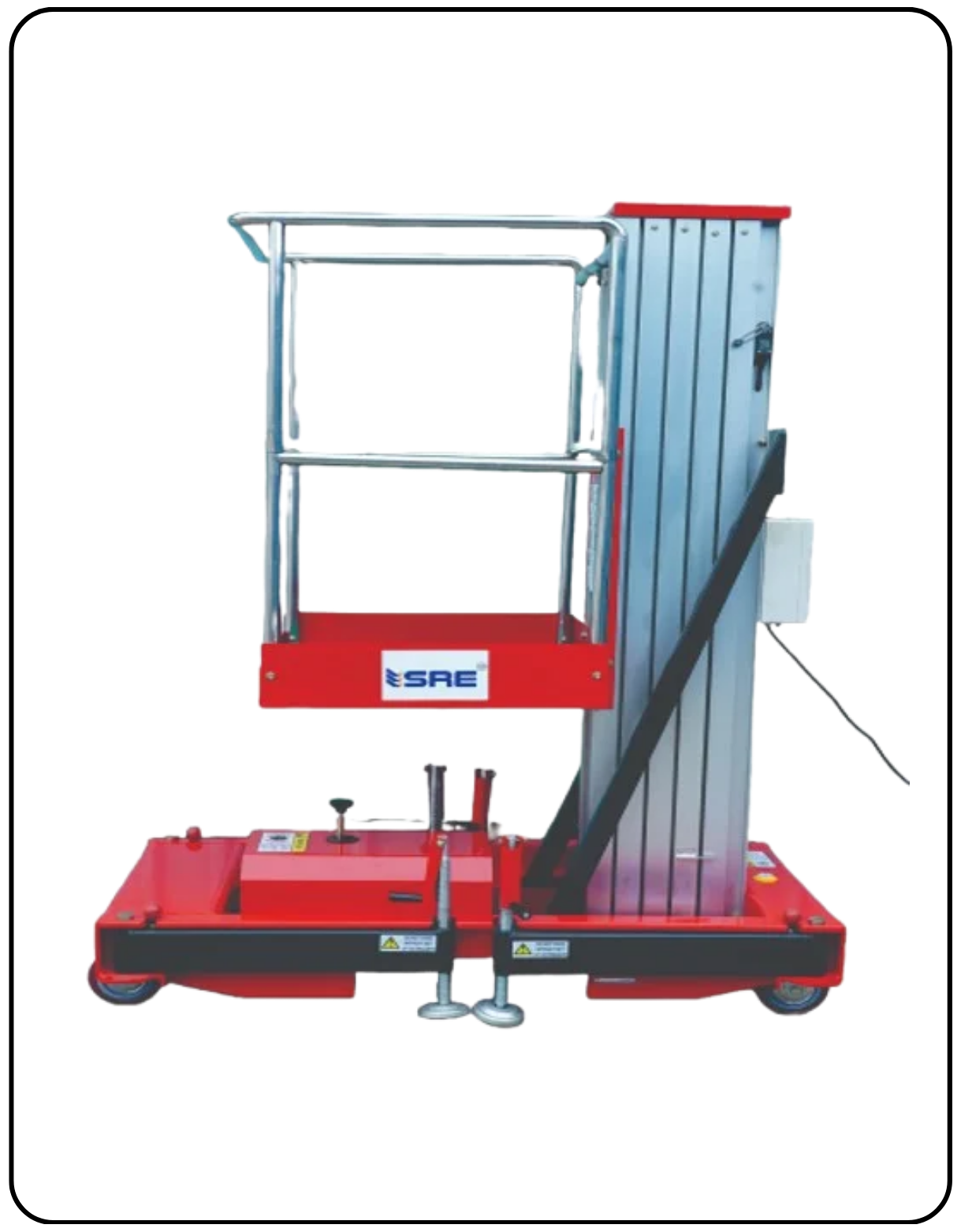
SRE Material Handling Equipment Pvt. Ltd.: Manufacturer, Supplier And Exporter Of Aerial Lift in India.
SRE Material Handling Equipment Pvt. Ltd., Manufacturer And Supplier Of Aerial Lift in Pune.
Our Manufacturing Unit is in Ahmedabad, Vadodara, and Rajkot, Gujarat, India.
Aerial Lift in Pune: Enhancing Warehouse Efficiency and Safety
In today’s fast-paced industrial and warehouse environments, operational efficiency, safety, and productivity are no longer optional—they are critical. As businesses handle larger volumes, tighter deadlines, and complex internal workflows, traditional manual methods of material handling are being pushed to their limits. In daily warehouse operations in Pune and across India, managers and procurement teams face challenges such as labor fatigue, operational bottlenecks, and safety risks.
This is where Aerial Lifts have emerged as a practical, reliable solution. Designed to elevate personnel and materials safely, these machines streamline tasks that previously required ladders, scaffolding, or manual lifting, transforming workflow efficiency and reducing workplace risks.
The Changing Needs of Modern Warehouses and Industries
Modern warehouses and factories are evolving rapidly. Rising consumer demand, faster delivery expectations, and increased inventory turnover are creating operational pressures unseen a decade ago. Internal logistics now demand precision, speed, and flexibility.
Warehouse managers in Pune often report challenges like:
- Handling goods across multi-level storage racks
- Moving heavy materials without causing damage or strain
- Reducing downtime caused by labor fatigue or manual errors
- Ensuring worker safety in high-reach operations
In these circumstances, relying solely on forklifts, manual lifts, or scaffolding can compromise both efficiency and safety. Aerial Lifts provide a versatile solution, allowing workers to perform tasks at heights safely while improving throughput.
What Is an Aerial Lift?
In simple, industry-focused terms, an Aerial Lift is a mechanical device that safely elevates personnel and materials to elevated heights, allowing access to storage racks, machinery, or high installation points. Unlike ladders or temporary scaffolds, aerial lifts provide stability, controlled movement, and ergonomic support for repetitive tasks.
Common types include boom lifts, scissor lifts, and vertical mast lifts, each designed to fit specific warehouse or factory configurations. The key focus is operational practicality—lifting efficiency, safety, and workflow integration.
Why Aerial Lifts Are Replacing Traditional Equipment
Traditional material handling methods, including ladders, scaffolds, and manual lifting, pose multiple challenges:
- Labor Fatigue: Repetitive lifting and climbing take a toll on staff over shifts.
- Inconsistent Output: Manual operations are prone to errors, slower throughput, and uneven work quality.
- Safety Risks: Falls and strain injuries remain significant hazards in high-reach tasks.
Aerial lifts address these issues by providing ergonomic support, smooth vertical and horizontal movement, and reliable load handling. In daily operations, they reduce fatigue, maintain consistency across shifts, and enhance safety for both staff and materials.
Productivity Gains in Daily Operations
Integrating an Aerial Lift in warehouse operations improves productivity in measurable ways:
- Time Savings: Rapid elevation and positioning allow workers to complete tasks faster.
- Consistent Workflow: Uniform access reduces delays caused by manual adjustments or errors.
- Multi-Task Capability: Some aerial lifts allow simultaneous transport of personnel and light materials, reducing extra trips.
For example, in a high-volume warehouse in Pune, the use of scissor lifts on narrow aisles increased order-picking efficiency by up to 30%, while reducing strain on employees.
Improved Workplace Safety
Safety remains a top priority in any industrial setup. Aerial Lifts contribute to safer operations by:
- Providing a stable, controlled platform for high-reach tasks
- Minimizing the need for risky climbing or makeshift platforms
- Reducing musculoskeletal injuries associated with repetitive manual lifting
- Allowing secure attachment of tools and materials during operations
Practical safety protocols, combined with modern aerial lift design, reduce both direct accidents and secondary injuries caused by fatigue or instability.
Handling Heavier Loads with Ease
Modern warehouses handle increasingly bulky and heavy items, from large components to palletized goods. Manual handling is not only inefficient but unsafe for such tasks. Aerial Lifts provide:
- Stable platforms that can carry significant weight safely
- Smooth, controlled vertical movement to prevent load shifting
- Precision placement, which reduces product damage and operational delays
This allows warehouses to handle heavier loads without compromising worker safety or efficiency.
Technology & Operational Efficiency
Aerial lifts today come with advanced mechanical and power system designs, focusing on reliability and uptime:
- Battery-Powered Options: Quiet, zero-emission, suitable for indoor operations
- Hydraulic Systems: Smooth lifting with minimal operator effort
- Maintenance-Friendly Designs: Easy access to key components ensures predictable upkeep
The result is minimal downtime, reliable performance, and consistent workflow across shifts.
Space Optimization & Maneuverability
Warehouses often face space constraints, especially with narrow aisles and compact layouts. Aerial lifts offer:
- Compact Footprints: Ideal for confined spaces without sacrificing reach
- 360° Maneuverability: Efficient turning radius for dense storage areas
- Adjustable Platforms: Allow access at varying heights without moving surrounding inventory
This flexibility ensures that warehouses maximize storage space while maintaining operational fluidity.
Cost Efficiency Over Time
While initial investment in an aerial lift may seem higher than manual methods, long-term benefits outweigh upfront costs:
- Reduced labor-related fatigue and injuries
- Faster task completion and improved throughput
- Lower maintenance costs compared to temporary scaffolds or repeated manual handling
In essence, aerial lifts contribute to overall operational cost savings and more predictable budgeting.
Sustainability & Compliance
Modern aerial lifts support sustainability and compliance goals:
- Battery-operated models reduce carbon footprint
- Compliance with safety standards minimizes legal and insurance risks
- Energy-efficient designs lower operational costs
Integrating aerial lifts aligns with environmental and workplace compliance expectations in modern industries.
Integration with Warehouse / Factory Workflow
Aerial Lifts are not stand-alone equipment—they integrate seamlessly into workflows:
- Stock replenishment and order picking at high racks
- Maintenance and repair tasks for machinery and infrastructure
- Loading/unloading of items at varied elevations
This integration ensures smooth, uninterrupted operations across departments.
Training, Ease of Use & Maintenance
Modern aerial lifts are designed for operational simplicity:
- Short training sessions for safe and effective usage
- User-friendly controls and clear safety guidelines
- Predictable maintenance schedules, reducing unplanned downtime
Staff adoption is generally smooth, allowing companies to deploy aerial lifts quickly without disrupting existing workflows.
Why Choosing a Reliable Manufacturer Matters
Selecting a trusted manufacturer is critical to ensure quality, reliability, and compliance. A reliable partner provides:
- Well-tested, industry-compliant equipment
- Local support for maintenance and spare parts
- Expertise in operational integration
For industrial decision-makers in Pune, partnering with ensures access to professional-grade aerial lifts and dedicated service support. Learn more at SRE MATERIAL HANDLING EQUIPMENT PRIVATE LIMITED.
Conclusion
In daily warehouse and factory operations, Aerial Lifts are more than just equipment—they are an investment in safety, productivity, and operational efficiency. From handling heavier loads to improving workflow consistency and minimizing injuries, their practical value is evident across industries. For Pune-based industrial operations seeking to modernize material handling, aerial lifts are a reliable, long-term solution.
Key Takeaways
- Productivity: Faster task completion, consistent workflow
- Safety: Reduced injury risk, ergonomic handling
- Load Handling: Stable lifting of heavier materials
- Cost Efficiency: Long-term savings on labor, downtime, and maintenance
- Industry Trend: Modern warehouses increasingly rely on aerial lifts for operational efficiency
Frequently Asked Questions (Trending)
Q1: Are aerial lifts suitable for narrow-aisle warehouses?
Yes, compact designs and maneuverable platforms allow easy operation even in tight spaces.
Q2: How much training is required for operators?
Most aerial lifts require only basic training to ensure safe and effective use.
Q3: Do aerial lifts support heavy loads?
Yes, models are designed for stable and controlled lifting of significant weight, ideal for modern warehouses.
Q4: How does an aerial lift improve worker safety?
By providing stable platforms, controlled movement, and ergonomic positioning, reducing falls and strain injuries.
Q5: Can aerial lifts be integrated with existing warehouse workflows?
Absolutely. They fit seamlessly into tasks like stock replenishment, high-reach order picking, and equipment maintenance.
Contact Us Today for Reliable Aerial Lift Solutions in Pune. Call +91 75728 19958 or sremhepvtltd2025@gmail.com for assistance now.
#AerialLift #WarehouseEfficiency #IndustrialSafety #LoadHandling #SREMaterialHandlingEquipmentPrivateLimited #PuneIndustrySolutions