
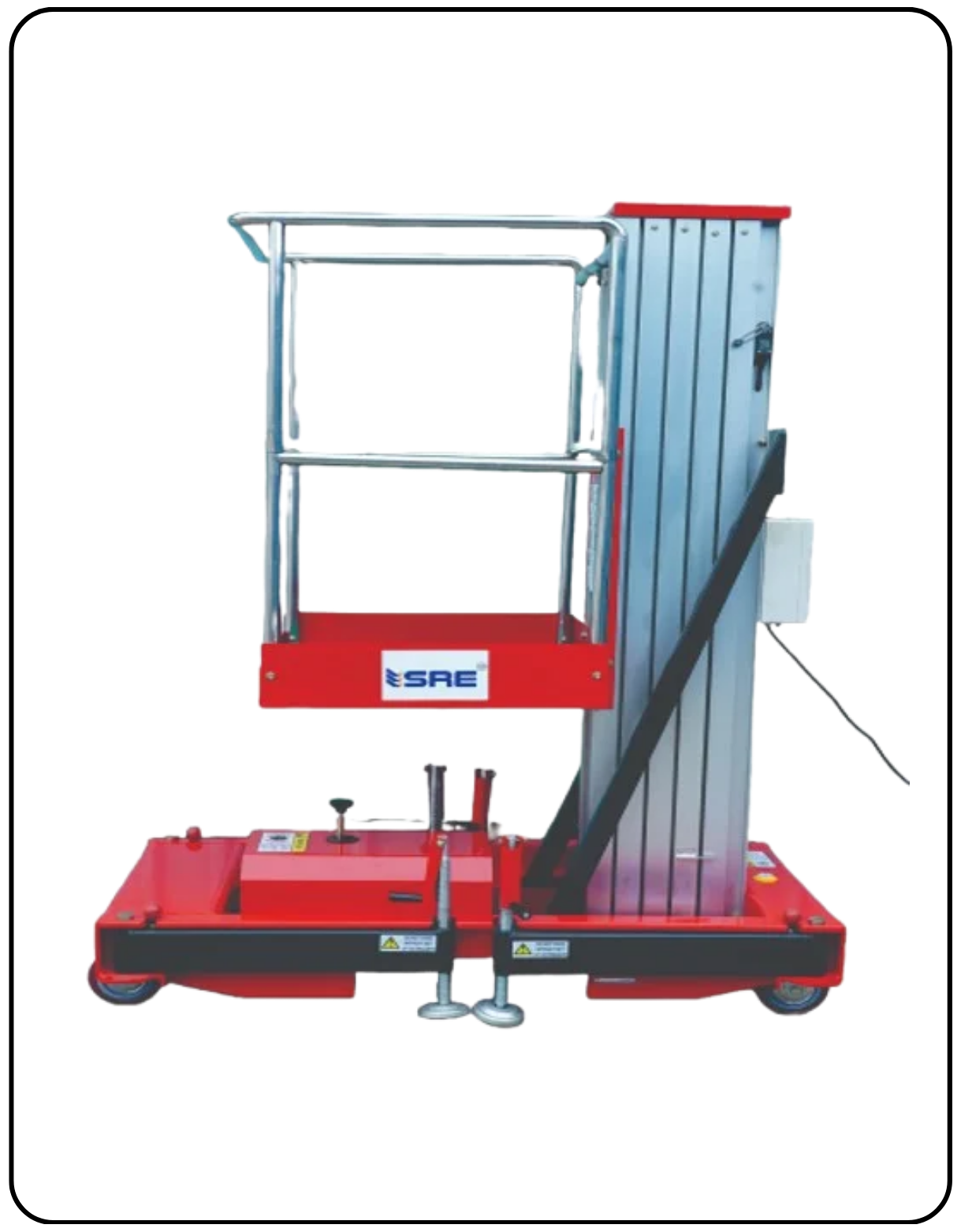
SRE Material Handling Equipment Pvt. Ltd.: Manufacturer, Supplier And Exporter Of Aerial Work Platform in India.
SRE Material Handling Equipment Pvt. Ltd., Manufacturer And Supplier Of Aerial Work Platform in Pune.
Our Manufacturing Unit is in Ahmedabad, Vadodara, and Rajkot, Gujarat, India.
Aerial Work Platform in Pune: Enhancing Warehouse and Industrial Operations
Introduction
Warehouse and industrial operations have evolved significantly over the past decade. The pressure to meet tighter deadlines, manage larger volumes, and ensure employee safety has never been higher. Traditional manual methods, like ladders and scaffolding, are increasingly insufficient for modern workflows. In this environment, the Aerial Work Platform (AWP) in Pune has emerged as a practical solution to streamline operations while minimizing risk and labor fatigue.
The Changing Needs of Modern Warehouses and Industries
In today’s industrial landscape, operational pressure is constantly rising. Warehouses and factories face growing inventory volumes, tighter shipping schedules, and increasing complexity in internal logistics. Daily workflows often involve high shelves, complex machinery, and areas difficult to access safely. Internal logistics, such as moving pallets, stacking materials, and performing maintenance at heights, demand precision and efficiency.
What Is an Aerial Work Platform?
An Aerial Work Platform is essentially a mechanically elevated platform that allows workers to access high areas safely and efficiently. Unlike traditional ladders or scaffolds, AWPs are designed to carry personnel and tools with stability, controlled movement, and minimal physical strain. In practice, they are versatile, allowing vertical and sometimes horizontal movement to reach difficult spots without compromising safety or workflow continuity.
Why Aerial Work Platforms Are Replacing Traditional Equipment
Traditional methods often lead to fatigue, inconsistent work output, and safety hazards. In daily warehouse operations, repetitive climbing, lifting, or balancing on ladders can significantly slow down productivity. AWPs, on the other hand, reduce worker fatigue, improve consistency, and enhance operational efficiency. Unlike manual methods, they enable teams to handle tasks with precision, even during extended shifts.
Productivity Gains in Daily Operations
The implementation of AWPs in warehouses and factories directly translates to productivity improvements. Tasks that previously required multiple staff members can now be completed by fewer personnel in less time. Consistent output across shifts becomes achievable because the physical strain on workers is minimized. In daily operations, an AWP can reduce task completion times, streamline inventory management, and improve overall workflow.
Improved Workplace Safety
Safety is a top concern in any industrial setting. AWPs significantly reduce the risk of falls, injuries, and accidents. By providing a stable platform with controlled movement, workers can operate at heights without the uncertainty of ladders or makeshift scaffolding. Ergonomic handling of materials is possible, reducing the risk of musculoskeletal injuries. In practical terms, this leads to fewer disruptions, lower injury-related costs, and a safer working environment for all staff.
Handling Heavier Loads with Ease
Modern warehouses handle increasingly heavier loads. From stacked inventory to machinery maintenance, lifting and positioning heavy items manually is risky and inefficient. AWPs are designed to manage heavier payloads safely, with platforms engineered for stability and controlled handling. This capability ensures that materials can be moved efficiently, reducing stress on employees and minimizing the potential for product damage.
Technology and Operational Efficiency
AWPs come equipped with advanced battery, power, or mechanical systems that enhance uptime and reliability. For daily warehouse operations, this translates to minimal downtime, predictable maintenance schedules, and extended operational hours. Features such as electric drive systems, hydraulic lifts, and compact controls ensure smooth and precise movement, supporting high-volume operations effectively.
Space Optimization and Maneuverability
One challenge in modern facilities is working within limited or narrow spaces. Many AWPs are designed with compact footprints and excellent maneuverability, allowing operators to navigate tight aisles without disrupting other processes. This adaptability ensures that high-density storage areas and complex factory layouts do not hinder workflow efficiency.
Cost Efficiency Over Time
While the initial investment in an AWP might be higher than traditional equipment, the long-term value is evident. Reduced injuries, lower labor fatigue, and faster task completion result in significant cost savings. Less downtime, minimal damage to goods, and optimized staffing contribute to a measurable return on investment, making AWPs a practical choice for cost-conscious operations.
Sustainability and Compliance
Modern AWPs support cleaner and more energy-efficient operations. Electric and hybrid platforms reduce emissions and align with sustainability goals. Furthermore, using AWPs helps maintain compliance with occupational safety standards, supporting a culture of safety and operational responsibility.
Integration with Warehouse and Factory Workflow
AWPs integrate seamlessly into existing workflows. From inventory replenishment to equipment maintenance, they fit naturally into operational systems without requiring extensive process redesign. Their use complements material handling equipment, forklifts, and internal logistics tools, ensuring continuity and efficiency across tasks.
Training, Ease of Use, and Maintenance
One of the key advantages of modern AWPs is simplicity. Basic training allows operators to use them safely and efficiently, and maintenance schedules are predictable. Components are designed for durability, ensuring that daily operations are not disrupted by frequent repairs or replacements.
Why Choosing a Reliable Manufacturer Matters
Selecting a trustworthy AWP supplier is crucial. A reliable manufacturer, such as SRE MATERIAL HANDLING EQUIPMENT PRIVATE LIMITED, ensures quality equipment, ongoing service support, compliance with industry standards, and operational guidance. Knowledgeable manufacturers provide solutions that align with real warehouse challenges, not just specifications on paper.
Conclusion
In daily warehouse and industrial operations, AWPs offer practical solutions for productivity, safety, and operational efficiency. By reducing fatigue, enabling better load handling, and supporting modern workflow demands, AWPs represent a long-term, sustainable investment. For warehouses and factories in Pune seeking to enhance operations, adopting Aerial Work Platforms is a step toward safer, more efficient, and modern industrial practices.
For more details on quality Aerial Work Platforms and operational solutions, visit SRE MATERIAL HANDLING EQUIPMENT PRIVATE LIMITED.
Key Takeaways
- Productivity: Reduces task completion time and supports consistent output.
- Safety: Minimizes fall risk and ergonomic injuries.
- Load Handling: Facilitates movement of heavier materials safely
- Cost Efficiency: Long-term savings through reduced downtime and labor fatigue.
- Industry Trend: Modern warehouses increasingly rely on AWPs for operational efficiency.
Trending FAQs
Q1: Are AWPs suitable for narrow warehouse aisles?
Yes, modern AWPs are compact and designed for maneuverability in tight spaces.
Q2: What maintenance is required for AWPs?
Basic routine inspections, battery checks, and hydraulic system servicing ensure reliable operation.
Q3: Can one operator manage multiple tasks with an AWP?
Yes, AWPs improve task efficiency, allowing one operator to handle tasks that previously required multiple staff.
Q4: Do AWPs comply with safety regulations?
Reputable AWPs meet industrial safety standards and reduce workplace accident risks.
Q5: How do AWPs affect operational costs?
While upfront costs are higher, reduced injuries, downtime, and labor fatigue result in long-term savings.
Reach SRE MATERIAL HANDLING EQUIPMENT PRIVATE LIMITED for trusted lift solutions. Call +91 75728 19958 or sremhepvtltd2025@gmail.com for assistance now.
#AerialWorkPlatform #WarehouseEfficiency #IndustrialSafety #LoadHandling #OperationalExcellence #SREMaterialHandlingEquipmentPrivateLimited #PuneIndustries #WarehouseSolutions #WorkplaceSafety #CostEfficiency