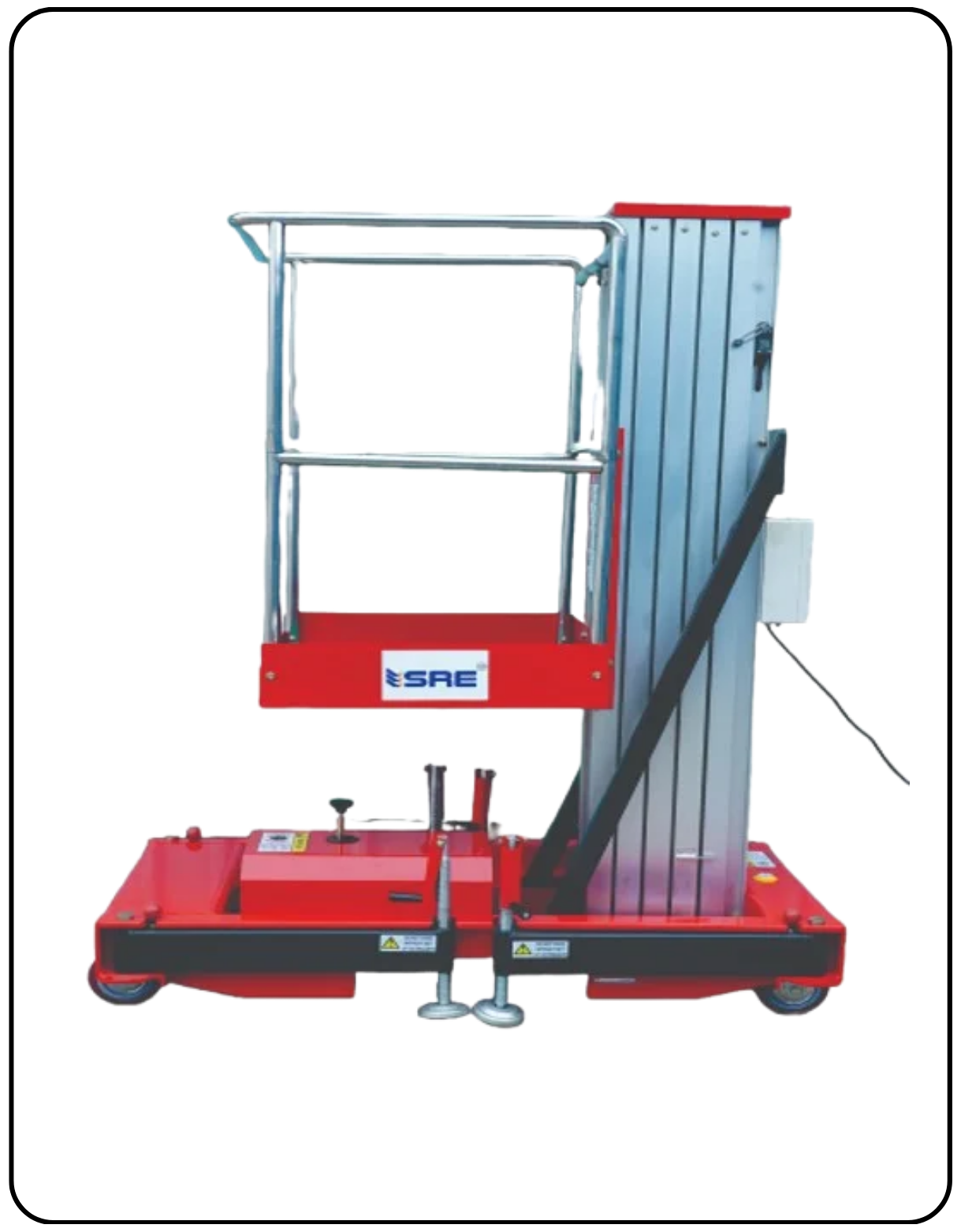
SRE Material Handling Equipment Pvt. Ltd.: Manufacturer, Supplier, And Exporter Of Aerial Work Platform in India.
SRE Material Handling Equipment Pvt. Ltd., Manufacturer And Supplier Of Aerial Work Platform in Rajkot.
Our Manufacturing Unit is in Ahmedabad, Vadodara, and Rajkot, Gujarat, India.
Aerial Work Platforms in Rajkot: A Useful Guide for Industrial Leaders
In the intricate setting of today’s warehouses and industrial sites, operational requirements have changed significantly in recent years. The rise of online shopping, stricter delivery deadlines, and wider product selections have compelled logistics and operations staff to reconsider how work is accomplished — more quickly, more securely, and with consistent excellence. In day-to-day warehouse tasks, activities previously handled by ladders, scaffolding, or manual reaching tools now expose personnel to strain and safety hazards while reducing output.
It is within this context that the Aerial Work Platform appears not as a passing fancy, but as a sensible answer to everyday hurdles in Rajkot’s industrial environment. Whether you manage a large distribution center, oversee a manufacturing area, or lead purchasing for supply chain assets, grasping how this machinery transforms operational effectiveness is crucial.
The Evolving Demands of Contemporary Warehouses and Industries
Current industrial sites function under stresses that were absent a decade ago:
- Growing Throughput Needs: Order volumes shift rapidly, and peak periods are more demanding. Stocking and picking tasks done at height become bottlenecks if not managed effectively.
- Speed With Precision: Schedules are rigid. Mistakes in high-level storage or upkeep duties lead to rework, affecting delivery timelines.
- Staffing Challenges: Labor availability is limited. Lessening physical exertion boosts staff retention and output across shifts.
In real-world internal logistics scenarios, reaching high storage shelves, performing routine maintenance on overhead systems, or installing overhead signs can quickly slow an operation if the correct tools are unavailable. Older methods — ladders, improvised staging, or multiple workers supporting a job — no longer meet the safety standards and productivity expectations of modern facilities.
This is where an Aerial Work Platform (AWP) becomes more than just equipment — it becomes a component of your operational plan for effectiveness and security.
What Precisely Is an Aerial Work Platform?
In practical industry terms, an Aerial Work Platform is a mobile, elevated access solution built to safely lift workers and tools to heights that would otherwise necessitate ladders or temporary platforms. Unlike ladders that depend solely on a person’s stability or manually built stages that take up valuable floor space, AWPs use solid bases, mechanical lifting mechanisms, and secure work areas to place technicians where they need to be.
Consider them functional extensions of your work process — devices that bring uniformity to tasks performed aloft, whether for handling stock, maintenance, inspections, or setups.
Why AWPs Are Superseding Traditional/Manual Equipment
The move from older methods to modern AWPs is based on tangible operational benefits seen on warehouse floors:
- Strain Reduction: Manual techniques require workers to climb, balance, and repeatedly carry gear, increasing fatigue throughout a shift. AWPs substantially reduce this physical burden by providing a secure, stable platform for the duration of the task.
- Uniformity and Efficiency: Unlike ladders or scaffolding, which might shift or require readjustment, AWPs remain fixed, allowing workers to finish repetitive tasks without stopping. This consistency directly improves the quality of output across shifts.
- Decreased Setup Time: Putting together traditional access methods can take 10–20 minutes per spot. AWPs, with easy-to-use controls, are ready in a fraction of that time — a vital gain when every moment matters during busy times.
Productivity Benefits in Daily Operations
In the daily work of high-volume sites, productivity improvements from using AWPs are measurable:
- Quicker Task Completion: One technician on an AWP can accomplish what might otherwise require two or more people using ladders.
- Less Waiting Time Between Jobs: Swift repositioning and simple activation mean fewer idle minutes and more productive time.
- Steady Output Across Shifts: Work done around the clock benefits from predictable access performance, improving scheduling and volume forecasting.
These gains accumulate over weeks and months, making AWPs a key contributor to meeting operational targets.
Enhanced Workplace Safety
One of the strongest arguments for adopting AWPs is the effect on workplace security:
- Fewer Incidents: Falls from ladders or makeshift platforms are a primary source of workplace accidents. AWP systems minimize the risk of falls through safety rails and controlled lifting mechanisms.
- Better Ergonomics: Personnel no longer need to lift tools and materials while trying to stay balanced at height — a frequent cause of sprains or immediate injuries.
- Controlled Motion: Smooth raising and lowering actions reduce sudden jerks or slips during access tasks.
This is not just theoretical — in sites that have substituted AWPs for ladders, accident rates linked to elevated work fall notably, resulting in safer work environments and lower insurance costs.
Handling Heavier Materials With Ease
Modern warehouses increasingly depend on dense storage and bulkier inventory items. While ladders limit what a worker can carry safely, AWPs provide:
- Secure Load Bearing: The platform’s engineered structure supports tools and materials without affecting balance.
- Improved Placement: Workers can position materials at height steadily, enhancing setting accuracy and reducing the need for corrections.
For duties involving frequent high-level staging or upkeep, this capability boosts output without exceeding safe worker limits.
Technology and Operational Smoothness
Aerial Work Platforms are more than just mechanical lifts — they incorporate technology that supports operational readiness and dependability:
- Battery and Power: Many AWPs use battery-powered systems that run for long periods without needing to stop, making them ideal for multi-shift tasks.
- Intuitive Controls: Operators can place the platform with precise movements, reducing overshoot and related delays.
- Monitoring and Reliability: Built-in sensors and indicators help maintenance crews keep equipment ready, minimizing unexpected failures.
For management and purchasing departments, these elements translate into dependable performance and fewer interruptions to routines.
Space Efficiency and Flexibility
Space within a warehouse or factory floor is valuable. AWPs are designed with this in mind:
- Small Footprint: Many models operate in tight aisles and confined areas without blocking key work paths.
- Full-Range Movement: Operators can move platforms in any direction without dismantling gear or clearing broad passageways.
In areas with dense storage, this allows for better utilization of vertical space without hindering ground traffic flow.
Cost Effectiveness Over Time
Though the initial purchase cost is a factor, the lasting worth of AWPs is rooted in their operational return:
- Lowered Injury Expenses: Fewer accidents mean reduced downtime and fewer insurance claims.
- Labor Optimization: Tasks that once required several staff can now be completed by a single trained operator.
- Less Operational Stoppage: Dependable equipment with predictable service schedules keeps your teams productive.
Over months and years, these savings build a strong case for AWPs as a strategic investment — rather than just another equipment expense.
Sustainability and Adherence to Rules
Current industrial operations are increasingly judged on environmental and compliance metrics. AWPs support this approach:
- Cleaner Operations: Battery-powered units emit lower emissions than engine-driven units, aligning with sustainability objectives.
- Energy Prudence: Efficient power systems and less time spent idle reduce overall energy use.
- Regulatory Conformity: Using proper elevated access gear aligns with safety codes and inspection mandates, ensuring compliance and audit readiness.
This dedication to sustainable, compliant operations enhances confidence among stakeholders and external partners.
Fitting Into Warehouse and Factory Processes
An effective Aerial Work Platform does not work in isolation — it blends with your wider operational structures:
- Job Scheduling: Integrating AWPs into daily transport or maintenance plans reduces conflicts and improves workflow.
- Material Handling Connections: AWPs complement conveyors, forklifts, and automated storage setups, allowing smooth access where required.
- Cross-Departmental Support: Maintenance, operations, and warehouse teams benefit from standardized elevated access across functions.
This integration ensures that the equipment contributes positively to overall performance gains.
Training, Simplicity, and Servicing
A key benefit of modern AWPs is their design focused on the user:
- Easy Handling: Clear controls let operators become efficient quickly with minimal instruction.
- Predictable Maintenance: Standard service schedules help maintenance teams plan around operational availability.
- Guides and Assistance: Clear operating instructions and safety guidelines promote correct usage and accountability.
For facilities aiming to standardize elevated work routines, consistent training and predictable servicing lead to fewer errors and longer equipment lifespans.
Why Selecting a Dependable Manufacturer Is Key
Choosing a reliable source for AWPs impacts performance and long-term satisfaction:
- Quality Build: Robust construction and tested parts ensure a long service life under industrial strain.
- Post-Sale Support: Timely spare parts, service networks, and technical help keep operations moving.
- Compliance Expertise: Experienced manufacturers help navigate safety standards and certifications relevant to your sector.
Focusing on these aspects ensures you acquire equipment that matches your needs.
Summary
Within the changing landscape of industrial operations and stockroom functions, devices such as the Aerial Work Platform play a vital role in balancing output, security, and financial prudence. In routine activities, AWPs reduce fatigue, enable precise handling of heavier loads, and integrate smoothly into procedures across sites in Rajkot and externally.
For purchasing departments and operational managers, the decision to use AWPs is not about acquiring the latest technology—it’s about resolving ongoing operational challenges with machinery that delivers tangible benefits.
Should you be examining access-from-height options for your facility, review the available options and assess how they align with your operational requirements. For comprehensive product details and professional assistance, please visit SRE MATERIAL HANDLING EQUIPMENT PRIVATE LIMITED.
Main Points
- Output: AWPs speed up task finalization and guarantee steady performance.
- Security: Carefully designed platforms substantially reduce the risk of falls and physical strain.
- Weight Management: Steady support for implements and supplies enhances both standard and volume.
- Value for Money: Savings over time surpass the initial expenditure.
- Sector Direction: Contemporary operations necessitate dependable, interconnected access-from-height methods.
Trending FAQs
Q1: How does an Aerial Work Platform improve warehouse safety?
AWPs provide stable elevated access with guardrails, reducing falls and ergonomic strain compared to ladders or manual setups.
Q2: Are AWPs suitable for narrow aisles?
Yes, many AWPs are designed with compact footprints and maneuverability for narrow‑aisle usage.
Q3: What kind of training is required to operate an AWP?
Basic hands‑on training focused on controls, safety protocols, and maintenance checks is typically sufficient.
Q4: Can AWPs reduce operational costs?
Over time, yes, through reduced injuries, improved productivity, and lower labor inefficiencies.
Get in touch with us today for assistance. Call +91 75728 19958 or sremhepvtltd2025@gmail.com for assistance now.
#AerialWorkPlatform #IndustrialSafety #WarehouseEfficiency #MaterialHandling #SREMaterialHandlingEquipmentPrivateLimited #RajkotOperations