
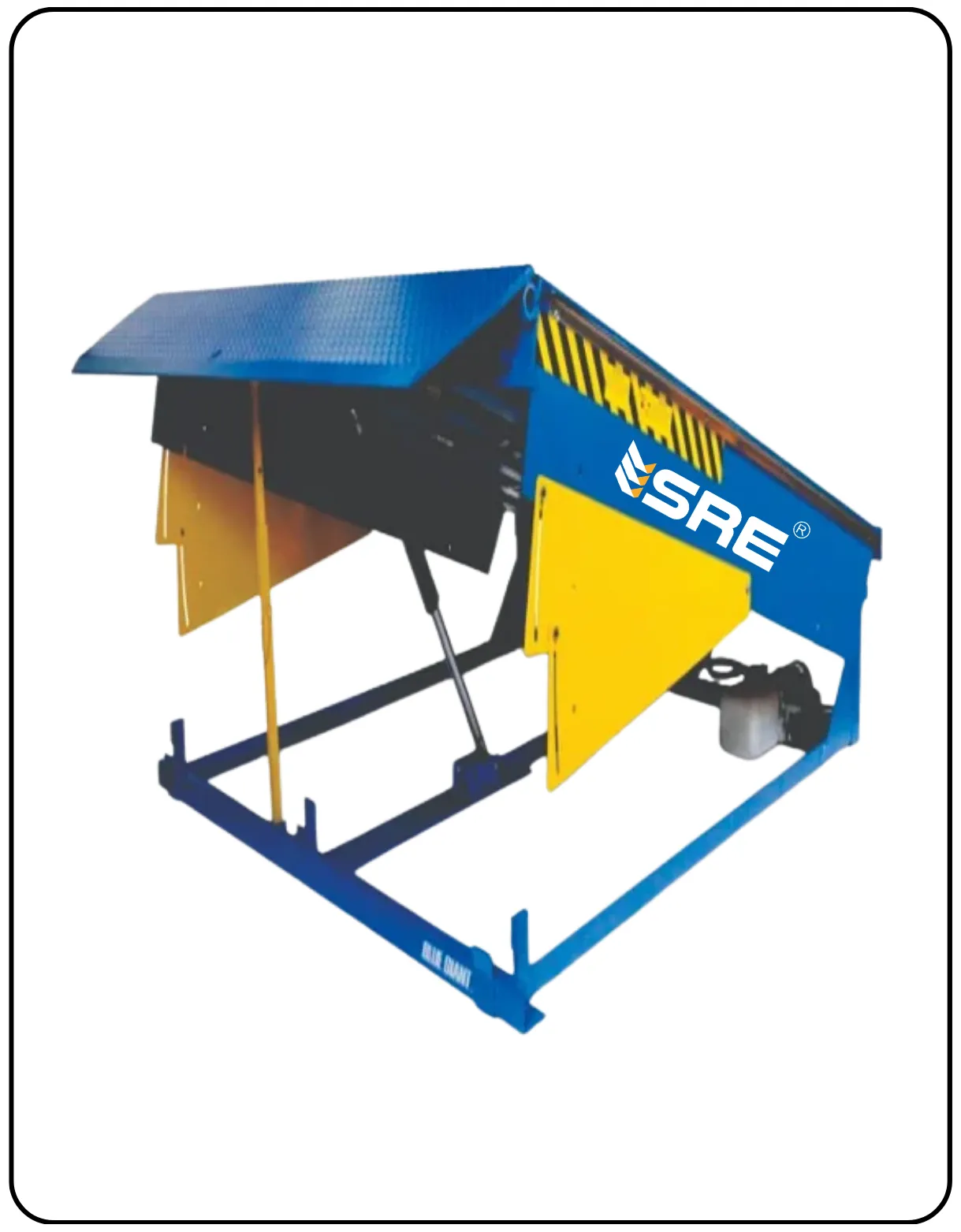
SRE Material Handling Equipment Pvt. Ltd.: Manufacturer, Supplier, And Exporter Of Dock Leveler in India.
SRE Material Handling Equipment Pvt. Ltd., Manufacturer And Supplier Of Dock Leveler in Bhosri.
Our Manufacturing Unit is in Ahmedabad, Vadodara, and Rajkot, Gujarat, India.
Dock Leveler in Bhosri: Practical Answers to Modern Warehouse Loading Challenges
In everyday warehouse and factory functions, docking and undocking have evolved past being a minor, separate task. It now sits central to velocity, security, and overall output. Within industrial centres such as Bhosri, loading facilities today manage larger volumes of freight, stricter delivery schedules, and assorted vehicle kinds—frequently with the same staffing as before.
This is the scenario where a Dock Leveler transitions from being an optional enhancement to an operational staple. Instead of depending on manual alterations, timber supports, or makeshift inclines, facilities are moving toward structured bay arrangements that introduce uniformity, safety, and oversight to the loading zone.
This piece examines the tangible, on-the-ground function of dock levelers in Bhosri’s industrial setting—stripping away promotional language—and concentrates on how they resolve common challenges encountered by building proprietors, plant supervisors, and supply-chain staff.
Shifting Demands of Contemporary Warehouses and Industrial Sites
Warehouses in manufacturing zones like Bhosri have transformed considerably over the last ten years.
Previously, cargo bays were configured for consistent truck dimensions and less frequent shipments. Now, the same bay might accommodate:
- Diverse vehicle elevations within one workday
- Heavier pallet weights due to clustered shipments
- Quicker turnaround expectations from clients
- A push to lessen staff exhaustion and accidents
Internally, operational teams are constantly balancing—meeting dispatch deadlines while safeguarding personnel and minimizing equipment downtime. Even a few minutes lost per vehicle can compound into delays throughout the day.
These pressures have prompted sectors to reconsider how goods transition between transport vehicles and the building floor.
Defining a Dock Leveler
A dock leveler is a mechanical or powered platform system built into the loading apron. Its purpose is straightforward yet vital: it spans the elevation gap between the structure’s floor and the vehicle’s deck.
Unlike manual approaches, a dock leveler adapts to various truck heights smoothly and securely. This establishes a firm, even plane for forklifts, pallet jacks, and manual movement—without guesswork or risky improvisation.
Practically speaking, it enables operators to transfer goods directly and safely, irrespective of the vehicle that arrives at the berth.
Rationale for Dock Levelers Superseding Conventional Manual Gear
For numerous years, many sites relied on timber blocks, detached metal panels, or manually adjusted ramps. While these systems sufficed in low-volume setups, they falter under contemporary conditions.
Manual techniques frequently result in:
- Uneven surfaces that destabilise material handlers
- Constant readjustments, slowing down throughput
- Increased physical strain on personnel
- Elevated probability of slips, stumbles, and cargo shifting
A dock leveler replaces this inconsistency with dependability. Once mounted, it becomes an integral component of the bay—prepared for use, reliably and safely, every single shift.
Throughput Enhancements in Daily Activities
In daily warehouse functions, time wasted at the bay is seldom obvious in documentation, but it is keenly felt on site.
Dock levelers contribute to better output by:
- Shortening the preparation time for each truck
- Allowing quicker ingress and egress for handling equipment
- Facilitating smoother workflows across multiple shifts
As the bay elevation is adjusted rapidly and precisely, operators dedicate less time correcting alignment issues and more time moving goods. Across weeks and months, these marginal gains accumulate into observable improvements in capacity.
Better Workplace Protection at the Loading Apron
Loading bays are among the most hazardous zones in any facility. Elevation variance, moving vehicles, and heavy goods create persistent dangers.
A dock leveler boosts safety via:
- Governed transition between the bay and the vehicle
- Diminished risk of forklift overturning or pallet instability
- Reduced stress on staff during manual transfers
Instead of stepping over spaces or rigging temporary inclines, operators work on a solid platform designed for commercial weights. This tangible upgrade directly aids in fewer accidents and safer daily routines.
Managing Heavier Shipments with Ease
Modern warehouses are increasingly processing bulkier pallets due to mass shipping and cost optimisation efforts. Manual docking solutions were never intended for such constant stress.
Dock levelers are constructed to:
- Support larger load ratings securely
- Sustain stability under repetitive equipment travel
- Manage uneven weight distribution without movement
For work involving raw materials, completed products, or substantial equipment parts, this assurance is crucial—not optional.
Engineering and Operational Performance
Depending on the variation, dock levelers might utilise mechanical, fluid-based, or electro-fluid systems. The primary focus, however, is not on the hardware itself—but on operational readiness.
Well-conceived dock levelers offer:
- Predictable operation with minimal oversight
- Consistent performance across temperature shifts and various loads
- Straightforward control interfaces that users can depend on
In busy loading zones, this dependability assists in averting blockages caused by equipment malfunction or erratic function.
Space Economy and Adaptability
Area is a perpetual constraint in industrial complexes, particularly in established areas like Bhosri, where expansion is restricted.
Dock levelers are engineered to:
- Integrate inside the bay pit without consuming floor acreage
- Permit forklifts to navigate cleanly at the bay edge
- Support compact aisle and limited bay configurations
By utilising vertical adjustment instead of ground space, they assist warehouses in making more effective use of existing structures.
Long-Term Value Over Initial Outlay
A dock leveler should be seen as a lasting operational asset rather than a brief expenditure.
Over time, organisations frequently benefit from:
- Fewer workplace accidents and related expenditures
- Diminished staff fatigue and attrition rates
- Fewer bottlenecks stemming from inefficient loading
- Reduced damage to inventory and handling machinery
When assessed across its lifespan, a dock leveler frequently proves more cost-effective than continuous repairs, replacements, and productivity loss associated with manual setups.
Green Practices and Regulatory Adherence
Modern warehousing sustainability encompasses streamlined processes just as much as energy consumption.
Dock levelers aid this goal by:
- Minimising redundant tasks and wasted movement
- Promoting organised, regulated loading activities
- Aligning with current safety and facility code obligations
For sites seeking to meet internal audit criteria or external compliance mandates, standardised dock setups offer a more robust foundation.
Seamless Integration into Site Operations
A key advantage of dock levelers is their natural fit within established operational flows.
They function smoothly alongside:
- Forklifts and pallet jacks
- Conveyor networks near shipping zones
- Standard dock entry points and vehicle locks
Since they become an integral part of the dock structure, they enhance processes rather than interrupt them.
Usability, Learning Curve, and Upkeep
From an operational standpoint, new equipment must be easy to adopt.
Dock levelers are typically:
- Straightforward to use, following minimal instructions
- Naturally intuitive for seasoned forklift operators
- Backed by predictable servicing schedules
Standard checks and basic maintenance are usually adequate to ensure dependable long-term service.
The Importance of Selecting a Reputable Manufacturer
The construction of dock levelers varies significantly. The calibre of components, engineering standards, and post-sale assistance greatly impact sustained performance.
When vetting suppliers, key considerations include:
- Demonstrated background in industrial material handling
- Availability of technical support and replacement parts
- Adherence to safety and production benchmarks
- Clear technical documentation and setup guidance
Choosing a trusted manufacturer mitigates operational risk well beyond the installation phase.
One such reputable name in material handling is SRE MATERIAL HANDLING EQUIPMENT PRIVATE LIMITED, recognised for its emphasis on practical industrial solutions and comprehensive service. Further details regarding their product range are available at https://www.sremhepvtltd.com/.
Summary
In manufacturing hubs like Bhosri, where operational excellence and employee safety are intrinsically linked, a dock leveler provides solutions to tangible, daily loading dock challenges.
It enhances process uniformity, lessens physical exertion, accommodates heavier payloads, and integrates effortlessly into current operations. For facility managers and operations leads, the true value resides in reliable day-to-day function, not just advanced features.
For organisations charting a course toward sustained operational stability, evaluating dock infrastructure is a sensible next move—a deliberate enhancement rather than an impulsive purchase.
Core Benefits Recap
- Productivity: Expedited, more consistent loading and unloading cycles
- Safety: Reduced accident potential and managed dock movements
- Load Capacity: Firm footing for heavier and diverse cargo types
- Economic Advantage: Less downtime, fewer incidents, enduring worth
- Industry Direction: Transition from manual loading bays to engineered systems
Trending FAQs
Q1. Is a dock leveler suitable for small warehouses in Bhosri?
- Yes. Even mid-sized warehouses benefit from improved safety and consistent operations.
Q2. How long does installation usually take?
- Installation timelines depend on dock structure, but most setups are completed with minimal operational disruption.
Q3. Does a dock leveler require skilled operators?
- No. Basic training is usually enough for regular warehouse staff.
Q4. Can dock levelers handle different truck heights?
- Yes. They are designed to adjust across a wide range of vehicle bed heights.
Q5. What maintenance is typically required?
- Routine inspections and basic servicing help ensure long service life and reliable operation.
Get in touch with SRE Material Handling Equipment today. Call +91 9316 2088798 or sremhepvtltd2025@gmail.com for assistance now.
#DockLeveler #BhosriIndustries #WarehouseOperations #LoadingDockSafety #MaterialHandling #IndustrialEfficiency #SREMaterialHandling #SupplyChainIndia