
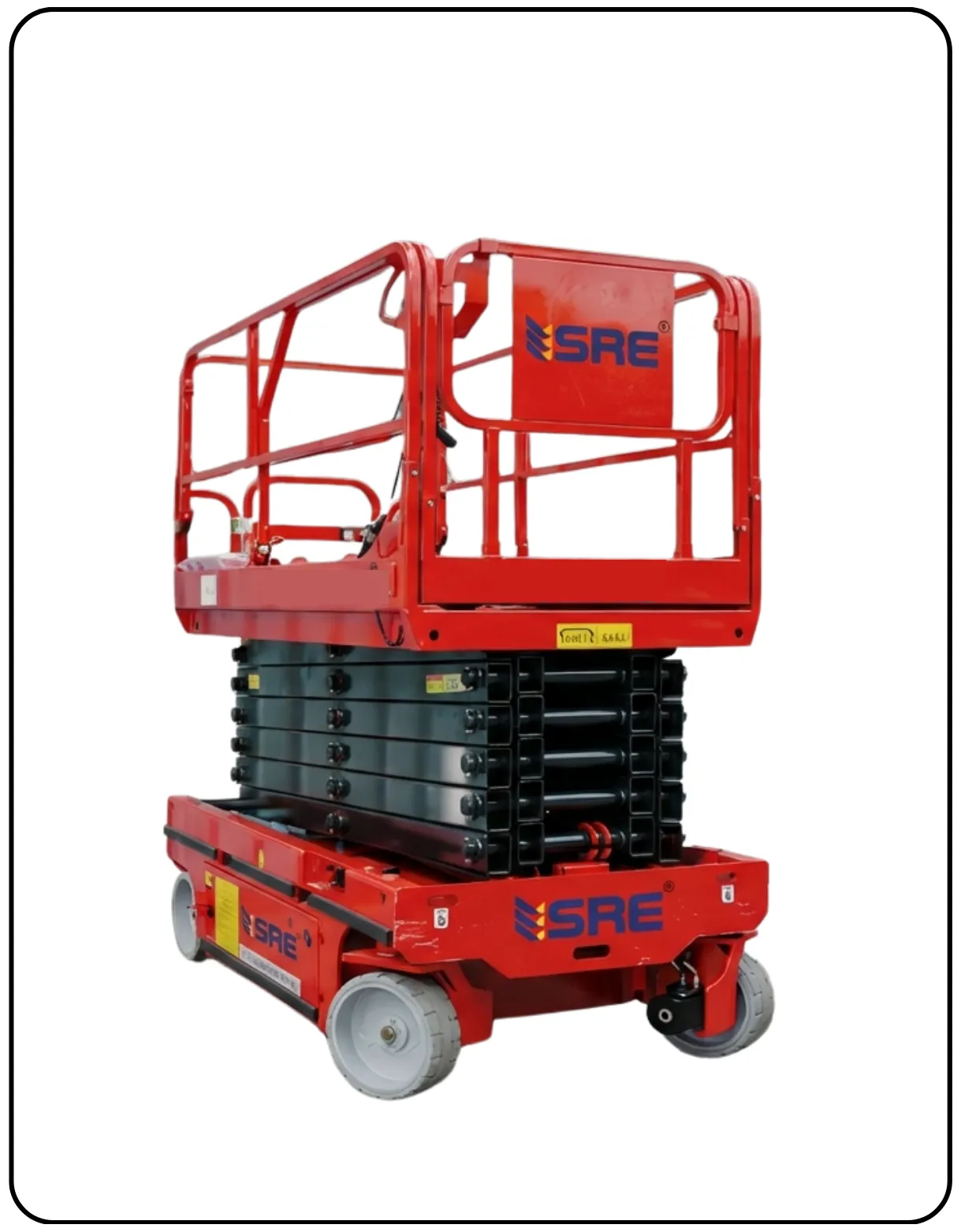
SRE Material Handling Equipment Pvt. Ltd.: Manufacturer, Supplier, And Exporter Of Fully Automatic Self-Scissor Lift Table in India.
SRE Material Handling Equipment Pvt. Ltd., Manufacturer And Supplier Of Fully Automatic Self Scissor Lift Table in Vadodara.
Our Manufacturing Unit is in Ahmedabad, Vadodara, and Rajkot, Gujarat, India.
Fully Automated Self-Scissor Lift Platform in Vadodara: A Sensible Enhancement for Contemporary Industrial Workflows
Introduction
In the day-to-day running of logistics centers and production plants, how materials are moved has seen significant shifts over the past ten years. Sites now manage greater quantities, tighter deadlines, and higher safety demands than ever before. Methods that worked with manual labor or simple lifting aids now frequently cause delays, worker exhaustion, and preventable hazards.
Site supervisors, plant administrators, and logistics coordinators often grapple with similar hurdles: keeping pace without straining staff, safely relocating substantial weights, and ensuring uniform performance across all shifts. Staff tiredness, minor accidents, and fluctuating output are no longer minor details—they directly impact productivity and overheads.
Against this backdrop, the Fully Automated Self-Scissor Lift Platform has emerged as a pragmatic, operations-oriented solution. Instead of displacing personnel, it assists them—making the raising, placement, and transfer of goods safer, more uniform, and less physically taxing.
This article details how a Fully Automated self-scissor lift Platform in Vadodara integrates into actual production settings, emphasizing practical benefits over marketing hype.
The Evolving Requirements of Modern Logistics and Manufacturing
Warehouses and factories in Vadodara are under constant pressure to increase throughput. Whether dealing with automotive parts, machinery, consumer goods, or heavy fabricated materials, internal logistics chains have grown more intricate.
Typical operational strains involve:
- Quicker movement of incoming and outgoing freight
- More frequent stacking and handling activities
- Less tolerance for mistakes or downtime
- Increased oversight regarding employee well-being and regulations
In real-world situations, relying on human strength or semi-automated aids frequently slows down procedures. Staff spend extra minutes realigning platform heights, waiting for vehicle support, or manually matching pallet positions. Over time, these minor inefficiencies build up into lost production capacity.
Contemporary facilities require equipment that promotes nonstop movement without adding operational complexity. This is where automated lifting tables become pertinent.
Defining a Fully Automated Self-Scissor Lift Platform
A Fully Automated Self-Scissor Lift Platform is a powered lifting surface engineered to elevate, descend, and support loads at a regulated operational elevation. Unlike manual tables or basic hydraulic lifts, its adjustments are automatic based on material-handling requirements.
In straightforward operational terms:
- The unit moves materials vertically to the required altitude
- Operators avoid the need for manual pumping or fine-tuning
- The motion is regulated, fluid, and dependable
Rather than forcing staff to stoop or constantly devise interim fixes, the lift platform brings the load to the operator. This subtle alteration yields a significant improvement in both efficiency and safety during routine tasks.
Why Fully Automated Self-Scissor Lift Platforms Supersede Manual Gear
Older manual and semi-manual equipment previously served logistics centers adequately. However, as volumes expanded, their limitations became evident.
Manual material handling often results in:
- Physical stress and exhaustion
- Inconsistent working elevations
- Lengthier task completion times
- Elevated probability of minor injuries
A Fully Automated self-scissor lift Platform mitigates these issues by standardizing load management. Personnel operate at a comfortable height, irrespective of the load’s dimensions or mass.
Over the course of a working period, this uniformity helps sustain output without exceeding safe employee capabilities.
Efficiency Gains in Standard Operations
In routine warehouse assignments, time savings accrue not from one major leap but from numerous minor improvements. Lift platforms contribute by:
- Decreasing the duration spent readjusting load setups
- Minimizing lulls between handling segments
- Enabling smoother handoffs between sequential processes
When operators are freed from manually stopping to reposition loads, workflows maintain a steadier tempo. This effect is apparent during busy periods or operations running multiple shifts.
Consistency between shifts is another upside. Automated raising ensures that all shifts adhere to identical handling parameters, thus reducing variability in final output.
Enhancing Workplace Security
Safety improvements are among the most compelling reasons to adopt automated lifting tables.
Manual lifting and awkward postures are common triggers for strain-related incidents. Even when loads are within weight limits, repeated bending and lifting heighten the potential for harm over time.
A Fully Automated self-scissor lift Platform facilitates safer handling by:
- Maintaining loads at ideal ergonomic working heights
- Reducing the necessity for physical lifting
- Delivering movement in a controlled, vertical manner
From a well-being oversight perspective, fewer incidents translate to less downtime, fewer insurance claims, and improved team morale.
Managing Heavier Goods with Simplicity
As facilities expand, the typical load size frequently grows. Heavier palletized goods, bulk containers, and pre-assembled parts are now commonplace.
Manual systems falter under these conditions. Stability becomes uncertain, and precise placement is compromised.
Fully automated scissor lift platforms are engineered to handle heavier loads with precise motion control. The scissor mechanism offers inherent stability, while automation assures steady lifting without sudden jolts.
For workflows involving substantial or irregularly shaped items, this inherent stability makes daily handling more predictable and secure.
Technology and Operational Dependability
Modern lifting units are constructed with reliability as a core focus. Based on the specific configuration, they may use electrical or hydraulic powertrains tailored for continuous industrial deployment.
From an operational view, the key advantages include:
- Predictable performance across various shifts
- Minimal disruption during peak activity times
- Dependable elevation without manual input
Efficient power systems or those with backup capabilities help sustain operational presence. When machinery performs as designed consistently, forecasting becomes easier for both maintenance and operations teams.
Optimizing Space and Ease of Placement
Floor space is frequently a premium commodity within logistics and production areas, especially in older structures or dense layouts.
A Fully Automated self-scissor lift Platform generally requires a small footprint. It fits neatly into:
- Packaging workstations
- Assembly conveyors
- Restricted passageways
- Loading and unloading docks
Instead of redesigning the layout around large machinery, sites can integrate lift tables into existing processes with minimal upheaval.
Financial Prudence Over the Long Term
While automated apparatus demands an initial capital outlay, astute purchasing departments assess long-term worth rather than just the sticker price.
Over its lifespan, a lift platform contributes to cost savings through:
- Lowering expenses linked to staff injuries
- Decreasing worker exhaustion and days missed
- Minimizing delays in material flow
- Supporting steady production volumes
When considered over several years of use, these elements often exceed the initial procurement cost.
Environmental Alignment and Regulatory Adherence
Numerous organizations are currently aligning their procedures with broader environmental and regulatory mandates. Cleaner, more efficient equipment bolsters this direction.
Automated lift platforms assist by:
- Decreasing dependence on manual, power-intensive methods
- Promoting safer, compliant work environments
- Encouraging uniform handling techniques
While not a primary ecological tool, they align well with contemporary, regulation-conscious operations.
Interfacing with Factory and Logistics Systems
A significant benefit of a Fully Automated Self-Scissor Lift Platform is its easy integration with existing infrastructure.
It functions effectively alongside:
- Transport belts
- Pallet movers
- Forklifts
- Assembly and packing stations
Rather than replacing existing setups, it enhances them. This facilitates a smoother rollout and reduces resistance from site personnel.
Operation, Training, and Servicing
From a practical viewpoint, ease of use is crucial. Most lift platforms are designed for uncomplicated operation.
Typical plus points include:
- Intuitive control interfaces
- Brief training duration for operators
- Predictable service timetables
Maintenance personnel value equipment that doesn’t demand specialized proficiencies or frequent servicing. This keeps the overall cost of ownership manageable.
The Importance of Selecting a Competent Supplier
The quality standards of lift platforms can vary significantly. For industrial purchasers, the supplier’s background and service availability are essential criteria.
A reputable manufacturer emphasizes:
- High-grade construction and validated parts
- Adherence to safety standards
- Readily available technical support and spare components
- A deep, practical comprehension of industrial needs
Entities such as SRE MATERIAL HANDLING EQUIPMENT PRIVATE LIMITED bring industry-specific knowledge to material movement solutions. Their track record serving diverse Indian industrial settings makes them a pertinent benchmark for sites operating in and around Vadodara.
Website: https://www.sremhepvtltd.com/
Summary
For logistics centers and production floors facing escalating operational demands, the Fully Automated Self-Scissor Lift Platform offers a balanced solution. It enhances safety, ensures reliable throughput, and integrates seamlessly into existing workflows.
It’s less a luxury and more a vital asset for sites aiming for peak performance without overburdening their labor force.
If your Vadodara-based enterprise is assessing avenues to improve internal material flow, investigating automated lift platforms is a logical progression—one focused on sustained operational stability rather than quick wins.
Key Takeaways
- Productivity: Fosters steady workflows and consistent output levels
- Safety: Minimizes manual lifting strain and ergonomic hazards
- Load Management: Handles heavier loads with enhanced precision
- Value Retention: Delivers long-term operational cost benefits
- Industry Shift: Aligns with the standards of modern, compliance-driven facilities
Trending FAQs
Q1. Where are fully automatic self-scissor lift tables commonly used?
They are widely used in warehouses, factories, assembly lines, packaging stations, and loading areas.
Q2. Do lift tables reduce worker fatigue?
Yes. Maintaining ergonomic working heights reduces bending and repetitive lifting.
Q3. Are these lift tables suitable for heavy industrial loads?
They are designed for stable handling of heavier loads when selected with the right capacity.
Q4. Is operator training complex?
Most models require minimal training due to simple and intuitive controls.
Q5. How do lift tables fit into existing workflows?
They integrate easily with conveyors, pallet trucks, and other material handling systems.
Contact us today for reliable material handling solutions in Vadodara. Call +91 9316 208879 or sremhepvtltd2025@gmail.com for assistance now.
#FullyAutomaticSelfScissorLiftTable #MaterialHandlingSolutions #WarehouseEfficiency #IndustrialSafety #VadodaraIndustry #SREMaterialHandlingEquipment #SmartWarehousing #FactoryOperations