
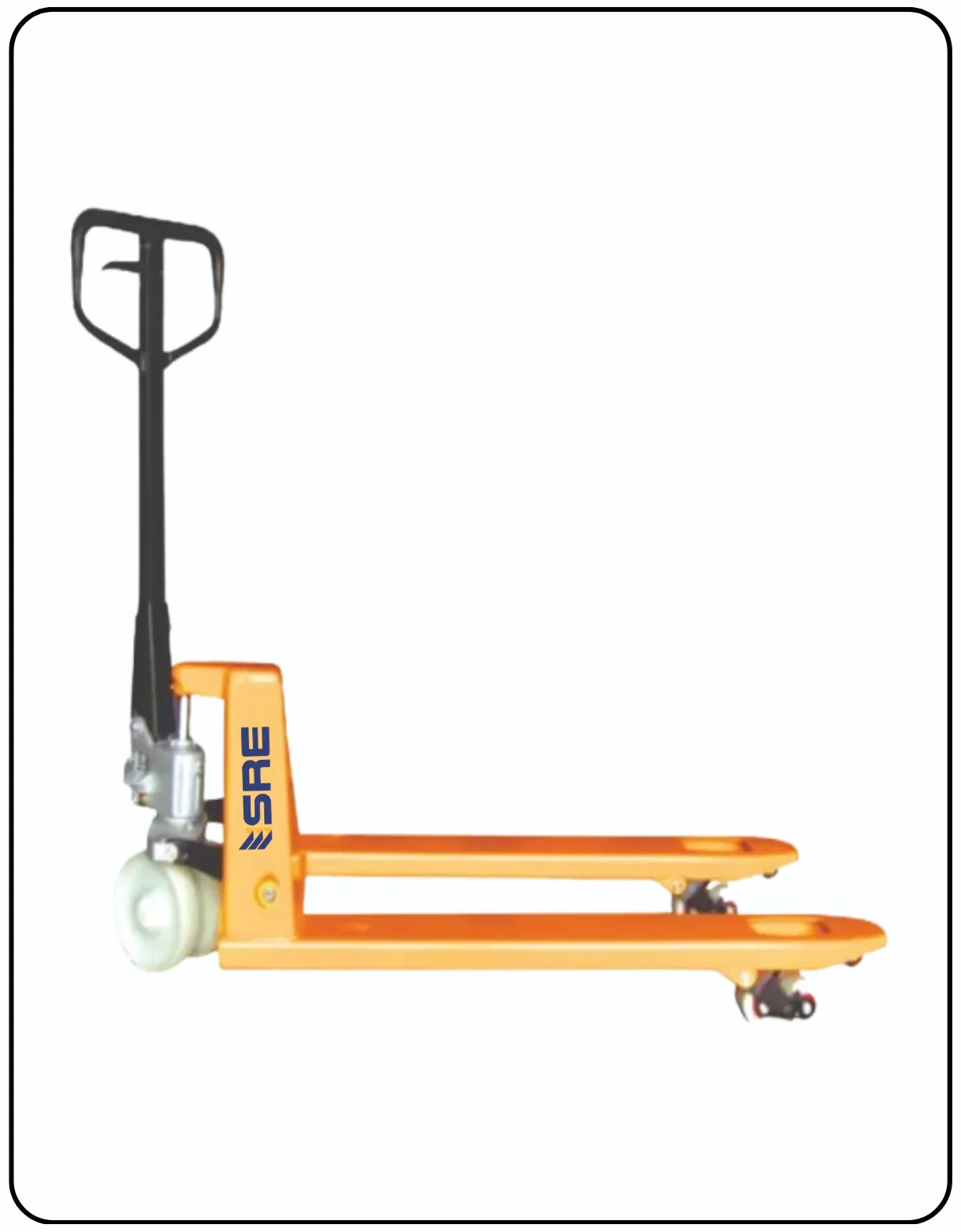
SRE Material Handling Equipment Pvt. Ltd.: Manufacturer, Supplier, And Exporter Of Hydraulic Hand Pallet Truck in India.
SRE Material Handling Equipment Pvt. Ltd., Manufacturer And Supplier Of Hydraulic Hand Pallet Truck in Mumbai.
Our Manufacturing Unit is in Ahmedabad, Vadodara, and Rajkot, Gujarat, India.
Hydraulic Hand Pallet Truck in Mumbai: Solving Real Warehouse Challenges
In the landscape of modern industrial operations—especially in a bustling logistics hub like Mumbai—the pressures on warehouse and factory operations have intensified. Rising shipment volumes, tighter delivery windows, and persistent labour shortages are daily realities that warehouse owners, operations heads, and procurement teams contend with. In this environment, incremental improvements in material handling can make the difference between a smooth workflow and frequent bottlenecks.
Hydraulic Hand Pallet Truck units are one of those practical tools that deliver measurable impact. Not flashy or high‑tech like automated guided vehicles, but rugged, reliable, and deeply aligned with daily operational challenges. This blog draws on real warehouse experience to explore how hydraulic hand pallet trucks change the way material moves on the ground—especially in Mumbai’s fast‑paced industrial settings.
The Changing Needs of Modern Warehouses and Industrial Facilities
In daily warehouse operations, the pace never slows. Order volumes increase, SKU counts grow, and customer expectations for rapid fulfilment keep tightening.
Consider a typical week in a Mumbai distribution centre:
- Multiple inbound deliveries from suppliers arrive throughout the day.
- Picking teams race to fulfil next‑day delivery orders.
- Forklift operators shuttle pallets across crowded aisles with mixed traffic.
- Manual handling tasks multiply during peak periods.
These pressures surface persistent workflow issues:
- Slow material flow: When teams rely on manual lifting and movement, transit times stretch out.
- Labour fatigue: Physical strain accumulates over repeated handling cycles.
- Inconsistent throughput: Some shifts struggle to keep pace, especially when movement depends on human strength alone.
Operational leaders increasingly recognise that addressing internal logistics—how materials move from receiving to storage to outbound—is fundamental to meeting performance targets. A Hydraulic Hand Pallet Truck is often the first tangible step toward consistent, efficient movement of palletised goods.
What Is a Hydraulic Hand Pallet Truck?
At its core, a Hydraulic Hand Pallet Truck is a manually operated lift and move device designed to transport pallets and large goods within short to medium distances inside warehouses, factories, and retail storerooms.
In practical terms, it consists of:
- Forks to slide under a pallet or skidded load
- A hydraulic pump and handle that raise and lower the load
- Wheels and steering that allow movement across warehouse floors
Unlike textbook definitions that focus on components, experienced operators think in terms of outcomes: reliable load movement, reduced lifting strain, and predictable performance during peak shifts.
Why Hydraulic Hand Pallet Trucks Are Replacing Traditional Manual Methods?
Many facilities still rely on ad‑hoc solutions like wooden skids moved by brute force or teams manually lifting goods. These approaches introduce real operational challenges:
- Fatigue and inconsistency: Two workers may move the same load very differently from one day to the next.
- Safety risks: Improvised lifting often results in back strain and more injury claims.
- Slow cycle times: Manual carrying or pushing limits throughput, especially on heavy or bulky goods.
In contrast, hydraulic hand pallet trucks provide:
- Mechanical advantage: Operators raise heavy goods with minimal effort using the hydraulic pump.
- Consistent lift height: Predictable fork elevation streamlines loading and unloading.
- Reduced physical strain: Workers conserve energy for tasks that truly require judgment and skill.
For facility managers in Mumbai facing high throughput and limited labour availability, this balance between human judgment and mechanical assistance is especially valuable.
Productivity Gains in Daily Operations
One of the most tangible benefits of introducing a Hydraulic Hand Pallet Truck is measurable time savings.
Example from daily shifts:
- Before: A team manually pushes and adjusts loads using brute force, slowing transit times to 10–15 minutes per load cycle.
- After: With a hydraulic pallet truck, the same movement often takes 3–5 minutes, with less physical exertion.
These savings compound across shifts:
- Teams consistently handle more loads per hour.
- Storage and retrieval workflows synchronise better with receiving and dispatch windows.
- Workers maintain a steadier pace throughout the day, regardless of load size.
Equipment like hydraulic hand pallet trucks integrates into real process flows rather than disrupting them. Operators learn quickly; maintenance requirements are predictable; and throughput becomes more stable across shifts.
Improved Workplace Safety
Safety isn’t a buzzword—it’s a daily concern in industrial spaces. Manual handling accounts for a large share of workplace injuries, particularly back strains, slips, and impact injuries during heavy pallet movement.
Compared to ad‑hoc manual methods:
- Hydraulic pallet trucks reduce lifting stress on the lumbar spine.
- Controlled lowering of loads decreases the risk of dropped goods.
- Operator control over movement speed minimises unexpected impacts.
Workers who previously relied on shoulder strength to push or drag goods find that the hydraulic assist aligns with safer handling mechanics. Warehouse supervisors also appreciate the predictable behaviour of trained teams using these trucks, as it reduces unplanned incidents that disrupt daily workflows.
Handling Heavier Loads with Ease
Modern warehouses in Mumbai handle a wide range of products—from lightweight packaged goods to heavy machinery parts. Demands often vary hour‑to‑hour, complicating load planning.
Hydraulic hand pallet trucks respond to this variability:
- They are designed for load capacities ranging from 2 to 5+ tonnes, accommodating most internal movement needs.
- Their stability and low centre of gravity keep pallets secure, even in congested aisles.
- Operators can confidently move oversized or awkward pallets without resorting to risky manual adjustments.
In practice, this means fewer delays caused by waiting for forklift availability or juggling teams to assist with heavy lifts. From seasonal surges to steady high‑volume operations, the truck becomes a basic but indispensable tool.
Technology and Operational Efficiency
Although a hydraulic hand pallet truck is fundamentally mechanical rather than digital, its engineering has real operational implications:
- Reliable hydraulic systems ensure predictable lift performance across thousands of cycles.
- Low‑maintenance wheels and bearings contribute to uptime, reducing interruptions for service.
- Smooth steering mechanics reduce resistance on warehouse floors, minimising wasted exertion.
For warehouse decision‑makers, uptime matters. A machine that moves smoothly day after day with minimal adjustment supports better scheduling, fewer unplanned repairs, and more predictable material flow.
This reliability becomes even more important in multi‑shift operations where small delays quickly aggregate into delivery bottlenecks.
Space Optimisation and Maneuverability
In dense industrial spaces—especially in urban nodes like Mumbai—floor space is precious. Warehouses optimise layouts aggressively, with narrow aisles and tight storage corridors.
Hydraulic hand pallet trucks offer:
- Compact footprint: Easier navigation in narrow aisles than bulkier forklifts.
- Responsive steering: Allows operators to pivot and position loads precisely in tight spots.
- Low height profile: Ideal for moving pallets under low shelving or mezzanine platforms.
This ability to move efficiently in confined areas enhances operational flexibility. During periods of reconfiguration—whether seasonal, promotional, or driven by SKU mix changes—these trucks adapt without expensive layout modifications.
Cost Efficiency Over Time
Procurement teams rightly scrutinise costs over the lifecycle of industrial equipment. A Hydraulic Hand Pallet Truck may not appear transformative in isolation, but its cumulative value becomes clear in everyday operations:
- Reduced labour strain limits absenteeism from injuries.
- Consistent throughput improves predictability in scheduling and staffing.
- Minimal maintenance costs compared to powered vehicles.
- Extended service life when maintained properly.
Leaders who look beyond upfront price see these tools as long‑term enablers—especially in operations where cost per move directly affects profitability.
Sustainability and Compliance
Sustainability is increasingly part of warehouse planning, whether driven by corporate responsibility or regulatory compliance.
Hydraulic hand pallet trucks contribute by:
- Using no fuel or emissions: Unlike internal combustion forklifts, they operate without combustion exhaust.
- Minimising energy waste: Their mechanical design requires no external power.
- Supporting ergonomic compliance: Helping facilities meet internal safety standards and ergonomic benchmarks.
For decision‑makers in sectors with sustainability reporting requirements or ISO‑aligned safety programs, these trucks fit naturally into broader compliance frameworks.
Integration with Warehouse and Factory Workflow
For many operations, material handling isn’t a standalone task—it connects receiving docks, storage racks, production lines, and dispatch areas. A Hydraulic Hand Pallet Truck becomes part of that rhythm.
Consider typical integration points:
- Upon receiving, trucks move pallets from dock doors to staging areas.
- In storage aisles, they support repositioning and stock rotation.
- On production floors, they ferry inputs to workstations.
- At dispatch, they consolidate outbound pallets for carrier pickup.
This kind of integration means teams view these devices as trusted extensions of their workflow—not occasional helpers.
Training, Ease of Use, and Maintenance
Simple equipment doesn’t mean low impact. Hydraulic hand pallet trucks balance ease of operation with real performance:
Operators become proficient after brief hands‑on training.
Basic maintenance—greasing pivot points, checking wheels, and monitoring hydraulic fluid—keeps units in service long term.
Predictable service intervals reduce surprise downtime.
Facilities that invest even moderately in operator training see fewer handling errors and stronger adoption across shifts.
Why Choosing a Reliable Manufacturer Matters?
The quality of hydraulic pallets varies across manufacturers. Facilities should consider:
- Engineering standards: Consistent performance across multiple production lines.
- After‑sales support: Ready access to parts and service advice when needed.
- Compliance with industrial safety norms: Stamped load capacities and tested components.
- Proven track record: Equipment that stands up to real daily use.
Choosing a reputable manufacturer reduces risk and ensures that trucks perform reliably through heavy operation cycles.
For trusted solutions tailored to Indian warehouse realities, consider exploring options from SRE MATERIAL HANDLING EQUIPMENT PRIVATE LIMITED, a provider with in‑field experience and product support. Visit their website: https://www.sremhepvtltd.com/ to review specifications and support services.
Conclusion:
In the real‑world dynamics of Mumbai’s warehouses, the Hydraulic Hand Pallet Truck stands out not because it’s high‑tech, but because it consistently solves everyday problems:
- It reduces physical strain.
- It speeds up pallet movement.
- It enhances safety and predictability.
- It fits seamlessly into material workflows.
- It supports cost‑efficient operations over time.
For industrial decision‑makers focused on stability, safety, and steady throughput gains, this equipment often becomes one of the most practical investments in internal logistics.
If your facility is evaluating ways to strengthen material handling efficiency, a closer look at hydraulic hand pallet trucks from experienced manufacturers may offer immediate improvement with manageable investment and operational integration.
Key Takeaways
- Productivity: Hydraulic assistance speeds up pallet movement across shifts.
- Safety: Reduced physical strain and predictable controls lower injury risk.
- Load Handling: Designed to carry heavier loads reliably and stably.
- Cost Efficiency: Long‑term value through reduced downtime and maintenance.
- Industry Trend: An established tool in modern warehouses, improving internal logistics.
FAQS
1. What load capacities should I consider for a Hydraulic Hand Pallet Truck?
- Choose based on your most common pallet weights. Standard units handle 2–3 tonnes, but heavier capacities are available based on operational needs.
2. Is specialised training required for operators?
- Basic hands‑on training is sufficient for most teams. Focus on safe lifting and maneuvering practices.
3. Can these trucks be used outdoors on uneven surfaces?
- They perform best on smooth industrial floors. For uneven outdoor use, consider rugged wheel options or powered alternatives.
4. How often should maintenance be performed?
- Regular monthly checks with quarterly servicing keep units in reliable condition.
#HydraulicHandPalletTruck #MaterialHandling #WarehouseOperations #IndustrialEfficiency #SafetyInLogistics #SREMaterialHandling #MumbaiWarehouses #SupplyChainManagement