
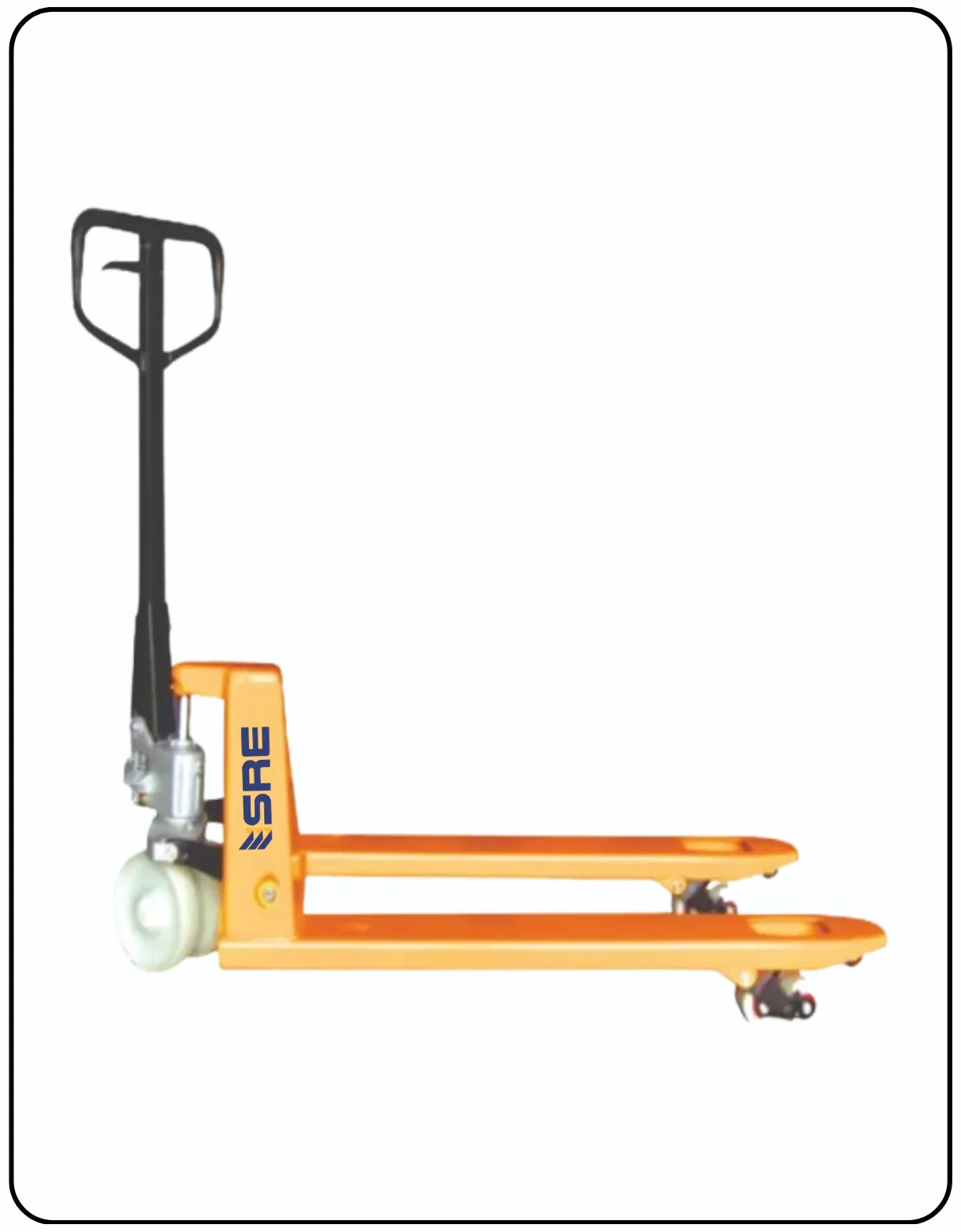
SRE Material Handling Equipment Pvt. Ltd.: Manufacturer, Supplier, And Exporter Of Hydraulic Pallet Truck in India.
SRE Material Handling Equipment Pvt. Ltd., Manufacturer And Supplier Of Hydraulic Pallet Truck in Nashik.
Our Manufacturing Unit is in Ahmedabad, Vadodara, and Rajkot, Gujarat, India.
Hydraulic Pallet Truck in Nashik: Practical Solutions for Modern Warehouses
Amidst the rapid progression of industry today, facilities in Nashik face mounting demands to manage greater volumes, adhere to stricter timelines, and uphold workplace safety. Conventional hand-operated methods often fall short of these requirements, leading to staff exhaustion, uneven output, and increased hazard exposure.
In day-to-day storage activities, moving substantial loads efficiently without jeopardizing well-being is a paramount concern. This is where the Hydraulic Pallet Mover becomes valuable—a straightforward, dependable solution crafted to boost output while lessening burdens on personnel.
The Evolving Requirements of Contemporary Storage and Sectors
Modern storage facilities and industrial sites function as active centers, not merely holding areas. Supply chains have accelerated and grown more intricate, necessitating swifter processing of incoming and outgoing goods.
In practical workflows, this means personnel frequently transport pallets between receiving bays, shelving structures, and production zones, often under pressure of time. Manual dollies and lift trucks, while useful, can struggle in confined spaces, over uneven floors, and with repetitive motions. Workflow chokepoints, errors stemming from tiredness, and potential harm are frequent obstacles needing viable answers.
Defining the Hydraulic Pallet Truck
A Hydraulic Pallet Truck is an apparatus, manually or electrically driven, intended for the smooth conveyance of goods placed on pallets. Unlike standard lift trucks, it is compact, readily maneuverable, and built for shorter hauls within storage facilities, workshops, or logistics hubs.
Simply put, it enables those working in storage to elevate a pallet slightly off the ground using a hydraulic mechanism, then roll it across the floor without significant muscle exertion. Beyond academic descriptions, the emphasis here is on practical utility—swiftness, manageability, and dependable performance.
Grounds for Hydraulic Pallet Movers Superseding Older Gear
Traditional pallet relocation relies heavily on physical exertion, which can be slow, unpredictable, and taxing. Conversely, hydraulic pallet movers provide:
- Diminished Strain: Hydraulic raising eliminates the need for forceful pushing or bending. Staff can shift multiple pallets during a shift without overtaxing themselves.
- Uniform Productivity: Each pallet lift and transit is consistent, minimizing workflow fluctuation among different shifts or operators.
- Operational Steadiness: Unlike manual techniques, hydraulic systems afford smoother governance and avert sudden descents or abrupt movements.
In actual industrial settings, these advantages result in more consistent throughput and fewer disruptions to production schedules.
Output Enhancements in Routine Activities
Routine storage tasks call for velocity and trustworthiness. With a hydraulic pallet mover, fundamental actions like transferring raw materials from storage to assembly lines become quicker and more methodical.
- Time Conservation: Personnel dedicate less energy and fewer moments to relocating pallets.
- Alleviated Shift Congestion: Predictable handling assures fluid operations, even during peak intervals.
- Improved Workflow Integration: Standardized pallet movement fits seamlessly with automated conveyor systems or manual packing stations.
Essentially, the appropriate hydraulic pallet mover acts as a minor yet vital engine for enhanced efficiency in any industrial configuration.
Bettering Safety on the Job
Accidents at work are a frequent worry in material handling. Overexertion, slippage, or poor pallet management can lead to strains or incidents. Hydraulic pallet movers mitigate these hazards through:
- Ergonomic Design: Operators can lift and transport pallets with minimized bending or twisting.
- Regulated Motion: Hydraulic mechanisms permit steady raising and setting down, precluding sudden lurches.
- Reduced Overhead Risk: The compact form factor lessens the chance of collisions in tight lanes, particularly when moving bulky contents.
Safety encompasses more than rule adherence—it directly influences operational continuity and staff contentment.
Managing Heavier Shipments Effortlessly
Contemporary storage facilities frequently manage weightier and bulkier palletized stock. A hydraulic pallet mover is engineered for stability and command, allowing operators to ferry heavier freight safely and effectively.
- Increased Load Capability: Most units handle typical pallet weights while preserving smooth movement.
- Superior Equilibrium: A low center of mass and sturdy forks guard against tipping, even on somewhat uneven terrain.
- Applicable Versatility: Perfect for manufacturing sites, climate-controlled storage, or large distribution centers where frequent movement of heavy pallets is the norm.
Technology and Operational Smoothness
Hydraulic pallet movers are available in non-powered and battery-operated versions, each presenting distinct operational benefits:
- Battery-Powered Variants: Reduce manual input, boost transit speed, and prolong operator stamina.
- Mechanical Dependability: Quality hydraulic pumps guarantee consistent lifting across countless cycles.
- Focus on Availability: Robust construction and minimal upkeep obligations decrease periods of non-operation.
Practically speaking, this means the equipment aids in smoother daily running without recurrent service interruptions.
Maximizing Space and Agility
Today’s warehouses often feature narrow lanes or condensed shelving arrangements. Hydraulic pallet movers excel in these settings due to their:
- Small Footprint: Easy to navigate between racks without sacrificing floor area.
- Tight Turning Capacity: Enables operators to execute sharp turns without collision risk.
- Adaptable Build: Suitable for multi-level storage zones or mixed-use facility layouts.
Effective space deployment leads to better workflow organization and greater storage density.
Value Over the Long Term
While the initial outlay is a consideration, the enduring worth of a hydraulic pallet mover is clear:
- Lower Staff Burden: Reduced physical stress translates to fewer incidents and less absenteeism.
- Decreased Repair Expenses: Simple construction necessitates fewer routine service calls compared to heavy machinery.
- Reliable Output: Minimizes operational delays, assisting storage houses in meeting schedules dependably.
In summary, the equipment justifies its cost through improved productivity, enhanced safety, and fewer operational hitches.
Environmental Care and Adherence to Rules
Facility operations are increasingly prioritizing environmental responsibility and regulatory conformity:
- Cleaner Processes: Manual movers or lift trucks can lead to spills or mishaps; hydraulic units lower these exposures.
- Energy Prudence: Electric hydraulic movers consume less power than conventional lift trucks.
- Compliance Focus: Ergonomic and secure handling aligns with workplace safety mandates and audit necessities.
Adopting these units demonstrates both operational accountability and ecological awareness.
Integration with Warehouse and Factory Procedures
Hydraulic pallet jacks are not isolated instruments—they work in concert with larger facility systems:
- Bay-to-Shelf Movement: Smoothly transfers items from unloading zones to storage shelving.
- Assembly Line Supply: Guarantees prompt provision of materials or parts.
- Packaging and Shipping Prep: Assists in steady pallet alignment for outgoing shipments or inspections.
When incorporated into procedural planning, these units boost output without necessitating large structural alterations.
Operator Instruction, Simplicity, and Upkeep
How easily something is adopted significantly impacts its usefulness in any setting:
- Straightforward Handling: Personnel rapidly grasp lifting, navigation, and pallet placement.
- Limited Instruction Needed: An intuitive design shortens the orientation period for new users.
- Reliable Servicing: Routine fluid checks, periodic hydraulic attention, and wheel reviews guarantee enduring performance.
For facility supervisors, this straightforward nature translates to negligible interruption of daily tasks.
The Importance of Selecting a Trustworthy Producer
Picking the correct manufacturer is vital for consistent operational performance:
- Quality Guarantees: Robustly engineered hydraulic mechanisms avoid frequent failures.
- Support Availability: Prompt servicing assistance maintains equipment availability.
- Sector Familiarity: Producers experienced with facility logistics grasp real-world issues and regulatory needs.
For enterprises in Nashik, reputable suppliers such as SRE MATERIAL HANDLING EQUIPMENT PRIVATE LIMITED offer both expertise and a grounded comprehension of local industrial requirements.
Summary
In routine factory and storage functions, a Hydraulic Pallet Truck transcends a simple lifting mechanism—it’s a functional answer for boosting output, security, and streamlined activity. From lessening operator strain and preventing harm to bettering load management and maximizing area use, the advantages are concrete for any contemporary facility or production floor.
For those making choices in Nashik, incorporating hydraulic pallet trucks into your activities is a simple, value-conscious move toward superior operational standards.
Core Points
- Throughput: Smoother pallet flow lessens chokepoints and elevates daily production figures.
- Workplace Security: Comfortable handling and managed elevation decreased on-site accidents.
- Load Management: Facilitates the movement of heavier loads with balance and little effort.
- Financial Prudence: Lowers worker strain, periods of inactivity, and ongoing running expenses.
- Sector Direction: Contemporary depots increasingly depend on compact, dependable methods for moving materials.
Trending FAQ
Q1: What load capacity can a hydraulic pallet truck handle?
- A: Standard models handle 2,000–3,000 kg; heavy-duty versions exceed 5,000 kg.
Q2: Are electric models worth the investment?
- A: Yes, for high-volume warehouses, electric trucks reduce fatigue and improve travel speed.
Q3: How much training is required?
- A: Minimal; most operators can safely use a hydraulic pallet truck after 1–2 hours of guidance.
Q4: Can they operate in narrow aisles?
- A: Yes, compact design allows smooth maneuvering even in tight warehouse layouts.
Q5: How often should maintenance be performed?
- A: Routine checks monthly, hydraulic servicing annually, depending on usage.
Upgrade Your Warehouse Operations — Contact Us Today. Call +91 9316 2088798 or sremhepvtltd2025@gmail.com for assistance now.
#HydraulicPalletTruck #WarehouseEfficiency #MaterialHandling #IndustrialSafety #SREMaterialHandlingEquipmentPrivateLimited #NashikWarehouses #LoadHandlingSolutions #OperationalProductivity #WarehouseTechnology