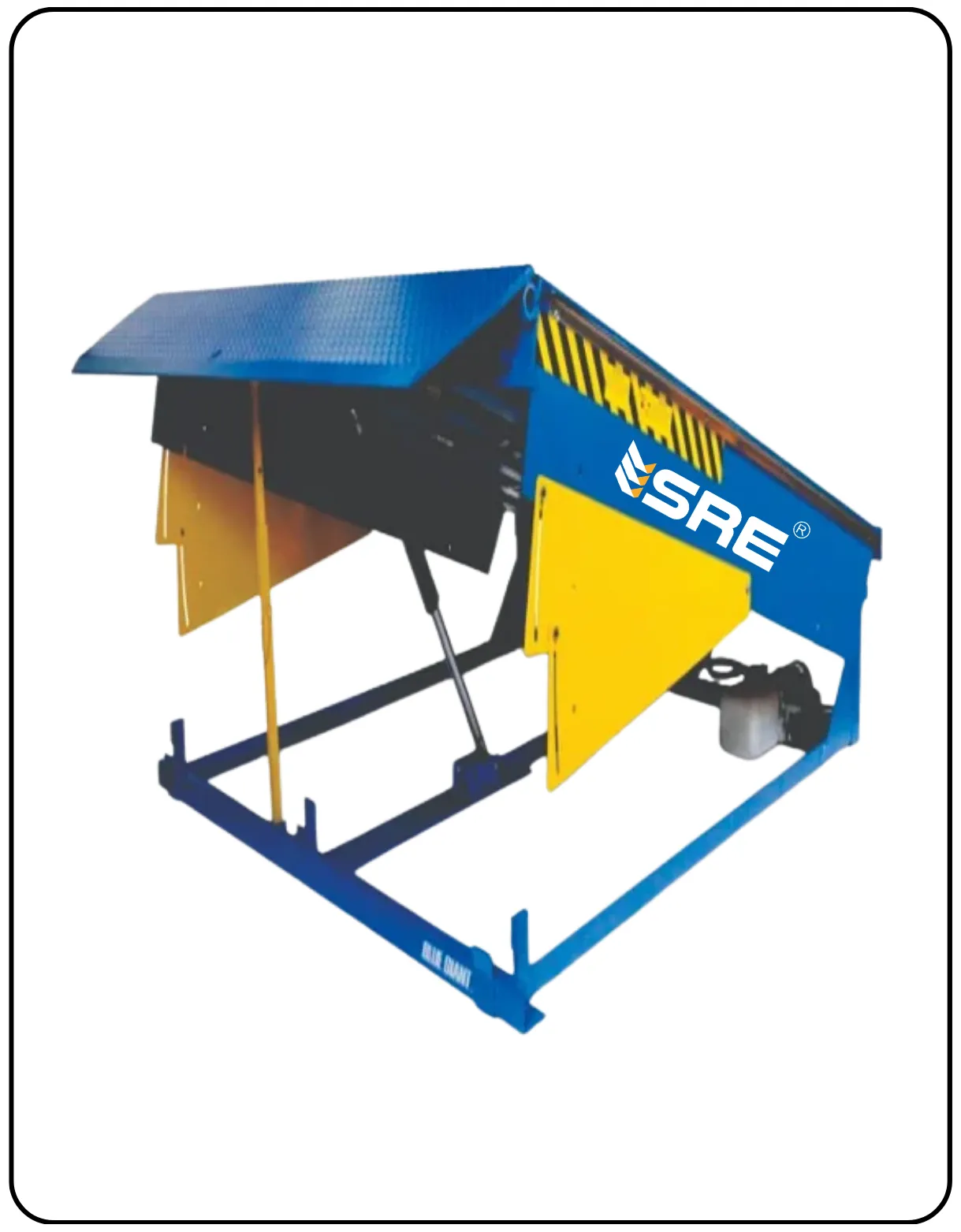
SRE Material Handling Equipment Pvt. Ltd.: Manufacturer, Supplier, And Exporter Of Industrial Dock Leveler in India.
SRE Material Handling Equipment Pvt. Ltd., Manufacturer And Supplier Of Industrial Dock Leveler in Bhosri.
Our Manufacturing Unit is in Ahmedabad, Vadodara, and Rajkot, Gujarat, India.
Industrial Dock Leveler in Bhosri: A Practical Guide for Modern Warehouses
In the present industrial setting, managing warehouses and plants faces significant pressure to achieve greater output with fewer resources—requiring increased speed, enhanced security, and smarter execution. The processes of goods receipt, unloading, internal transit, and dispatch have seen substantial shifts in recent years. Boosting throughput, easing workforce strain, and mitigating hazards are daily goals for management, purchasing departments, and logistics supervisors.
In routine warehouse activities, one often-overlooked piece of apparatus frequently wields a major influence on both efficiency and safety: the Industrial Dock Leveler. Whether overseeing a busy distribution centre or refining factory logistics, the correct dock infrastructure is vital for the smooth movement of freight across loading aprons.
This article examines the nature of Industrial Dock Levelers, their growing necessity, and how key personnel can evaluate their practical worth in actual job sites. We will emphasize tangible issues and practical remedies, steering clear of mere promotional language.
Evolving Demands of Contemporary Industrial Spaces
Logistics spaces have transformed from simple storage areas into fast-paced operational centres. Several trends amplify the strain on internal procedures:
- Elevated throughput targets: Both retail outlets and manufacturing firms require faster turnaround schedules. Meeting same-day or next-day delivery windows intensifies demands at the loading docks.
- Increased freight volumes: Driven by global connectivity and the expansion of e-commerce, the quantity and frequency of goods arriving and leaving have risen.
- Workforce demographics: Labour availability has changed, and keeping staff is difficult. Tasks that were once manual or improvised now benefit from equipment that lessens fatigue and risk.
In most venues, just one choke point—such as inefficient dock processing—can impede everything from incoming receiving to outgoing shipping. If your teams struggle with changes in elevation between docks and trailers, inconsistent work patterns, or unexpected hold-ups, these problems invariably generate delays further down the line.
Defining the Industrial Dock Leveler
Fundamentally, an Industrial Dock Leveler is a structural apparatus installed in a pit that spans the vertical and horizontal divergence between a building’s floor level and the deck of a lorry or trailer.
Instead of relying on temporary ramps, timber planks, or strenuous manual effort to bridge elevation differences, a dock leveler provides an adaptable, steady platform that aligns with trailers of various heights. What sets a commercial-grade model apart from basic dock plates is its robustness, controlled movement, uniform surface quality, and reduced need for manual intervention.
In practical terms, when a vehicle reverses into your bay:
- The dock leveler adjusts to match the trailer floor elevation.
- Your workforce—using forklifts, powered pallet trucks, or hand carts—transfers items across without interruption.
- The mechanism returns to its secure resting setting once work concludes.
This process seems simple, yet in day-to-day warehouse duty, these functions resolve common frustrations: uneven transitions, jarring impacts to transport gear and cargo, and hold-ups during handoffs between personnel.
Why the Industrial Dock Leveler Supersedes Older, Manual Practices
In environments where every moment is crucial, reverting to older techniques—such as manually adjusted plates or depending on subjective judgment for pallet placement—carries clear disadvantages.
Manual Methods Versus Modern Dock Levelers
Consider staff endurance: during a demanding shift, constantly lifting, positioning, or modifying stop-gap solutions imposes needless physical strain on employees. Over time, this contributes to protracted cycle times, errors, and potential harm.
Modern dock levelers are engineered to:
- Decrease manual handling requirements
- Support repeatable, uniform procedures
- Integrate seamlessly into standard loading/unloading flows
In settings reliant on precise scheduling and shift coordination, standardisation is not just a convenience—it’s a catalyst for greater output.
Productivity Gains in Routine Operations
During a standard workday, dock activities link with nearly all incoming and outgoing functional streams.
Time Efficiencies
When a truck pulls up to a dock:
- A correctly fitted Industrial Dock Leveler slashes the alignment and preparation time.
- Operators of materials handling equipment spend less time reorienting loads or compensating for irregular surfaces.
- Cargo transitions more smoothly across the gap.
In large facilities managing numerous truck movements daily, these small time savings accumulate significantly. Across multiple shifts, less setup time translates to processing more shipments without extending operational hours.
Consistency Between Shifts
A hidden drag on productivity is variability when one crew must navigate the same complicated gap the previous shift handled; inefficiencies compound.
Industrial Dock Levelers ensure standardized alignment every single time. This results in:
- Shorter instruction periods for novice operators
- Fewer miscommunications during shift changeovers
- More accurate performance metric tracking
Enhanced Workplace Security
Safety is not a concept—it’s a quantifiable operational output.
In daily tasks, uneven crossings between the facility floor and trailer beds often lead to:
- Instability in forklifts or shifting pallets
- Operator stumbles or slips
- Cargo displacement or falls
An Industrial Dock Leveler furnishes a solid, dependable platform engineered to handle the demanding, repetitive loads and forces typical in industrial settings.
Ergonomics and Injury Mitigation
Manual approaches often necessitate repeated movements for lifting, adjustment, or compensation. Over a long working day, these actions collectively increase physical strain.
Industrial Dock Levelers:
- Reduce the frequency of hands-on physical adjustments
- Offer reliable ergonomic transitions for both machinery and personnel
- Lessen the occurrence of strain-related incidents
When staff members perceive a safer workspace, they perform with greater assurance and uniformity—which indirectly boosts productivity.
Managing Heavier Loads with Greater Ease
Today’s warehouses manage cargo that is both greater in volume and weight than ever before. Supply chains increasingly incorporate large machinery and substantial pallet loads that challenge traditional manual handling limits.
An Industrial Dock Leveler is engineered to support:
- Higher-rated load capacities
- Stable movement of dense freight
- Minimization of jarring movements during transitions
This is crucial not only for safety but also for equipment longevity. Forklifts, pallet jacks, and conveyors all function more fluidly when the floor-to-truck interface is stable and predictable.
Tech & Operational Streamlining
Dock leveler technology has advanced past simple metal platforms. Leaders should assess how these systems fit facility requirements:
Mechanical and Power Varieties
- Spring-loaded setups: Suitable for lower-frequency usage, offering dependable movement and less upkeep.
- Hydraulic apparatuses: Often selected for busier docks where fluid, adjustable operation aids in handling differing trailer heights efficiently.
- Air-driven selections: Provide controlled motion needing little manual input, beneficial where staff well-being is a priority.
Dependability and Operational Time
In actual use, reliability directly impacts the volume of goods moved. Frequent alignment needs due to worn or poorly matched gear hinder procedures and result in lost time and funds.
Robust Industrial Dock Levelers are designed for:
- Repeated use without deterioration
- Minimal unexpected service interruptions
- Synchronisation with regular facility upkeep schedules
Area Maximisation & Mobility
Space is consistently limited in industrial and storage buildings. Dock locations specifically can become crowded with:
- Forklifts moving in and out of transports
- Holding zones for incoming and outgoing freight
- Staff managing shipments
Thoughtfully designed dock levelers improve general traffic patterns by:
- Offering consistent connection points
- Reducing awkward angles requiring correction
- Facilitating narrow path movement
Since contemporary levelers adapt to varied truck bed heights without requiring extra space for staging, they assist premises in maintaining tidier, more efficient dock environs.
Value Over Duration
It’s easy to equate the initial purchase price with worth—but lasting expenses reveal a different reality in industrial activities.
Unforeseen Expenses of Ad-Hoc Methods
- Business stoppage stemming from accidents
- Decreased output from slow setup times
- Equipment erosion from unsteady dock meeting points
- Recurring fixes on fragile or temporary setups
Sustained Worth of Industrial Dock Levelers
- A sturdy building reduces the need for early replacement
- Uniform load support lessens harm to industrial trucks and trailers
- Better physical setups lower insurance claims and lost work time
Instead of focusing only on the initial outlay, operational groups should evaluate the total cost of ownership across several years of service. Industrial dock solutions frequently yield returns through smoother operations, reduced hazards, and lower maintenance spending.
Green Initiatives & Regulations
Environmental consciousness is more than just industry jargon—many sites now monitor green performance as part of regulatory adherence and corporate duty.
Industrial Dock Levelers help by:
- Cutting energy wastage linked to inefficient processes
- Decreasing fuel consumption from repeated forklift repositioning
- Enabling smoother shifts that lower exhaust from stationary trailers
In areas with strict rules, purpose-built gear also aids in maintaining adherence to workplace safety and environmental benchmarks. Properly serviced, correctly installed dock systems simplify inspections and reviews.
Alignment with Facility / Plant Operations
An Industrial Dock Leveler doesn’t function in isolation—it’s part of a larger sequence which might involve:
- Yard tracking systems
- Booking software
- Material handling machinery
- Conveyor and holding sections
When planning dock upgrades, decision-makers need to confer with internal departments so that:
- Dock apparatus matches the required output levels
- Control systems interface with existing safety mechanisms
- Layout modifications boost overall flow
Careful interconnection ensures that dock advancements amplify advantages elsewhere in the facility.
Staff Instruction, Simplicity, & Servicing
Regardless of how capable the hardware is, personnel must feel comfortable and assured using it.
Effective industrial dock setups are:
- Straightforward to run with clear controls
- Supported by simple servicing guides
- Accompanied by basic teaching that can happen on the floor
Foreseeable maintenance—like lubricating joints or inspecting fluid systems—helps avoid unexpected breakdowns. Premises with proactive upkeep schedules typically achieve superior uptime and reduced unforeseen expenditures.
Importance of Selecting a Trustworthy Builder
Picking hardware from an established vendor is important because not all Industrial Dock Levelers are constructed identically. Key considerations include:
- Product superiority: Solid components engineered for true industrial usage cycles
- After-sale support: Access to spares and prompt technical help
- Expertise: A supplier knowledgeable about regional industrial challenges, such as severe temperatures, high usage rates, or specific load types
When teams install dock equipment matching actual needs and site conditions, they experience more reliable performance and fewer interruptions.
For enterprises looking at options in the Pune–Bhosri vicinity, resources such as SRE MATERIAL HANDLING EQUIPMENT PRIVATE LIMITED offer relevant product choices and insights. You can examine their selections thoughtfully at: https://www.sremhepvtltd.com/
This is not a commercial endorsement, but an acknowledgment of how experienced vendors can aid in evaluations and decisions tailored to your facility’s precise demands.
Summary
For warehouse supervisors, plant administrators, and logistics experts, peak operation starts with mastering the basics. The connection between the dock floor and the transport bed might seem small, but weaknesses here impact workflows, safety results, and daily output.
An Industrial Dock Leveler is a functional investment—not due to its visual appeal, but because it resolves routine operational issues with consistency and longevity. From gains in productivity and injury reduction to steady function and lower long-term expenses, the benefits reach across staff and shifts.
If your facility is exploring methods to refine dock activities and enhance material transit, consider revisiting your dock equipment plan as part of your wider efficiency strategy. Incorporating solutions like Electric Stacker and Good Lift can streamline operations, reduce physical strain, and improve overall warehouse productivity.
Main Points
- Productivity: Standardised crossings accelerate goods movement both ways.
- Workplace Well-being: Engineered platforms help lessen physical strain and accident risk.
- Cargo Capacity: Modern levelers handle heavier, more varied freight.
- Expense Prudence: Long-term worth often exceeds the initial outlay.
- Market Shift: Warehouses increasingly adopt engineered dock resolutions for uniformity and adherence.
Trending FAQs
Q: What maintenance does an Industrial Dock Leveler require?
- A: Routine checks of mechanical or hydraulic components, greasing pivot points.
Q: How does a dock leveler improve safety?
- A: It provides a smooth, stable bridge between dock and trailer, reducing slips.
Q: Are dock levelers suitable for all trailer heights?
- A: Yes—industrial systems are designed with adjustable ranges to accommodate varying trailer bed heights.
Q: Can existing docks be retrofitted with levelers?
- A: In many cases, yes. Dock retrofitting should be evaluated by professionals who assess pit dimensions.
Q: What’s the typical lifespan of a dock leveler?
- A: With proper maintenance and usage suited to design capacity, industrial dock levelers can last many years.
Contact us today to discuss your dock leveler needs. Call +91 9316 2088798 or sremhepvtltd2025@gmail.com for assistance now.
#IndustrialDockLeveler #WarehouseOperations #MaterialHandling #LogisticsEfficiency #SafetyFirst #SupplyChainSolutions #DockEquipment #SREMaterialHandlingEquipmentPrivateLimited #WarehouseTechnology #BhosriIndustry #FactoryWorkflow