
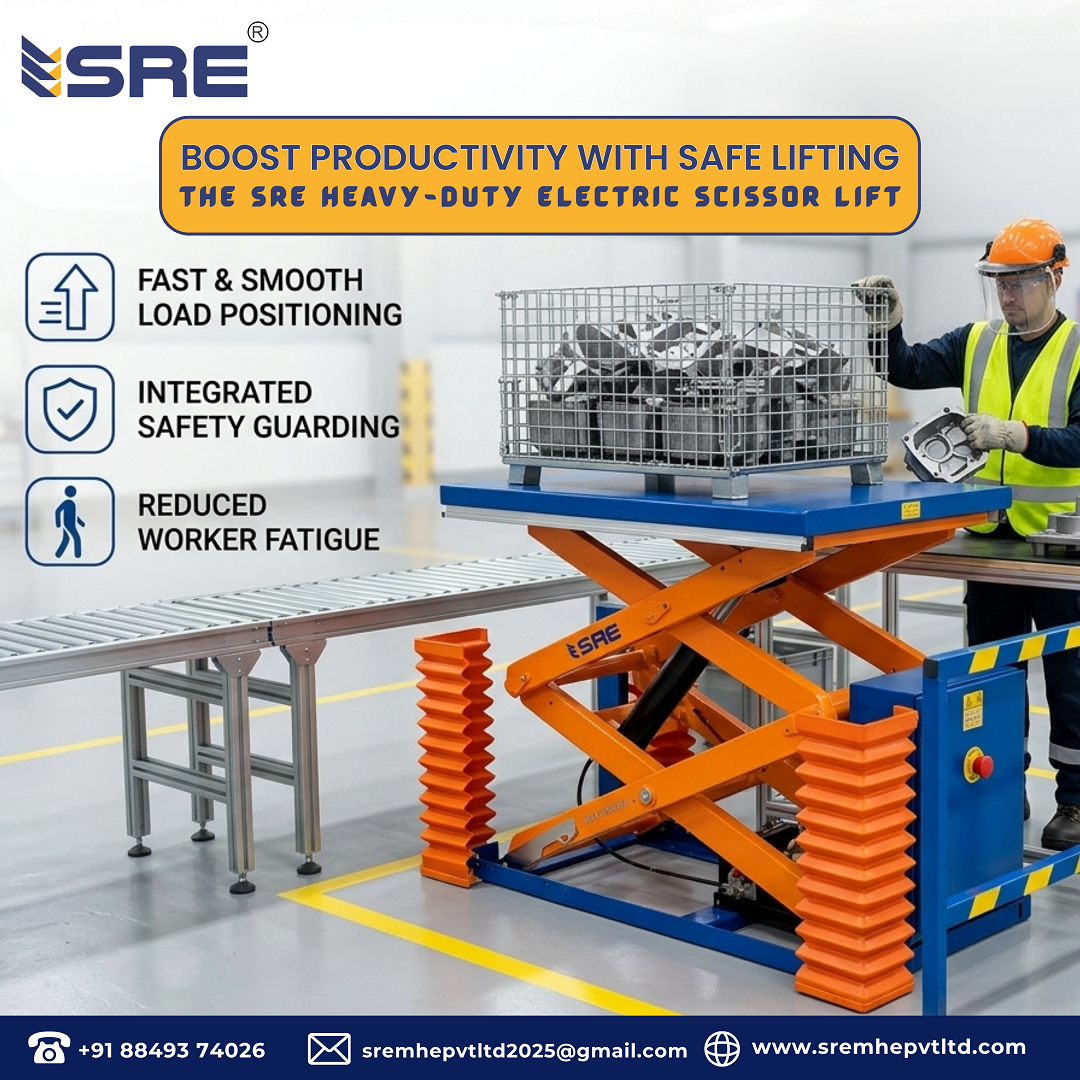
800 Kg x 1500 mm size – 1200 X 610 (All Size Available)
Rs. 150000
(Taxes to be paid extra)
Brand: SRE
Min Order Qty: 1
Boost Workplace Efficiency Using Electric Scissor Lift Table: SRE Material Handling Equipment Pvt. Ltd.
Maximize Productivity Using Electric Scissor Lift Tables — walk through any busy warehouse or production facility and you’ll quickly notice a recurring issue: a significant amount of time isn’t lost in transporting goods from Point A to Point B, but in the in-between tasks—lifting, lowering, positioning, and constantly readjusting loads to match different working heights.
It may not seem like a major concern at first glance, but over the span of an entire shift and across multiple workstations, this hidden inefficiency translates into measurable costs and increased physical strain on workers.
Over the past decade, warehouse and industrial operations have evolved rapidly. Order volumes have surged, SKU counts have multiplied, delivery timelines have tightened, and at the same time, labor availability has become increasingly unpredictable. Alongside these challenges, workplace safety standards have grown stricter than ever before.
In this changing landscape, Electric Scissor Lift Tables have quietly become a practical and effective solution to one of the most persistent bottlenecks in material handling—improving workflow efficiency while enhancing safety, without disrupting existing operations.
The Changing Pressure on Modern Industrial Operations
If you manage a warehouse, factory floor, or distribution center, the last five years have likely felt like running on a faster treadmill. E-commerce growth has pushed fulfillment expectations to same-day or next-day delivery. Manufacturing lines are expected to flex between product variations with minimal downtime. Supply chain disruptions have put extra pressure on internal logistics to make up the difference.
What this means practically is that every station in your operation needs to perform consistently and quickly — not just at the beginning of a shift, but at the end too, when operator fatigue starts to set in.
The traditional response was to add labor or ask existing staff to work harder. Neither is sustainable. The smarter response is to look at where your workflow is losing time and energy at a fundamental level — and ergonomic material positioning is almost always near the top of that list.
Staying updated with global industry and logistics trends, as highlighted by CNN, helps businesses adopt smarter solutions like Electric Scissor Lift Tables to improve efficiency and workplace safety.
What Is an Electric Scissor Lift Table, Really?
In simple operational terms, an Electric Scissor Lift Table is a powered platform that raises or lowers a load to a working height that suits the task or the worker — at the push of a button.
The “scissor” refers to the linked folding mechanism underneath the platform, which extends and retracts to change height. The “electric” part means the lifting is battery-powered or motor-driven — rather than requiring manual pumping or mechanical effort from the operator.
They come in a wide range of load capacities, platform sizes, and height ranges. Some are fixed workstation units. Others are mobile lift tables, built on castors so they can be repositioned across the floor. Some are integrated into conveyor or assembly lines; others are standalone units used for loading, packing, or maintenance tasks.
If you’re evaluating a specific model for your facility, you can explore the Electric Scissor Lift product page for detailed specifications and configurations.
What they have in common is the core function: bringing the work to the right height, rather than forcing the worker to awkwardly reach up or bend down.
Why Electric Scissor Lift Tables Are Replacing Traditional Manual Equipment?
For years, the standard approach to height adjustment in warehouses was either manual hand-pump lift tables or simply stacking pallets and having workers adapt. Both approaches have the same fundamental flaw — they shift the burden onto the worker’s body rather than onto the equipment.
Manual pump systems require repeated physical effort to raise loads, which contributes directly to operator fatigue — especially in high-volume operations running multiple shifts. Over time, this fatigue doesn’t just slow workers down; it increases the likelihood of musculoskeletal injuries, which are among the most common and costly workplace injuries in industrial settings.
Electric Scissor Lift Tables remove that physical burden entirely. The operator positions the load, presses a button, and the platform moves to the required height. The effort required is minimal and consistent whether it’s the first cycle of the morning or the hundredth cycle of the afternoon shift.
Beyond fatigue, there’s a consistency argument. Manual adjustments are inherently variable — different operators position loads at slightly different heights, which creates micro-inefficiencies at every station. Electrically controlled height adjustment standardizes that process, which is particularly valuable on assembly or packing lines where repeatability matters.
For facilities that also rely on hydraulic stackers or electric stackers in their workflow, adding electric scissor lift tables at key stations creates a more complete and consistent ergonomic handling system across the floor.
Productivity Gains in Daily Operations
In daily warehouse operations, the gains from switching to Electric Scissor Lift Tables often show up in ways that aren’t immediately obvious from the outside but are clearly visible to anyone managing the floor.
Cycle times at packing and sorting stations typically improve because workers aren’t adjusting their posture or repositioning loads manually between tasks. Loading and unloading operations at dock areas become faster because the platform height can be matched precisely to truck bed height without guesswork or makeshift solutions. Facilities using dock levelers alongside scissor lift tables often see the biggest gains at the loading bay — both pieces of equipment work together to eliminate height mismatch completely.
Across multiple shifts, this consistency adds up. When your second-shift team starts work, they’re operating from the same optimized setup as the first shift — not rebuilding the workflow from scratch or compensating for fatigue-driven adjustments.
For facilities running lean operations where every minute of throughput matters, that kind of steady, predictable output across the full working day is worth paying attention to.
Improved Workplace Safety: The Case Beyond Compliance
Workplace safety in material handling is often discussed in terms of regulatory compliance — meeting OSHA requirements, maintaining audit records, ticking the right boxes. That’s important, but it’s not the whole picture.
The more immediate reason to care about ergonomic equipment is operational. Workplace injuries are expensive — not just in direct medical and compensation costs, but in the disruption they cause to your workforce, your scheduling, and your output.
Back injuries and shoulder strains from repeated heavy lifting or awkward reaching are almost entirely preventable with the right equipment. Electric Scissor Lift Tables contribute directly to reducing that risk by keeping loads at a comfortable working height and eliminating the need for excessive reaching, bending, or manual lifting.
The controlled, motorized movement of these platforms also reduces the risk of sudden shifts or drops that can damage goods or injure workers — a real concern when handling heavy or fragile materials. Movement is smooth, predictable, and operator-controlled at all times.
For operations that require working at elevated heights, combining scissor lift tables with aerial work platforms creates a layered safety approach that covers both floor-level and elevated tasks.
Handling Heavier Loads with Confidence
Modern warehouses and factories routinely handle loads that would have been considered challenging even a few years ago. Heavy machinery components, bulk packaged goods, large fabricated assemblies — the scale of what’s moving through industrial facilities has grown.
Electric Scissor Lift Tables designed for industrial use are built to handle substantial load capacities in a stable, controlled way. The platform remains level throughout the lifting range, which matters when you’re positioning heavy or unbalanced loads for further processing or transfer.
For operations handling particularly heavy or dense materials, pairing scissor lift tables with chain blocks and hoists or magnetic lifters gives you a complete heavy load handling system that addresses both vertical movement and precise positioning.
Stability during load transfer is a point that experienced floor managers care about deeply. An unstable lift — one that shifts or tilts under load — creates risk and slows down operations because workers have to compensate manually. A well-built Electric Scissor Lift Table eliminates that problem by design.
Technology, Uptime, and Operational Reliability
One of the practical concerns for any manager considering powered equipment is downtime. If the machine stops working, does your operation stop with it?
Modern Electric Scissor Lift Tables are built with operational reliability as a priority. Battery-powered mobile units are designed for full-shift operation on a single charge, with charging typically happening during breaks or shift changes. Fixed electric units connected to electrical supply eliminate the battery question entirely.
The mechanical components — the scissor linkage, the platform, the control systems — are designed for high-cycle industrial use. Maintenance requirements are predictable: regular inspections, lubrication at wear points, battery maintenance for electric units. There are no complex hydraulic systems to manage in most modern designs, which reduces the technical burden on your maintenance team.
From an uptime perspective, the equipment is generally more reliable and easier to maintain than older manual or hydraulic alternatives.
According to insights shared by HubSpot, optimizing operational workflows and reducing manual effort are key factors in improving overall business productivity and efficiency.
Space Efficiency and Floor Flexibility
Factory and warehouse floor space is always at a premium. Equipment that takes up significant footprint or requires wide operating clearances creates real layout constraints.
Electric Scissor Lift Tables are available in compact configurations designed specifically for space-constrained environments. Mobile units can be repositioned to where they’re needed rather than occupying permanent floor space at each station. Fixed units at workstations are designed to integrate cleanly into the surrounding layout without requiring excessive clearance.
For facilities also using platform trolleys or pallet trucks for floor-level movement, scissor lift tables fit naturally into the same workflow — handling the vertical element while your existing equipment handles the horizontal.
Long-Term Cost Efficiency: Looking Beyond the Purchase Price
For procurement teams evaluating material handling equipment, the initial purchase cost is always a factor — but experienced operations managers know that the total cost of ownership tells a different story.
The relevant numbers include: reduction in workplace injury incidents (and associated costs), lower labor fatigue leading to more consistent output, reduced product damage from manual handling, and decreased downtime from equipment that requires less complex maintenance.
When those factors are calculated honestly over a three-to-five year operating horizon, Electric Scissor Lift Tables frequently justify their investment in ways that go well beyond simple productivity metrics. The facilities that have made this transition generally find that the business case becomes clearer over time, not less so.
Sustainability and Operational Compliance
Electric operation aligns naturally with the direction most industrial operations are heading — toward cleaner, quieter, lower-emission working environments. Battery-powered or electrically connected equipment produces no exhaust, creates minimal noise, and imposes a smaller environmental footprint than equipment running on fossil fuels.
For facilities working toward sustainability certifications or operating under environmental compliance requirements, electric equipment simplifies that conversation. It’s not the only factor, but it’s a meaningful one.
Fitting Into Your Existing Workflow
One practical question for any operations manager considering new equipment is how it integrates with what’s already there. Electric Scissor Lift Tables are designed to fit into existing material handling systems rather than replace them wholesale.
They work alongside electric order pickers, goods lifts, and manual workstations. They can be introduced at specific bottleneck points in an existing workflow without requiring the entire operation to change around them.
Businesses across Maharashtra have already seen this integration work smoothly in practice. If you’re based in the region, you can read about real implementations of Electric Scissor Lift Tables in Mumbai, Electric Scissor Lift Tables in Nashik, and Electric Scissor Lift Tables in Bhosri to understand how facilities similar to yours have approached the transition.
Training, Ease of Use & Maintenance
The operational value of any equipment depends partly on how easy it is for your team to use and maintain. Electric Scissor Lift Tables have a straightforward learning curve — most operators are comfortable with basic operation within a short training period.
Controls are typically simple and intuitive: raise, lower, position. Safety features like overload protection and controlled descent are built in rather than relying on operator judgment. Maintenance is systematic and predictable, which makes it easier to schedule around your operational needs.
Why the Manufacturer You Choose Matters?
Equipment quality, after-sales support, and the availability of spare parts and service are not secondary considerations — they’re operational necessities. A lift table from a manufacturer with limited service capability in your region creates a vulnerability in your operation.
When evaluating suppliers, look for demonstrated experience in industrial material handling, a track record of equipment performance in similar operational environments, and the infrastructure to support you after the sale. SRE Material Handling Equipment Private Limited has built its presence specifically around serving industrial customers across India with that kind of ongoing operational support in mind.
You can explore their full range of material handling products, learn more on the About Us page, or reach out directly via the Contact Us page to discuss your specific operational requirements.
Compliance with relevant safety standards should be verifiable — not just claimed in marketing materials.
Conclusion: A Practical Investment in Operational Performance
Electric Scissor Lift Tables don’t promise to solve every challenge in a warehouse or factory. But they do solve a specific, widespread problem — the inefficiency and physical strain of working at wrong heights — in a way that has measurable impact on daily operations.
For industrial decision-makers weighing equipment investments, the practical case is straightforward: consistent ergonomic positioning reduces fatigue, reduces injuries, improves throughput, and supports operational reliability across shifts. That combination is hard to argue with.
If your operation is still relying on manual lifting or outdated height-adjustment equipment at key workstations, it’s worth having a direct conversation with a reliable supplier. Get in touch with our team today — and explore the right Electric Scissor Lift Table for your facility on the product page.
Key Takeaways
- Productivity: Electric Scissor Lift Tables reduce cycle time, standardize working heights, and maintain consistent output across all shifts — not just the first.
- Safety: Controlled, motorized lifting reduces back injuries, strain-related incidents, and goods damage from unstable manual handling.
- Load Handling: Modern units are engineered for heavy industrial loads with stable, level platforms and smooth movement throughout the lift range.
- Cost Efficiency: Long-term ROI includes reduced injury costs, lower maintenance complexity, and improved operational reliability.
- Industry Trend: The shift from manual to electric material handling equipment is accelerating across warehousing, manufacturing, and distribution — driven by labor, safety, and sustainability pressures.
Frequently Asked Questions (FAQs)
Q1. What load capacities are typically available in Electric Scissor Lift Tables?
- Industrial Electric Scissor Lift Tables are commonly available in capacities ranging from 500 kg to over 5,000 kg, depending on the application. For heavy manufacturing environments, higher-capacity models with reinforced platforms are available. You can explore available configurations on our Electric Scissor Lift product page.
Q2. How long does a battery-powered Electric Scissor Lift Table last on a single charge?
- Most modern battery-powered units are designed for a full 8-hour shift on a single charge under normal operating conditions. Actual runtime depends on load weight and lift frequency.
Q3. Can Electric Scissor Lift Tables be customized for specific workstation dimensions?
- Yes. Many manufacturers offer customization in platform size, height range, and surface configuration (such as roller tops or turntable surfaces) to match specific workflow requirements. Contact our team to discuss your specific needs.
Q4. What maintenance does an Electric Scissor Lift Table typically require?
- Routine maintenance includes periodic inspection of the scissor mechanism and pivot points, lubrication of wear parts, and battery maintenance for mobile units. Most schedules are simple enough to be handled by in-house maintenance teams.
Q5. Are Electric Scissor Lift Tables compliant with industrial safety standards?
- Equipment from reputable manufacturers is built to comply with applicable safety standards and certifications. Always verify documentation before purchase. Learn more about our quality standards on the About Us page.
Q6. How disruptive is it to introduce Electric Scissor Lift Tables into an existing workflow?
- In most cases, the transition is manageable. Units can be introduced at specific bottleneck stations without redesigning the broader operation, and operator training is typically brief. Browse our complete product range to see how scissor lift tables complement your existing equipment.
#ElectricScissorLiftTable #WarehouseProductivity #MaterialHandling #IndustrialEquipment #WorkplaceSafety #ErgonomicHandling #LiftTable #WarehouseOperations #FactoryFloorEfficiency #LoadHandling #SRE #SREMaterialHandling #IndustrialSolutions #OperationsManagement #SupplyChainEfficiency #SmartWarehousing #ManufacturingEfficiency #WorkforceSafety #ProcurementDecisions #IndustrialIndia