
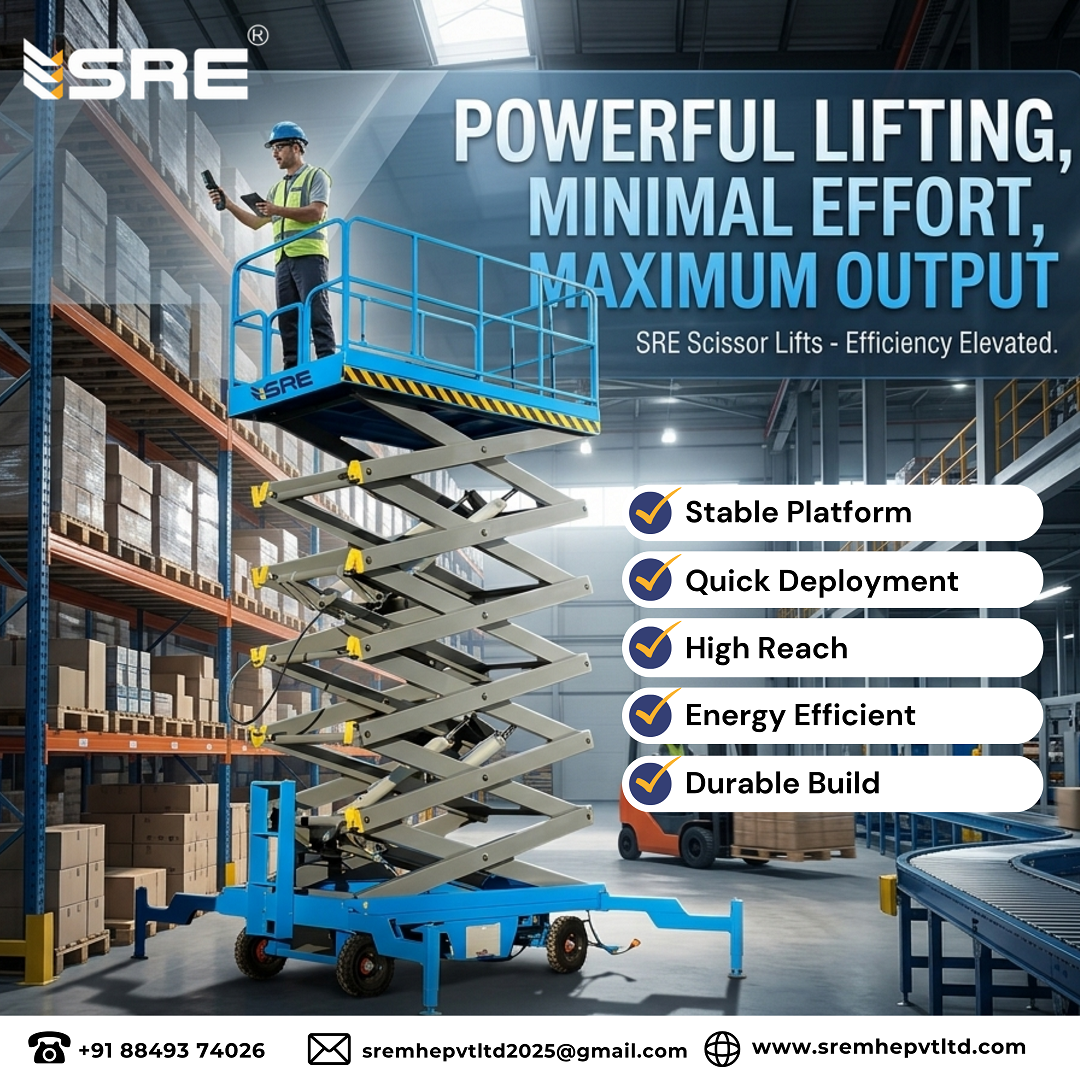
500kg – 4meter (All Size Available)
Rs. 200000
(Taxes to be paid extra)
Brand: SRE
SKU: SRE 149
Min Order Qty: 1
Smart Scissor Lift for Maximum Output – SRE Material Handling Equipment Solutions for Higher Efficiency and Productivity
Warehouse and industrial operations have evolved dramatically over the past decade. Smart Scissor Lift for Maximum Output has become a key enabler in this transformation, helping businesses achieve faster workflows, improved precision, and consistent productivity even under increasing operational pressure and tight delivery schedules.
In day-to-day warehouse environments, teams are required to move materials quickly, handle heavier loads, and maintain strict safety standards. At the same time, challenges such as labor fatigue, repetitive strain injuries, and workflow bottlenecks continue to impact overall efficiency and performance for managers and operators.
This is where Scissor Lifts prove to be a practical and dependable solution. Rather than replacing human effort, they enhance it by improving height access, streamlining lifting operations, and ensuring safer, more controlled handling of materials across industrial and warehouse applications.
The Changing Needs of Modern Warehouses / Industries
Industrial environments today are driven by demand fluctuations, faster order cycles, and higher customer expectations. Warehouses are no longer just storage spaces—they function as dynamic distribution hubs.
Operations heads and supply chain managers frequently deal with:
- Tight dispatch schedules
- Increased SKU handling
- Multi-level storage systems
- Limited floor space
- Workforce fatigue during peak hours
In such conditions, relying only on manual lifting or basic equipment often leads to inefficiencies. Internal logistics becomes a challenge when materials must be lifted, positioned, or accessed at different heights repeatedly throughout the day.
What Is a Scissor Lift?
A Scissor Lift is a type of material handling equipment designed to lift loads vertically using a crisscross (scissor-like) mechanism. It is commonly used to raise workers, tools, or materials to a required height in a stable and controlled manner.
In simple terms, it acts as a safe and adjustable platform that allows operators to work at different elevations without the need for ladders or manual lifting.
Unlike traditional lifting methods, it provides both elevation and stability, which is critical in industrial environments where precision matters.
Why Scissor Lifts Are Replacing Traditional Equipment?
Manual lifting methods and basic tools like ladders or makeshift platforms are still used in some facilities. However, these methods often lead to:
- Operator fatigue
- Inconsistent productivity
- Higher risk of injury
- Limited load-handling capacity
In contrast, Scissor Lifts provide a structured and ergonomic approach to lifting tasks.
Operators no longer need to strain physically to reach heights or handle loads. Instead, the equipment does the lifting, allowing workers to focus on accuracy and task completion.
Over time, many factories and warehouses have shifted toward scissor lifts because they bring consistency to operations—something manual processes struggle to maintain.
Productivity Gains in Daily Operations
One of the most noticeable benefits of using Scissor Lifts is improved productivity.
In real-world warehouse settings, time is often lost in:
- Adjusting positions manually
- Repeated climbing or bending
- Coordinating multiple workers for simple lifting tasks
With a scissor lift, these inefficiencies are reduced. Tasks that once required two or three people can often be handled by a single operator with better control.
Improved Workplace Safety
Safety is a major concern in any industrial environment. Many workplace injuries are linked to improper lifting techniques, overreaching, or unstable platforms.
Scissor Lifts address these issues by providing:
- Stable working platforms
- Controlled vertical movement
- Reduced need for manual lifting
- Better posture during operations
From an operational perspective, fewer injuries mean fewer disruptions. It also contributes to a safer work culture, which is increasingly important for compliance and workforce retention.
For more details on advanced Scissor Lift solutions tailored to your operational needs, contact us today and let our experts help you improve efficiency and safety.
Handling Heavier Loads with Ease
Modern warehouses are dealing with heavier and bulkier materials than ever before. Manual handling becomes impractical and unsafe beyond a certain point.
Scissor Lifts are designed to handle substantial loads while maintaining stability. This is particularly useful in:
- Loading/unloading operations
- Assembly line processes
- Maintenance tasks at height
The ability to lift and position loads accurately reduces the risk of product damage and improves overall workflow efficiency.
To learn more about advanced Scissor Lift solutions, contact us today or reach out through our HubSpot page for quick assistance and expert support.
Technology & Operational Efficiency
Today’s Scissor Lifts are built with reliability and uptime in mind. Depending on the model, they may use hydraulic systems, electric motors, or battery-powered mechanisms.
From an operational standpoint, this means:
- Predictable performance
- Minimal downtime when maintained properly
- Energy-efficient operation in indoor environments
Battery-powered models are especially useful in indoor warehouses where noise and emissions must be controlled.
Space Optimization & Maneuverability
Space is often a limiting factor in warehouses, especially in facilities with narrow aisles or high-density storage systems.
Modern Scissor Lifts are designed to operate in such environments. Their compact structure allows them to:
- Navigate tight spaces
- Operate in narrow aisles
- Access elevated storage areas efficiently
This makes them suitable for both large-scale distribution centers and smaller industrial units where space optimization is critical.
Stay informed with the latest industrial trends on CNN.com and connect with us to discover efficient Scissor Lift systems tailored to your needs.
Cost Efficiency Over Time
While the initial investment in a Scissor Lift may seem significant, the long-term value is often more important for decision-makers.
Key cost-related advantages include:
- Reduced labor dependency for lifting tasks
- Lower risk of workplace injuries
- Decreased product damage
- Improved operational efficiency
Over time, these factors contribute to a lower total cost of ownership, especially in facilities with continuous operations.
Sustainability & Compliance
Sustainability is becoming a priority across industries. Equipment that supports cleaner and more efficient operations is increasingly preferred.
Electric Scissor Lifts contribute by:
- Reducing emissions in indoor environments
- Lowering energy consumption compared to traditional systems
- Supporting compliance with safety and environmental regulations
For organizations aiming to align with modern compliance standards, such equipment plays a supporting role.
Integration with Warehouse / Factory Workflow
One of the practical advantages of Scissor Lifts is how easily they integrate into existing workflows.
They can be used in:
- Picking and packing operations
- Maintenance tasks
- Loading docks
- Assembly lines
Because they are versatile, they do not require a complete overhaul of current systems. Instead, they enhance existing processes by making them more efficient and safer.
Training, Ease of Use & Maintenance
From an operational perspective, equipment must be easy to use and maintain.
Most Scissor Lifts are designed with:
- Simple control systems
- Basic operator training requirements
- Standard maintenance procedures
With proper training, operators can quickly adapt to using the equipment. Maintenance is generally predictable, which helps in planning and minimizing downtime.
Why Choosing a Reliable Manufacturer Matters?
The performance of a Scissor Lift depends not only on its design but also on the quality and support provided by the manufacturer.
When evaluating suppliers, decision-makers typically consider:
- Build quality and durability
- Availability of service support
- Compliance with safety standards
- Industry experience
Working with an experienced manufacturer ensures that the equipment performs reliably under real-world conditions.
For example, companies like SRE MATERIAL HANDLING EQUIPMENT PRIVATE LIMITED (https://www.sremhepvtltd.com/) focus on delivering practical material handling solutions tailored to industrial needs, with attention to durability and operational efficiency.
Conclusion:
In today’s fast-paced industrial environment, improving efficiency is not just about working faster—it’s about working smarter.
Scissor Lifts provide a balanced solution by addressing multiple operational challenges at once. They improve productivity, reduce physical strain, enhance safety, and support better workflow management.
For warehouse owners, factory managers, and procurement teams, investing in the right lifting solution can make a measurable difference in day-to-day operations.
If you’re evaluating ways to improve output without increasing workforce pressure, exploring well-designed scissor lift solutions is a practical step forward.
Get in touch with us to explore high-performance Scissor Lift systems designed for maximum productivity and seamless material handling in your facility.
Key Takeaways
- Productivity: Faster operations with consistent output across shifts
- Safety: Reduced risk of injuries and better ergonomic handling
- Load Handling: Efficient lifting of heavier materials with stability
- Cost Efficiency: Long-term savings through reduced downtime and labor strain
- Industry Trend: Increasing adoption in modern warehouses and factories
Frequently Asked Questions (FAQs)
Q1. Where are Scissor Lifts commonly used?
- They are widely used in warehouses, factories, construction sites, and maintenance operations where vertical lifting is required.
Q2. Are Scissor Lifts safe for daily operations?
- Yes, when used properly and maintained regularly, they offer a safer alternative to manual lifting and unstable platforms.
Q3. Do Scissor Lifts require special training?
- Basic operator training is usually sufficient, as most models are designed for easy and safe operation. However, proper guidance and familiarization with the equipment is recommended before use. Scissor Lifts from SRE Material Handling Equipment Pvt. Ltd. are user-friendly and built for smooth handling, making them easy to operate with minimal training.
Q4. What type of Scissor Lift is best for indoor warehouses?
- Electric or battery-powered models are generally preferred due to low noise and zero emissions.
Q5. How do Scissor Lifts improve efficiency?
- They reduce manual effort, save time, and allow operators to complete tasks more consistently.
#ScissorLifts #MaterialHandling #WarehouseEfficiency #IndustrialSafety #SupplyChainOptimization #FactoryAutomation #LogisticsSolutions #EquipmentHandling #OperationalEfficiency #SREMHEquipment #IndustrialGrowth