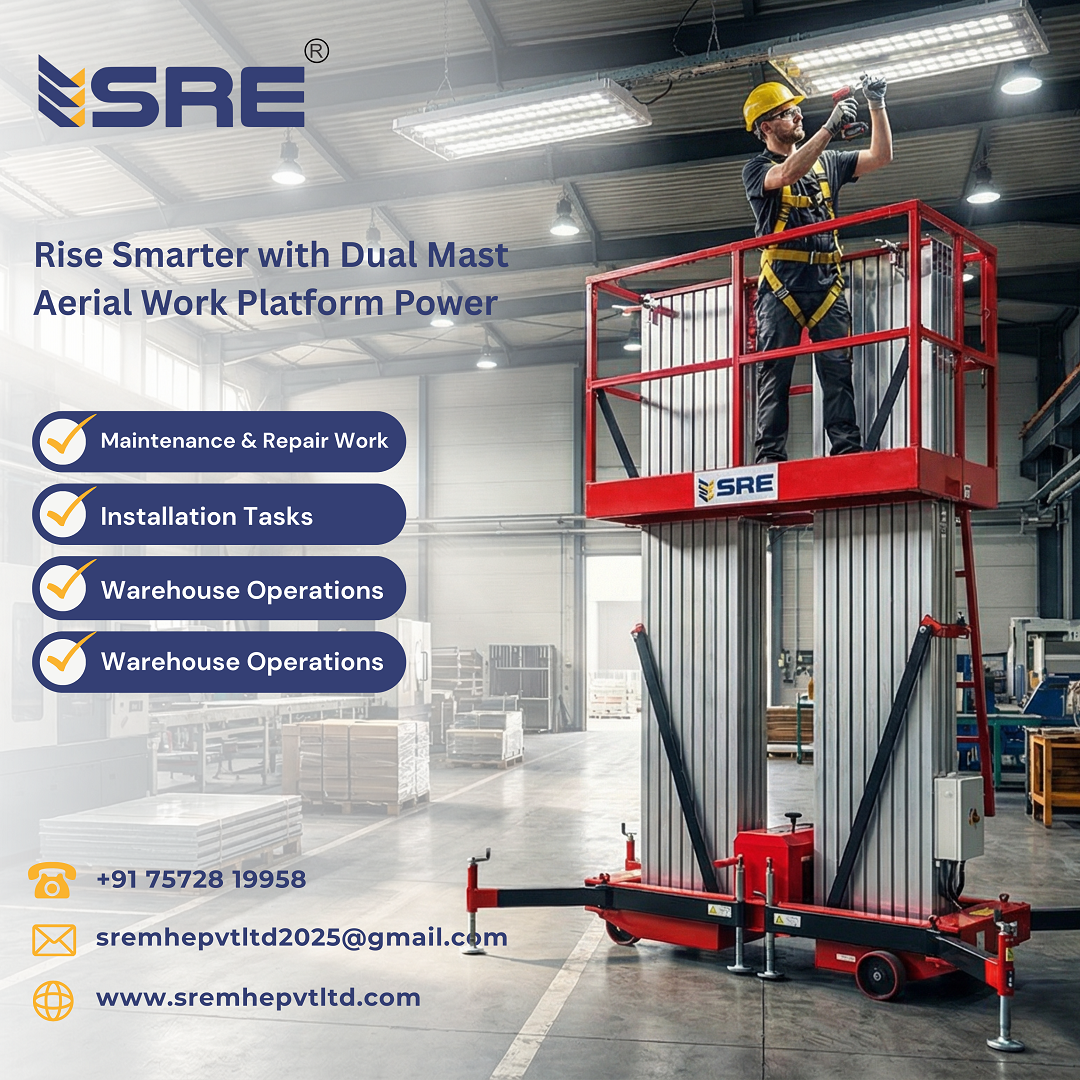
200kg – 10mtr (All Size Available)
Rs. 330000
(Taxes to be paid extra)
Brand: SRE
SKU: SRE 152
Min Order Qty: 1
Boost Workplace Efficiency Using Dual Mast Aerial Platforms by SRE Material Handling Equipment
Why Dual Mast Aerial Work Platforms Boost Productivity is an important question for industries aiming to improve efficiency, safety, and operational speed. In today’s fast-moving industrial environment, warehouse and factory operations face increasing pressure. Order volumes continue to grow, delivery timelines are becoming tighter, and workplace safety expectations are higher than ever. At the same time, labor fatigue and operational inefficiencies can still affect overall productivity and performance.
In daily warehouse operations, even small inefficiencies—such as delays in reaching elevated storage racks or frequently repositioning equipment—can gradually lead to significant productivity losses during a single shift. This is where a Dual Mast Aerial Work Platform becomes more than just a lifting machine. It serves as a practical solution that enables safer access to heights, supports smoother workflow management, and helps teams save valuable time during routine tasks.
For decision-makers such as warehouse owners, plant heads, operations managers, and procurement teams, understanding how this equipment addresses real-world operational challenges is essential before investing. Choosing the right access platform can directly impact productivity, worker safety, and long-term operational efficiency.
The Changing Needs of Modern Warehouses and Industrial Facilities
Warehouses today are not what they were ten years ago.
High-density racking systems, vertical storage layouts, and multi-shift operations are now common. E-commerce growth, spare parts logistics, FMCG distribution, and manufacturing supply chains have significantly increased internal material movement.
Common operational challenges include:
- Frequent access to elevated storage
- Tight aisle navigation
- Pressure to reduce picking time
- Worker fatigue during repetitive elevation tasks
- Strict workplace safety compliance
Manual ladders or basic lifting solutions that once worked are no longer sufficient in high-volume environments. When teams must repeatedly climb, reposition, and handle loads at height, productivity drops and safety risks increase.
This is where a Dock Leveler addresses real operational pain points—not in theory, but in daily practice.
What Is a Dual Mast Aerial Work Platform?
A Dual Mast Aerial Work Platform is a vertical lifting solution designed for stable, controlled elevation of personnel and light materials.
Unlike single-mast systems, the dual-mast structure provides enhanced stability and load balance. It is typically compact, battery-powered, and built for indoor industrial use.
In practical terms, it allows operators to:
- Safely access elevated racks
- Perform maintenance at height
- Handle inventory picking tasks
- Work in narrow warehouse aisles
The dual mast configuration improves structural rigidity, reducing sway during elevation. For operators working at height, this added stability makes a noticeable difference in comfort and confidence.
Why Dual Mast Aerial Work Platforms Are Replacing Traditional Methods?
For years, many facilities relied on:
- Manual ladders
- Scaffolding
- Hydraulic stackers are used for temporary elevation
- Makeshift platforms
- While these methods may seem cost-effective initially, they often create hidden inefficiencies.
- Fatigue Reduction
Climbing ladders repeatedly during a shift increases physical strain. Over time, this leads to fatigue, slower picking speeds, and a higher risk of errors.
Productivity Gains in Daily Operations
Productivity improvements from a Dual Mast Aerial Work Platform are not dramatic overnight transformations. They are incremental gains that compound daily.
In real warehouse environments, operators often report:
- Faster picking cycles
- Reduced repositioning time
- Smoother movement between aisles
- Better coordination between ground and elevated tasks
When access to height becomes faster and safer, workflow bottlenecks reduce.
Improved Workplace Safety
Workplace safety is no longer optional. It is a compliance and operational priority.
Falls from height remain one of the leading causes of industrial injuries. Manual ladders and unstable platforms increase that risk.
A Dual Mast Aerial Work Platform improves safety through:
- Guard-railed work platforms
- Controlled ascent and descent
- Stable dual mast support
- Emergency stop mechanisms
- Non-slip working surfaces
From an ergonomic standpoint, operators maintain a balanced posture while working. This reduces strain compared to leaning from ladders or reaching beyond safe limits.
Safer access also means fewer disruptions due to injury-related absences.
Handling Heavier Loads with Better Stability
Modern warehouses store goods at greater heights and often in higher densities.
Even light loads become difficult to handle when lifted manually at elevation. Stability matters.
The dual mast structure distributes load more evenly than single-column systems. This provides:
- Reduced sway
- Better platform balance
- Greater operator confidence at height
While these platforms are not intended for heavy pallet lifting like forklifts, they support personnel with tools and manageable loads effectively.
For operations that combine picking and inspection tasks, this balance is critical.
Technology and Operational Efficiency
Most Dual Mast Aerial Work Platforms today operate on battery-powered systems.
This provides several operational benefits:
- Indoor-friendly operation (no emissions)
- Quiet functioning during multi-shift environments
- Reduced dependency on fuel-based equipment
- Lower maintenance complexity compared to engine-driven lifts
Battery systems are typically designed for a full operational shift under normal usage conditions.
From a reliability standpoint, Mobile Ramp fewer moving parts and simplified hydraulic systems mean predictable maintenance schedules and less unexpected downtime.
Uptime is a major factor in productivity, and modern platforms are designed with this in mind.
Space Optimisation and Maneuverability
Warehouse space is expensive and increasingly optimised for vertical storage.
Equipment that cannot maneuver within narrow aisles creates congestion.
Dual mast platforms are designed with compact footprints. This enables:
- Navigation in tight rack layouts
- Access in confined industrial zones
- Use in mezzanine-supported areas
- Efficient storage when not in use
In facilities where every square meter is planned, maneuverability becomes as important as lifting height.
Cost Efficiency Over Time
Decision-makers often evaluate equipment based on upfront cost.
However, the true value of a Dual Mast Aerial Work Platform lies in long-term operational efficiency.
Cost benefits include:
- Reduced injury-related downtime
- Lower worker fatigue and turnover
- Faster picking cycles
- Decreased reliance on temporary scaffolding
- Reduced maintenance compared to improvised lifting methods
While not the cheapest access solution, it offers structured productivity gains that support ROI over time.
Sustainability and Compliance
Environmental and safety compliance standards are tightening across industries.
Battery-operated aerial work platforms support:
- Reduced carbon emissions
- Lower noise pollution
- Cleaner indoor air quality
- Compliance with workplace safety standards
Facilities aiming to align with sustainability initiatives or ESG reporting find electric access equipment more suitable than fuel-powered alternatives.
For inquiries, product details, or a tailored solution for your facility, contact us today and our team will guide you with the right Dual Mast Aerial Work Platform options.
Integration with Warehouse and Factory Workflow
A Dual Mast Aerial Work Platform does not operate in isolation.
It integrates into:
- Inventory picking systems
- Maintenance operations
- Quality inspection routines
- Electrical and overhead service tasks
- Assembly line adjustments
- Because it is mobile and quick to deploy, it supports multiple departments.
In real facilities, equipment that serves cross-functional needs delivers higher utilisation rates and stronger operational value.
For the latest global news and updates, visit CNN to stay informed with trusted and real-time reporting.
Training, Ease of Use, and Maintenance
Ease of operation matters.
Operators typically require basic training to handle:
- Elevation controls
- Safety mechanisms
- Pre-operation inspections
Most systems use intuitive control panels, minimising the learning curve.
Explore more expert insights, marketing strategies, and industry trends on the HubSpot blog to stay ahead in your business growth journey.
Why Choosing a Reliable Manufacturer Matters?
The design and safety of elevated access equipment cannot be compromised.
When selecting a supplier, decision-makers should consider:
- Compliance with safety standards
- Build quality and structural integrity
- Service network availability
- Spare parts support
- Technical assistance response time
Working with experienced manufacturers ensures long-term reliability.
For example, companies like SRE MATERIAL HANDLING EQUIPMENT PRIVATE LIMITED provide structured industrial lifting solutions backed by operational understanding and service support. More information about their equipment range can be explored at: https://www.sremhepvtltd.com/
Choosing the right partner reduces future maintenance headaches and ensures compliance alignment.
Conclusion:
A Dual Mast Aerial Work Platform is not just an access solution—it is a productivity tool for modern industrial environments.
From reducing operator fatigue to improving safety, from supporting narrow-aisle operations to enhancing workflow consistency, it addresses practical challenges faced daily in warehouses and factories.
For industrial decision-makers evaluating operational improvements, the focus should remain on:
- Safety enhancement
- Repeatable efficiency
- Long-term cost control
- Workflow compatibility
Investing in structured access equipment is a step toward organised, compliant, and scalable operations.
If you are reviewing your internal access processes, evaluating current inefficiencies, or planning facility upgrades, a Dual Mast Aerial Work Platform is worth serious consideration.
Get in touch with our experts to discuss your requirements, request a quote, or schedule a consultation to improve safety and efficiency in your operations.
Key Takeaways
- Productivity: Faster picking cycles and consistent output across shifts
- Safety: Reduced fall risks and improved ergonomic handling
- Load Handling: Stable dual mast design for better balance
- Cost Efficiency: Lower downtime and long-term operational value
- Industry Trend: Growing adoption in modern high-density warehouses
Frequently Asked Questions (F&Q)
1. Where is a Dual Mast Aerial Work Platform commonly used?
- It is widely used in warehouses, manufacturing plants, maintenance departments, logistics centres, and high-rack storage facilities.
2. Is it suitable for narrow aisles?
- Yes. Most models are designed with compact dimensions to operate efficiently in tight industrial layouts.
3. How does it improve safety compared to ladders?
- It provides guard rails, controlled elevation, stable support, and emergency stop functions, significantly reducing fall risks.
4. What kind of maintenance is required?
- Routine battery checks, hydraulic inspection, structural assessment, and scheduled servicing ensure reliable operation. Regular maintenance by SRE Material Handling Equipment Pvt. Ltd helps maintain performance and extend equipment lifespan.
5. Is it cost-effective for small warehouses?
- Even in smaller setups, improved safety and faster task completion can justify the investment over time.
#DualMastAerialWorkPlatform #WarehouseProductivity #IndustrialSafety #MaterialHandlingSolutions #WarehouseEfficiency #FactoryOperations #LiftEquipment #IndustrialGrowth #SREMATERIAHANDLINGEQUIPMENTPRIVATELIMITED