
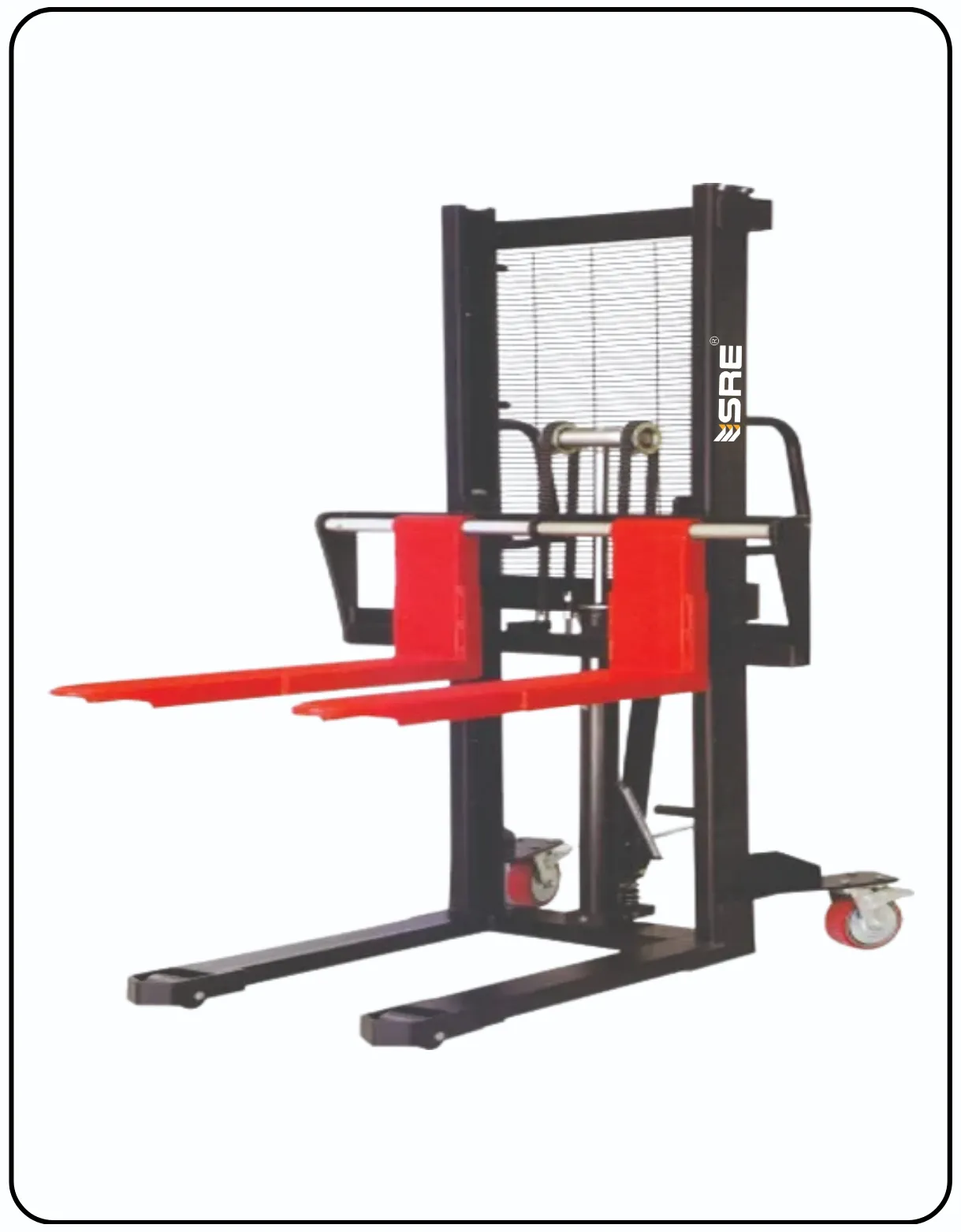
SRE Material Handling Equipment Pvt. Ltd.: Manufacturer, Supplier, And Exporter Of Manual Stacker in India.
SRE Material Handling Equipment Pvt. Ltd., Manufacturer And Supplier Of Manual Stacker in Rajkot.
Our Manufacturing Unit is in Ahmedabad, Vadodara, and Rajkot, Gujarat, India.
Guide to Manual Stackers in Rajkot: A Tool for Industrial Leaders
In the brisk tempo of modern industrial and storage settings, the need to shift goods quickly, securely, and dependably is paramount. Changes in in-house logistics have prompted warehouse supervisors, operations directors, supply chain experts, and purchasing departments to re-evaluate routine tasks such as receiving, stacking, and moving product.
Day-to-day storage tasks often face hurdles such as staff fatigue, limited space, increased output goals, and adherence to safety rules—all of which can hamper efficiency and raise costs. A straightforward, effective answer gaining favour in Rajkot and beyond is the Manual Stacker: a basic yet sturdy device that bridges the gap between old-fashioned hand methods and advanced automated setups.
This comprehensive overview explores why the Manual Stacker warrants focus for industrial use, its functions, how it fits into current processes, and the value it delivers over time.
Evolving Demands of Contemporary Storage & Production Sites
Today’s warehouses and factories look notably different from those of just ten years ago. The surge in online retail, tighter delivery schedules, and customer demands for faster service place immense strain on workflows. Many sites require teams to manage hundreds, possibly thousands, of pallets and boxes daily.
In daily practice, this translates to:
- Greater movement volume: More stock-keeping unit (SKU) shifts per work period.
- Shorter timelines: Expectations of same-day or next-day delivery.
- Area constraints: Narrow lanes and crowded floor layouts.
- Staffing difficulties: Fluctuations, shift variations, and ergonomic risks.
Under this pressure, older methods—hand stacking, basic carts, or relying only on forklifts—often fail. Manual handling can be sluggish, inconsistent, and physically taxing. Forklifts might be excessive for lighter jobs and incur fuel, upkeep, and space expenditure.
What’s needed is apparatus balancing simplicity, effectiveness, and ergonomics—and this is where the Manual Stacker proves its worth.
Defining the Manual Stacker
A Manual Stacker is equipment designed to lift, transport, and stack pallets, containers, or other heavy goods without engine power. Unlike a fuel or battery-powered forklift, a manual stacker employs mechanical advantage and operator effort to raise and lower loads. Its typical configuration includes:
- A grip for steering and powering the lift
- Forks designed to slide beneath pallets
- A lifting system controlled by the user (often through a hand pump)
- Wheels or rollers for movement
From an operational standpoint, it sits between a pallet jack and a powered stacker—offering greater lift capacity than the former and simpler operation than the latter. In day-to-day Rajkot storage workflows, a manual stacker becomes the go-to tool for short-range transfers and stacking adjustments where full automation isn’t practical.
Why Manual Stackers Supersede Older/Manual Equipment
Numerous facilities still resort to makeshift or purely manual means for internal transport: lifting by hand, sliding goods, or using simple trolleys. These approaches carry substantial drawbacks:
- Operator strain: Continuous heavy lifting takes a physical toll.
- Inconsistent results: Manual methods differ based on the individual’s strength.
- Slower cycle times: Every lift or move takes more time when performed manually.
Conversely, a Manual Stacker:
- Reduces physical stress via mechanical assistance.
- Standardizes handling across all shifts.
- Quickens common moves, particularly in multi-level shelving.
Based on our observations of storage teams, these improvements are tangible—they are reflected in daily cycle times and worker ease of use. Across a standard shift, a stacker can save valuable minutes on each lift, leading to notable gains in output.
Productivity Gains in Everyday Work
In the real-world operations of a medium-sized distribution centre in Rajkot, productivity is gauged not by abstract metrics but by pallets shifted per hour, orders completed per shift, and mistakes avoided.
A manual stacker aids in several direct ways:
- Quicker turnarounds: Lifts that might take 2–3 minutes with traditional methods can be handled by one operator in much less time.
- Steady pace: Unlike manual lifting, where pace drops as fatigue sets in, stackers maintain consistent performance throughout shifts.
- Versatile applications: From unloading lorries to shifting inventory between racks, stackers handle a wide range of tasks without halting for equipment changes.
These advancements are crucial in high-volume settings. For instance, during peak season order fulfilment, efficiently repositioning stock directly impacts customer delivery windows and labour expenditure.
Elevating Workplace Safety
Safety is more than a regulatory requirement; it is fundamental to stable operations. In actual warehouse environments:
- Repetitive lifting is a primary source of strain and injury.
- Makeshift handling raises the risk of spills and drops.
- Traditional lifting often lacks control over movement speed and balance.
Manual stackers tackle these safety concerns by offering:
- Ergonomic design: Controls and lifting structures lessen strain on the back and shoulders.
- Managed motions: Operators can elevate/lower loads with predictable, smooth action.
- Improved balance: Load centre of gravity is secured through design, lowering tip hazards.
In workplaces where safety reviews and accident records are key metrics, adopting a well-engineered manual stacker helps lower incident rates and promotes a healthier staff.
Moving Heavier Goods with Greater Facility
As storage needs expand, the weight and complexity of loads increase, too. While manual methods suffice for lighter boxes, heavier pallets require mechanical aid.
Manual stackers excel in this area:
- Greater weight capacity: Many models support loads of 1,000–2,000 kg, covering most daily warehouse requirements.
- Superior stability and control: A slim frame and a steady wheelbase improve navigation.
- Adjustable for racking: Stackers work with a range of pallet sizes and shelf heights.
In settings where loads fluctuate—from light cartons to densely packed pallets—the stacker provides an adaptable instrument that avoids the need to switch machinery frequently.
Engineering & Operational Effectiveness
While the term “manual” suggests simplicity, modern stackers feature thoughtful construction that promotes uptime and dependable service.
Key structural points include:
- Robust mechanical lift systems: Long-lasting hydraulics or gear-driven mechanisms requiring minimal servicing.
- High-quality running gear: Effortless rolling reduces operator exertion and floor wear.
- Low maintenance needs: The absence of batteries or engines means fewer failures and lower servicing expenses.
From a service perspective, this straightforward design leads to predictable upkeep schedules and fewer unexpected issues. For operations managers, this dependability aids in accurate planning and lowers the overall lifetime cost.
Optimizing Space & Agility
Space is arguably the most valuable commodity in a storage facility. Unlike bulkier vehicles, manual stackers provide:
- Small physical footprint: Easy movement through narrow aisles.
- Tight turning radius: Vital in crowded zones or near fixed structures.
- Vertical reach without a broad base: Ideal for multi-level storage setups.
In facilities where every square metre is critical, a manual stacker can access areas larger equipment cannot, enabling more effective utilisation of both vertical and horizontal space.
Long-Term Financial Prudence
Industrial purchasing decisions rarely hinge on the initial cost alone; they focus on value over time. Manual stackers offer financial advantages extending beyond the purchase amount:
- Reduced running expenses: No need for fuel or battery charging gear.
- Fewer injury-related costs: Improved ergonomics reduces work compensation claims and missed workdays.
- Minimal upkeep costs: Fewer moving parts equate to lower service bills.
When facility owners and purchasing staff calculate the total investment cost, manual stackers often appear as prudent assets rather than merely as expense entries.
Environmental Responsibility & Adherence
In a commercial landscape where green performance and regulatory conformity are important, manual stackers present benefits:
- No operational emissions: No exhaust fumes or battery charge outputs on-site.
- Smaller energy draw: Mechanical lift systems efficiently use human power.
- Commitment to wellbeing: Easier to meet workplace health and safety benchmarks with ergonomic tools.
For businesses integrating sustainability metrics into their acquisition choices, the intrinsic efficiency of manual stackers supports broader environmental and workplace mandates.
Fit Within Factory/Warehouse Daily Routines
A device’s utility is determined by how smoothly it integrates into daily habits. Manual stackers fit seamlessly into:
- Receiving docks: Fast unloading from trucks without waiting for powered gear.
- Order handling zones: Shifting stock between workstations.
- Shipping areas: Adjusting pallet positions before dispatch.
Practically speaking, operations teams value stackers that are dependable and predictable. Unlike sophisticated machinery requiring scheduling or specialist operators, stackers can be deployed as needed across various tasks.
Instruction, Ease of Operation, and Servicing
A key advantage of manual stackers is how readily they are adopted:
- Limited instruction time: Basic operating tutorials can be completed swiftly.
- Precise controls: Operators quickly master steering, lifting, and braking functions.
- Simple care: Routine checks, such as lubrication and wheel assessment, fit into regular duties.
For HR and safety departments, this means faster staff integration and fewer hurdles to practical application.
Trending FAQs – Manual Stacker in Rajkot
- What load capacity does a manual stacker typically handle?
Most manual stackers in industrial settings handle loads of 500 kg to 2,000 kg, depending on the model and design. Choosing the right capacity ensures safety and efficiency.
- How high can a manual stacker lift loads?
Manual stackers usually lift pallets to heights between 1.6 meters and 3 meters, suitable for most warehouse racking systems.
- Is training required to operate a manual stacker?
Yes, but training is minimal. Most operators can learn basic operation in a few hours, including lifting, maneuvering, and safety checks.
- How does a manual stacker improve workplace safety?
It reduces physical strain, prevents manual lifting injuries, and provides controlled, stable movement, lowering accident risks.
Get in Touch with SRE Material Handling Equipment Today. Call +91 9316 208879 or sremhepvtltd2025@gmail.com for assistance now.
#ManualStacker #WarehouseEfficiency #MaterialHandling #SREMaterialHandlingEquipmentPrivateLimited #IndustrialOperations #RajkotLogistics