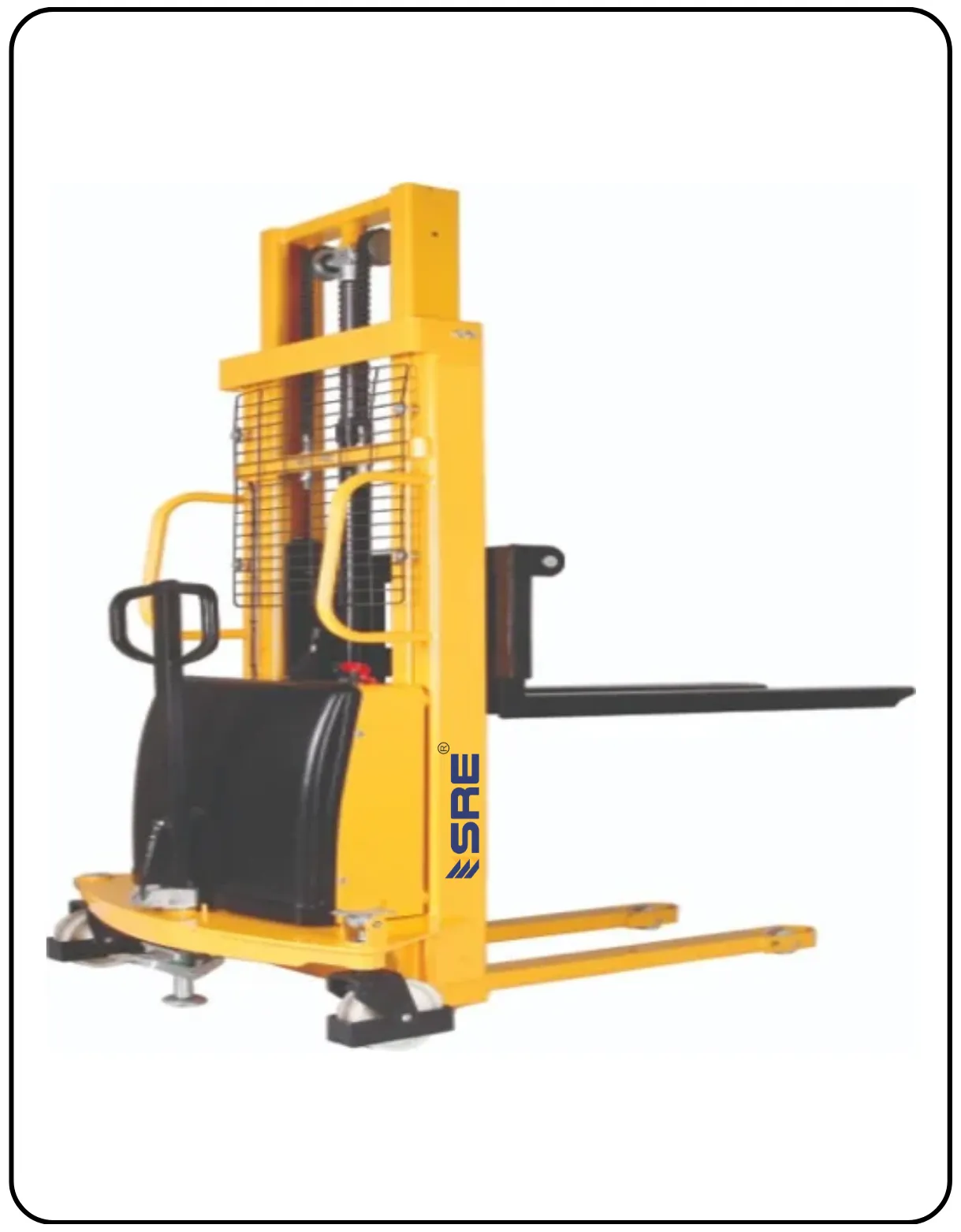
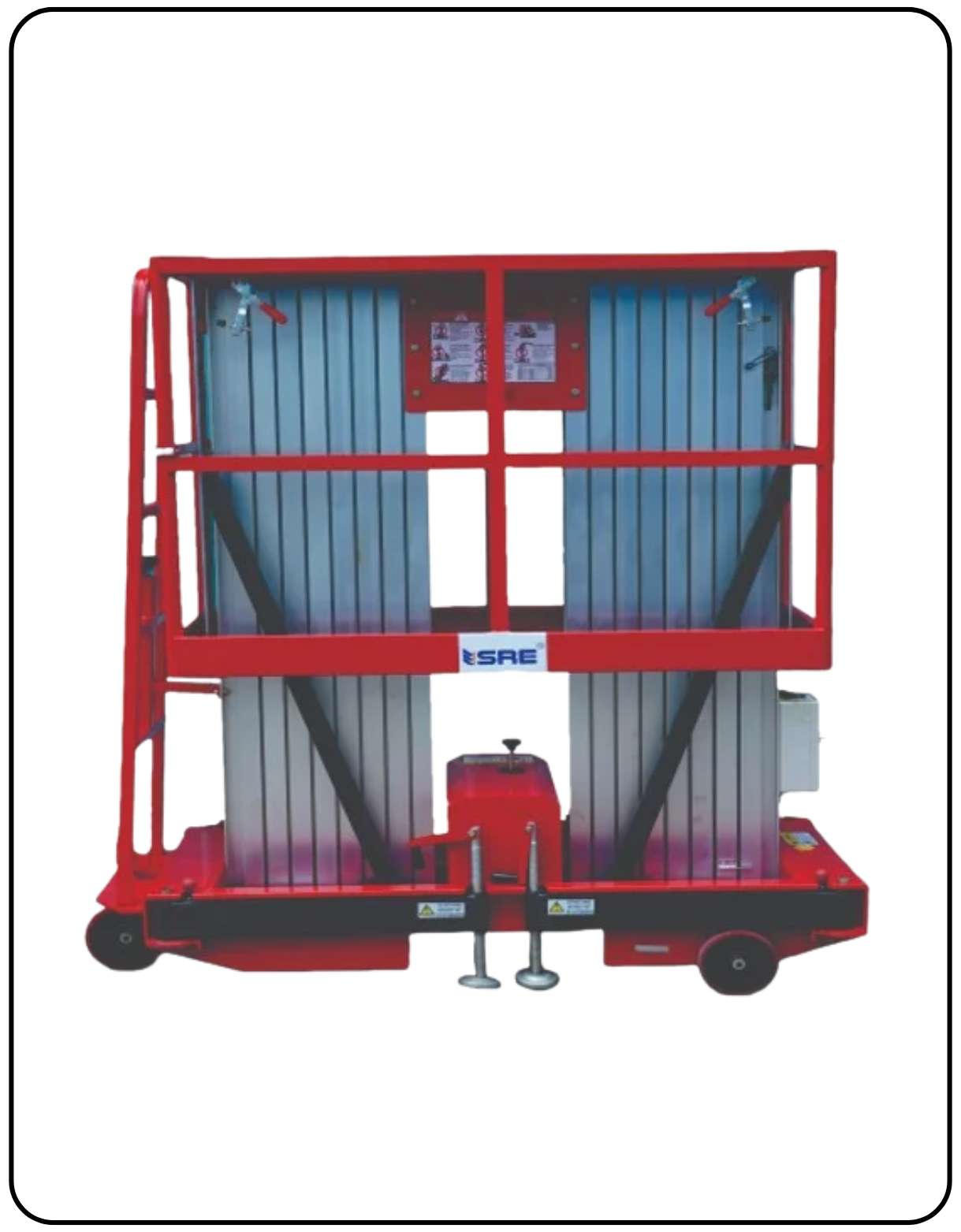
SRE Material Handling Equipment Pvt. Ltd.: Manufacturer, Supplier, And Exporter Of Semi Battery Stacker in India.
SRE Material Handling Equipment Pvt. Ltd., Manufacturer And Supplier Of Semi Battery Stacker in Mumbai.
Our Manufacturing Unit is in Ahmedabad, Vadodara, and Rajkot, Gujarat, India.
Semi Battery Stacker in Mumbai: A Practical Guide for Modern Warehouse & Industrial Operations
In the last decade, warehouse and industrial operations across Mumbai and India have transformed dramatically. The surge in e‑commerce, just‑in‑time deliveries, tighter production schedules, and rising labor costs have forced businesses to rethink how materials move through their facilities. Speed, accuracy, safety, and reliable throughput are no longer “nice‑to‑have” — they are fundamental to operational success.
In daily warehouse operations, teams struggle with bottlenecks caused by manual handling, inconsistent equipment performance, and workforce fatigue. These challenges directly impact productivity, safety, and costs. This is where a Semi Battery Stacker comes into play: a practical, technology‑forward solution that helps close the gap between manual labor and fully automated systems.
The Changing Needs of Modern Warehouses & Industries
Mumbai’s industrial landscape — from distribution centers in Navi Mumbai to manufacturing hubs in Thane and industrial estates in Dombivli — now runs around the clock. Order volumes have increased, delivery windows have tightened, and expectations for operational accuracy are higher than ever.
In this environment, internal logistics isn’t just about moving products. It’s about:
- Reducing time spent on repetitive handling tasks
- Minimizing product damage during stacking, unstacking, and cross‑dock transfers
- Ensuring stable workflow across multiple shifts
- Maintaining safety standards while maximizing throughput
Traditional material handling methods often struggle with these demands. Forklifts may be too large for narrow aisles, pallet jacks require significant physical effort, and manual stacking exposes workers to repetitive strain and injury risks. The push for operational efficiency has created demand for solutions like the Semi Battery Stacker — a balance of performance, ease of use, and controlled power.
What Is a Semi Battery Stacker?
A Semi Battery Stacker is a powered material handling machine designed to lift, lower, and transport palletized or bulky loads in warehouses, factories, and industrial facilities. Unlike fully manual pallet jacks, it leverages battery‑assisted power to reduce physical effort and improve control.
From an operational perspective, it allows warehouse operators to:
- Move goods over short distances with battery assist
- Stack pallets at different heights with controlled lifting
- Navigate through aisles without the bulk of a full counterbalance forklift
Semi battery stackers sit between manual equipment and full electric forklifts — delivering power and reliability while maintaining compactness and ease of operation.
Why Semi Battery Stacker Is Replacing Traditional & Manual Equipment?
In daily operations, material handlers often switch between manual pallet jacks, hand trucks, and forklifts. Each has limitations:
- Manual pallet jacks require significant physical strength and can slow throughput.
- Hand trucks are useful for boxes but impractical for pallet loads.
- Full forklifts are powerful but large, expensive, and often overkill for mid‑sized tasks.
Productivity Gains in Daily Operations
In the context of daily warehouse workflows — loading, unloading, staging, restocking — time is one of the greatest variables. Small delays compound quickly, especially in multi‑shift operations.
A Semi Battery Stacker provides measurable productivity benefits:
- Reduced handling time: Battery assist speeds up lifting and lowering cycles compared with manual options.
- Consistent output: Workflow remains steady regardless of operator rotation or shift changes.
- Streamlined staging: Pallets can be moved from docking areas into storage grids with fewer steps and less physical repositioning.
In a facility with 3–4 distinct work zones (receiving, storage, picking, dispatch), Magnetic Lifter And Mobile floore Crane even minor reductions in handling time per pallet translate into meaningful daily throughput improvements.
Improved Workplace Safety
Safety remains a top priority for any warehouse or industrial manager. Manual lifting contributes to sprains, strains, and long‑term musculoskeletal issues. Forklifts, while powerful, pose tip‑over and collision risks if not operated with precision and experience.
Here’s where a Semi Battery Stacker makes practical difference:
- Controlled movement: Powered lift and drive systems allow operators to handle loads more smoothly.
- Ergonomic design: Operator controls are within easy reach, reducing excessive twisting and stretching.
- Reduced strain: Battery assistance means operators do not need to exert force to lift loads.
In facilities with mixed experience levels among staff — a common scenario in peak‑season hiring — equipment that inherently promotes safer handling can reduce injury rates and associated downtime.
Handling Heavier Loads with Greater Confidence
As businesses grow, so do the sizes and weights of inventory batches moving through warehouses. Whether handling heavier pallets of raw materials or larger outbound loads, the need for stability and controlled handling is clear.
A Semi Battery Stacker supports day‑to‑day operations by:
- Providing consistent lifting power for moderately heavy loads
- Delivering stable lift control even in narrow aisles
- Supporting repeatable stacking heights without manual variation
Stability and controlled motion become especially important when working in multi‑tier racking systems — where accuracy matters and mistakes can lead to product damage or rack collisions.
Technology & Operational Efficiency
Battery performance and reliability are practical concerns in daily operations. A semi battery stacker typically features:
- A robust battery system designed for multiple shifts
- Efficient power management to maximize uptime
- Easy battery charging and replacement workflows
Operational efficiency matters most when uptime is critical. Downtime for charging should be predictable and planned, which is why many facilities choose battery systems with clear indicators and quick swap‑out capabilities.
The dependable power system also ensures smooth acceleration, lifting, and braking — contributing directly to operational consistency.
Space Optimization & Maneuverability
Space constraints are a defining characteristic of many urban warehouses, including those in Mumbai’s industrial belts. Narrow aisles and high rack density create challenges for large forklifts.
A Semi Battery Stacker addresses this by:
- Offering a compact footprint ideal for narrow aisles
- Providing tight turning radii for complex layouts
- Allowing stacking at various heights without occupying excessive floor space
In facilities where every square foot counts, choosing equipment optimized for maneuverability is a strategic advantage — especially when transitioning from bulk handling to high‑density shelving.
Cost Efficiency Over Time
When evaluating equipment investment, it is important for procurement teams and financial planners to look beyond upfront price. True cost efficiency includes:
- Reduced injury‑related costs from fewer accidents
- Lower maintenance costs compared to larger powered forklifts
- Improved labor output with reduced fatigue
- Extended equipment lifespan due to balanced load handling
In many mid‑sized facilities, a Semi Battery Stacker delivers strong long‑term value by reducing reliance on more expensive equipment for tasks that don’t require full forklift capabilities.
Sustainability & Compliance
Compliance with safety standards and environmental best practices is increasingly critical. Battery‑powered handling equipment offers:
- Lower emissions within indoor spaces
- Reduced noise levels
- Compliance with workspace safety guidelines
Facilities with sustainability goals — whether internal or mandated by clients — benefit from material handling options that support cleaner, safer environments.
Integration with Warehouse & Factory Workflow
Equipment choice should support existing workflows, not disrupt them. A Semi Battery Stacker integrates well into:
- Receiving and staging areas
- High turnover picking zones
- Cross‑dock operations
- Back‑of‑house storage systems
Operators can quickly adapt the stacker into routine tasks, and supervisors can design workflows that leverage its strengths without extensive process overhaul.
Training, Ease of Use & Maintenance
Practical adoption depends on how quickly staff can operate and maintain equipment. Semi battery stackers typically feature:
- Intuitive controls with minimal learning curve
- Straightforward operator training modules
- Predictable service and maintenance tasks
This reduces onboarding time for new operators and allows facilities to maintain uptime without specialized technicians on every shift.
Why Choosing a Reliable Manufacturer Matters?
When selecting a Semi Battery Stacker, quality and after‑sales support are essential. A reliable manufacturer delivers:
- Durable equipment built for continuous use
- Clear documentation and safety guidelines
- Accessible service support and parts availability
- Compliance with industry quality standards
A reputable manufacturer ensures that equipment performs as expected and that support is available when operational challenges arise.
Conclusion:
In today’s competitive industrial landscape, material handling choices directly influence operational efficiency, safety, and long‑term costs. A Semi Battery Stacker is a practical, balanced solution for warehouses and factories that need powered lift performance without the cost or space demands of full forklifts.
Whether improving daily throughput, enhancing worker safety, or optimizing floor space, this equipment plays a meaningful role in modern operations.
If your facility is evaluating material handling solutions, consider how a Semi Battery Stacker can align with your operational goals.
For detailed specifications, support, and expert guidance, visit SRE MATERIAL HANDLING EQUIPMENT PRIVATE LIMITED at https://www.sremhepvtltd.com/.
Key Takeaways
- Productivity: Consistent, battery‑assisted movement improves throughput.
- Safety: Reduced manual strain and controlled lifting enhance workplace safety.
- Load Handling: Efficient handling of heavier loads with stable operation.
- Cost Efficiency: Long‑term savings through reduced injuries and maintenance.
- Industry Trend: A practical solution for modern warehouse logistics and internal operations.
FAQS
Q1. How is a Semi Battery Stacker different from an electric forklift?
- A Semi Battery Stacker is more compact, easier to maneuver in narrow aisles, and suited to moderate lifting tasks — whereas electric forklifts are larger and designed for heavier, high‑speed operations.
Q2. Can semi battery stackers operate in multi‑shift environments?
- Yes. With proper battery management and charging protocols, they can support multiple shifts reliably.
Q3. What kind of training is required?
- Most operators can become proficient with a short hands‑on session focused on controls, safety checks, and handling procedures.
Q4. Are semi battery stackers suitable for all warehouses?
- They are ideal for operations with moderate loads and tight spaces. For very heavy lifting or outdoor terrain, other equipment might be necessary.
Q5. Do these stackers require special maintenance?
- Routine checks, battery care, and periodic servicing keep the stacker in good condition — often simpler than full forklift maintenance.
#SemiBatteryStacker #MaterialHandling #WarehouseEquipment #IndustrialSolutions #SREMaterialHandlingEquipmentPrivateLimited #MumbaiIndustry #OperationalEfficiency #WorkplaceSafety