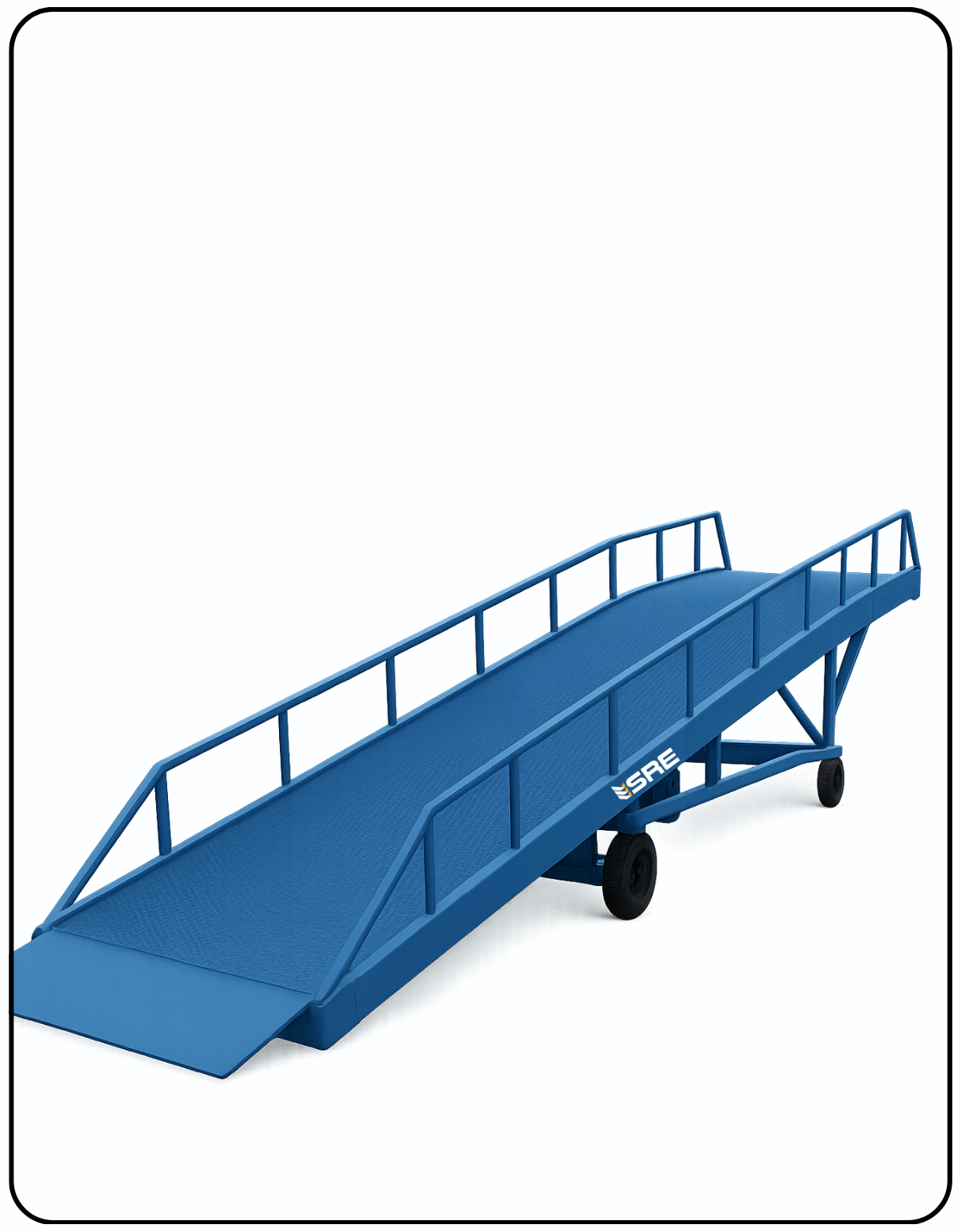
10 Ton x 1.6 Meter H (All Size Available)
Rs. 425000
(Taxes to be paid extra)
SKU: SRE162
Brand: SRE
Min Order Qty: 1
Warehouse and industrial operations have evolved dramatically over the past decade. What once worked with basic manual equipment—such as wooden planks, fixed dock plates, or improvised ramps—can no longer meet today’s higher throughput demands, strict compliance requirements, and advanced safety standards. As a result, businesses are increasingly turning to reliable
Mobile Ramp Manufacturer and Supplier solutions to ensure efficient, safe, and scalable material handling operations. Operations managers now deal with faster dispatch cycles, tighter delivery windows, and fewer workers available for physically demanding tasks. When a truck pulls up to a loading bay with a floor height mismatch, the old options were slow, inconsistent, and often unsafe. Injury at the dock threshold remains one of the most common and preventable workplace incidents in any warehouse or factory.This is where the
Mobile Ramp becomes a practical operational tool — not just another piece of equipment, but a direct answer to the real-world problems that
loading dock operations face every single day. To explore the full product range, visit
SRE Material Handling Equipment Private Limited.The Changing Needs of Modern Warehouses and Industrial Facilities
Volume growth is not slowing down. E-commerce expansion, just-in-time supply chains, and multi-shift operations mean
loading bays are under pressure from early morning to late night. Even a 15-minute delay in vehicle turnaround at the dock compounds into significant throughput loss across a week.Internal logistics challenges have also grown. More SKUs, varied vehicle types — high-beds, flatbeds, low-loaders — and mixed product weights mean that fixed infrastructure creates bottlenecks rather than solving them.Labour fatigue is a real operational cost. Workers manually handling heavy ramps or improvised boards across shifts are fatigued workers — and fatigued workers make mistakes. The cost of a musculoskeletal injury, a forklift near-miss, or a dropped load far exceeds the cost of a well-specified
heavy-duty mobile loading ramp.Procurement teams and operations heads increasingly recognise that the right
industrial mobile ramp is not an expense — it is infrastructure that pays for itself in avoided incidents, reduced downtime, and faster cycle times.
What Is a Mobile Ramp?
In simple terms, a
Mobile Ramp is a free-standing, wheeled loading platform that bridges the height difference between a vehicle’s cargo floor and a warehouse or factory floor — without any permanent installation.Unlike a fixed dock leveller that is bolted into a loading bay during construction, a
Mobile Ramp sits independently on its own frame and heavy-duty castors. When a vehicle needs to be unloaded or loaded, the ramp is positioned, secured, and the forklift or pallet truck can operate across it. When the work is done, it can be moved to the next dock, stored to the side, or repositioned as operations demand.The term is sometimes used interchangeably with
yard ramp,
dock ramp, or
portable loading ramp — all referring to the same core concept: a relocatable ramp that creates a stable transition surface between a vehicle and a floor. You can view the detailed
Mobile Dock Ramp product page for full specifications and configuration options.
Why the Mobile Ramp Is Replacing Traditional and Manual Equipment?
Manual methods — loose dock boards, improvised wooden or steel planks — have serious operational limitations that become more visible as volumes and safety scrutiny increase.When comparing a traditional fixed ramp against a
Mobile Ramp, the differences are immediate and practical. A fixed ramp is locked to one location and requires significant civil work to install. A
Mobile Ramp can be repositioned in minutes, requires no installation, and one unit can serve multiple bays — reducing capital expenditure across the facility.On load capacity, traditional manual ramps typically handle 3–5 Ton at best. The
10-Ton rated Mobile Ramp from
SRE Material Handling Equipment Private Limited handles the heaviest standard industrial loads without compromise.Injury risk is also meaningfully lower. Manual boards and improvised ramps create gaps, instability, and unpredictable surfaces. A
hydraulic mobile dock ramp provides a stable, rated, guided transition — reducing the exposure to forklift incidents and manual handling injuries at every shift.In daily warehouse operations, the shift away from fixed or manual solutions typically follows a pattern — an incident, a near-miss, a failed audit, or simply the recognition that the old method costs more in time and fatigue than it saves. The
portable hydraulic dock ramp addresses each of those drivers directly.
Mobile Ramp — Product Description
The
Mobile Ramp from
SRE Material Handling Equipment Private Limited is a
10-Ton capacity hydraulic-assisted portable loading ramp built for the demands of high-cycle industrial operations. With an overall platform size of
11,340 mm × 2,100 mm, it is engineered to accommodate standard forklift widths and loaded pallet jack movements without creating lateral instability.The
hydraulic system allows height adjustment to match varying vehicle floor heights — a critical requirement in mixed fleets where truck beds can vary by 200–400 mm depending on load and vehicle type. The
customised configuration means the unit is specified to your specific floor-to-vehicle height range rather than a standard-compromise solution.The running surface is finished with an
anti-slip profile to maintain grip under loaded tyres across shifts — including in conditions where moisture or minor spills occur. The structural frame is fabricated from
heavy-duty structural steel with a load-rated design that carries real-world peak loads, not just theoretical test conditions.
Heavy-duty swivel castors with locking brakes give full manoeuvrability for repositioning and firm, stable placement during active use. The locking mechanism is designed to be engaged and released by a single operator without specialist tools.For facilities in Maharashtra, SRE supplies and supports
Mobile Ramp installations across key industrial zones. If you are looking for a
Mobile Ramp in Mumbai, Mobile Ramp in Nashik, or a Mobile Ramp in Bhosri, the team can support site-specific specification and delivery.
Technology and Operational Efficiency
The
hydraulic drive system in a
hydraulic mobile ramp is chosen for industrial applications because it delivers high-force adjustment with minimal operator effort. The mechanical advantage of hydraulics means the operator is guiding the platform — not wrestling it into position.For a
10-Ton rated unit, this matters significantly. The structural loads involved in forklift transitions — particularly with full load and dynamic movement — create forces that need to be managed by equipment design, not by operator compensations. The
hydraulic system keeps the ramp surface at the correct angle during active use rather than relying on wedge-and-pin manual adjustments.Reliability in an industrial setting is straightforward to define: the equipment should work on demand, every shift, without requiring specialist intervention between scheduled maintenance intervals. This unit is designed with that operational standard in mind — components are accessible,
hydraulic circuits are protected from contamination, and the mechanical structure is over-specified relative to rated load to provide a conservative safety margin.
Cost Efficiency Over Time
The initial procurement decision for any
material handling equipment should account for total cost of ownership — not just the purchase price. For a
Mobile Ramp, the long-term value calculation is clear.A single mobile unit can serve multiple docks. In a facility with 6–10
loading bays that do not all operate simultaneously, one well-specified
mobile dock ramp shared across bays reduces capital expenditure compared to fixed levellers at every position. Fixed levellers also require civil works — pit excavation, concrete forming, electrical connections — costs that a
Mobile Ramp entirely avoids.Injury reduction is a real number. Musculoskeletal injuries at
loading docks — back injuries, foot injuries from unstable manual boards — carry direct costs in medical, compensation, and lost-time terms. A stable, rated
loading ramp surface meaningfully reduces the exposure to those events.Downtime reduction is also measurable. When equipment is unavailable, vehicle turnaround suffers and schedules slip. The
Mobile Ramp’s mechanical simplicity reduces unplanned downtime compared to complex powered dock solutions with electrical systems and control panels.
Key Features of the Mobile Ramp
- 10 Ton Rated Load Capacity — handles the heaviest standard forklift and loaded pallet loads without deflection or instability
- 11,340 × 2,100 mm Platform Dimensions — full-width forklift access with no single-track constraint
- Hydraulic Height Adjustment — matches a range of vehicle floor heights without tools or manual shimming
- Customised Configuration — height range, lip design, and side guard options specified to site requirements
- Heavy-Duty Swivel Castors with Locking Brakes — full manoeuvrability with secure placement during use
- Anti-Slip Running Surface — maintains grip under loaded tyres across all operating conditions
- Heavy-Duty Industrial Steel Construction — structural steel with epoxy coating for long service life
- Single-Operator Deployment — no team lift required to position or lock the ramp
- No Civil Works Required — deploy at any facility, any dock, without structural modification
- Conservative Structural Safety Margin — designed beyond rated load, not just tested to it
Applications of the Mobile Ramp
The
industrial mobile loading ramp is not limited to a single sector. Any operation involving the transfer of goods between a vehicle and a facility floor at different heights is a potential application.In
warehousing and distribution, the
Mobile Ramp handles dock levelling between trucks and loading bays, and supports pallet transfers across split-level floors where fixed levellers are not practical.In
manufacturing plants, it enables raw material delivery directly from ground-level trucks into raised production lines — eliminating the need for manual offloading and secondary handling.
Cold chain and food processing facilities use the
portable loading ramp to bridge refrigerated vehicle thresholds without creating temperature fluctuation gaps that affect product integrity.In the
automotive sector, the ramp moves heavy assemblies, engine components, and sub-assemblies across floor height differences with consistent stability and rated load capacity.
Steel and metal yards benefit from the ability to handle coil trolleys and heavy blanks in areas where fixed ramp infrastructure is impractical or unavailable.
E-commerce fulfilment centres with high-frequency dock operations rely on the
Mobile Ramp’s rapid repositioning capability to keep throughput moving across multiple bays per shift.
Retail distribution centres use a shared
mobile dock ramp across multi-dock layouts — reducing capital cost compared to fixed levellers at every bay position.
Ports and container yards deploy the
Mobile Ramp for ground-level container unloading in areas without permanent fixed loading infrastructure.
Training, Ease of Use, and Maintenance
One of the practical advantages of a
hydraulic mobile ramp over more complex powered dock equipment is the simplicity of operation. There is no control panel, no network connection, no fault code to interpret. The
hydraulic system responds to a straightforward lever or pump — raise, lock, position, operate.New operators can be trained on the unit within a standard induction session. No specialist certifications are required beyond the standard forklift operator competency that already applies to dock work. That simplicity reduces dependency on specific trained individuals and keeps operations running smoothly even when regular operators are absent.Maintenance is predictable. The core schedule involves periodic
hydraulic fluid checks and top-ups, castor bearing inspections, brake function checks, and a visual structural inspection. None of these tasks require extended downtime. Wear parts — seals, castor wheels, brake pads — are standard industrial components, not proprietary parts with long lead times.Predictable maintenance means an operation can plan a monthly inspection into a scheduled quiet period — not react to unexpected failure during peak throughput.
Why Choosing a Reliable Manufacturer Matters?
The market for
mobile loading ramps and
portable dock ramps includes a wide range of products at varying quality levels. For a
10-Ton application in a live industrial environment, the difference between a well-engineered unit and an under-specified one is not just performance — it is safety.A reliable manufacturer will provide rated load documentation, material certifications, and welding quality records. They will have a track record of delivering
customised mobile ramp configurations that are structurally valid — not just dimensionally adjusted standard units. And they will have service support that addresses field issues without requiring the unit to return to a distant service centre.Experience in the
material handling equipment space matters because it reflects exposure to the failure modes and operational realities that only come from years of installations across varied industrial sites. A manufacturer who has supplied
mobile ramps across warehouses, automotive plants, distribution centres, and cold chain facilities understands those demands in a way a generalised fabricator does not.Compliance with relevant structural and safety standards should be verifiable, not assumed. Ask for documentation. A confident manufacturer will provide it without hesitation.
Conclusion
Loading dock operations are among the most repetitive, physically demanding, and time-critical elements of any warehouse or manufacturing facility. The equipment used at that interface — between vehicle and facility — directly affects throughput, safety, and the physical wellbeing of the workforce.The
Mobile Ramp is a practical, well-understood solution to a problem that has existed in industrial logistics for decades. What has changed is the operational context — higher volumes, tighter timelines, greater safety scrutiny. A
10-Ton hydraulic mobile dock ramp at
11,340 mm × 2,100 mm with a
customised configuration is a fundamentally different operational capability — not just a marginal upgrade over a manual dock board.If your facility is still relying on manual or fixed ramp solutions that no longer match your current volume, vehicle mix, or safety standards, it is worth having a direct conversation with a specialist who can configure the right solution for your operation.
Contact SRE Material Handling Equipment Private Limited to discuss your specifications, site requirements, and delivery timeline.
Key Takeaways
- Productivity — Repositionable in minutes; eliminates dedicated-ramp downtime per dock
- Safety — Stable hydraulic-levelled platform reduces manual handling injuries and forklift incidents at transitions
- Load Handling — 10 Ton rated capacity handles the heaviest standard industrial loads without compromise
- Cost Efficiency — One mobile ramp serves multiple docks — lower total capital cost, no civil works required
- Industry Trend — Modern operations are moving toward flexible, redeployable mobile loading ramp equipment over permanent fixed infrastructure
Frequently Asked Questions
Q1: What is the maximum load capacity of this Mobile Ramp?
- This unit is rated at 10 Ton (10,000 kg), making it suitable for heavy forklift operations, loaded pallets, and industrial trolleys across all standard industrial environments.
Q2: Is the hydraulic system easy to operate?
- Yes. The hydraulic system is designed for straightforward operation. Standard operator training is typically completed in under a working day with no specialist certification required.
Q3: Can the Mobile Ramp be customised for our floor-to-vehicle height difference?
- Customisation is a core part of the offering. Height range, platform width, lip design, and structural configuration can all be adjusted to your site specifications. Get in touch to discuss your requirements.
Q4: What kind of maintenance does a hydraulic Mobile Ramp require?
- Routine maintenance includes hydraulic fluid level checks, castor and brake inspections, and periodic structural checks. No specialist engineers are needed for day-to-day upkeep.
Q5: Is this Mobile Ramp suitable for outdoor or wet environments?
- The industrial epoxy coating and structural steel construction provide durability in typical industrial environments. For specific outdoor or corrosive environments, discuss surface treatment options directly with SRE Material Handling Equipment.
#MobileRamp #MobileDockRamp #HydraulicMobileRamp #LoadingRamp #IndustrialRamp #MaterialHandling #WarehouseEquipment #DockEquipment #FactoryLogistics #SupplyChainEquipment #SREMaterialHandling #IndustrialSafety #WarehouseOperations #LoadingDock #HeavyDutyRamp #LogisticsEquipment #ForkLiftRamp #MadeInIndia #IndustrialMaterialHandling #PortableRamp