Applications Of Warehouse Dock Leveler And Key Features Of Warehouse Dock Leveler In Bhosri
10 Ton x 1.6 Meter (All Size Available)
Rs. 230000
(Taxes to be paid extra)
Brand: SRE
SKU: SRE 163
Min Order Qty: 1
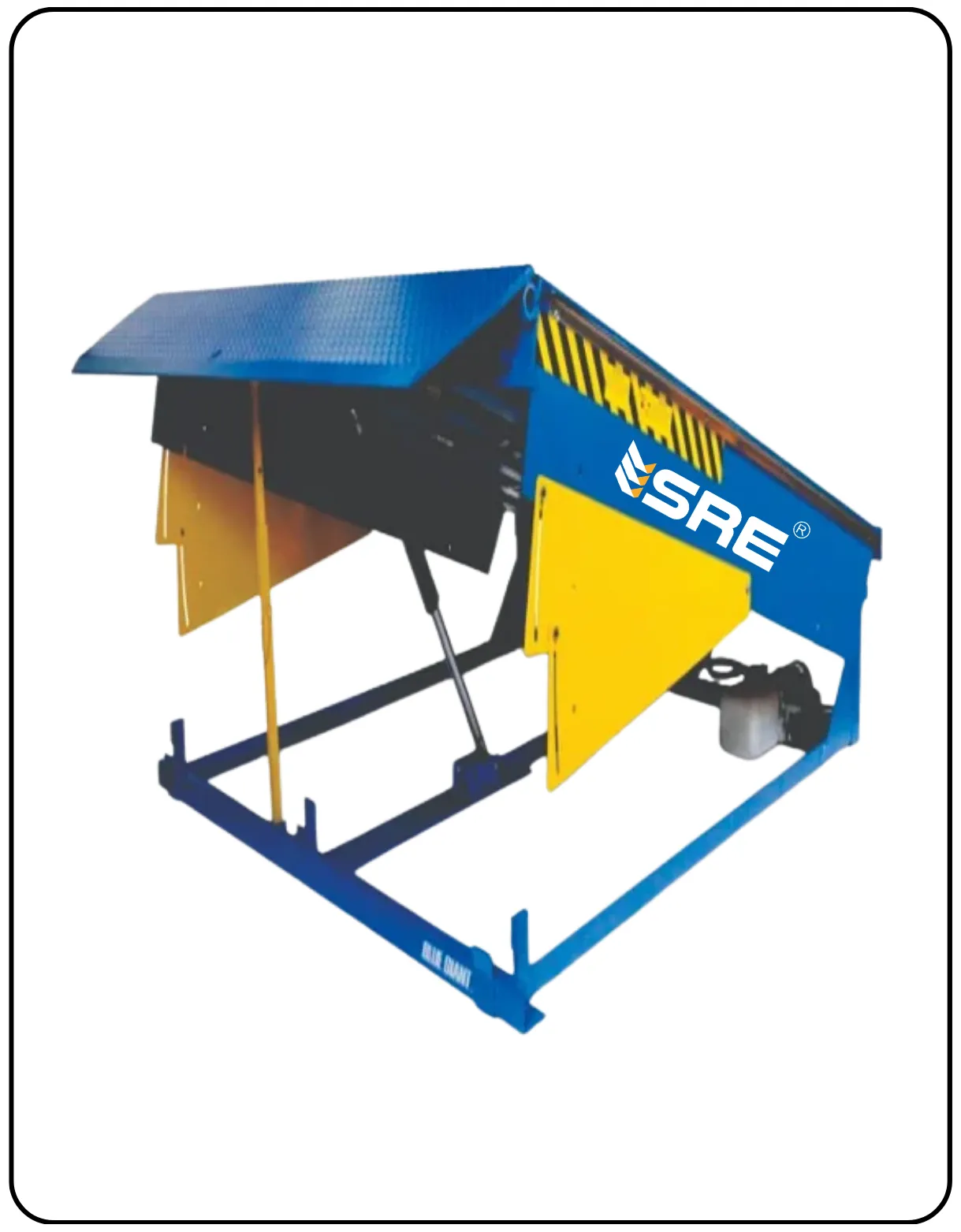
Warehouse operations managers and logistics heads at large manufacturing and distribution facilities in Bhosri MIDC and across the Pune industrial belt face a loading dock problem that costs more than most procurement teams calculate: the height difference between the raised dock floor and the truck bed varies by ±200–300 mm across the mixed truck fleet arriving daily — ranging from LCV 2-ton tempos at 900 mm bed height to 32-ton multi-axle trucks at 1,300–1,400 mm bed height. Without a permanent dock bridge solution, forklift operators navigating these height differences either damage truck chassis, drop pallets at the gap, or — in the worst cases — drive forklifts partially off the dock edge. The engineered permanent solution that warehouse design consultants and logistics procurement managers at Bhosri, Pune, and across Maharashtra specify for every raised-dock loading bay is a Warehouse Dock Leveler in Bhosri — the SRE 163 from SRE Material Handling Equipment Pvt. Ltd., a hydraulically actuated pit-mounted dock leveler rated at 10 Ton capacity with a 1.6-metre platform width, bridging ±300 mm of height variation from dock to truck in under 15 seconds. Available at Rs. 2,30,000 (taxes extra), manufactured under ISO 9001:2015 quality management in Ahmedabad and supplied PAN India.
Key Features Of SRE 163 Warehouse Dock Leveler That Solve Mixed-Fleet Truck Height Variation At Bhosri And Pune Loading Docks
10-Ton Forklift-Rated Platform — Handles Loaded 3-Ton Counter-Balance Forklifts Without Deflection
Warehouse safety managers and dock supervisors at Bhosri MIDC distribution and manufacturing facilities who specify dock levelers for bays that use 2.5–3 Ton counterbalance forklifts know the most critical capacity requirement: it is not the cargo weight alone, but the combined dynamic weight of a fully loaded forklift crossing the dock leveler at speed — a 3-Ton counterbalance forklift loaded to 2,500 kg creates a platform dynamic load of approximately 8–9 Ton at the moment the rear axle crosses the leveler lip due to the rear-axle counterweight concentration. The SRE 163 Warehouse Dock Leveler is rated at 10 Ton dynamic platform capacity — providing the correct safety margin for loaded counterbalance forklift traffic at Bhosri MIDC warehouse loading bays. The platform is fabricated from MS steel IS 2062 with a minimum 12 mm deck plate, reinforced with a box-section subframe at 250 mm centres, and hot-dip galvanised primer-coated before topcoat finish — providing corrosion resistance for the Pune and Maharashtra monsoon environment at outdoor dock faces.
Hydraulic Lip Extension — 400 mm Truck Bed Contact for Stable Forklift Bridge Crossing
Dock operations supervisors at large Bhosri MIDC FMCG, automotive, and 3PL warehouses who have reviewed forklift tip-over incidents at loading docks frequently find the same root cause: a dock leveler lip that contacts the truck bed at less than 200 mm of overlap — either because the truck reversed insufficiently close, or because the lip failed to fully extend under hydraulic pressure. This leaves the leading edge of the leveler unsupported on the truck bed, creating a cantilever condition that buckles under forklift front axle load. The SRE 163 uses a hydraulically extended lip of 400 mm minimum contact length, with a factory-set hydraulic stop ensuring full lip extension before the platform settles to truck bed height. The lip hinge is a full-width continuous hinge (piano type) in MS steel with stainless steel hinge pin, rated for 500,000 lip extension cycles — approximately 8–10 years at 150 truck movements per day at a busy Bhosri or Pune warehouse dock. SRE Material Handling Equipment Pvt. Ltd. provides factory test certification with every unit dispatched from Ahmedabad.
Applications Of Warehouse Dock Leveler Across Industries In Bhosri, Maharashtra, And PAN India
Warehouse facility planners, logistics managers, and industrial real estate developers in Bhosri, Pune, Ahmedabad, and Bangalore install a warehouse dock leveler at every raised loading dock bay where forklift traffic crosses between dock floor and truck bed. Proven applications include:
- Automotive component JIT warehouses at Bhosri MIDC and Chakan: Multi-shift forklift dock operations loading sequenced component pallets — 10-Ton rating handles counterbalance forklift plus max load without platform deflection
- FMCG and 3PL distribution centres in Bhiwandi, Nashik, and Pune: High-throughput outbound despatch docks handling 30–100 truck movements per day across mixed truck heights from tempo to multi-axle
- Cold chain and pharmaceutical distribution in Bhosri and Hyderabad: Temperature-controlled dock bays where dock leveler seals with the truck reefer unit to minimise thermal break during loading — insulated leveler deck option available
- E-commerce fulfilment centres in Noida, Gurugram, and Bangalore: Peak season outbound docks with high forklift traffic frequency — hydraulic dock leveler handles rapid consecutive truck-to-truck cycling without manual repositioning
- Steel and heavy engineering warehouses in Ahmedabad, Vatva, and Kutch: Heavy load forklift crossings at steel coil and heavy fabrication despatch docks — 10-Ton capacity covers the heaviest loaded reach truck and counterbalance configurations
- Export packing and CFS facilities at Pune and JNPT hinterland: Container truck loading docks where leveler bridges variable height from dock floor to container floor — standard range covers all ISO container variants
- Food processing and FMCG manufacturing despatch in Gujarat (Gandhidham, Mahesana): Food-grade despatch docks where SS 304 deck surface option meets hygiene requirements for food product pallet loading
- Textile and apparel export warehouses in Surat and Bhavnagar: Garment roll and carton pallet loading at multi-dock export warehouse facilities
- Hospital and healthcare supply warehouses in Noida, Faridabad, and Ambala: Medical supply pallet loading at hospital central store truck docks — leveler prevents pallet drop at truck-dock gap
- Airport cargo terminals in Bangalore, Hyderabad, and Chennai: Air cargo ULD and standard pallet loading at cargo terminal truck docks with variable aircraft-container height interfaces
How SRE 163 Warehouse Dock Leveler Compares To Mobile Dock Ramp And Pit Scissor Lift Table In Bhosri And Gujarat
| Feature | Mobile Dock Ramp | Pit Scissor Lift Table | SRE 163 Warehouse Dock Leveler (10 Ton) |
|---|---|---|---|
| Height Adjustment Range | Fixed angle only | Floor to 1,500 mm | ±300 mm from dock floor — full hydraulic variable |
| Rated Capacity | Up to 6 Ton | 500–2,000 kg | 10 Ton — forklift-rated dynamic load |
| Lip / Bridge Contact | Rests on truck bumper | Pallet slides across gap | 400 mm hydraulic lip — full truck bed contact |
| Forklift Access | Yes — angled crossing | No — pallet only | Yes — full forklift drive-on |
| Platform Position When Idle | Above floor — obstruction | Flush with floor | Flush with dock floor — pit mounted |
| Actuation | Manual / hydraulic lever | Electric hydraulic | Electric hydraulic — 15-second cycle |
| Price Range (INR) | Rs. 40,000–80,000 | Rs. 75,000–1,50,000 | Rs. 2,30,000 (SRE 163) |
For Bhosri MIDC and Maharashtra raised-dock warehouse facilities where counterbalance forklifts cross between dock and truck bed across a mixed height fleet, the SRE 163 Warehouse Dock Leveler at Rs. 2,30,000 is the only specification that delivers 10-Ton forklift-rated capacity, ±300 mm height adjustment, and a 400 mm hydraulic lip bridge — the three elements that dock safety requires simultaneously. Mobile ramps and pit scissor lifts serve different applications and cannot replace a properly specified dock leveler at a raised-dock forklift loading bay. For related dock and logistics equipment: Mobile Ramp, Pallet Truck, and Electric Stacker. Related blog reading: Pit Mounted Scissor Lift Table in Mumbai and Pit Mounted Die Loader in Mumbai. Submit an inquiry online for site assessment and pit civil drawings.
Technical Specifications And How To Order SRE 163 Warehouse Dock Leveler For Bhosri, Gujarat, And PAN India
Warehouse facility planners and procurement teams in Bhosri, Pune, Ahmedabad, and Bangalore specifying the SRE 163 Warehouse Dock Leveler need to confirm dock floor height above truck yard grade, truck fleet bed height range, and forklift model at the inquiry stage. Standard specification: rated capacity 10 Ton (dynamic forklift load), platform width 1,600 mm, platform depth 2,000 mm (standard), height adjustment range ±300 mm from dock floor level, hydraulic lip extension 400 mm minimum contact, deck plate MS IS 2062 minimum 12 mm with chequer pattern anti-slip surface, subframe MS box section at 250 mm centres, hydraulic power unit 0.75 kW / 415V 3-phase, actuation time ≤15 seconds full travel, lip hinge full-width piano hinge with SS pin, lip cycle rating 500,000 cycles, paint system hot-dip galvanised primer + epoxy topcoat. Civil pit dimensions provided free with every quotation. SRE Material Handling Equipment Pvt. Ltd., an ISO 9001:2015 certified Make in India manufacturer, delivers to Bhosri and Maharashtra in 20–30 working days. Contact SRE Material Handling Equipment Pvt. Ltd. for a free dock site assessment.
Install India’s most reliable 10-Ton warehouse dock leveler at your Bhosri facility — Rs. 2,30,000.
📞 Get Free Site Assessment & Quote — Call +91 9316 208879 or +91 97247 2240410 Ton forklift-rated · 400 mm hydraulic lip · Civil pit drawings free · ISO 9001:2015 certified · PAN India delivery
For the quality management standard applicable to dock leveler manufacturers, see ISO 9001:2015 Quality Management System. For IS standards governing loading dock equipment in India, visit Bureau of Indian Standards (BIS). For loading dock safety guidelines covering dock levelers and forklift dock crossing, refer to OSHA Loading Dock and Dockboard safety standard.
Frequently Asked Questions — Warehouse Dock Leveler For Bhosri And Maharashtra Buyers
Q1. What is the rated capacity, height adjustment range, and lip extension of the SRE 163 Warehouse Dock Leveler for Bhosri and Pune raised-dock warehouse facilities?
The SRE 163 Warehouse Dock Leveler is rated at 10 Ton dynamic forklift load capacity, with a height adjustment range of ±300 mm from dock floor level — covering the full truck bed height variation of mixed LCV and multi-axle truck fleets. The hydraulic lip extends a minimum 400 mm onto the truck bed, with a 500,000-cycle lip hinge. SRE Material Handling Equipment Pvt. Ltd., an ISO 9001:2015 certified manufacturer, provides civil pit drawings free with every quotation and delivers to Bhosri and Maharashtra in 20–30 working days.
Q2. Why does a Bhosri warehouse dock require a 10-Ton rated dock leveler when the heaviest cargo pallet is only 2,000–2,500 kg?
The 10-Ton dock leveler capacity is required not for cargo weight alone, but for the dynamic load of a loaded counterbalance forklift crossing the leveler. A 3-Ton counterbalance forklift loaded to 2,500 kg creates an instantaneous platform dynamic load of 8–9 Ton at the moment the rear axle counterweight crosses the leveler platform at speed. Under-rated dock levelers deflect, weld-crack, and fail structurally within months under this loading pattern at Bhosri MIDC warehouse docks. The SRE 163 10-Ton rating provides the correct structural safety margin.
Q3. What civil pit dimensions and electrical supply are required to install the SRE 163 Warehouse Dock Leveler at a Bhosri or Pune warehouse facility?
The SRE 163 Warehouse Dock Leveler pit typically requires approximately 1,700 mm wide × 2,100 mm long × 500–600 mm deep in the dock floor, with 200 mm reinforced concrete walls and base. The hydraulic power unit requires a 415V / 3-phase / 50 Hz / 10A electrical supply at the dock bay. SRE Material Handling Equipment Pvt. Ltd. provides complete press-specific pit drawings and electrical specifications free of charge with every quotation — allowing the civil contractor at Bhosri to begin pit construction before equipment delivery in 20–30 working days.
Q4. What is the expected lip cycle life and maintenance schedule for the SRE 163 Warehouse Dock Leveler at a high-throughput Bhosri MIDC distribution warehouse?
The SRE 163 hydraulic lip hinge is rated at 500,000 lip extension cycles — at 150 truck movements per day × 300 days per year = 45,000 cycles per year, this provides approximately 11 years of hinge service life. Annual maintenance includes: hydraulic oil condition check (ISO VG 46), lip hinge pin lubrication, deck anti-slip surface inspection, and hydraulic cylinder seal check — estimated annual service cost Rs. 3,000–8,000. Spare parts are dispatched from SRE Material Handling Equipment Pvt. Ltd.‘s Ahmedabad plant to Bhosri and PAN India within 3–7 working days.
Q5. Bhosri ya Pune ke raised-dock warehouse ke liye Warehouse Dock Leveler SRE 163 ki delivery aur civil pit construction mein kitna total time lagta hai?
Bhosri aur Pune ke warehouse facilities ke liye SRE 163 Warehouse Dock Leveler ka process: civil pit drawing 2–3 working days mein free provide hoti hai. Civil pit construction typically 5–7 working days. Equipment delivery 20–30 working days. Installation aur commissioning 1 day. Total project timeline approximately 4–5 weeks. SRE Material Handling Equipment Pvt. Ltd. delivery scheduling civil contractor ke completion ke saath coordinate karta hai. Load test certificate, wiring diagram, aur operator manual included hote hain.
Q6. Ahmedabad ya Gujarat ke large 3PL warehouse ke liye Warehouse Dock Leveler aur Mobile Dock Ramp mein se kaun permanent install karna better investment hai?
Ahmedabad aur Gujarat ke 3PL warehouses ke liye long-term comparison: Mobile Dock Ramp (Rs. 40,000–80,000) — portable, fixed angle, forklift crossing safe only on gentle slopes, obstruction when idle. SRE 163 Warehouse Dock Leveler (Rs. 2,30,000) — 10-Ton forklift-rated, ±300 mm variable height, 400 mm lip, flush when idle, 15-second hydraulic adjustment. For docks handling 20+ trucks per day with forklift crossing, dock leveler delivers better safety and throughput ROI within 6–12 months of installation.
Q7. Kya Warehouse Dock Leveler ki hydraulic seal replacement aur AMC service Noida, Hyderabad, ya Bangalore mein available hai?
Haan. SRE Material Handling Equipment Pvt. Ltd. ke Ahmedabad plant se spare parts — hydraulic cylinder seal kits, lip hinge pin sets, hydraulic power unit motor assemblies, deck anti-slip grating sections, aur ISO VG 46 hydraulic oil — Noida, Hyderabad, Bangalore, aur PAN India ke liye 3–7 working days mein courier dispatch hote hain. AMC available hai jisme annual hydraulic oil change, lip hinge lubrication, aur cylinder seal inspection covered hai — recommended for high-throughput docks operating 100+ truck movements per day.