
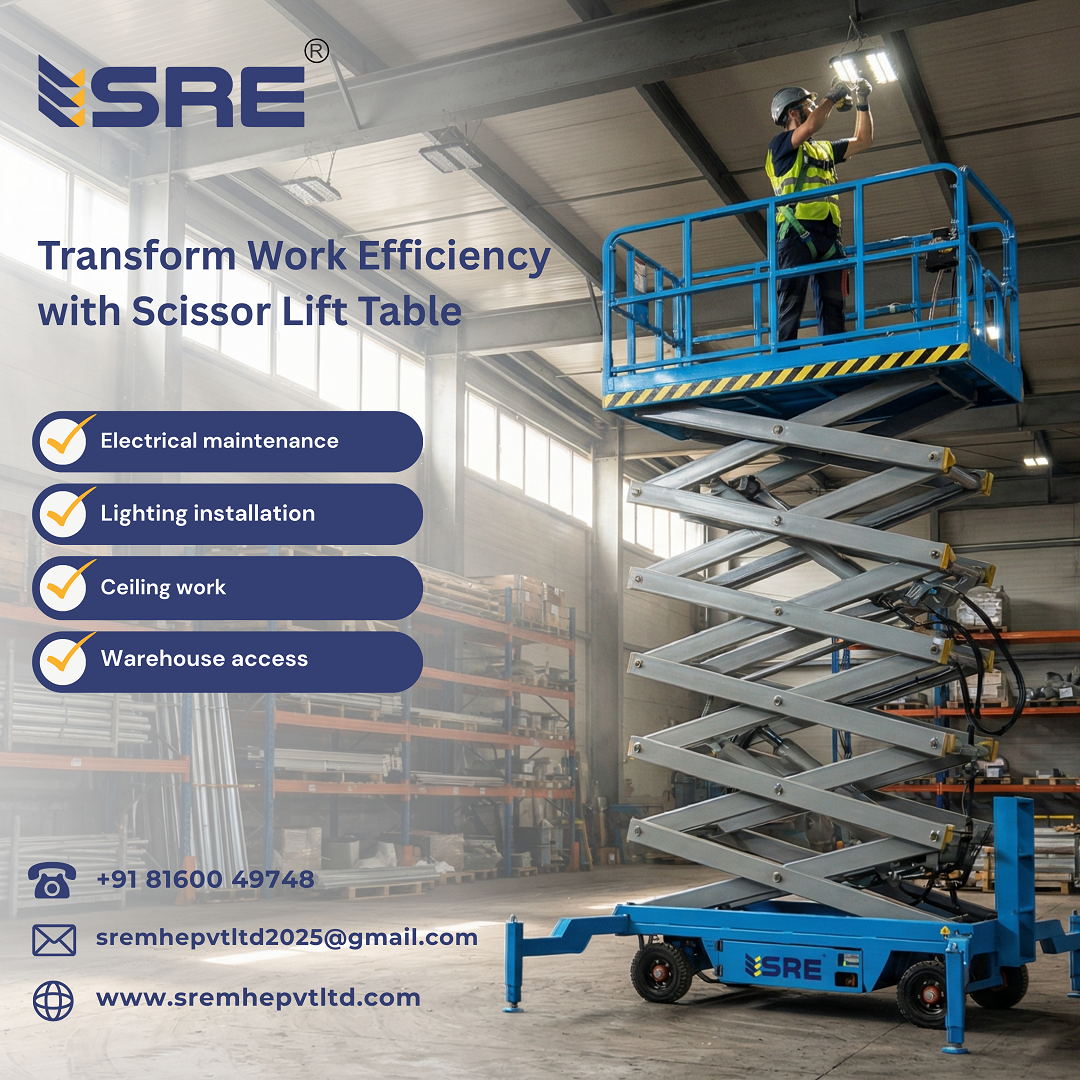
500kg – 900mm (All Size Available)
Rs. 26000
(Taxes to be paid extra)
Brand: SRE
SKU: SRE 149
Min Order Qty: 1
Industry-Focused Smart Scissor Lift Tables by SRE Material Handling Equipment Pvt. Ltd.
In daily warehouse operations, the pace of work has fundamentally changed. Smart Scissor Lift Table Solutions for Industry are increasingly essential as order volumes rise, delivery timelines tighten, and workplace safety expectations grow stricter. Teams are now required to move more material with fewer personnel, often across extended shifts, making fatigue a real operational risk. Repeated bending, lifting, and manual repositioning quickly strain workers and slow productivity.
This is the point where a carefully chosen scissor lift platform transitions from being seen as “extra gear” to a crucial element for both output and workplace security. When used appropriately, lift tables keep items at an optimal working elevation, permit managed material movement, and assist teams in sustaining uniform production over long work periods—all while sparing the workforce unnecessary physical strain.
Presented here is a hands-on, field-tested perspective on how scissor lift platforms function in current industrial settings—and where they deliver tangible benefits rather than just theoretical ones.
Evolving Demands in Contemporary Warehouses and Industries
Today’s storage and production sites are more than just static spaces. They function as nodes within agile supply networks.
- Tighter order fulfillment timelines necessitate more frequent collection and packing.
- The variety of Stock Keeping Units (SKUs) is expanding.
- Seasonal volume spikes are more severe.
On the floor, this translates to crowded passageways, more handoffs between workstations, and less downtime for “re-centering” between jobs. Internal logistics departments face pressure to move goods rapidly while maintaining low error rates.
Supervisors frequently identify these common roadblocks:
- Workers are wasting time adjusting their stance instead of performing tasks.
- Varied handling practices between different work shifts.
- An uptick in musculoskeletal stress injuries during peak operations.
These aren’t solely equipment failures; they are workflow inefficiencies. However, the selection of equipment can certainly ease the friction in day-to-day work.
What Exactly Is a Scissor Lift Table?
At ground level, a scissor lift platform is a level-adjustable surface that raises or lowers loads to a convenient working height. It occupies a middle ground between fixed workstations and large-scale elevating machinery.
Operators utilize it to:
- Elevate pallets or containers to waist level.
- Maintain a constant work surface elevation as the load’s size changes.
- Minimize the need for manual bending, reaching, or lifting.
In practical application, it becomes integrated into the workspace. Teams place items onto it, work from it, and remove finished goods from it. When positioned correctly within the process stream, it subtly removes substantial physical exertion from routine actions.
Why Scissor Lift Tables Are Superseding Older Manual Methods?
Many operations still depend on static-height benches, improvised platforms, or handling items directly on the floor. These arrangements often suffice “adequately” until volumes climb.
Manual material handling carries three frequent drawbacks:
- Rapid onset of fatigue: Repeated stooping slows personnel down by the middle of a shift.
- Inconsistent body positioning: Different team members work at varying heights, escalating the risk of strain.
- Process deviation: Staff adapts their approaches to cope, leading to variability in output.
A lift table introduces uniformity. The task is brought to the worker, reversing the traditional dynamic. Over time, this erodes the small delays that accumulate across hundreds of cycles per shift.
Productivity Gains in Standard Operations
Productivity improvements from lift tables are seldom dramatic immediately. They appear as small, continuous enhancements:
- Reduced time spent repositioning items.
- Fewer breaks for staff to realign their posture.
- More uniform cycle times from the shift’s start to its finish.
In packaging and assembly zones, keeping boxes at the correct elevation cuts down on the tiny delays caused by bending and reaching. Across an entire day, this uniformity proves more significant than pure speed.
Enhancing Workplace Security
The majority of warehouse injuries do not stem from accidents. They arise from repetitive stress and awkward motions.
A lift table assists by:
- Keeping items within a secure operational zone.
- Minimizing twisting and excessive reaching.
- Allowing controlled vertical movement instead of manual hoisting.
Safety supervisors often report fewer minor strain incidents when workstations offer height adjustability. It doesn’t eliminate all peril, but it lessens exposure during standard tasks.
Managing Heavier Packages with Greater Ease
Modern operations frequently handle diverse loads: lightweight boxes one moment, heavy machine parts the next. Fixed fixtures struggle with this fluctuation.
Lift tables provide:
- Solid support for weightier articles.
- Regulated elevation and descent to prevent sudden changes.
- Better alignment with conveyors, transport carts, or packing lines.
This stability is vital when load weight or shape varies throughout the day.
For more insights on business growth and operational efficiency, refer to Village Voice News.
Technology and Operational Smoothness
Current lift tables are engineered with uptime as the priority, not just new features. Battery-operated and hydraulic mechanisms are built for dependable utilization.
From an operations standpoint, what counts is:
- Dependable lifting and retention capabilities.
- Predictable power consumption or recharging needs.
- Straightforward controls that keep work flowing.
Equipment that performs consistently, without constant tinkering, is easier to weave into shift scheduling.
For more insights on industrial workflow optimization, read our detailed guide on Times Of India Daily.
Space Maximization and Adaptability
Floor real estate is perpetually limited. Compact machinery is essential in narrow corridors and busy staging zones.
Effectively designed lift tables:
- Fit within confined work cells.
- Allow operators to function without encroaching upon aisles.
- Reduce the necessity for temporary platforms that obstruct access.
This helps maintain clear routes for trucks and carts, lessening bottlenecks during peak operations.
For expert guidance on selecting the right Scissor Lift Table for your application, contact us today and optimize your workflow efficiency.
Financial Prudence Over the Long Term
The benefit of a lift table manifests over time, not just within a single budget period.
Facilities often see returns via:
- Decreased absences linked to strain.
- Fewer interruptions caused by minor physical issues.
- More reliable throughput during high-demand periods.
While the apparatus itself is a capital outlay, the workflow steadiness it delivers lessens the hidden expenses tied to worker fatigue and interruptions.
To get a clear picture of how the manufacturing sector and industrial businesses are growing across India, it helps to keep an eye on digital news networks. Visit India Bulletin News for the latest stories and reports from the material handling industry.
Environmental Responsibility and Adherence to Standards
Sustainability in logistics isn’t solely about energy consumption. It involves running processes that are cleaner and simpler to standardize.
Lift tables contribute by:
- Cutting down on superfluous motion.
- Supporting uniform procedures that are easier to review.
- Aligning with ergonomic standards frequently mandated by compliance guidelines.
This assists sites in maintaining a focus on compliance without adding extra layers to daily work.
Incorporation into Warehouse and Factory Routines
A lift table performs best when situated precisely where tasks occur:
- At packaging stations.
- Between machining and inspection points.
- Within kitting and assembly cells.
In routine warehouse activities, the goal is to eliminate “extra steps.” When a lift table becomes an integral part of the station’s layout, it reduces handling actions rather than introducing one more piece of apparatus to manage.
Operator Education, Simplicity, and Servicing
Workers should not require specialized licensing to operate a lift table safely.
Successful deployments feature:
- Uncomplicated, intuitive controls.
- Essential instruction during initial orientation.
- Clear servicing schedules that align with existing routines.
Foreseen maintenance is simpler to organize than emergency fixes. This minimizes disruptions to production schedules.
Why Selecting a Trustworthy Provider is Significant?
Not all lift platforms are built for the demands of constant industrial use. The distinction becomes apparent after months of service.
When evaluating vendors, decision-makers often seek:
- A track record in material handling apparatus.
- Readily available support and replacement components.
- Clear documentation regarding weight capacities and regulatory adherence.
Partnering with established manufacturers such as SRE Material Handling Equipment Private Limited helps ensure equipment meets regulations and can be supported throughout its service life. Their official website is https://www.sremhepvtltd.com/.
The aim is not to acquire the most technically advanced gadget on paper, but the one that matches your operational circumstances and support capabilities.
In summary:
A Scissor Lift Table is not a universal solution for every logistics issue. It is, nevertheless, a pragmatic instrument that smooths out friction in repetitive tasks. When selected and positioned with actual workflows in mind, it fosters stable output, safer handling, and more consistent performance across work shifts.
For management personnel, the choice is less about adopting new gear and more about eliminating minor inefficiencies that accumulate over time. Assessing lift tables based on your real operational procedures is the surest path to realizing their lasting benefits.
If you are revisiting workstation design or planning capacity for the next growth phase, it is worthwhile to map out where adjustable height handling could alleviate strain and enhance flow—then pilot it in one crucial area before expanding.
Get in touch with our team to discuss your requirements and receive a customized solution tailored to your operational needs.
Key Takeaways
- Productivity: A stable working height facilitates steady output throughout shifts.
- Safety: Reduced stooping and controlled movement lessen exposure to strain.
- Load Management: Stable surfaces improve control for varied and heavy items.
- Cost Efficiency: Long-term worth derives from fewer interruptions and fewer injuries.
- Industry Movement: Height-adjustable handling is becoming the standard in modern facilities.
FAQS
Q1: Where do lift tables deliver the greatest advantage in a warehouse?
- Packing areas, kitting zones, and receiving inspection points often show the fastest positive outcome because item heights fluctuate frequently in a warehouse system.
Q2: Do lift tables impede workflow?
- When built into the workstation layout, they typically eliminate steps rather than add them. Improper placement is what causes workflow slowdowns. SRE Material Handling Equipment Pvt. Ltd. ensures optimal integration for smooth operations.
Q3: Are lift tables practical for narrow spaces?
- Compact variations are frequently utilized in tight work cells and staging spots without obstructing warehouse traffic flow.
Q4: How much instruction do users require for lift tables?
- Basic operational guidance during onboarding is generally adequate when controls are simple and standardized.
Q5: What type of servicing needs planning for lift tables?
- Routine maintenance checks aligned with existing equipment maintenance schedules help prevent unexpected outages and improve machine lifespan.
#ScissorLiftTable #MaterialHandling #WarehouseOperations #FactoryEfficiency #ErgonomicHandling #SupplyChain #OperationsManagement #IndustrialSafety #SREMATERIALHANDLINGEQUIPMENTPRIVATELIMITED