Applications Of Hydraulic Pallet Truck And Key Features Of Hydraulic Pallet Truck In Bhosri
3 Ton 550 x 1150 (All Size Available)
Rs. 13500
(Taxes to be paid extra)
Brand: SRE
SKU: SRE 101
Min Order Qty: 1
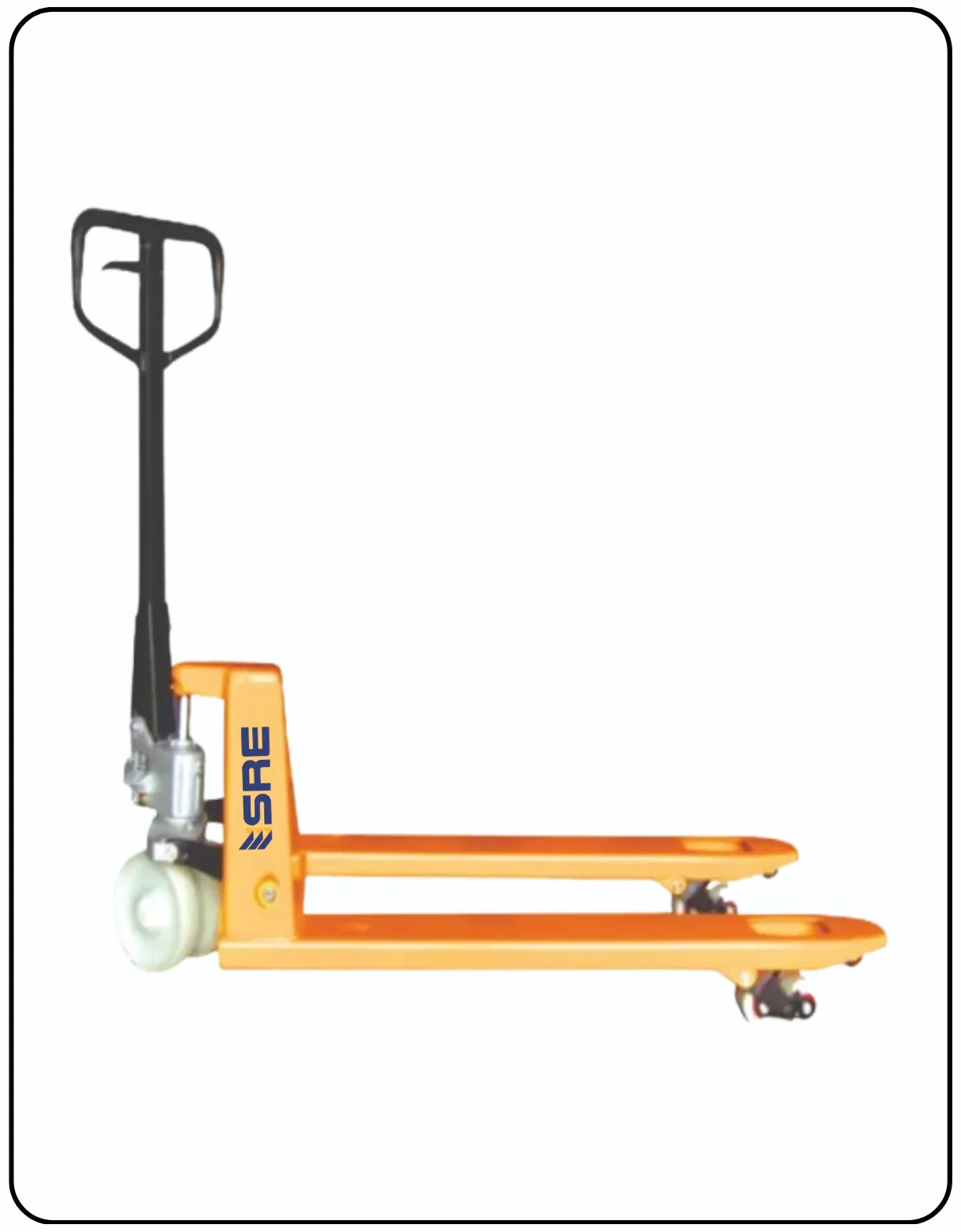
Logistics managers, despatch supervisors, and supply chain operations heads at Bhosri MIDC manufacturing plants and distribution facilities that operate multiple loading bays serving mixed truck fleets — ranging from 2-Ton LCV deliveries to 32-Ton multi-axle container trucks — know the operational reality of truck loading and unloading: the hydraulic pallet truck is the primary tool connecting the dock to the truck floor, and its reliability, load capacity, and ground clearance determine whether each loading cycle completes in 8–12 minutes or stretches to 25–35 minutes due to equipment-related delays. At Bhosri manufacturing facilities moving 30–80 trucks per day across multiple loading bays, a single hydraulic pallet truck failure takes an entire dock out of service until a replacement arrives. The dock-proven solution that plant logistics and purchase managers in Bhosri, Pune, and across Maharashtra specify for every loading bay is an Hydraulic Pallet Truck in Bhosri from SRE Material Handling Equipment Pvt. Ltd. — the SRE 101, a 3-Ton rated industrial hydraulic pallet truck with 550 × 1,150 mm forks, chrome-bore pump, and heavy-duty PU wheels, available at Rs. 13,500 (taxes extra), manufactured under ISO 9001:2015 quality management in Ahmedabad, and delivered PAN India with full service support.
Key Features Of SRE 101 Hydraulic Pallet Truck That Keep Bhosri And Pune Loading Docks Operating Without Interruption
Low-Profile Fork Entry at 85 mm — Correct Clearance for Container Floors and Truck Beds
Dock supervisors at Bhosri MIDC automotive and FMCG despatch docks know that fork entry clearance is the most operationally critical dimension in a loading bay hydraulic pallet truck specification: ISO-standard wooden pallets typically have a bottom board clearance of 95–115 mm, and plastic pallets used in pharmaceutical and food-grade supply chains can be as low as 90 mm. A pallet truck with a lowered fork height above 90 mm physically cannot enter under low-clearance plastic pallets — creating loading delays when the truck fleet includes mixed pallet types. The SRE 101 Hydraulic Pallet Truck has a fully lowered fork height of 85 mm — providing reliable entry under both wooden and plastic pallets, as well as under goods stacked directly on container floor sheets with 75–80 mm low-profile skids. This 85 mm lowered height is achieved through the dual-scissor lowering linkage geometry — when fully lowered, the forks contact the ground at only the front tip wheels, maintaining the 85 mm minimum dimension throughout the fork length. SRE Material Handling Equipment Pvt. Ltd. verifies this clearance on every SRE 101 at the Ahmedabad factory quality inspection point before dispatch to Bhosri and Maharashtra.
3,000 kg Rated Capacity — Handles the Heaviest Mixed-Fleet Loading Scenarios at Bhosri MIDC Docks
Supply chain managers at Bhosri MIDC automotive component manufacturers and at Pune distribution centres whose despatch teams load mixed-product trucks know the loading bay hydraulic pallet truck capacity requirement changes depending on the pallet being handled: a steel component pallet can weigh 1,800–2,500 kg, a standard FMCG case goods pallet reaches 1,200–1,500 kg, and a bulk liquid or chemical IBC pallet may reach 1,000–1,200 kg. When a loading bay team uses the same hydraulic pallet truck for all pallet types without checking individual pallet weight against truck capacity, overload events on under-rated trucks are common — accelerating seal wear and frame fatigue. The SRE 101 Hydraulic Pallet Truck is rated at 3,000 kg (3 Ton) — providing a comfortable operating margin above the heaviest commercial pallet types used in Bhosri MIDC automotive component and engineering supply chains. The MS steel IS 2062 box-profile fork structure (150 mm height × 550 mm width) is rated for 100,000 full load cycles at rated 3,000 kg — approximately 4–6 years at 50 loading cycles per shift in a standard dock environment.
Applications Of Hydraulic Pallet Truck In Loading Bay And Dock Operations Across Bhosri, Maharashtra, And PAN India
Logistics operations managers, dock supervisors, and fleet procurement officers in Bhosri, Pune, Ahmedabad, and Bangalore use a hydraulic pallet truck at every loading dock and vehicle bay where pallet loading and unloading is the primary function. Proven applications include:
- Automotive component JIT despatch at Bhosri MIDC loading bays: Loading sequenced component pallets into dedicated OEM milk run trucks — 3-Ton rating handles steel and assembly component pallet weights without overload risk
- Container floor pallet loading and devanning at Bhosri and Pune CFS: Loading and unloading of 20-foot and 40-foot container floor cargo — 85 mm lowered height ensures reliable entry under pallets on container floor sheets
- LCV and tempo loading at FMCG distribution despatch in Bhiwandi and Nashik: Fast-turnaround secondary distribution truck loading where dock trucks cycle through 20–40 loading events per LCV per day
- Flatbed and open-body truck loading at steel service centres in Ahmedabad, Vatva: Sheet metal pallet and coil pallet loading on flatbed trucks at grade-level docks where fork clearance at the truck bed edge matters
- Cement and construction material pallet loading in Jaipur, Udaipur, and Rajasthan: Pallet movement at rural depot truck loading bays where outdoor rough concrete requires robust PU load wheels
- Export CFS and ICD loading in Bhosri, Pune, and JNPT hinterland: Container pallet loading for export shipment — fork dimensions and 3-Ton capacity correct for standard export cargo pallet weights
- Pharmaceutical cold-chain vehicle loading in Hyderabad and Bangalore: Loading temperature-controlled pallets into refrigerated vehicle cargo areas — cold-grade PU wheel option for -10°C to -25°C reefer interior use
- Agricultural produce and food processing truck loading in Gujarat (Gandhidham, Mahesana): Produce pallet loading at packhouse and processing facility loading bays — SS 304 fork option for food hygiene compliance
- Bulk chemicals IBC and drum loading in Vatva and Kutch: IBC and drum cluster pallet loading at chemical plant loading bays — 3-Ton rating handles maximum IBC load weights
- Hospital and medical supply vehicle loading in Noida, Gurugram, and Faridabad: Medical consumable pallet loading into hospital fleet delivery vehicles — non-marking wheels and quiet operation for hospital facility compliance
Specifying The Right Hydraulic Pallet Truck For Your Bhosri Loading Bay — Capacity, Fork Length, And Wheel Type
Purchase managers and logistics procurement heads in Bhosri and across Gujarat and Maharashtra who manage multiple loading bays with different pallet and truck types need a structured selection framework for their hydraulic pallet truck fleet specification.
| Loading Bay Requirement | Correct SRE Specification | Why |
|---|---|---|
| Standard warehouse — mixed pallet types, indoor dock | SRE 101 — 3 Ton, 550 × 1,150 mm, PU wheels | Handles all commercial pallet weights; PU wheels protect floor and provide non-marking surface |
| Outdoor truck yard — rough concrete, exposed dock | SRE 101 — nylon or polyamide wheel option | Nylon wheel harder than PU — longer life on rough outdoor concrete and aggregate surfaces |
| Cold store or reefer truck loading — sub-zero environments | SRE 101 — cold-grade PU seal + ISO VG 15 oil | Standard seals stiffen at 0°C; cold-grade seals maintain pump performance to -20°C |
| Food or pharma truck loading — hygiene compliance | SRE 101 — SS 304 fork option | SS 304 fork resists food acid corrosion and meets GMP hygiene surface requirements |
| Heavy engineering — steel pallet above 2,500 kg | SRE 101 — 3 Ton rated (with margin for steel pallet weights) | 3 Ton operating margin ensures no overload at maximum steel component pallet weights |
| Long pallet (1,200 × 2,400 mm) — bulk goods | SRE 101 — 685 × 1,450 mm fork option | Extended fork length and width ensures support across full long pallet base dimension |
SRE Material Handling Equipment Pvt. Ltd., an ISO 9001:2015 certified Make in India manufacturer, supplies the full range of SRE 101 Hydraulic Pallet Truck configurations — standard, cold-rated, SS fork, nylon wheel, and extended fork — from the Ahmedabad plant with 5–10 working days delivery to Bhosri and Maharashtra. Bulk orders of 10+ units receive fleet pricing and 10–15 working days delivery. For related dock and loading equipment: Dock Leveler, Mobile Ramp, and Electric Stacker. Related blog reading: Hand Pallet Truck Services in Mumbai and Hydraulic Stacker Pune. Submit an inquiry online with your loading bay specification for a custom fleet recommendation.
Equip every loading bay at your Bhosri facility with India’s most dock-proven hydraulic pallet truck — Rs. 13,500.
📞 Order Now — Call +91 9316 208879 or +91 97247 224043 Ton · 85 mm fork clearance · 100,000 cycle rated · ISO 9001:2015 certified · PAN India delivery · Fleet pricing available
For the quality management standard applicable to hydraulic pallet truck manufacturers, see ISO 9001:2015 Quality Management System. For IS standards governing industrial hydraulic trucks in India, visit Bureau of Indian Standards (BIS) — IS 7217. For loading dock and powered industrial truck safety guidelines, refer to OSHA Powered Industrial Trucks safety standard.
Frequently Asked Questions — Hydraulic Pallet Truck For Bhosri Loading Bays And Maharashtra Buyers
Q1. What is the minimum lowered fork height and rated capacity of the SRE 101 Hydraulic Pallet Truck for container floor pallet loading at Bhosri MIDC docks?
The SRE 101 Hydraulic Pallet Truck has a fully lowered fork height of 85 mm — the critical specification for reliable entry under low-clearance plastic pallets (90 mm clearance) and container floor pallets with 75–80 mm skid height. The rated capacity is 3,000 kg (3 Ton) — correctly specified for the heaviest automotive steel component pallets used at Bhosri MIDC container loading docks. SRE Material Handling Equipment Pvt. Ltd., an ISO 9001:2015 certified manufacturer, verifies fork clearance at the Ahmedabad factory quality inspection before dispatch to Bhosri and PAN India.
Q2. How many loading cycles is the SRE 101 Hydraulic Pallet Truck fork structure rated for at a Bhosri and Pune full-day loading dock operation?
The SRE 101 Hydraulic Pallet Truck fork structure — MS steel IS 2062 box-profile (150 mm height × 550 mm width) with continuous MIG-welded joints — is rated for 100,000 full load cycles at 3,000 kg. At a Bhosri MIDC loading dock running 50 loading cycles per shift × 2 shifts per day × 300 days per year = 30,000 cycles per year, this provides approximately 3–4 years of fork structural service life before structural inspection is required. The frame paint — epoxy primer + PU topcoat — provides 3–5 years corrosion resistance under normal dock conditions.
Q3. What wheel type should a Bhosri MIDC outdoor truck yard hydraulic pallet truck use versus an indoor factory dock hydraulic pallet truck?
For indoor factory docks at Bhosri MIDC with smooth concrete or painted epoxy floors: specify 200 mm PU tandem drive wheels — non-marking, rated 500,000 metres of travel at full load. For outdoor truck yard docks with rough concrete, aggregate, or exposed stone surfaces: specify the nylon or polyamide wheel option — harder compound, approximately 2× the abrasion life of PU on rough outdoor surfaces. The cold-rated low-temperature PU wheel option is recommended for reefer vehicle loading bays operating at -10°C to -25°C on a regular basis.
Q4. What is the fleet pricing and delivery lead time for bulk orders of SRE 101 Hydraulic Pallet Trucks for a multi-bay loading dock at a Bhosri MIDC or Gujarat plant?
Standard single-unit orders of the SRE 101 Hydraulic Pallet Truck for Bhosri and Maharashtra are delivered in 5–10 working days at Rs. 13,500 per unit. Bulk fleet orders of 10+ units are fulfilled in 10–15 working days with competitive per-unit fleet pricing. SRE Material Handling Equipment Pvt. Ltd. provides a GST-compliant invoice, product warranty card, and spare parts list with every unit. AMC covering quarterly hydraulic condition check and wheel inspection is available for fleet buyers across Gujarat, Maharashtra, and PAN India.
Q5. Bhosri ya Pune ke loading bay fleet ke liye Hydraulic Pallet Truck — kaunsa wheel type select karein aur bulk pricing kya hai?
Bhosri aur Pune ke loading bays ke liye wheel selection: indoor smooth dock → PU wheel (non-marking, 500,000 metre rated); outdoor rough yard → nylon/polyamide wheel (2× abrasion life); reefer/cold dock → cold-rated PU wheel (-20°C rated). Bulk fleet (10+ units) par special pricing aur 10–15 working days delivery available hai. SRE Material Handling Equipment Pvt. Ltd. ke Ahmedabad plant se Maharashtra ke sabhi dock locations tak delivery available hai. Fleet AMC bhi available hai.
Q6. Ahmedabad ya Gujarat ke container loading CFS ke liye Hydraulic Pallet Truck vs Forklift — kab pallet truck better option hai?
Ahmedabad aur Gujarat ke CFS container loading operations ke liye comparison: Forklift (Rs. 5–12 lakh) better hai jab pallets container door se 10+ metres inside tak push karne ho. SRE 101 Hydraulic Pallet Truck (Rs. 13,500) better hai jab container door ke paas last 3–5 metre precision positioning karna ho, ya jab forklift overhead clearance insufficient hai short containers mein. Best practice: forklift outside container + pallet truck inside container — dono equipment ek saath use hote hain high-throughput CFS operations mein.
Q7. Kya Hydraulic Pallet Truck ki dock-specific spare parts aur AMC service Noida, Indore, ya Hyderabad mein available hai?
Haan. SRE Material Handling Equipment Pvt. Ltd. ke Ahmedabad plant se dock-specific spare parts — PU drive wheel sets (200 mm), nylon load wheel assemblies, pump seal kits (chrome-bore), descent valve units, fork tip protector sets, aur handle grip assemblies — Noida, Indore, Hyderabad, aur PAN India ke liye 2–5 working days mein courier dispatch hote hain. AMC fleet buyers ke liye available hai jisme quarterly hydraulic check, wheel wear measurement, aur descending valve test covered hai.