
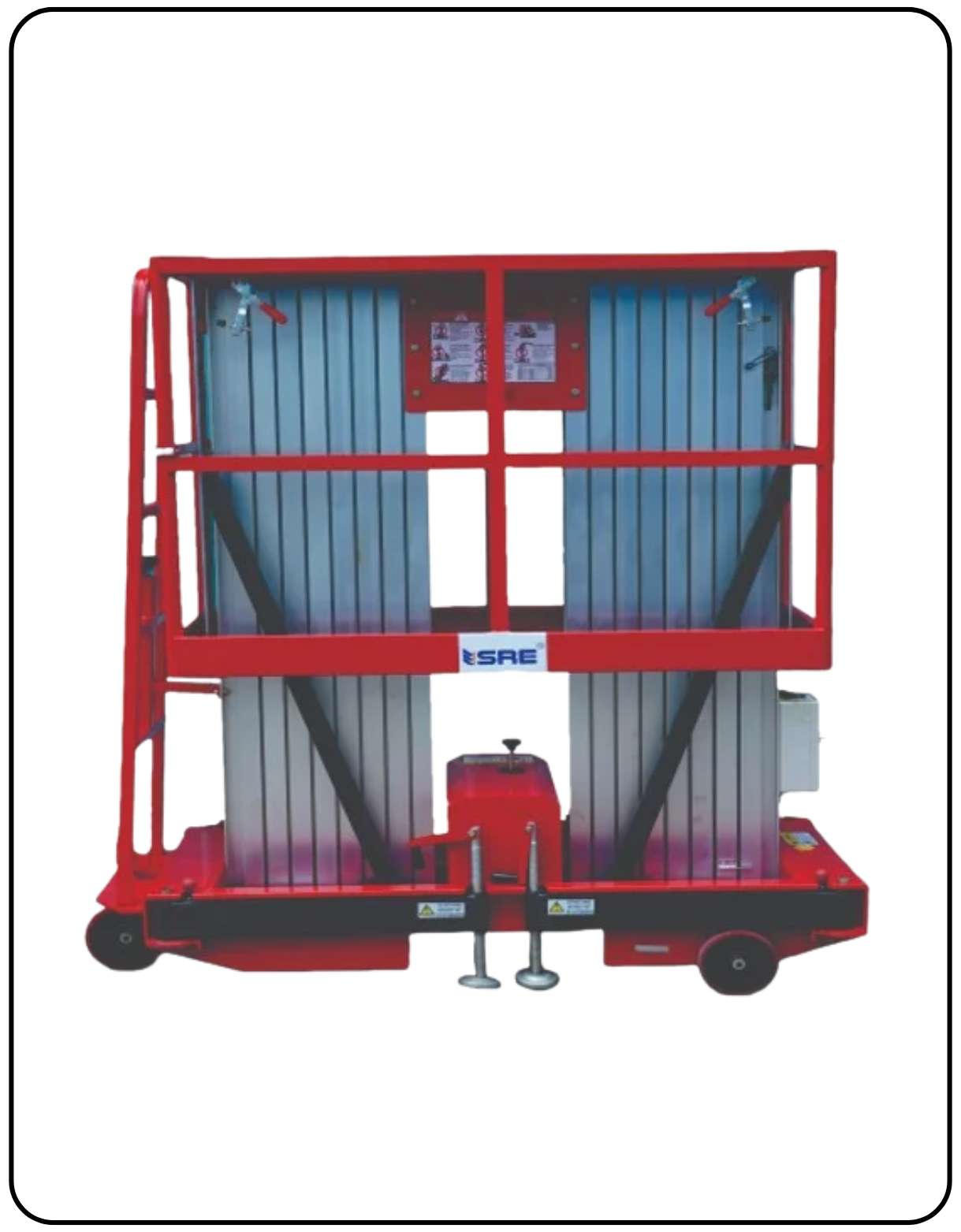
Applications Of Aerial Work Platform And Key Features Of Aerial Work Platform In Bhosri
220 Kg-10 Meter (All Size Available)
Rs. 310000
(Taxes to be paid extra)
Brand: SRE
SKU: SRE 152
Min Order Qty: 1
Engineering plant managers and safety compliance officers at Bhosri MIDC manufacturing units — where factory buildings routinely reach ceiling heights of 9–12 metres in automotive, heavy engineering, and electronics sectors — face a documented risk: overhead maintenance tasks including cable tray installation, high-bay lighting replacement, and HVAC servicing are being carried out from improvised ladder arrangements that create recordable incidents under Maharashtra Factories Act inspections and ISO 45001 audits. The certified solution that facility procurement teams now specify as a permanent safety asset at Bhosri, Pune, and across Maharashtra is an Aerial Work Platform in Bhosri — the SRE 152 from SRE Material Handling Equipment Pvt. Ltd., a battery-powered, two-person mast platform reaching 10 metres working height with 220 kg rated capacity, compliant with IS 3521 and FEM 1.001, and available at Rs. 3,10,000 (taxes extra) with PAN India delivery from the ISO 9001:2015 certified Ahmedabad plant.
Key Features Of Aerial Work Platform SRE 152 That Address Height-Access Safety Gaps In Bhosri And Pune Industrial Plants
Two-Person 220 kg Platform at 10 Metres — Correct Specification for Bhosri’s Tall Factory Buildings
Safety engineers and plant engineers at large automotive and engineering facilities in Bhosri MIDC and Chakan consistently find that single-person compact mast platforms at 6–7 metres cannot reach the overhead structures, cable trays, and high-bay luminaires installed at 8–10 metre levels in buildings designed for crane operation. Purchasing an under-height platform means workers still use ladders to bridge the remaining gap — creating the exact fall risk the aerial work platform was meant to eliminate. The SRE 152 Aerial Work Platform carries 220 kg (two persons plus a full tool kit) to a maximum working height of 10,000 mm, with a guard-rail-enclosed platform of approximately 700 × 1,200 mm providing ample working space for two-person MEP installation or inspection tasks. The platform guard rail height is 1,100 mm on three sides with a manual entry gate, meeting the minimum height requirement under IS 3521 for working platforms above 2 metres. The outrigger stabilised footprint of 2,500 × 2,500 mm with individual levelling jacks (rated at ±50 mm floor compensation) handles the gradient variations common on Bhosri MIDC factory concrete floor areas.
Battery-Powered Mast Drive — Zero Emission Indoor Operation for Bhosri Pharma and Electronics Plants
EHS compliance managers at pharmaceutical, electronics, and food-grade manufacturing plants in Bhosri, Hyderabad, and Bangalore whose facilities operate under stringent indoor air quality requirements cannot authorise diesel or petrol-powered access equipment within production enclosures. Even generator-powered electric units create cable-routing hazards across active production floor areas. The SRE 152 is fully battery-operated — the 24V / 100 Ah sealed lead-acid battery drives the 24V DC rack-and-pinion mast lift and all platform controls with zero fuel combustion and zero fume emission inside the facility. One standard overnight charge from a 240V / 15A single-phase socket provides approximately 30–40 complete lift cycles — ground level to 10 metres and return — covering a complete 8-hour maintenance shift. A spring-loaded drum brake on the mast drive auto-engages on power interruption, preventing uncontrolled platform descent in the event of any electrical fault during operation in Bhosri factories.
Applications Of Aerial Work Platform Across Industries In Bhosri, Maharashtra, And PAN India
Facility managers, maintenance team leaders, and procurement officers in Bhosri, Pune, Ahmedabad, and Jaipur deploy an aerial work platform wherever certified two-person access is required at heights up to 10 metres in industrial, commercial, or institutional buildings. Proven applications include:
- High-bay LED lighting installation and group relamping in Bhosri MIDC factories: LED fixture replacement at truss-mounted positions in buildings with 9–12 metre ceiling height — two-person platform allows one technician to work while a second manages the fixture safely
- HVAC duct installation and servicing in Pune and Nashik manufacturing plants: Overhead duct section installation, VAV box servicing, and AHU coil replacement in buildings where ceiling-mounted equipment is at 7–10 metre levels
- Overhead conveyor chain maintenance in Bhosri MIDC automotive plants: Chain lubrication, trolley inspection, and overhead conveyor structure servicing across large assembly plant floor areas
- Fire suppression system inspection in large Bhosri warehouses: Sprinkler head inspection, heat and smoke detector testing, and suppression system pipe-joint checks at 8–10 metre ceiling heights
- Cable tray installation and cable pulling in Bhosri electronics plants: Overhead cable management during expansion and modification projects where battery operation eliminates extension cord floor hazard
- Stadium and large venue overhead rigging in Pune and Nashik: Speaker array mounting, lighting truss installation, and display screen rigging in large-span venues up to 10 metre height
- Warehouse racking installation in Bhiwandi, Nasik, and Noida: Rack frame and beam bolting at heights up to 10 metres during new warehouse fit-out with two-person team capability
- Power substation equipment installation in Jaipur, Udaipur, and Rajasthan: Overhead switchgear mounting, cable tray, and bus-bar installation at transformer bay ceiling heights
- Exterior and interior façade inspection in Gurugram and Faridabad: Building cladding inspection, window seal repair, and exterior lighting maintenance on low-rise commercial buildings
- Cold store and food processing facility maintenance in Gujarat (Bhavnagar, Gandhidham): Refrigeration coil, overhead conveyor, and lighting maintenance in cold storage buildings with temperature-rated battery option
How Aerial Work Platform SRE 152 Compares To SRE 151 (6-Metre) And Scaffold Tower For Bhosri Facility Managers
Procurement managers in Bhosri and across Gujarat need a clear product comparison before committing to a capital purchase request for an aerial work platform. The selection between the compact SRE 151 (6 m, 130 kg), the full-height SRE 152 (10 m, 220 kg), and a conventional scaffold tower is primarily driven by ceiling height and team size requirements.
| Feature | Scaffold Tower (Aluminium) | SRE 151 AWP (6 m, 130 kg) | SRE 152 AWP (10 m, 220 kg) |
|---|---|---|---|
| Max Working Height | 8 m (multi-tier) | 6 metres | 10 metres |
| Platform Capacity | Multiple workers (200+ kg) | 130 kg — single person | 220 kg — two persons + tools |
| Setup Time per Location | 45–90 min erect + dismantle | 20–30 min single operator | 30–45 min two-person crew |
| Battery Operation | N/A | 24V / 55 Ah — 25–35 cycles | 24V / 100 Ah — 30–40 cycles/charge |
| Indoor Emission | Zero | Zero | Zero — fully battery operated |
| IS Safety Compliance | Manual — no certification | IS 3521 + FEM 1.001 | IS 3521 + FEM 1.001 — 125% load tested |
| Price (INR) | Rs. 30,000–1,00,000 | Rs. 1,75,000 | Rs. 3,10,000 (SRE 152) |
For Bhosri MIDC and Pune factories with ceiling heights between 8–12 metres where two-person maintenance teams need certified elevated access, the SRE 152 Aerial Work Platform is the only specification that meets all requirements simultaneously. The scaffold tower is unsafe above 8 metres in narrow aisles, and the SRE 151 cannot reach 10-metre structure levels with a two-person team. SRE Material Handling Equipment Pvt. Ltd. recommends facility ceiling height verification before specifying the correct model — a free site-specific recommendation is available on request.
Technical Specifications And How To Order SRE 152 Aerial Work Platform For Plants In Bhosri, Gujarat, And PAN India
Engineering procurement teams in Bhosri, Pune, Ahmedabad, and Bangalore placing capital purchase orders for the SRE 152 Aerial Work Platform need complete verified specifications. The unit is supplied with: rated capacity 220 kg, working height 10,000 mm, platform 700 × 1,200 mm with 1,100 mm guard rail and manual entry gate, base travel footprint 1,200 × 700 mm, outrigger footprint 2,500 × 2,500 mm with levelling jacks (±50 mm), mast drive 24V DC electric rack-and-pinion, battery 24V / 100 Ah sealed lead-acid (lithium-ion option available), charger 24V smart — 240V / 15A single-phase, lift speed 0.10–0.15 m/s, governed descent speed 0.15 m/s max, castor rating 800 kg per castor with dual-lock brake, safety standard IS 3521 + FEM 1.001, load test 125% (275 kg), frame MS steel IS 2062. Delivery to Bhosri and Maharashtra: 10–20 working days; fleet orders (5+ units): 25–35 working days. For related access and lifting solutions: Mobile Scissor Lift, Scissor Lift, and Chain Block and Hoist. For related blog reading: Aerial Work Platform in Mumbai and Mobile Aerial Work Platform in Mumbai. Submit an inquiry online for pricing and site recommendation.
Eliminate ladder risks at your Bhosri plant — SRE 152 Aerial Work Platform, 220 kg, 10 metres, Rs. 3,10,000.
📞 Get Quote Now — Call +91 9316 208879 or +91 97247 22404125% load tested · IS 3521 + FEM 1.001 compliant · ISO 9001:2015 certified · PAN India delivery
For the authoritative international quality management standard applicable to aerial work platform manufacturers, see ISO 9001:2015 Quality Management System standard. For IS standards governing aerial work platforms in India, visit Bureau of Indian Standards (BIS) — IS 3521. For internationally recognised AWP safety guidelines, refer to OSHA Aerial Lifts safety standard.
Frequently Asked Questions — Aerial Work Platform For Bhosri And Maharashtra Industrial Buyers
Q1. What is the rated capacity, maximum working height, and key safety certifications of the SRE 152 Aerial Work Platform available in Bhosri and Pune?
The SRE 152 Aerial Work Platform is rated at 220 kg (two persons plus tools) with a maximum working height of 10,000 mm. The platform is approximately 700 × 1,200 mm with a 1,100 mm guard rail. The unit complies with IS 3521 and FEM 1.001 standards and is factory load-tested at 125% rated capacity (275 kg). SRE Material Handling Equipment Pvt. Ltd., an ISO 9001:2015 certified manufacturer, provides a factory acceptance test report with every unit dispatched to Bhosri, Pune, and PAN India.
Q2. When should a Bhosri plant specify the SRE 152 Aerial Work Platform (10 m) rather than the SRE 151 compact unit (6 m)?
Specify the SRE 152 (10 m, 220 kg) when your facility ceiling height is between 8–12 metres AND your maintenance tasks require two-person simultaneous access — for example, overhead conveyor maintenance, large duct section installation, or two-worker cable pulling. The SRE 151 (6 m, 130 kg) is correct for single-operator tasks at 4–6 metre ceiling heights in standard Bhosri MIDC factory buildings. Confirm ceiling height before raising a purchase order to avoid under-specification.
Q3. What is the battery life and charging requirement for the SRE 152 Aerial Work Platform at Bhosri MIDC manufacturing plants?
The SRE 152 battery — 24V / 100 Ah sealed lead-acid — provides approximately 30–40 complete lift cycles per charge (ground to 10 metres and return), covering a full 8-hour maintenance shift under typical Bhosri MIDC facility usage. The 24V smart charger reaches full charge from any standard 240V / 15A single-phase socket in 6–8 hours. A lithium-ion battery option with faster charge time is also available from SRE Material Handling Equipment Pvt. Ltd. for high-intensity multi-shift facility operations.
Q4. What is the delivery lead time and warranty for the SRE 152 Aerial Work Platform for buyers in Bhosri and Maharashtra?
Standard delivery of the SRE 152 Aerial Work Platform to Bhosri and Maharashtra is 10–20 working days. Fleet orders of 5+ units are fulfilled in 25–35 working days with competitive per-unit fleet pricing. SRE Material Handling Equipment Pvt. Ltd. provides a 12-month structural warranty and 6-month electrical warranty. Spare parts — including 24V battery packs, mast drive assemblies, outrigger legs, and control pendants — are dispatched from the Ahmedabad plant to Bhosri and PAN India within 2–5 working days.
Q5. Bhosri ya Pune ke manufacturing plant ke liye Aerial Work Platform SRE 152 ki delivery aur assembly mein kitna time lagta hai?
Bhosri aur Pune ke liye SRE 152 Aerial Work Platform ki standard delivery 10 se 20 working days mein hoti hai. On-site assembly 2-person crew 30–45 minutes mein complete karta hai — color-coded pin-lock mast sections se. Battery overnight charge karein (240V / 15A socket, 6–8 hours) aur unit next morning ready hai. SRE Material Handling Equipment Pvt. Ltd. ke Ahmedabad plant se Maharashtra ke sabhi MIDC zones tak delivery available hai. Load test certificate aur operator manual included.
Q6. Ahmedabad ya Gujarat ke heavy engineering factory ke liye Aerial Work Platform buy karna ya rent karna — kaunsa financially better hai?
Ahmedabad aur Gujarat ke engineering factories ke liye financial analysis: AWP rental cost Rs. 4,000–6,000 per day at 3 days per week = Rs. 52,000–78,000 per month. SRE 152 AWP purchase price Rs. 3,10,000 — capital recovery in approximately 4–6 months. Baad mein 8–12 years tak zero rental cost. Maintenance cost Rs. 2,000–4,000 annually. Buying clearly better hai agar plant mein 10+ maintenance days per month overhead access ke liye required hain.
Q7. Kya Aerial Work Platform ki spare parts aur AMC service Noida, Faridabad, ya Hyderabad mein available hai?
Haan. SRE Material Handling Equipment Pvt. Ltd. ke Ahmedabad plant se spare parts — 24V battery packs (lead-acid aur lithium-ion), mast rack-and-pinion drive units, outrigger leg sets, tilt sensor assemblies, aur control pendant units — Noida, Faridabad, Hyderabad, aur PAN India ke liye 2–5 working days mein courier dispatch hote hain. AMC available hai jisme annual battery test, mast brake inspection, aur outrigger joint check covered hai.