
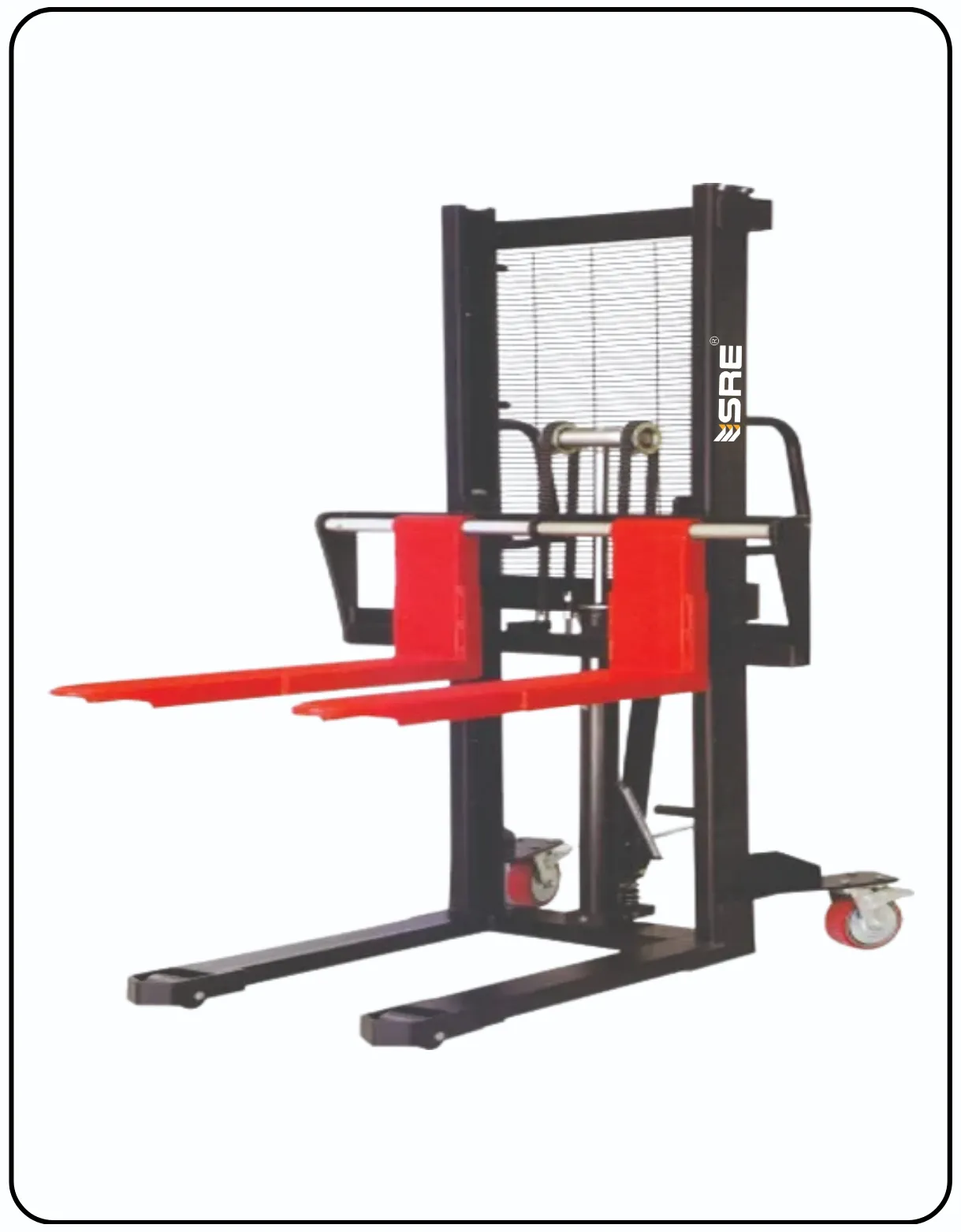
Applications Of Hydraulic Stacker And Key Features Of Hydraulic Stacker In Nashik
500 Kg x 1.6 Meter H (All Size Available)
Rs.30000
(Taxes to be paid extra)
Brand: SRE
SKU: SRE 111
Min Order Qty: 1
Small warehouse owners, production store managers, and logistics supervisors in Nashik who need to stack pallets and materials on racking shelves up to 1.6 metres high — without the capital investment of a powered electric stacker or the complexity of forklift operation — face a straightforward but important procurement decision: which hydraulic stacker model is built well enough to survive daily use in a Nashik MIDC industrial environment without failing at the hydraulic pump seal within the first 12 months. The answer specified by small and medium manufacturers, warehouses, and workshops across Nashik, Pune, and Maharashtra is the Hydraulic Stacker in Nashik from SRE Material Handling Equipment Pvt. Ltd. — the SRE 111, rated at 500 kg capacity with a 1.6 metre maximum lift height, available from Rs. 30,000 (taxes extra), manufactured under ISO 9001:2015 quality management in Ahmedabad and supplied PAN India.
Key Features Of Hydraulic Stacker That Deliver Reliable Daily Performance In Nashik And Maharashtra Warehouses
500 kg Rated Hydraulic System — Heavy-Duty Pump Built for Production-Floor Use
Store managers and warehouse supervisors in Nashik, Pune, and Ahmedabad who have operated budget hydraulic stackers know the common failure pattern: within 3–6 months of daily use above 300 kg, the pump rod seal begins leaking hydraulic oil onto the floor, lift speed drops, and the stacker can no longer reach maximum lift height under full load. This happens because low-cost stackers use standard commercial-grade pump seals not rated for industrial-duty cycling at rated load. The SRE 111 Hydraulic Stacker uses a double-acting piston pump with a chrome-bore cylinder rod of 40 mm diameter and industrial-grade polyurethane lip seals rated for a minimum of 300,000 pump strokes before seal replacement is required — approximately 3–5 years of normal single-shift use in a Nashik warehouse environment. Hydraulic oil grade is ISO VG 46, factory-filled in a sealed reservoir preventing dust and moisture contamination common in Nashik MIDC workshop environments during the monsoon season. The release valve provides controlled gradual descent at a governed speed of 0.05–0.08 m/s, preventing sudden load drops that cause pallet damage.
Mast and Straddle Frame — Stable Load Positioning at 1.6 Metre Rack Height
Racking supervisors in Nashik, Bhopal, and Indore whose warehouse operators use stackers to place pallets on second-level racking beams at 1.4–1.6 metres report a consistent safety concern with poorly fabricated stackers: mast deflection under load at maximum height creates a tilting moment that causes the front of the straddle legs to lift off the floor — the first stage of a tip-over incident. The SRE 111 Hydraulic Stacker mast is fabricated from MS steel IS 2062 duplex-channel profile sections with gusset plates at the mast base, providing a calculated mast deflection of less than 8 mm at maximum height under full 500 kg load — within the safe deflection limit that prevents straddle leg liftoff. The straddle legs extend to a 1,000 mm straddle width (standard, adjustable on some configurations to 1,200 mm for wider pallets) and are fabricated from MS flat bar 50 mm × 10 mm with PU-coated straddle wheel sets rated at 300 kg per wheel. All SRE 111 units are manufactured by SRE Material Handling Equipment Pvt. Ltd. at the Ahmedabad plant and load-tested at 125% of rated capacity (625 kg) before dispatch.
Applications Of Hydraulic Stacker Across Industries In Nashik, Maharashtra, And PAN India
Shop floor supervisors, store managers, and procurement officers in Nashik, Ahmedabad, Pune, and Jaipur deploy a hydraulic stacker wherever pallet or material stacking is required at heights up to 1.6 metres at moderate cycle frequencies without powered drive investment. Proven applications include:
- Small FMCG and general warehouses in Nashik (Satpur, Ambad, Deolali): Pallet put-away and picking on single-depth racking up to 1.5 metres beam height — 20–40 cycles per shift without operator fatigue at 500 kg capacity
- Manufacturing raw material stores in Nashik MIDC: Raw material pallet positioning at store rack shelves, in-process WIP pallet stacking, and finished goods staging at despatch zones
- Pharma and chemical warehouses in Nashik and Vadodara: Bulk ingredient and packaging material pallet stacking in GDP-compliant storage areas — SS 304 fork option available for hygiene compliance
- Construction material stores in Jaipur, Udaipur, and Rajasthan: Tile, sanitary ware, and packaging material pallet stacking at distributor and dealer stockyards
- Auto ancillary parts stores in Nashik MIDC and Pune: Engine component kits, fastener bulk cartons, and assembly sub-component pallet stacking at JIT parts stores
- Textile and apparel warehousing in Surat, Bhavnagar, and Ahmedabad: Fabric roll and garment carton stacking on lower racking levels in climate-controlled warehouses
- Food processing raw material stores in Gujarat (Himmatnagar, Mahesana): Ingredient bag and packaging material pallet stacking with food-grade SS 304 fork surface
- Hospital and healthcare stores in Noida, Gurugram, and Faridabad: Medical consumable and equipment carton stacking in hospital central stores — narrow aisle configuration fits hospital receiving bays
- Retail back-of-store operations in Nashik, Pune, and Indore: Replenishment stock pallet stacking in retail stockrooms with limited floor space
- Export packing stations in Nashik and Aurangabad: Finished goods carton pallet stacking for container loading preparation at export-oriented units
How Hydraulic Stacker Compares To Manual Stacker And Semi-Electric Stacker In Nashik And Gujarat
| Feature | Manual Stacker (Hand Pump) | SRE 111 Hydraulic Stacker | Semi-Electric Stacker |
|---|---|---|---|
| Lift Drive | Hand pump — operator effort | Foot pump — ergonomic, standing operation | Electric motor lift + manual push |
| Capacity (SRE 111) | Up to 1,000 kg (custom) | 500 kg standard (custom up to 2,000 kg) | 500–1,500 kg |
| Lift Height | Up to 1.6 m (hand pump) | 1.6 m standard (custom up to 3 m) | Up to 4.5 m |
| Pump Seal Life | 100,000–200,000 strokes | 300,000+ strokes (PU industrial seal) | Electric pump — separate service |
| Power Required | None | None — fully manual | Electric charging required |
| Price (INR) | Rs. 20,000–28,000 | Rs. 30,000 (SRE 111) | Rs. 55,000–1,00,000 |
| Best Use Case | Very low volume, light loads | Regular use, 500 kg, up to 1.6 m — no power needed | Frequent use, heights above 2 m |
For Nashik warehouses and stores with 20–50 pallet cycles per shift at heights up to 1.6 metres and no power supply at the stacking location, the SRE 111 Hydraulic Stacker at Rs. 30,000 is the most cost-efficient and maintenance-reliable solution. SRE Material Handling Equipment Pvt. Ltd. supplies bulk orders to logistics companies, retail chains, and manufacturing firms across Maharashtra, Gujarat, Rajasthan, and PAN India with competitive pricing on 5+ unit orders. Contact SRE Material Handling Equipment Pvt. Ltd. for bulk pricing.
How To Order Hydraulic Stacker For Warehouses And Stores In Nashik, Gujarat, And PAN India
Procurement managers in Nashik, Pune, Ahmedabad, and Jaipur placing orders for the SRE 111 Hydraulic Stacker should confirm three parameters: maximum load weight (confirm SRE 111’s 500 kg rating covers the heaviest pallet), maximum racking height (confirm 1.6 m lift height reaches the highest beam level), and fork width requirement (standard 540 mm, adjustable on some models to fit pallet type). For stacking heights above 1.6 metres, see the Hydraulic Stacker range with custom lift heights up to 3 metres. Standard delivery to Nashik and Maharashtra: 7–15 working days; bulk orders (5+ units): 15–25 working days. For related warehouse equipment, also explore the Electric Stacker for powered high-height operations, and the Pallet Truck for floor-level transport. Related blog reading: Hydraulic Stacker Pune and Manual Stacker Pune. Submit an inquiry online for pricing and bulk order terms.
Get the SRE 111 Hydraulic Stacker for your Nashik warehouse — 500 kg, 1.6 m, Rs. 30,000.
📞 Order Now — Call +91 9316 208879 or +91 97247 22404125% load tested · 300,000+ pump stroke seal life · ISO 9001:2015 certified · PAN India delivery
For the authoritative international quality management standard applicable to hydraulic stacker manufacturers, see ISO 9001:2015 Quality Management System standard. For IS standards governing industrial trucks including hydraulic stackers, visit Bureau of Indian Standards (BIS) — IS 7217. For workplace safety guidelines covering hydraulic stackers and pallet handling equipment, refer to OSHA Powered Industrial Trucks safety standard.
Frequently Asked Questions — Hydraulic Stacker For Nashik And Maharashtra Buyers
Q1. What is the rated capacity, lift height, and pump seal life of the SRE 111 Hydraulic Stacker available in Nashik?
The SRE 111 Hydraulic Stacker is rated at 500 kg capacity and 1.6 metre maximum lift height. The chrome-bore cylinder (40 mm rod) with industrial-grade PU lip seals is rated for a minimum of 300,000 pump strokes — approximately 3–5 years of daily single-shift use before seal replacement is required. SRE Material Handling Equipment Pvt. Ltd., an ISO 9001:2015 certified manufacturer, load-tests every SRE 111 at 125% rated capacity (625 kg) before dispatch from Ahmedabad.
Q2. What is the straddle width and fork dimension of the SRE 111 Hydraulic Stacker for use with standard pallets in Nashik warehouses?
The SRE 111 Hydraulic Stacker has a standard straddle leg width of 1,000 mm (adjustable on certain configurations to 1,200 mm) and fork dimensions of approximately 540 mm width × 1,150 mm length. This configuration fits both EUR pallets (800 × 1,200 mm) and standard Indian wooden pallets (1,000 × 1,200 mm) without modification. PU-coated straddle wheels are rated at 300 kg per wheel, preventing floor marking in Nashik painted warehouse environments.
Q3. What is the delivery lead time and warranty for the SRE 111 Hydraulic Stacker for buyers in Nashik and Maharashtra?
Standard delivery of the SRE 111 Hydraulic Stacker to Nashik and Maharashtra is 7–15 working days. Bulk orders of 5+ units are delivered in 15–25 working days with competitive per-unit pricing. SRE Material Handling Equipment Pvt. Ltd. provides a 12-month structural warranty and 6-month hydraulic warranty. Spare parts — including seal kits, PU straddle wheels, and descent valve assemblies — are stocked at the Ahmedabad plant for PAN India dispatch within 2–5 working days.
Q4. Is the SRE 111 Hydraulic Stacker suitable for pharma and food-grade warehouse applications in Nashik and Vadodara?
Yes. SRE Material Handling Equipment Pvt. Ltd. supplies the SRE 111 Hydraulic Stacker with an SS 304 stainless steel fork surface for pharma and food-grade warehouse applications in Nashik, Vadodara, and Hyderabad. The hydraulic oil reservoir is sealed to prevent contamination, and the frame can be supplied with an epoxy powder-coat finish resistant to cleaning chemical washdown. Confirm application requirements at the inquiry stage for correct specification.
Q5. Nashik ya Pune ke warehouse ke liye Hydraulic Stacker ki delivery aur maintenance mein kitna time lagta hai?
Nashik aur Pune ke liye SRE 111 Hydraulic Stacker ki delivery 7 se 15 working days mein hoti hai. Maintenance minimal hai: har 100,000 pump strokes par hydraulic oil flush karein; har 6 months par pump seal condition inspect karein. Spare parts — seal kits, PU wheels, descent valves — SRE Material Handling Equipment Pvt. Ltd. ke Ahmedabad plant se 2–5 working days mein courier dispatch hote hain. 12-month structural warranty included hai.
Q6. Ahmedabad ya Gujarat ke small warehouse ke liye Hydraulic Stacker aur Electric Stacker mein se kaun best hai?
Ahmedabad aur Gujarat ke small warehouses ke liye decision simple hai: agar stacking height 1.6 metres tak hai aur cycles per shift 40 se kam hain, toh SRE 111 Hydraulic Stacker (Rs. 30,000) best value hai — no charging needed, no motor maintenance. Agar height 2 metres+ hai ya cycles 80+ per shift hain, toh electric stacker mein invest karein. SRE Material Handling Equipment Pvt. Ltd. application ke basis par recommend karta hai — free consultation available hai.
Q7. Kya Hydraulic Stacker ki spare parts aur service Noida, Indore, ya Jaipur mein available hai?
Haan. SRE Material Handling Equipment Pvt. Ltd. ke Ahmedabad facility se spare parts — pump seal kits, hydraulic oil (ISO VG 46), PU straddle wheel sets, aur descent valve assemblies — Noida, Indore, Jaipur, aur PAN India ke liye 2–5 working days mein courier dispatch hote hain. AMC (Annual Maintenance Contract) bulk buyers ke liye available hai jisme annual hydraulic inspection aur wheel condition check covered hai.