
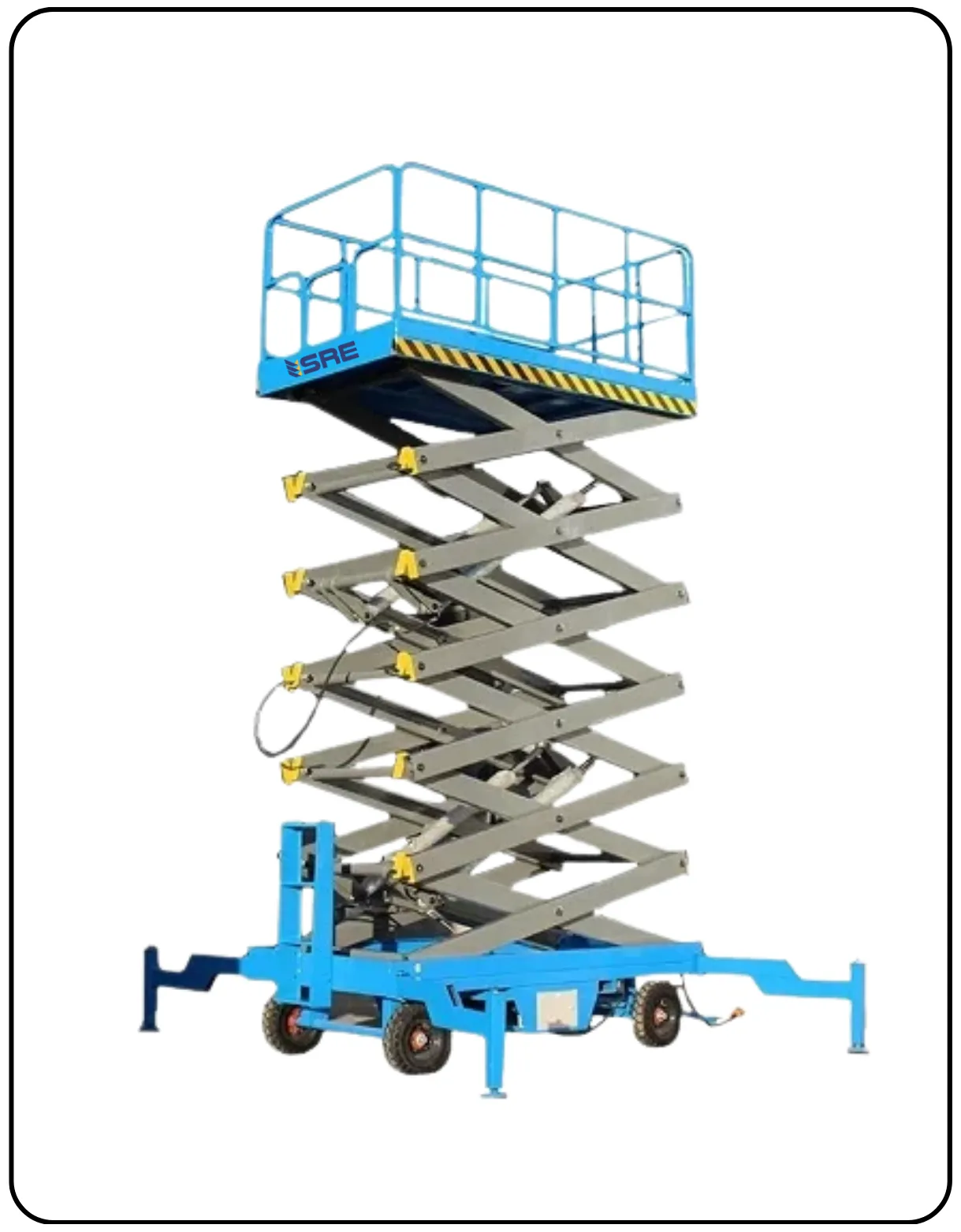
500 kg-900 mm (All Size Available)
Rs. 26000
(Taxes to be paid extra)
Brand: SRE
Min Order Qty: 1
Applications of Scissor Lift Table and Key Features of Scissor Lift Table in Nashik
Production engineers and ergonomics managers across Nashik repeatedly flag the same problem at assembly lines, packing stations, and material transfer points — workers bending to floor level to pick up components or cartons, repeating the same low-position motion every 45–60 seconds across an 8-hour shift. Ergonomics research consistently shows that repeated floor-level bending is the single largest contributor to lumbar musculoskeletal disorders in manufacturing environments, and each lost-time back injury costs a Nashik MIDC factory an average of Rs. 40,000–80,000 in medical, HR, and productivity losses. The purpose-built preventive solution is a Scissor Lift Table in Nashik — a fixed-position hydraulic platform that raises a load from floor level to an ergonomically correct working height, eliminating repetitive bending entirely at production, packing, and transfer stations.
SRE Material Handling Equipment Pvt. Ltd., an ISO 9001:2015 certified manufacturer registered under MSME and the Make in India initiative, manufactures the Scissor Lift Table with a rated capacity of 500 Kg and a maximum platform height of 900 mm, priced at Rs. 26,000 (taxes extra). All sizes are available for custom procurement across Nashik, Pune, Ahmedabad, Vadodara, Gujarat, Maharashtra, and pan India. At Rs. 26,000, this is the most cost-effective ergonomic workstation investment available for any Indian factory floor.
How a Scissor Lift Table Eliminates Ergonomic Injury Risk and Boosts Line Productivity in Nashik, Pune, and Ahmedabad
The Hidden Cost of Floor-Level Work Repetition
A packing operator at a Nashik FMCG plant bending to floor level every 45 seconds makes approximately 640 low-position bends per 8-hour shift. Over a 6-day working week, that is nearly 3,840 lumbar flexion events per worker — a cumulative load that clinical occupational health literature links directly to accelerated disc degeneration and eventual lost-time injury. Beyond individual injury risk, floor-level work is measurably slower — the same operator working at an ergonomically correct height of 750–900 mm completes the same task approximately 18–22% faster because the body position is more efficient. A hydraulic scissor lift table rated at 500 Kg and installed flush with the production line feed point eliminates the floor-level problem at a single, fixed workstation permanently.
How the SRE Scissor Lift Table Works at a Production Station
The SRE Scissor Lift Table uses a hydraulic cylinder actuator connected to a steel scissor arm mechanism fabricated from IS 2062 Grade A MS flat bar. The platform raises from a minimum collapsed height of approximately 200 mm to a maximum height of 900 mm — a travel range that covers the full ergonomic working height spectrum for both seated and standing operators across the population range typical at Maharashtra and Gujarat industrial facilities. The platform deck is 6 mm anti-skid MS checker plate, and the platform perimeter is clearance-safe for forklift or pallet truck loading. Actuation is via a foot pump pedal — hands-free operation that allows the operator to load or unload with both hands simultaneously while activating the lift.
Key Applications of Scissor Lift Table Across Industries in Gujarat, Maharashtra, and Rajasthan
The hydraulic scissor lift table is deployed wherever a fixed workstation needs height-adjustable capability for ergonomic production, packing, or material transfer. Plant managers and production heads across Jaipur, Bhopal, Indore, Hyderabad, and Chennai specify it at every high-frequency manual assembly or packing point. Core applications include:
- Packing & Cartonisation Stations — Nashik & Pune: Raising carton or product pallet to correct packing height for standing operators — eliminates the floor-level bending that causes cumulative lumbar injury in high-frequency packing lines running 400+ cycles per shift.
- Assembly Line Feed Points — Nashik MIDC & Vatva: Presenting component bins and sub-assembly trays at arm-reach height to line assemblers — measurable output gain of 15–20% over floor-level presentation in automotive and electronics assembly lines.
- Goods Receiving Inspection — Ahmedabad & Hyderabad: Raising incoming pallets to QC inspection height so inspectors work at table level rather than crouching — reduces inspection time per batch and eliminates posture-related fatigue in quality control departments.
- Machine Loading & Unloading — Pune & Gurugram: Presenting material at the exact spindle or chuck height of CNC machines, press brakes, and injection moulding machines — eliminating operator lifting effort at every machine load cycle.
- Pharma Dispensing & Weighing Stations — Hyderabad & Chennai: Height-adjustable platform for weighing scales, dispensing cabinets, and batching stations in pharmaceutical manufacturing where operator working height directly affects measurement precision and GMP compliance posture.
- Cold Store Dispatch Staging — Noida & Faridabad: Raising pallets to dispatch platform height in cold stores where operator exposure time at low temperatures is minimised by faster ergonomic working position.
- Steel & Metal Fabrication — Bhavnagar & Kutch: Presenting heavy weldments and machined parts at welding or grinding table height — eliminates ground-level working that is both ergonomically hazardous and a fire risk from grinding sparks at floor level.
Key Technical Features of SRE Scissor Lift Table That Production Engineers in Nashik, Ambala, and Rohtak Specify
Scissor Mechanism, Platform Size and Structural Specifications
The scissor mechanism of the SRE Scissor Lift Table uses 80 × 10 mm IS 2062 Grade A MS flat bar arms with precision-bored pivot points fitted with hardened steel pins and bronze bushings — the critical wear points that determine long-term lift accuracy and platform stability. Platform surface area in the standard configuration is 1,000 × 800 mm, accommodating standard pallets, machine tool fixtures, and carton batches within the 500 Kg rated load. The platform deck is 6 mm anti-skid MS checker plate welded to a 50 × 50 × 5 mm MS angle frame with full perimeter weld inspection per BIS IS 816 weld quality standards. Load is tested at 125% rated capacity — 625 Kg static — before every unit leaves the Ahmedabad factory.
Actuation System, Safety Features and Custom Options
SRE Material Handling Equipment Pvt. Ltd. supplies the standard Scissor Lift Table with a foot-operated hydraulic pump for hands-free actuation and a hydraulic load-holding valve that locks the platform at any selected height — preventing uncontrolled descent even if the hydraulic line develops a fault. For facilities requiring electric actuation — pharma cleanrooms, cold stores, or high-frequency production lines in Nashik, Noida, and Gurugram — an electric-hydraulic power unit (240V single-phase) option is available. Custom platform sizes from 600 × 600 mm to 2,000 × 1,500 mm, capacities from 250 Kg to 5,000 Kg, and lift heights up to 1,500 mm are configurable for facilities in Bhavnagar, Kutch, and Gandhidham with non-standard load or height requirements. Contact SRE for a custom scissor lift table specification and quote.
Why SRE Material Handling Equipment Pvt. Ltd. Is the Preferred Scissor Lift Table Manufacturer for Nashik, Gujarat, and Maharashtra
The SRE Scissor Lift Table at Rs. 26,000 is the most value-competitive ergonomic lift solution manufactured to a verified quality standard in India today. SRE Material Handling Equipment Pvt. Ltd. has served factory owners, plant managers, and logistics heads across Nashik, Pune, Vadodara, Bangalore, Mangalore, Jaipur, Udaipur, Chennai, Hyderabad, Noida, Bhopal, Faridabad, Indore, Rohtak, Ambala, Gurugram, Bhavnagar, Kutch, Himmatnagar, Vatva, Kathwada, Kalol, Gandhidham, Mahesana, and Chattral since 2011. Standard lead time is 1–2 weeks from order confirmation for the standard 500 Kg × 900 mm model.
Facilities deploying scissor lift tables should also review the Mobile Scissor Lift for relocatable workstation applications, the Hand Pallet Truck for floor-level feeding to the lift table, and the Dock Leveler for dock-height management upstream of the production line.
Get a Quote for Scissor Lift Table — Nashik, Pune & Pan India
Standard 500 Kg × 900 mm units at Rs. 26,000. Custom sizes, capacities up to 5,000 Kg, and electric actuation available. Dispatch in 1–2 weeks across Gujarat, Maharashtra, and all India.
Frequently Asked Questions — Scissor Lift Table in Nashik
Q1. What is the load capacity and maximum platform height of the SRE Scissor Lift Table available in Nashik and Pune? EN
The SRE Scissor Lift Table has a rated load capacity of 500 Kg and a maximum platform height of 900 mm, priced at Rs. 26,000 (taxes extra). All sizes are available — custom capacities from 250 Kg to 5,000 Kg and lift heights from 600 mm to 1,500 mm are configurable. SRE Material Handling Equipment Pvt. Ltd., an ISO 9001:2015 certified manufacturer, dispatches to Nashik, Pune, and pan India within 1–2 weeks of order confirmation for standard units.
Q2. Is the SRE Scissor Lift Table available with electric actuation for pharma or cold store facilities in Hyderabad or Chennai? EN
Yes. SRE Material Handling Equipment Pvt. Ltd. offers the Scissor Lift Table with an electric-hydraulic power unit (240V single-phase) as an option for facilities requiring hands-free, push-button height adjustment — particularly pharma cleanrooms, cold stores in Hyderabad and Chennai, and high-frequency production lines in Nashik and Noida where foot pump actuation is not practical. The electric power unit includes an overload protection relay and a hydraulic load-holding valve for safe platform locking at any height. Contact SRE for electric scissor lift table pricing.
Q3. What is the standard platform size of the SRE Scissor Lift Table — is it compatible with standard pallets used in Gujarat and Maharashtra warehouses? EN
The standard SRE Scissor Lift Table platform is 1,000 × 800 mm — compatible with Euro pallets (1,200 × 800 mm) with slight overhang and suitable for standard component trays, carton batches, and machine fixture loading within the 500 Kg rated load. For full EPAL 1,100 × 1,100 mm pallet compatibility, a custom 1,200 × 1,200 mm platform is available. SRE manufactures custom platform sizes from 600 × 600 mm to 2,000 × 1,500 mm for Gujarat and Maharashtra facilities with non-standard load footprints.
Q4. Can procurement managers in Rajasthan, Jaipur, and Noida order Scissor Lift Tables in bulk for multiple plant locations? EN
SRE Material Handling Equipment Pvt. Ltd., registered under MSME and the Make in India initiative, supports multi-location bulk orders from purchase managers across Rajasthan, Jaipur, Udaipur, Noida, and pan India. Standard 500 Kg × 900 mm Scissor Lift Tables at Rs. 26,000 each can be dispatched in batches of 5–20 units within 2–3 weeks of bulk order confirmation. Contact SRE for bulk order pricing and delivery scheduling.
Q5. Nashik ya Pune mein Scissor Lift Table ki delivery kitne time mein milti hai aur price kya hai? HI
SRE Material Handling Equipment Pvt. Ltd. standard 500 Kg × 900 mm Scissor Lift Table (Rs. 26,000) ki delivery Nashik aur Pune mein 1 se 2 weeks mein karta hai order confirm hone ke baad. Custom size ya electric actuation wale units ke liye 2 se 3 weeks lead time applicable hai. ISO 9001:2015 certified manufacturing ke saath har unit ka 625 Kg static load test (125% capacity) hota hai dispatch se pehle. Maharashtra ke factory managers ke liye affordable aur reliable ergonomic solution hai — sirf Rs. 26,000 mein.
Q6. Ahmedabad ya Gujarat ke production line ke liye Scissor Lift Table ka kaunsa size best rahega? HI
Ahmedabad, Vatva, aur Kathwada ki production lines ke liye standard 1,000 × 800 mm platform, 500 Kg capacity, 900 mm height (Rs. 26,000) most popular choice hai — yeh Euro pallets, component trays, aur carton batches sab ko handle karta hai. Jahan full EPAL pallet (1,100 × 1,100 mm) rakhni ho, 1,200 × 1,200 mm custom platform available hai. Bhavnagar aur Kutch ke heavy fabrication shops ke liye 5,000 Kg capacity tak custom units bhi SRE manufacture karta hai.
Q7. Kya Scissor Lift Table ki hydraulic maintenance aur after-sales service Rajasthan, Jaipur aur Bhopal mein available hai? HI
SRE Material Handling Equipment Pvt. Ltd. Scissor Lift Table ke saath hydraulic system maintenance guide, pivot pin lubrication schedule, aur seal replacement guide provide karta hai. Jaipur, Udaipur, Bhopal, Indore, aur Rohtak ke customers direct manufacturer se spare parts aur technical guidance le sakte hain. Hydraulic load-holding valve aur pivot pin bearings annual inspection aur lubrication ke liye sufficient routine maintenance hain. Service life typically 8–10 saal hai regular factory use mein. Inquiry: +91 93162 08879.