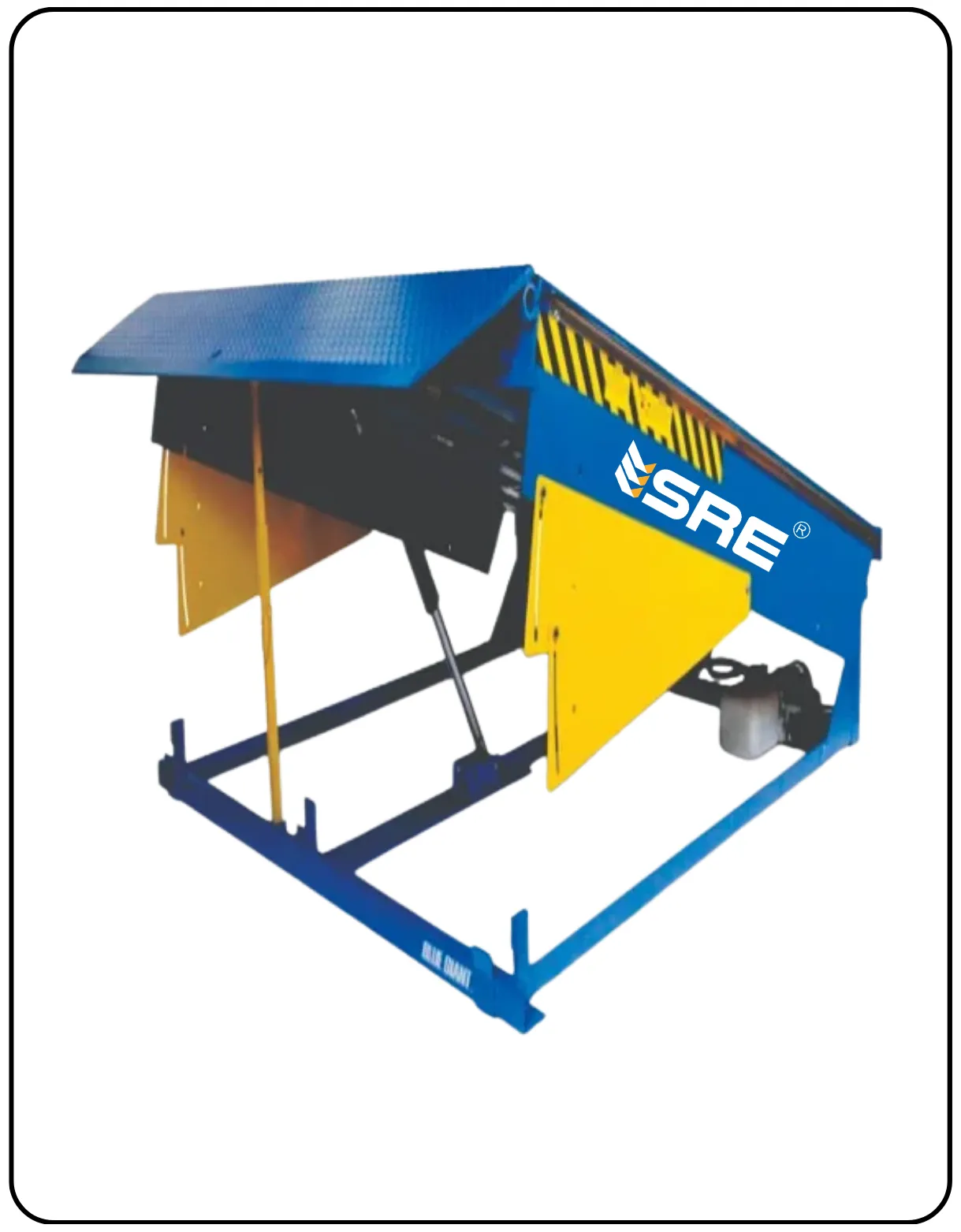
10 Ton x 1.6 Meter (All Size Available)
Rs. 230000
(Taxes to be paid extra)
Brand: SRE
SKU: SRE 163
Min Order Qty: 1
Applications of Industrial Dock Leveler and Key Features of Industrial Dock Leveler in Nashik
Every loading bay manager in Nashik running a fixed-dock operation knows the problem — trucks arrive with beds sitting anywhere from 900 mm to 1,400 mm above dock floor level, and every millimetre of mismatch translates directly into forklift entry risk, pallet drop damage, and lost loading time. Wooden dock boards crack under repeat forklift loads, and improvised steel plates shift underfoot, creating a live safety hazard on every shift. The engineered answer is an Industrial Dock Leveler in Nashik — a permanently installed, load-rated bridge mechanism built from IS 2062 Grade MS steel, designed to compensate for truck height variation and allow forklift entry at a consistent, safe angle across every loading cycle.
SRE Material Handling Equipment Pvt. Ltd., an ISO 9001:2015 certified manufacturer registered under MSME and the Make in India framework, manufactures the Industrial Dock Leveler (SKU: SRE 163) with a rated capacity of 10 Ton × 1.6 Meter width, priced at Rs. 2,30,000 (taxes extra). All sizes are available for custom orders from Nashik, Pune, Ahmedabad, Vadodara, Gujarat, Maharashtra, and across pan India. Whether your facility handles automotive components, FMCG goods, pharma consignments, or bulk industrial materials, a correctly specified hydraulic dock leveler or mechanical dock leveler eliminates the single biggest bottleneck at every fixed loading bay.
How an Industrial Dock Leveler Solves Fixed-Bay Loading Problems in Nashik, Pune, and Ahmedabad
The Hidden Cost of Dock Height Mismatches
In high-throughput warehouses across Nashik MIDC and Pune, dock height mismatches are responsible for a disproportionate share of equipment damage claims. A counterbalance forklift entering a truck at an incline exceeding 7° places excessive stress on the front axle, mast bearings, and hydraulic cylinder seals — maintenance engineers at Gujarat logistics hubs report that uncontrolled dock entry angles are the single largest cause of premature forklift hydraulic failures. Beyond equipment cost, there is direct safety exposure: a forklift tipping at a steep dock entry can result in fatal crush injuries. A dock leveler for warehouse rated at 10 Ton eliminates this angle problem entirely by providing a flush, level bridge surface at precisely the truck bed height.
How the SRE Industrial Dock Leveler Works
The SRE Industrial Dock Leveler (SKU: SRE 163) is installed into a recessed dock pit and operates via a hydraulic actuator system powered by a 0.75 kW electric motor, adjusting the platform lip from –200 mm below dock level to +300 mm above dock level — covering virtually all standard truck bed heights used in Maharashtra and Rajasthan logistics operations. The platform is fabricated from IS 2062 Grade A MS structural steel with a 6 mm anti-skid checker plate surface and a hinged lip of 400 mm projection. Cycle time from dock-level to full extension is under 15 seconds, enabling fast truck turnaround at busy bays in Indore, Faridabad, and Noida distribution centres.
Key Applications of Dock Leveler Across Industries in Gujarat, Maharashtra, and Rajasthan
The Industrial Dock Leveler is the standard infrastructure choice for any facility with a permanent, fixed loading bay and regular truck docking operations. Procurement heads and plant managers across Jaipur, Udaipur, Bhopal, Hyderabad, and Chennai deploy it wherever throughput volume and safety compliance demands cannot be met by portable ramps. Core applications include:
- Automotive & Auto-Component Plants — Nashik & Pune: Loading finished assemblies and pressed body panels onto enclosed trucks where dock height consistency within ±50 mm is required to avoid panel damage during forklift entry.
- FMCG & Packaged Goods Distribution — Ahmedabad & Indore: High-frequency docking (40–80 trucks/day) where a fast-cycle hydraulic dock leveler enables continuous shift operation without manual dock board repositioning delays.
- Pharma & Cold-Chain Warehouses — Hyderabad & Chennai: Temperature-controlled facilities where dock seal integration with the leveler lip minimises cold-air loss during loading — a direct energy cost reduction of 15–25% per docking cycle.
- Steel & Heavy Engineering — Bhavnagar, Kutch & Gandhidham: Loading coil stock, fabricated sections, and castings with forklift weights exceeding 5 Ton — the 10 Ton rated dock leveler is the only safe option for these load classes.
- E-Commerce & 3PL Warehouses — Noida, Gurugram & Faridabad: Multi-dock fulfillment facilities where each bay handles 300+ pallet movements per shift and dock leveler reliability directly determines pick-and-ship SLA compliance.
- Textile & Garment Export — Jaipur & Ahmedabad: Container-stuffing operations where a flush dock surface eliminates pallet rocking during entry, preventing bale and carton damage.
- Chemical & Fertilizer Plants — Vatva & Kathwada: Drum and IBC loading operations where floor-level sealing between the leveler and truck prevents spillage at the dock threshold — a MSME and safety compliance requirement at chemical handling facilities.
Key Technical Features of SRE Industrial Dock Leveler That Purchase Managers in Nashik, Ambala, and Rohtak Specify
Structural Build and Surface Specifications
The main platform of the SRE Dock Leveler uses 100×50×6 mm MS channel sections for the primary frame with 50×50×5 mm MS angle cross-bracing at 300 mm centres, giving the platform a dead weight of approximately 650–750 kg depending on the size configuration. The deck surface is 6 mm IS 2062 Grade A MS checker plate with full penetration MIG welds on all structural joints, inspected per Bureau of Indian Standards IS 816 weld quality norms. Every unit is load-tested at 125% of rated capacity — that’s 12.5 Ton static test load on a 10 Ton rated platform — before dispatch from the Ahmedabad manufacturing facility.
Hydraulic System, Safety Features and Custom Options
The hydraulic power unit uses a 0.75 kW, 415V three-phase motor with a dedicated hydraulic cylinder rated for 50,000+ actuation cycles before major service. Safety features include a velocity fuse on the hydraulic line that locks the platform in position if a hydraulic line ruptures — eliminating free-fall risk. A maintenance prop (safety leg) is built into every unit for lockout during dock inspection. SRE Material Handling Equipment Pvt. Ltd., registered as an MSME unit under the Government of India, also offers mechanical spring-operated dock levelers for facilities without three-phase power supply, covering industrial zones in Himmatnagar, Kalol, Mahesana, and Chattral where single-phase or generator-dependent power is common.
Why SRE Material Handling Equipment Pvt. Ltd. Is the Trusted Dock Leveler Manufacturer for Nashik, Gujarat, and Maharashtra Facilities
Factory owners and logistics heads across Nashik, Pune, Vadodara, Bangalore, Mangalore, Jaipur, Udaipur, Chennai, Hyderabad, Noida, Bhopal, Faridabad, Indore, Rohtak, Ambala, Gurugram, Bhavnagar, Kutch, Himmatnagar, Vatva, Kathwada, Kalol, Gandhidham, Mahesana, and Chattral consistently shortlist SRE Material Handling Equipment Pvt. Ltd. because the manufacturing process is transparent and verifiable — incoming raw material certificates, weld inspection records, and load test reports are available with every supply. Production lead time for the standard 10 Ton × 1.6 Meter Dock Leveler (SKU: SRE 163) at Rs. 2,30,000 is 2–3 weeks from order confirmation, with civil drawing support provided for pit construction. Contact SRE for a site-specific dock leveler quote and pit drawing.
Facilities evaluating complete dock infrastructure can also review the Mobile Ramp for open-yard or temporary dock operations, the Hand Pallet Truck for in-dock cargo positioning, and the Hydraulic Stacker for multi-level racking operations adjacent to loading bays.
Get a Quote for Industrial Dock Leveler — Nashik, Pune & Pan India
Discuss pit dimensions, load requirements, and custom width options with our technical team. Standard units dispatch in 2–3 weeks across Gujarat, Maharashtra, and all India.
Frequently Asked Questions — Industrial Dock Leveler in Nashik
Q1. What is the rated capacity and standard size of the SRE Industrial Dock Leveler available for factories in Nashik and Pune? EN
The SRE Industrial Dock Leveler (SKU: SRE 163) carries a rated load capacity of 10 Ton with a standard platform width of 1.6 Meter, priced at Rs. 2,30,000 (taxes extra). All sizes are available — custom widths from 1,800 mm to 2,500 mm and lip projections up to 500 mm are configurable. SRE Material Handling Equipment Pvt. Ltd., an ISO 9001:2015 certified manufacturer, dispatches to Nashik, Pune, and pan India within 2–3 weeks of order confirmation with pit construction drawings included.
Q2. What pit dimensions are required for installing a 10 Ton Dock Leveler at a Nashik or Pune warehouse facility? EN
A standard 10 Ton hydraulic dock leveler installation requires a pit depth of 500–600 mm, width of 1,800–2,000 mm, and length of 2,000–2,400 mm depending on the platform configuration. SRE Material Handling Equipment Pvt. Ltd. provides complete pit construction drawings and civil specifications with every order, so your Nashik or Pune civil contractor can prepare the site accurately. All dimensional data is based on IS 2062 Grade MS steel structural calculations and verified under load testing at 125% rated capacity.
Q3. Is a hydraulic dock leveler or a mechanical dock leveler better for an industrial warehouse in Gujarat or Maharashtra? EN
For high-throughput facilities in Gujarat and Maharashtra with reliable three-phase power, a hydraulic dock leveler is preferred — it cycles in under 15 seconds, requires less operator effort, and maintains consistent platform positioning. For facilities in Himmatnagar, Kalol, or Mahesana with power reliability issues, a mechanical spring-operated dock leveler offers zero electrical dependency. The choice depends on dock volume, power supply reliability, and operator skill — SRE’s technical team can recommend the right type based on your specific facility profile.
Q4. Can procurement heads in Rajasthan, Jaipur, or Udaipur place bulk dock leveler orders for multiple warehouse locations? EN
Yes. SRE Material Handling Equipment Pvt. Ltd., registered under MSME and the Make in India initiative, handles bulk procurement for purchase managers and logistics heads across Rajasthan, Jaipur, Udaipur, and pan India. Standard 10 Ton × 1.6 Meter Dock Levelers (SKU: SRE 163) at Rs. 2,30,000 each are available in multi-unit batches with coordinated delivery schedules. Contact SRE for volume pricing and multi-site delivery planning.
Q5. Nashik ya Pune mein Industrial Dock Leveler ki installation aur delivery kitne time mein hoti hai? HI
SRE Material Handling Equipment Pvt. Ltd. standard 10 Ton × 1.6 Meter Dock Leveler (SKU: SRE 163) ki delivery Nashik aur Pune mein 2 se 3 weeks mein karta hai order confirm hone ke baad. Installation ke liye pit drawing aur civil specification bhi saath milti hai. IS 2062 Grade MS steel se fabricated aur 125% load test ke baad dispatch hoti hai har unit — ISO 9001:2015 certified manufacturing process ke saath Maharashtra ke factory managers ke liye reliable choice hai.
Q6. Ahmedabad ya Gujarat ke warehouse ke liye kaunsa Dock Leveler model best rahega — hydraulic ya mechanical? HI
Ahmedabad, Vatva, Kathwada, aur Gandhidham ke warehouses ke liye jahan reliable three-phase power supply hai, hydraulic dock leveler best choice hai — 15 seconds mein cycle complete karta hai aur 40–80 trucks/day ki high-frequency operations ke liye suitable hai. Jahan power unreliable ho — jaise Himmatnagar ya Kalol ke kuch zones mein — mechanical spring dock leveler better rahega. SRE dono types manufacture karta hai, all sizes available hain.
Q7. Kya Dock Leveler ki after-sales service aur maintenance support Rajasthan, Jaipur aur Bhopal mein milti hai? HI
SRE Material Handling Equipment Pvt. Ltd. har Industrial Dock Leveler ke saath maintenance manual, wear-part list, aur hydraulic system service guide provide karta hai. Jaipur, Udaipur, Bhopal, Indore, aur Rohtak ke customers ke liye technical support direct manufacturer se milta hai. Hydraulic cylinder ki service life 50,000+ actuation cycles hai — typically 5–7 saal regular operation mein. Annual inspection aur hydraulic fluid replacement routine maintenance ke liye sufficient hai. Inquiry: +91 93162 08879.