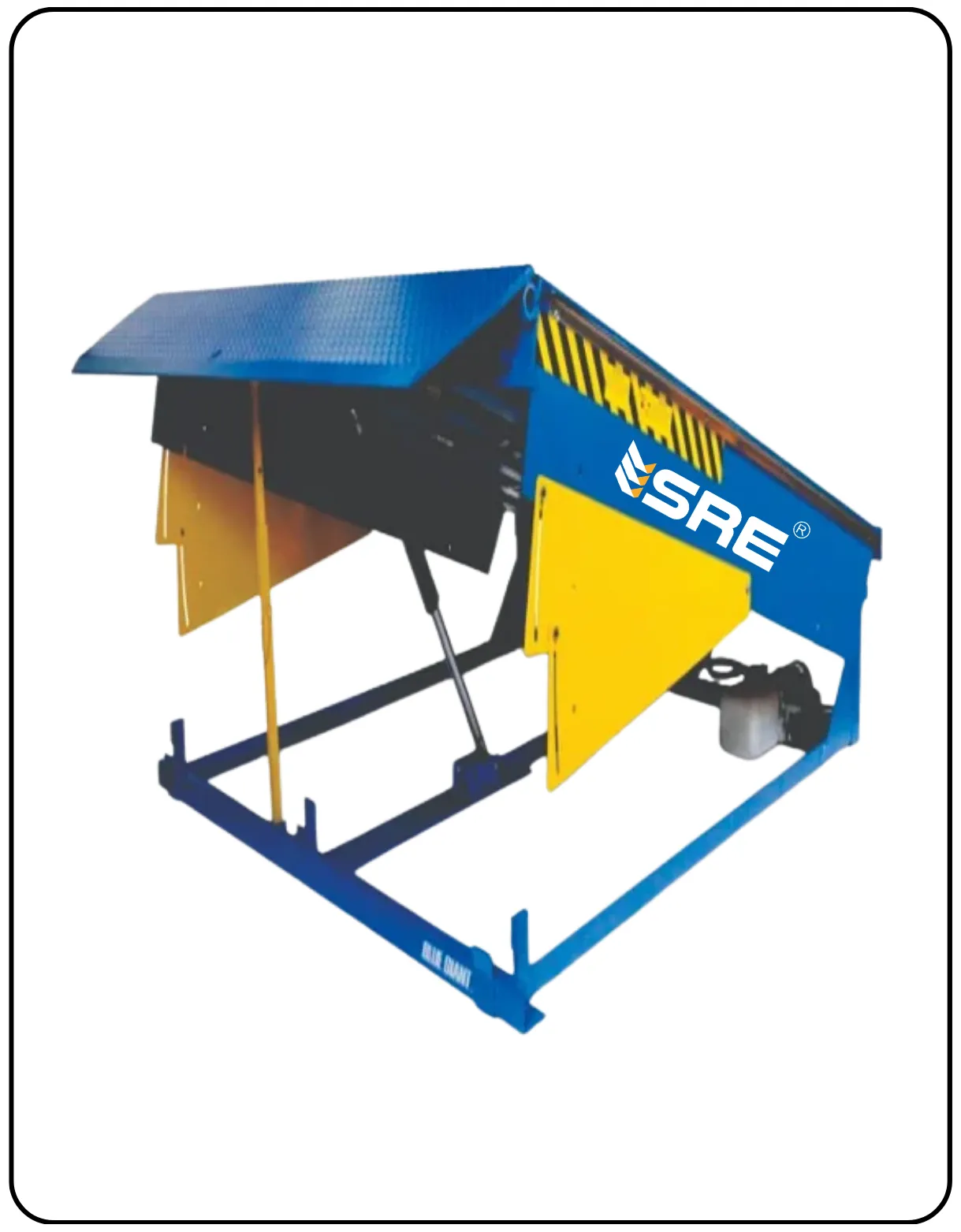
10 Ton x 1.6 Metre (All Size Available)
Rs. 230000
(Taxes to be paid extra)
Brand: SRE | SKU: SRE 163 | Min Order Qty: 1
Applications Of Warehouse Dock Leveler And Key Features Of Warehouse Dock Leveler in Nashik
Warehouse managers and logistics heads operating large distribution centres and manufacturing warehouses in Nashik‘s MIDC, Sinnar, and highway industrial corridor face a daily loading bay problem that directly impacts dispatch throughput: truck beds and trailer floors do not arrive at a fixed height. In Nashik’s busy automotive and FMCG warehouses, truck bed heights can vary from 900 mm to 1,300 mm above dock level — a gap that prevents direct pallet truck access, slows every unloading and loading cycle, creates forklift approach angle risks, and damages goods at the dock edge. The Warehouse Dock Leveler in Nashik from SRE Material Handling Equipment Pvt. Ltd. — the SRE 163 rated at 10 ton capacity with 1.6 metre platform width, priced at Rs. 2,30,000 — bridges this gap permanently, enabling seamless pallet truck and forklift loading across Maharashtra, Gujarat, and Rajasthan distribution centres.
How Warehouse Dock Levelers Are Used in Loading Bay Operations Across Nashik, Bhiwandi, and Gujarat
A warehouse dock leveler — also called a loading dock leveler, dock board, or dock plate bridge — is a hydraulically operated platform installed flush with the dock floor. When a truck docks, the operator activates the hydraulic system to raise the platform above dock level, extend the adjustable lip onto the truck bed, then slowly lower until the lip seats firmly on the truck floor — creating a level, continuous ramp from the warehouse floor onto the truck bed. In Nashik’s automotive component distribution centres doing 30–50 truck loading cycles per day, a properly installed dock leveler reduces each truck docking-to-pallet-truck-access time from 15–20 minutes (using manual dock boards) to under 3 minutes per cycle.
Key Applications of Warehouse Dock Leveler Across Nashik’s Logistics and Industrial Sectors
- Automotive Component Distribution Centres: High-frequency loading and unloading in Nashik MIDC automotive distribution centres doing 30–50 truck cycles per day.
- FMCG and Cold Chain Warehouses: Sealed dock loading for temperature-controlled vehicles in cold chain distribution centres in Nashik, Pune, and Gujarat.
- Pharmaceutical Distribution Hubs: Level loading for pharma product trucks in Nashik and Aurangabad pharma distribution facilities.
- E-Commerce Fulfillment Centres: High-speed truck cycle operations in large e-commerce distribution centres in Nashik, Gurugram, and Faridabad.
- Steel and Building Material Distribution: Heavy forklift loading onto flat-bed and box trucks in Nashik and Bhavnagar building material distribution hubs.
- Food Processing Dispatch: Hygienic sealed loading in food processing despatch docks in Nashik food processing parks.
SRE Material Handling Equipment Pvt. Ltd., an ISO 9001:2015 certified, MSME-registered, Make in India manufacturer in Ahmedabad, supplies warehouse dock levelers in capacities from 6 tonnes to 15 tonnes and platform widths from 1.6 metres to 2.0 metres. Civil pit drawings, anchor bolt specifications, and installation support documentation supplied free with every order. Dispatch to Nashik within 20–30 working days with complete commissioning documentation.
Technical Specifications of SRE Warehouse Dock Leveler (SRE 163) for Procurement Managers in Nashik and Rajasthan
The SRE 163 dock leveler has a rated capacity of 10 tonnes per unit and platform width of 1.6 metres, compatible with standard 40-foot and 20-foot truck and trailer access. The dock leveler platform is fabricated from IS 2062 Grade A MS steel with anti-slip chequerplate surface and dock bumpers. The hydraulic system uses a 0.75–1.5 kW electric pump unit (415V three-phase) with ISO VG 46 hydraulic oil, providing platform adjustment range of +300 mm to -300 mm from dock level — covering truck bed height variations from 900 mm to 1,500 mm. The extendable lip extends 400–500 mm onto the truck bed surface. Safety: lip safety leg preventing collapse; velocity fuse preventing uncontrolled descent. Per ISO 9001 quality standards.
Hydraulic Dock Leveler vs. Mobile Dock Ramp: Which Is Right for Nashik Warehouse Operations?
A mobile dock ramp at Rs. 40,000–1,00,000 is appropriate for facilities doing under 10 truck cycles per day where trucks park at varying locations — the ramp can be repositioned. A fixed hydraulic dock leveler at Rs. 2,30,000 is the correct specification for Nashik distribution centres doing 20+ truck cycles per day at dedicated dock bays — it provides faster cycle time, higher load capacity, and lower labour cost per truck cycle. For Nashik facilities planning a 3–5 year logistics infrastructure investment, the fixed dock leveler reduces labour cost per loading cycle by 60–70% compared to manual dock boards. Explore full Dock Leveler range from SRE, Mobile Ramp solutions, and Mobile Scissor Lift solutions. View: Hand Pallet Truck Services in Nashik. Call Now: +91 9316 208879. Send Inquiry to SRE Material Handling Equipment Pvt. Ltd. Per Make in India. Per BIS standards.
Frequently Asked Questions – Warehouse Dock Leveler in Nashik
What is the load capacity and platform width of a Warehouse Dock Leveler for high-volume loading operations in Nashik?
The SRE Warehouse Dock Leveler (SKU: SRE 163) is rated at 10 tonnes capacity with platform width of 1.6 metres. Platform adjustment range: +300 mm to -300 mm from dock level, covering truck bed heights from 900 mm to 1,500 mm. Extendable lip extends 400–500 mm onto truck bed. Custom capacities from 6 tonnes to 15 tonnes and widths to 2.0 metres available. IS 2062 Grade A MS steel. Civil pit drawings included free.
What is the price of a Warehouse Dock Leveler in Nashik and what civil work is required for installation?
The Warehouse Dock Leveler price in Nashik is Rs. 2,30,000 per unit (taxes extra) for the standard 10-tonne, 1.6-metre model (SRE 163). SRE Material Handling Equipment Pvt. Ltd., an ISO 9001:2015 certified Make in India manufacturer, provides civil pit drawings, anchor bolt specifications, and installation documentation free. Pit dimensions: approximately 1.8 m x 2.5 m x 600 mm deep. Dispatch to Nashik within 20–30 working days.
How much does a Warehouse Dock Leveler improve loading throughput compared to manual dock boards in Nashik distribution centres?
A manual dock board in a Nashik distribution centre takes 15–20 minutes to position per truck and limits entry to lighter equipment. The SRE 163 dock leveler provides vehicle access in under 3 minutes per truck cycle and supports 10-tonne forklift entry. For a facility doing 30 truck cycles per day, this saves 3–5 hours of dock labour per day — recovering the Rs. 2,30,000 investment within 3–5 months in labour savings alone.
What safety features does the SRE Warehouse Dock Leveler include for EHS compliance in Nashik logistics facilities?
The SRE 163 dock leveler includes: lip safety leg preventing platform collapse if hydraulic pressure fails; velocity fuse preventing uncontrolled descent; dock bumpers absorbing truck impact and preventing dock structure damage; and anti-slip chequerplate surface. The hydraulic power unit (0.75–1.5 kW, 415V) includes overload relief valve. Full EHS documentation package provided for Nashik warehouse safety audits.
Nashik ya Pune ke large distribution centre ke liye Warehouse Dock Leveler ki delivery time aur civil work specification kya hai?
Nashik aur Pune ke liye SRE Material Handling Equipment Pvt. Ltd. standard model 20 se 30 working days mein deliver karta hai. Civil pit approximately 1.8 m x 2.5 m x 600 mm deep — drawings free milte hain. Rs. 2,30,000 mein hydraulic power unit, extendable lip, dock bumpers, velocity fuse, lip safety leg, aur EHS documentation included hain. ISO 9001:2015 certified.
Nashik ke cold chain ya pharma distribution warehouse ke liye Warehouse Dock Leveler ya Mobile Ramp — kaun sa better choice hoga?
Nashik ke cold chain aur pharma distribution centres ke liye jahan dedicated dock bays hain aur 20+ truck cycles per day hote hain — fixed hydraulic dock leveler (Rs. 2,30,000) best choice hai — sealed loading, faster cycle, 10-tonne forklift access. Agar trucks varying locations pe park karte hain aur volume under 10 cycles per day hai — Mobile Ramp cost-effective option hai.
Kya Warehouse Dock Leveler ki hydraulic service aur spare parts Nashik ya Aurangabad mein available hain?
Haan — SRE ka service network Nashik, Aurangabad, aur Maharashtra ke sabhi major logistics clusters mein available hai. Hydraulic seal kits, lip hinge assemblies, velocity fuse kits, aur dock bumper sets 48–72 ghante mein available hain. Annual maintenance: hydraulic oil (ISO VG 46) check har 6 mahine, lip mechanism inspection annually — total service cost under Rs. 5,000–8,000 per year.