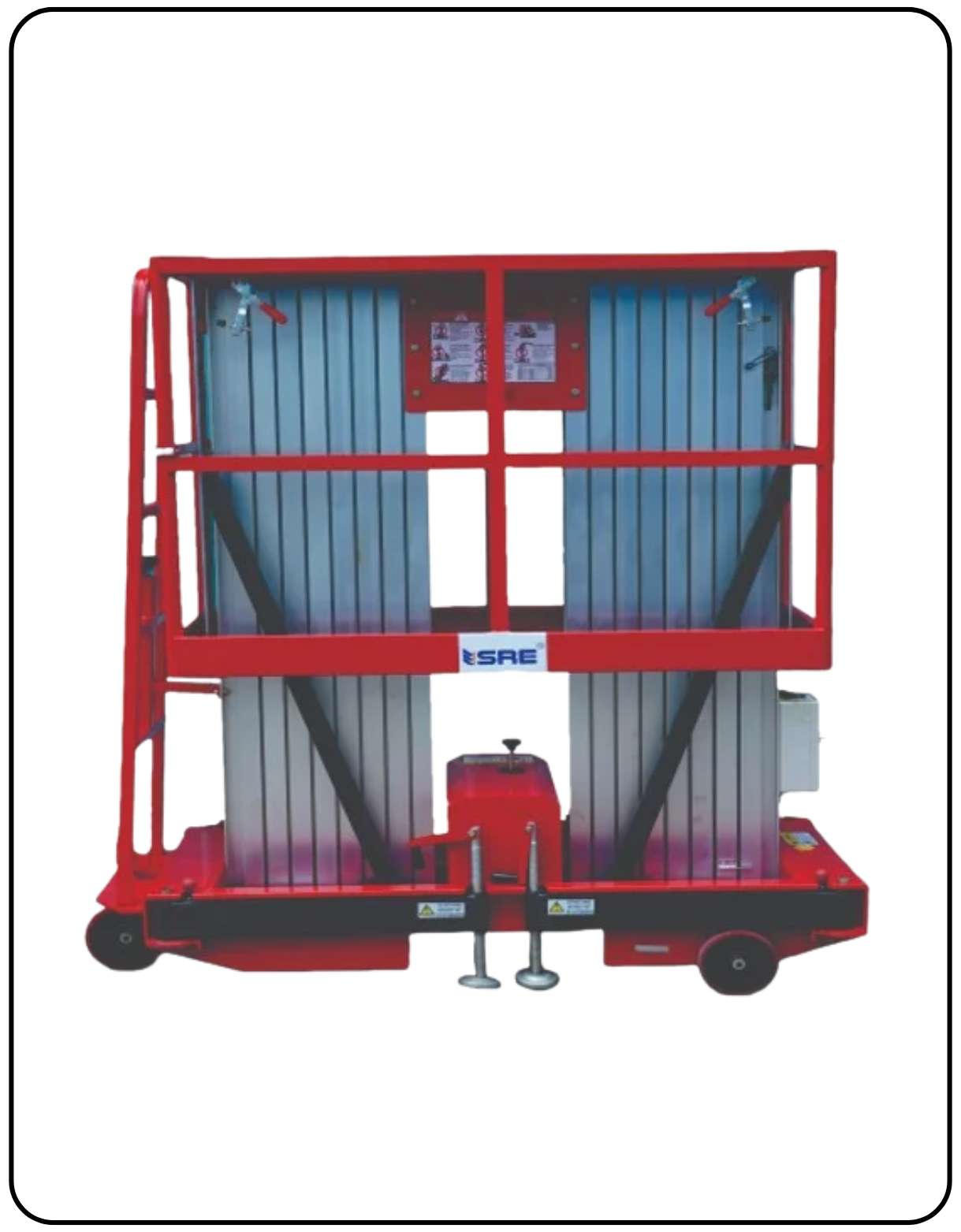
220 Kg × 10 Meter (All Size Available)
Rs. 310000
(Taxes to be paid extra)
Brand: SRE
SKU: SRE 152
Min Order Qty: 1
Applications Of Aerial Work Platform And Key Features Of Aerial Work Platform in Nashik
Maintenance engineers and project managers in Nashik‘s large industrial facilities — the Sinnar Special Economic Zone, MIDC Satpur, Ambad, and the Nashik-Pune and Nashik-Mumbai highway industrial corridor — who need to access heights between 6 and 10 metres face a critical working-at-height specification gap. A single-mast aerial lift handles one operator at up to 6 metres. Scaffolding at 8–10 metres is structurally complex, requires extensive erection time, and cannot be repositioned without full dismantling. A double-mast aerial work platform is the engineered solution for this height range: two mast columns provide the lateral stability needed for two-person tasks at 10 metres, with a larger platform that accommodates two operators plus tools, and battery-electric self-drive that eliminates the scaffolding erection cycle entirely. The Aerial Work Platform in Nashik from SRE Material Handling Equipment Pvt. Ltd. — the SRE double mast AWP (SKU: SRE 152) — carries 220 kg to 10 metres working height, priced at Rs. 3,10,000, and is the standard specification for high-bay industrial maintenance in Nashik, Aurangabad, and across Maharashtra.
How Aerial Work Platforms Are Used in High-Bay Industrial Maintenance Across Nashik, Aurangabad, and Maharashtra
A double mast aerial work platform — also called a twin mast AWP or double mast personnel lift — uses two vertical mast columns connected by a cross-beam to carry a platform of typically 800 mm × 1200 mm to 1200 mm × 1500 mm to working heights of 8–12 metres. The dual-mast architecture provides significantly greater platform stability than a single-mast unit at heights above 6 metres — a critical safety factor when two operators are working side-by-side on an overhead task such as large-area ceiling replacement, structural beam painting, or major conveyor system overhaul. In Nashik’s large automotive plants, steel fabrication shops, and food processing facilities — where ceiling heights routinely reach 8–12 metres — the double mast AWP is the working-at-height tool that handles the height range between a single-mast unit and a boom lift.
Key Applications of Aerial Work Platform (Double Mast) Across Nashik’s High-Bay Industrial Sectors
- High-Bay Automotive Plant Overhead Maintenance: Overhead conveyor overhaul, large-area ceiling fixture replacement, and structural steel inspection in high-bay automotive assembly plants in Nashik MIDC Satpur, Sinnar SEZ, and Pune with ceiling heights of 8–12 metres.
- Large Warehouse High-Bay Ceiling Work: High-bay lighting replacement, sprinkler system overhaul, and rack anchorage inspection in Nashik and Bhiwandi high-bay warehouses storing racking to 8–10 metre heights.
- Food Processing & Brewery Facilities: Two-person elevated access for duct, vessel, and process equipment maintenance in Nashik’s large food processing and winery facilities — battery-electric, zero-emission operation in food-safe environments.
- Steel Plant & Heavy Fabrication: Overhead crane runway beam maintenance, structural painting, and gantry inspection in steel plants and heavy fabrication shops in Nashik, Bhavnagar, and Vatva.
- Power Plant & Infrastructure Maintenance: Overhead cable tray installation, lighting maintenance, and structural inspection in power plant buildings and substation structures in Maharashtra and Gujarat.
- Airport & Stadium Construction & Maintenance: Large-area ceiling access for airport terminal and stadium MEP installation and maintenance in Nashik, Pune, and Mumbai.
- Pharmaceutical Manufacturing Overhead Access: Two-person HVAC and process pipe maintenance in GMP pharma manufacturing facilities in Nashik, Aurangabad, and Ahmedabad.
- Cold Storage & Refrigeration Plant High-Bay Access: Two-person evaporator unit service and refrigerant line maintenance in high-bay cold storage facilities in Gujarat and Maharashtra.
SRE Material Handling Equipment Pvt. Ltd., an ISO 9001:2015 certified, MSME-registered, Make in India manufacturer in Ahmedabad, supplies aerial work platforms in working heights from 6 metres (single mast) to 14 metres (double mast) and platform capacities from 130 kg to 300 kg. Standard dispatch to Nashik, Pune, and across Gujarat, Maharashtra, and Rajasthan within 15–25 working days, with complete load test certificate, structural inspection report, and operator training documentation.
Key Technical Features of SRE Double Mast Aerial Work Platform (SKU: SRE 152) for Plant Engineers in Nashik and Aurangabad
The SRE Double Mast AWP (SRE 152) carries 220 kg — two operators plus approximately 20–40 kg of tools and materials — to a working height of 10 metres. Platform dimensions are typically 1000 mm × 1500 mm, providing a large, stable working area for two-person overhead tasks. The dual-mast structure is fabricated from IS 2062 Grade A MS steel with precision-machined rack-and-pinion drive channels on both mast columns, ensuring synchronized lift and level platform travel throughout the full 10-metre height range. The base chassis is designed for indoor use with a footprint of approximately 1200 mm × 1600 mm. The 48V electric drive and lift system is powered by a lithium-ion or sealed lead-acid battery providing 6–8 hours of operational runtime per charge.
Structural Safety Systems, Load Testing, and EHS Certification for Nashik High-Bay Facilities
The SRE SRE 152 double mast AWP is equipped with: full-perimeter guardrails at 1100 mm height with mid-rail and toeboard on all four sides of the platform; a tilt sensor that stops all lift and drive functions if floor gradient exceeds 3 degrees; a drive interlock preventing horizontal travel when platform height exceeds 2.5 metres, eliminating tip-over risk; and an emergency descent system providing controlled lowering at 0.15 m/s maximum. Every unit undergoes a factory structural load test at 125% rated capacity (275 kg) on both masts simultaneously before dispatch — a rigorous two-point load test that validates mast synchronisation as well as individual mast structural integrity. The test certificate is issued with the unit for EHS compliance documentation in Nashik MNC and Tier-1 automotive facility audits. Per ISO 9001 quality management standards. Compare with the Aerial Lift in Nashik (Single Mast) for single-operator applications.
Single Mast AWP vs. Double Mast AWP vs. Self Propelled Scissor Lift — Which Is Right for Procurement Managers in Nashik, Bangalore, and Hyderabad?
The three working-at-height platforms serve clearly distinct requirements. A single mast AWP at Rs. 1,75,000 — with its 800 mm base width — is specified for one-operator, narrow-aisle access to 6 metres in rack aisles and production corridors. A double mast AWP at Rs. 3,10,000 adds two-operator platform capacity at heights up to 10 metres with greater stability from the dual-column structure — the correct specification for large-area, two-person overhead maintenance in high-bay industrial facilities in Nashik, Hyderabad, and Bangalore. A self propelled scissor lift at Rs. 6,90,000 adds full drive-from-platform capability and a much larger platform (up to 1200 mm × 2400 mm) but requires significantly wider aisles. For plant managers in Nashik with ceiling heights of 8–10 metres and two-person maintenance requirements, the double mast AWP is the cost-optimal specification at roughly half the cost of a self propelled scissor lift.
For multi-unit fleet procurement by large industrial groups in Nashik, Aurangabad, and Pune, SRE Material Handling Equipment Pvt. Ltd. provides fleet pricing on 2+ unit orders, phased delivery, and AMC options with spare parts coverage across Maharashtra within 48–72 hours. Explore the full Aerial Work Platform range from SRE including single-mast and self-propelled models. View related: Fully Automatic Self Scissor Lift Table in Nashik for large-area self-propelled comparison. Explore Mobile Scissor Lift solutions for flexible platform needs. 📞 Call Now: +91 9316 208879 — Get Free Double Mast AWP Quote for Nashik. Send Fleet Inquiry to SRE Material Handling Equipment Pvt. Ltd. Per Make in India manufacturing standards.
Why EHS Compliance Teams in Nashik, Jalgaon, Dhule, and Mangalore Choose SRE Double Mast AWPs Over Scaffolding at 8–10 Metre Heights
Scaffolding at 8–10 metres is operationally complex: erection requires a 4–6 person scaffolding team, takes 3–5 hours, and costs Rs. 15,000–40,000 per erection for a single-point access in a large industrial facility. Dismantling and re-erection for each position change during a large-area maintenance program multiplies this cost by the number of positions — in a Nashik automotive plant doing overhead conveyor maintenance across 50 access points, scaffolding costs can reach Rs. 7,50,000–20,00,000 per maintenance cycle. An SRE Double Mast AWP at Rs. 3,10,000 deploys in under 8 minutes per position and repositions between points in under 2 minutes — a cost that is recovered within 2–4 major maintenance programs in any large Nashik industrial facility. Per BIS structural safety standards.
Frequently Asked Questions — Aerial Work Platform in Nashik
What is the platform capacity and maximum working height of a Double Mast Aerial Work Platform for high-bay maintenance in Nashik?
The SRE Double Mast Aerial Work Platform (SKU: SRE 152) carries 220 kg — two operators plus tools — to a working height of 10 metres. Platform dimensions: 1000 mm × 1500 mm. Custom working heights from 8 to 14 metres and capacities up to 300 kg available for specific Nashik high-bay facility requirements. Factory load-tested at 125% rated capacity (275 kg) on both masts simultaneously. Dual mast structure ensures synchronized lift and level platform throughout the full height range.
What is the price of a Double Mast Aerial Work Platform in Nashik and how does it compare to scaffolding cost for high-bay maintenance?
The Double Mast Aerial Work Platform price in Nashik is Rs. 3,10,000 per unit (taxes extra) for the standard 220 kg, 10-metre model (SRE 152). SRE Material Handling Equipment Pvt. Ltd., an ISO 9001:2015 certified Make in India manufacturer, includes battery, charger, full 4-side guardrail system, tilt sensor, drive interlock, emergency descent, and structural load test certificate. Scaffolding at 8–10 metres costs Rs. 15,000–40,000 per erection — the AWP recovers its purchase price within 8–20 scaffolding setups.
What is the difference between a Single Mast AWP and a Double Mast AWP for two-person overhead maintenance work in Nashik automotive and food processing plants?
A single mast AWP (SRE 151, Rs. 1,75,000) carries 130 kg — one operator — to 6 metres with a 600 mm × 800 mm platform. A double mast AWP (SRE 152, Rs. 3,10,000) carries 220 kg — two operators — to 10 metres with a 1000 mm × 1500 mm platform. The dual-mast structure provides significantly higher lateral stability at heights above 6 metres — essential for two-person tasks and large-area overhead work in Nashik high-bay facilities with ceiling heights of 8–12 metres.
What safety certifications and EHS documentation does the SRE Double Mast AWP provide for compliance in Nashik’s MNC automotive and pharma facilities?
The SRE Double Mast AWP (SRE 152) ships with: factory structural load test certificate at 125% rated capacity (275 kg) on both masts simultaneously; IS 2062 Grade A MS steel material test certificate for the mast structure; and weld inspection records. Safety systems: 1100 mm 4-side guardrails, tilt sensor at 3-degree floor gradient, drive interlock above 2.5 metres, and emergency descent at 0.15 m/s. All documentation satisfies EHS audit requirements in Nashik MNC facilities.
Nashik ya Pune ke high-bay automotive plant ke liye Double Mast AWP ki delivery time aur minimum order kya hai?
Nashik aur Pune ke liye SRE Material Handling Equipment Pvt. Ltd. standard model 15 se 25 working days mein deliver karta hai. Minimum order 1 unit. Rs. 3,10,000 mein 48V battery, charger, 4-side 1100 mm guardrails, tilt sensor, drive interlock, emergency descent, aur factory structural load test certificate included hain. ISO 9001:2015 certified. 2+ units ke fleet orders pe volume pricing aur AMC options available hain.
Nashik ke steel plant ya large warehouse mein Double Mast AWP ya Self Propelled Scissor Lift — kaun sa better choice hoga?
Nashik ke steel plants aur large warehouses ke liye: agar ceiling height 8–10 metres hai aur two-person maintenance chahiye — Double Mast AWP (SRE 152, Rs. 3,10,000) cost-optimal choice hai. Agar maintenance area 2,000 sq ft se upar hai aur frequent repositioning from elevated platform chahiye — Self Propelled Scissor Lift (Rs. 6,90,000) better hai. Double Mast AWP roughly half the cost mein same two-person height access deliver karta hai fixed-position maintenance ke liye.
Kya Double Mast Aerial Work Platform ki battery service aur structural spare parts Nashik, Aurangabad ya Kolhapur mein available hain?
Haan — SRE Material Handling Equipment Pvt. Ltd. ka service network Nashik, Aurangabad, Kolhapur, aur Maharashtra ke sabhi major industrial cities mein available hai. 48V battery packs, rack-and-pinion drive components, tilt sensor kits, aur guardrail assemblies 48–72 ghante mein available hain. Annual maintenance: battery service har 6 mahine, mast drive inspection, tilt sensor calibration — annual service cost under Rs. 5,000–8,000. AMC bhi available hai.