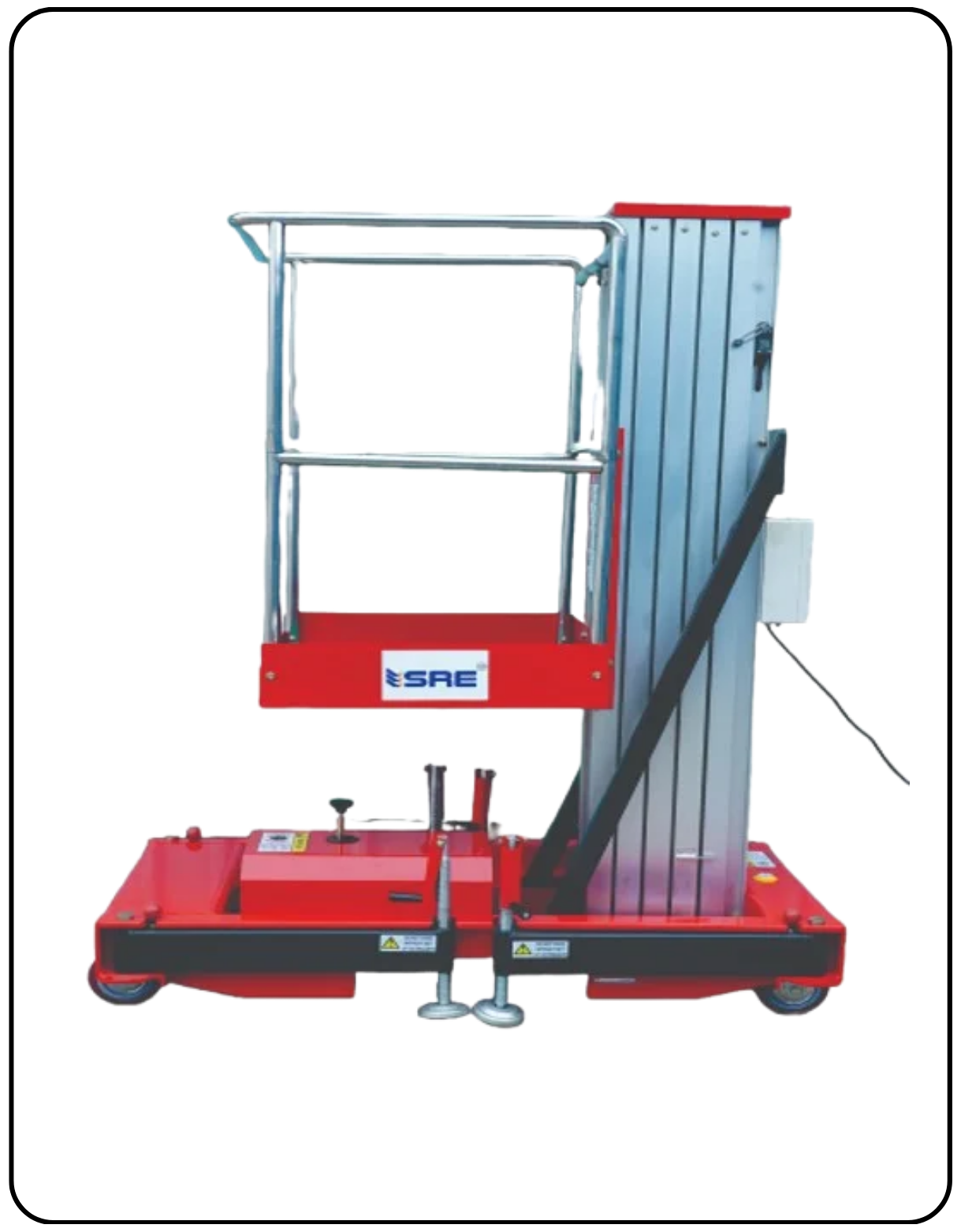
130 Kg–6 Meter (All Size Available)
Rs. 175000
(Taxes to be paid extra)
Brand: SRE
SKU: SRE 151
Min Order Qty: 1
Applications Of Mobile Aerial Work Platform And Key Features Of Mobile Aerial Work Platform in Nashik
Maintenance engineers and EHS managers in Nashik‘s MIDC Satpur, Ambad, and Sinnar industrial clusters face a recurring working-at-height challenge that ladders and fixed scaffolding cannot resolve efficiently: maintenance programs covering overhead conveyor systems, lighting networks, and process pipework above 3–6 metres in narrow factory corridors, warehouse rack aisles, and cleanroom service zones require a platform that the operator can drive to precisely, rise to working height without descending for each repositioning, and operate in aisle widths under 1,000 mm. A full scissor lift’s base width eliminates it from this use case entirely. The Mobile Aerial Work Platform in Nashik from SRE Material Handling Equipment Pvt. Ltd. — the SRE single mast mobile AWP (SKU: SRE 151) — operates in 900 mm clear aisles, carries 130 kg to 6 metres working height, costs Rs. 1,75,000, and deploys in under 5 minutes — replacing scaffolding that takes 45–90 minutes to erect for a single-point maintenance task.
How Mobile Aerial Work Platforms Are Used in Narrow-Aisle and High-Bay Industrial Facilities Across Nashik, Pune, and Aurangabad
The operational defining characteristic of a mobile aerial work platform — as distinct from a scissor lift or boom lift — is its narrow single-mast base design that enables aisle-width deployment. In Nashik’s automotive and food processing plants where production corridors between machine lines average 800–1,100 mm in clear width, the mobile AWP is the only powered working-at-height tool that physically fits. The operator drives the unit into position, presses the platform-mounted rise button, and is at 6-metre working height in under 20 seconds. Between maintenance points, the operator repositions from the elevated platform without descending — a cycle that takes 15–20 seconds per move versus the 4–7 minutes a scaffolding team needs to dismantle, move, and re-erect for each position change.
Key Applications of Mobile Aerial Work Platform Across Nashik’s Industrial Sectors
- Automotive Production Corridor Maintenance: Overhead conveyor service, cable tray installation, vision system sensor alignment, and structural inspection in narrow production corridors between assembly line modules in Nashik MIDC Satpur and Sinnar automotive plants.
- High-Bay Warehouse Rack Aisle Work: Rack beam inspection, overhead sprinkler head maintenance, aisle lighting replacement, and inventory audit at 4–6 metre rack heights in aisles as narrow as 900 mm in Nashik and Pune high-bay warehouses.
- Food Processing Overhead Access: Duct, lighting, and hygiene inspection at ceiling height in food processing facilities in Nashik — battery-electric, zero emission, suitable for food-safe environments without ventilation requirements.
- Pharmaceutical GMP Cleanroom Maintenance: Single-person elevated access for cleanroom HVAC duct, lighting, and process pipe service in GMP-certified pharma plants in Nashik, Aurangabad, and Ahmedabad.
- Cold Storage Overhead Maintenance: Evaporator unit and refrigerant pipework service in cold storage facilities in Maharashtra and Gujarat — lithium-ion battery variant maintains rated performance at temperatures down to -5°C.
- Engineering Workshop & Steel Plant Access: Overhead crane beam inspection, cable management, and roof truss painting in fabrication workshops and steel plants in Nashik, Bhavnagar, and Vatva.
- Commercial Building Interior Maintenance: Ceiling lighting, MEP services, and HVAC maintenance in commercial buildings, malls, and hospitals in Nashik, Pune, and Mumbai with restricted corridor widths.
- Printing & Packaging Plant Overhead Access: Dust collection duct, machine-top, and overhead conveyor service in printing and packaging units in Nashik, Indore, and Bhopal.
SRE Material Handling Equipment Pvt. Ltd., an ISO 9001:2015 certified, MSME-registered, Make in India manufacturer in Ahmedabad, supplies mobile aerial work platforms in working heights from 4 metres to 10 metres and platform capacities from 130 kg to 250 kg. Standard dispatch to Nashik, Pune, and across Gujarat, Maharashtra, Rajasthan, and Bangalore within 10–21 working days, with battery, charger, full guardrail system, and factory load test certificate included.
Key Technical Features of SRE Mobile Aerial Work Platform (SKU: SRE 151) That Purchase Managers in Nashik, Ahmedabad, and Rajasthan Must Verify
The SRE Mobile AWP (SRE 151) carries 130 kg — one operator plus up to 30–50 kg of tools and materials — to a working height of 6 metres on a precision-machined rack-and-pinion mast fabricated from IS 2062 Grade A MS steel. Platform dimensions are typically 600 mm × 800 mm, sufficient for one operator, a tool bag, drill, and small component kit. The base footprint is approximately 800 mm × 1200 mm — enabling deployment in rack aisles and production corridors of 900 mm and above. The 24V, 70Ah lithium-ion battery delivers rated 8-hour operational runtime per charge cycle, supporting a complete single-shift maintenance program in a Nashik or Aurangabad industrial facility without mid-shift recharging.
Safety Interlocks, Drive Mechanism, and EHS Compliance Documentation for Nashik Industrial Facilities
The SRE SRE 151 mobile AWP integrates the following critical safety systems for EHS compliance in Nashik‘s MNC automotive and pharma facilities: full-perimeter guardrails at 1100 mm height with mid-rail and integral toeboard preventing falls; a drive interlock automatically disabling travel when platform height exceeds 1.8 metres, eliminating base tip-over risk during transit at height; an emergency descent function providing controlled platform lowering at a maximum 0.15 m/s in case of battery or motor failure; and an overload sensor that prevents platform ascent when total load exceeds 130 kg rated capacity. Every unit undergoes a factory structural load test at 125% rated capacity (163 kg) before dispatch, with a signed test certificate for EHS audit documentation. Per ISO 9001 quality management standards.
Mobile Aerial Work Platform vs. Scaffolding vs. Standard Scissor Lift — The Right Specification for Factory Owners in Nashik, Bangalore, and Noida
Plant managers in Nashik, Bangalore, and Noida evaluating working-at-height equipment follow a simple specification filter. Scaffolding is appropriate only for permanent or multi-week construction access — setup takes 45–90 minutes and costs Rs. 3,000–8,000 per erection in labour. A standard scissor lift with its 1,000–1,400 mm base width cannot enter standard rack aisles or narrow production corridors — it is specified for open-floor maintenance areas only. A mobile aerial work platform at Rs. 1,75,000 — with its 800 mm base width and 5-minute deployment time — is correct for any facility with narrow-aisle maintenance requirements at heights between 3 and 6 metres. For Nashik automotive and food processing plants running monthly maintenance programs, the payback versus scaffolding rental typically occurs within 10–20 maintenance sessions.
SRE Material Handling Equipment Pvt. Ltd.‘s ISO 9001:2015 certified production facility in Ahmedabad maintains in-stock battery units, mast drive components, and guardrail assemblies — critical for Nashik and Ghandhidham operations where imported spare parts face 4–6 week delivery delays. For multi-unit fleet procurement by facility management companies in Gurugram, Faridabad, and Ambala covering multiple Maharashtra and Gujarat sites, fleet pricing and AMC options are available on orders of 3+ units. Explore the full Aerial Work Platform range from SRE including double-mast options. Compare with the Mobile Aerial Work Platform in Mumbai for cross-city fleet planning. Also explore Mobile Scissor Lift solutions. 📞 Call Now: +91 9316 208879 — Get Free Mobile AWP Quote for Nashik. Send Bulk Fleet Inquiry to SRE Material Handling Equipment Pvt. Ltd.
Why EHS Managers and Procurement Heads in Nashik, Bhavnagar, Kutch, and Mahesana Are Replacing Ladders With SRE Mobile AWPs
In Nashik’s MIDC industrial zones — from Satpur and Ambad to Sinnar and the Nashik-Pune highway corridor — EHS compliance teams face increasing regulatory pressure from factory inspectors to eliminate ladder use for any overhead maintenance task above 2 metres. Every documented ladder-related incident triggers a formal investigation, production halt, and potential penalty notice. The SRE Mobile AWP (SRE 151) with its 1100 mm guardrail system, drive interlock at 1.8 metres, and factory load test certificate provides the documented, certified working-at-height tool that EHS teams need to permanently replace ladder use in narrow-aisle environments. The battery-electric drive means zero fumes and zero noise — deployable inside food processing, pharma, and cold room environments without any special ventilation. For BIS-standard working-at-height compliance in Maharashtra‘s industrial facilities, the SRE mobile AWP is the correct certified specification. View the related Aerial Lift in Nashik blog for single-mast aerial lift comparison. Explore Scissor Lift solutions for above-floor platform needs and Dock Leveler solutions for loading bay height matching. Per Make in India manufacturing policy.
Frequently Asked Questions — Mobile Aerial Work Platform in Nashik
What is the platform capacity and working height of a Mobile Aerial Work Platform for narrow-aisle maintenance in Nashik?
The SRE Mobile Aerial Work Platform (SKU: SRE 151) carries 130 kg — one operator plus up to 50 kg of tools — to a working height of 6 metres on a base footprint of approximately 800 mm × 1200 mm, enabling deployment in production corridors and rack aisles as narrow as 900 mm. Custom working heights from 4 metres to 10 metres and platform capacities up to 250 kg are available for specific Nashik facility requirements. Factory load-tested at 125% rated capacity (163 kg) before dispatch.
What is the price of a Mobile Aerial Work Platform in Nashik and what is included in the standard unit?
The Mobile Aerial Work Platform price in Nashik is Rs. 1,75,000 per unit (taxes extra) for the standard 130 kg, 6-metre model (SRE 151). SRE Material Handling Equipment Pvt. Ltd., an ISO 9001:2015 certified Make in India manufacturer, includes 24V 70Ah lithium-ion battery, charger, full 1100 mm guardrail system, drive interlock, overload sensor, emergency descent function, and factory load test certificate at 125% capacity. Dispatch to Nashik within 10–21 working days.
How does a Mobile Aerial Work Platform reduce maintenance cost compared to scaffolding in Nashik’s automotive and food processing plants?
Scaffolding erection for a single overhead maintenance point in Nashik takes 45–90 minutes and 2–3 workers — typically Rs. 3,000–8,000 per setup. The SRE Mobile AWP deploys in under 5 minutes by one operator with 8-hour battery runtime and repositioning between points in 15–20 seconds. At Rs. 1,75,000, the payback versus scaffolding is achieved within 10–20 maintenance sessions in any Nashik automotive or food processing plant with regular overhead maintenance programs.
What safety features does the SRE Mobile AWP include for EHS compliance in Nashik’s pharma and automotive manufacturing facilities?
The SRE Mobile Aerial Work Platform (SRE 151) includes: 1100 mm full-perimeter guardrails with mid-rail and toeboard, drive interlock above 1.8 metres preventing travel at elevated height, overload sensor halting ascent above 130 kg, and emergency descent at maximum 0.15 m/s. Battery-electric — zero fumes, zero noise — approved for GMP pharma and food-safe environments in Nashik. Every unit ships with a factory load test certificate at 125% capacity for EHS audit compliance.
Nashik ya Pune ke narrow-aisle warehouse ya automotive plant ke liye Mobile Aerial Work Platform ki delivery time aur minimum order kya hai?
Nashik aur Pune ke liye SRE Material Handling Equipment Pvt. Ltd. standard models 10 se 21 working days mein deliver karta hai. Minimum order 1 unit. Rs. 1,75,000 mein 24V 70Ah lithium-ion battery, charger, 1100 mm guardrails, drive interlock, emergency descent system, aur factory load test certificate included hain. ISO 9001:2015 certified manufacturer — har unit ke saath EHS compliance documentation milta hai. 3+ units fleet orders pe volume pricing aur AMC options available hain.
Nashik ke pharma ya food processing GMP facility ke liye Mobile Aerial Work Platform mein kaun sa model suitable hoga aur minimum aisle width kya chahiye?
Nashik ke GMP pharma facilities aur food processing plants ke liye SRE 151 (6-metre working height, 130 kg platform capacity) standard specification hai. Minimum clear aisle width 900 mm required hai. Battery-electric operation — zero fumes, zero emissions — GMP compliance requirements satisfy karta hai bina special ventilation ke. SS 304 stainless steel platform surface food-grade facilities ke liye available option hai. SRE Material Handling Equipment Pvt. Ltd. free technical consultation provide karta hai before order.
Kya Mobile Aerial Work Platform ki battery service aur spare parts Nashik, Aurangabad ya Jalgaon mein available hain aur AMC kya hota hai?
Haan — SRE Material Handling Equipment Pvt. Ltd. ka service network Nashik, Aurangabad, Jalgaon, aur Maharashtra ke sabhi major industrial cities mein available hai. 24V 70Ah lithium-ion battery packs, charger units, drive controller boards, aur guardrail assemblies 48–72 ghante mein available hain. Annual maintenance: battery capacity check har 6 mahine, mast drive chain lubrication, overload sensor calibration — annual service cost under Rs. 3,000–5,000. AMC bhi available hai.