
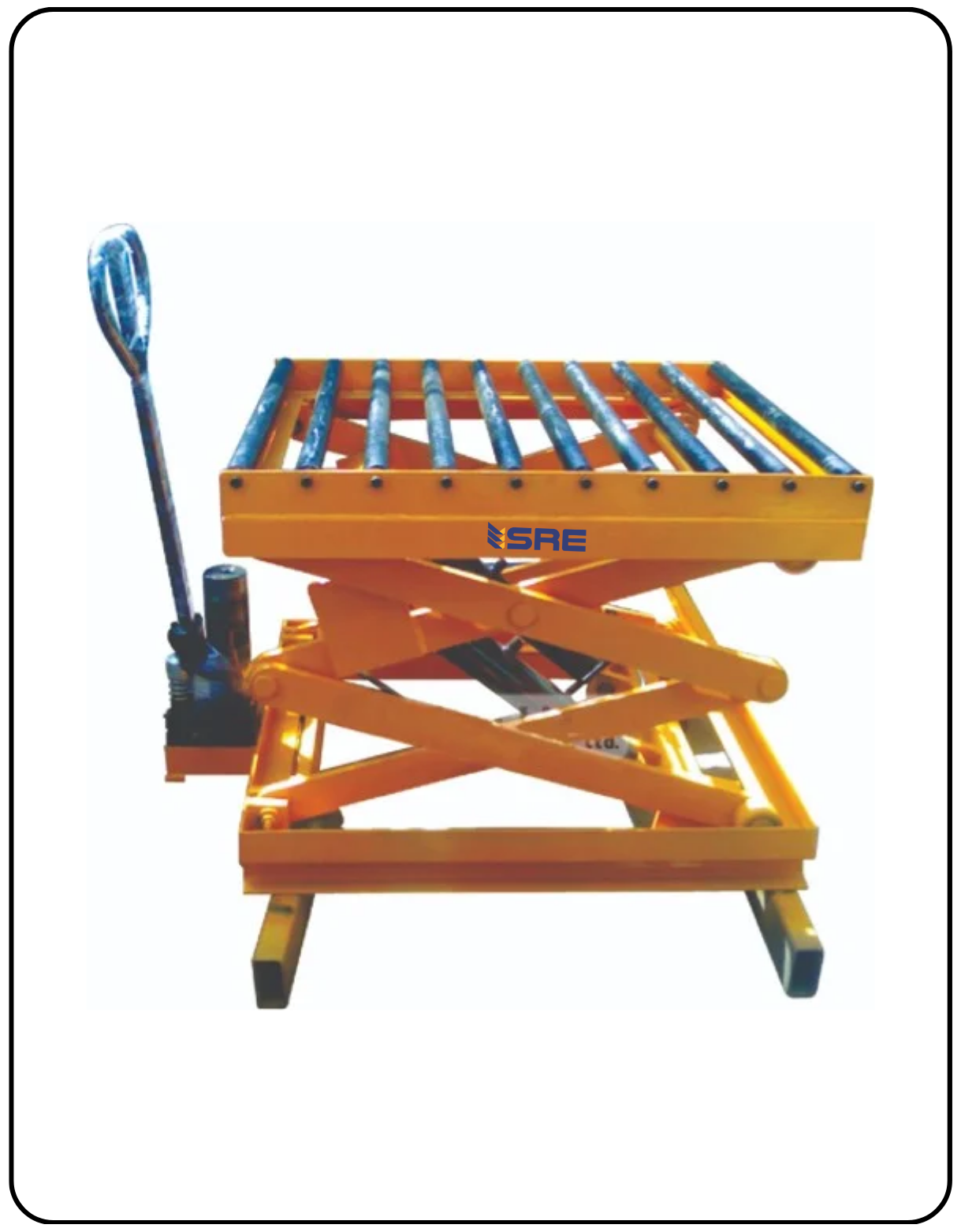
500 kg × 1500 mm H (All Size Available)
Rs. 75000
(Taxes to be paid extra)
Brand: SRE
Min Order Qty: 1
Applications Of Pit Mounted Die Loader And Key Features Of Pit Mounted Die Loader in Nashik
Press shop managers in Nashik, Pune, and Aurangabad who operate stamping and forging presses know that die change time is one of the most significant non-value-added losses in any sheet metal or press shop operation. A standard die change on a 500-tonne press using manual crane slinging can take 45–90 minutes, consuming crane time that disrupts other operations and requiring two to four skilled workers to manage a die that may weigh 200–500 kg. Every hour of die change time is a direct production hour lost. The Pit Mounted Die Loader in Nashik from SRE Material Handling Equipment Pvt. Ltd. is the engineered solution — a hydraulic lifting table installed flush into the press shop floor that raises dies to press bolster height precisely and safely, priced at Rs. 75,000 for the standard 500 kg, 1500 mm height configuration, and designed to reduce die change time to under 15–20 minutes across Nashik’s automotive and engineering press shops.
How Pit Mounted Die Loaders Are Used in Press Shop Operations Across Nashik, Pune, and Gujarat
A pit mounted die loader — also called a pit die change table or hydraulic die loading platform — is installed into a recessed pit cut in the press shop floor, with the platform surface flush with floor level when lowered. A die cart carrying the incoming die rolls across the floor onto the flush platform; the hydraulic mechanism raises the die to press bolster height precisely; the die slides horizontally into the press bolster without crane involvement or manual lifting. In Nashik’s automotive press shops — where die changes happen 4–8 times per shift across multiple presses — this reduction in change time from 60–90 minutes to 15–20 minutes adds 3–6 hours of additional press operating time per shift, directly improving machine utilisation from a typical 60–65% OEE to 80–85%.
Key Applications of Pit Mounted Die Loader in Manufacturing Sectors
- Automotive Stamping Press Shops: Die change on 100–1000 tonne presses in automotive body panel plants in Nashik, Pune, and Chennai — reducing die change from 60–90 min to 15–20 min.
- Sheet Metal Fabrication: Loading forming and punching dies into hydraulic press brakes and power presses in sheet metal shops in Nashik, Aurangabad, and Vatva.
- Forging & Casting Die Changes: Placing heavy forging dies in drop forges and hammer presses in forging units in Rajkot, Jamnagar, and Faridabad.
- Injection Moulding Tooling: Die/mould change on large injection moulding machines in plastics and rubber manufacturing plants in Pune, Noida, and Gurugram.
- Rubber & Gasket Press Shops: Mould change operations in rubber press shops serving automotive sealing and industrial rubber products manufacturers in Nashik and Aurangabad.
- Metal Extrusion Plants: Die positioning for aluminium and copper extrusion presses in extrusion facilities in Ahmedabad, Vatva, and Bhavnagar.
SRE Material Handling Equipment Pvt. Ltd., an ISO 9001:2015 certified, MSME-registered, Make in India manufacturer in Ahmedabad, designs and manufactures pit mounted die loaders in capacities from 500 kg to 10,000 kg and working heights from 500 mm to 1,800 mm to match the bolster heights of specific press models. Dispatch to Nashik, Pune, and across Maharashtra within 15–25 working days with full installation drawings and civil specification sheets.
Key Technical Features of SRE Pit Mounted Die Loader for Press Shop Managers in Nashik and Aurangabad
The SRE Pit Mounted Die Loader is fabricated from IS 2062 Grade A MS steel with a welded scissor mechanism rated for 500 kg uniform distributed load at maximum height of 1,500 mm. The platform surface is low-friction roller conveyor or plain chequerplate (application-specific) for smooth die slide-in. The hydraulic cylinder operates on mineral hydraulic oil ISO VG 46, driven by an electric hydraulic power unit (0.37–0.75 kW motor) — controlled via a push-button pendant for precise height adjustment. A safety velocity fuse on the hydraulic line prevents uncontrolled descent; a mechanical safety prop locks the platform at bolster height for the duration of the die change. Pit dimensions for the standard model: 800 mm × 1,200 mm × 500 mm deep (width × length × depth), with civil specification drawings supplied to the facility’s civil contractor. Per BIS structural standards.
Comparison: Pit Mounted Die Loader vs. Crane-Based Die Change in Nashik Press Shops
In a Nashik press shop doing 6 die changes per shift, a crane-based die change at 60 minutes per change consumes 6 hours of production time per shift — representing a 75% press utilisation loss on 8-hour shifts. A pit mounted die loader at 15–20 minutes per change reduces this to 1.5–2 hours per shift, recovering 4–4.5 hours of press time per shift. At a conservative Rs. 5,000 per press-hour value in a Nashik automotive press shop, this represents Rs. 20,000–22,500 of recovered production value per shift — making the Rs. 75,000 die loader investment a 3–5 shift payback in pure production recovery terms. Explore the Pit Mounted Die Loader in Mumbai for cross-city fleet planning. Also view Scissor Lift Tables and Mobile Scissor Lift solutions. 📞 Call Now: +91 9316 208879 — Get Free Die Loader Quote for Nashik. Send Press Shop Inquiry to SRE. ISO 9001 certified.
Frequently Asked Questions — Pit Mounted Die Loader in Nashik
What is the load capacity and maximum height of a Pit Mounted Die Loader for press shop use in Nashik?
The SRE Pit Mounted Die Loader is rated at 500 kg capacity with a maximum working height of 1,500 mm — matching standard press bolster heights in Nashik and Pune automotive press shops. Custom capacities from 500 kg to 10,000 kg and heights from 500 mm to 1,800 mm are available for specific press models. The IS 2062 Grade A MS steel scissor mechanism is factory load-tested before dispatch.
What is the price of a Pit Mounted Die Loader in Nashik and what civil work is required for installation?
The Pit Mounted Die Loader price in Nashik is Rs. 75,000 per unit (taxes extra) for the standard 500 kg, 1,500 mm height model. SRE Material Handling Equipment Pvt. Ltd., an ISO 9001:2015 certified Make in India manufacturer, provides civil pit drawings with every order — standard pit dimensions 800 mm × 1,200 mm × 500 mm deep. Dispatch to Nashik within 15–25 working days.
How much die change time reduction does a Pit Mounted Die Loader deliver in automotive press shops in Nashik?
A pit mounted die loader reduces die change time from a typical 60–90 minutes (crane-based) to 15–20 minutes per change in Nashik automotive press shops. For a press doing 6 die changes per shift, this recovers 4–4.5 hours of press operating time per shift — improving press OEE from 60–65% to 80–85%. The Rs. 75,000 investment typically pays back within 3–5 production shifts.
What safety mechanisms does the SRE Pit Mounted Die Loader include for press shop safety compliance in Nashik and Pune?
The SRE Pit Mounted Die Loader includes: safety velocity fuse (prevents uncontrolled hydraulic descent), mechanical safety prop (locks platform at bolster height during die change), overload relief valve at 110% rated capacity, and push-button pendant control with emergency stop. Platform surface options: low-friction rollers or chequerplate anti-slip. Meets factory safety standards for press shop operations in Nashik and Pune.
Nashik ya Pune ke press shop ke liye Pit Mounted Die Loader ki delivery time aur civil work specification kya hai?
Nashik aur Pune ke liye SRE Material Handling Equipment Pvt. Ltd. standard model 15 se 25 working days mein deliver karta hai. Civil pit dimensions: 800 mm × 1,200 mm × 500 mm deep — drawings order ke saath free mein milti hain. ISO 9001:2015 certified manufacturer — har unit ke saath load test certificate milta hai. Rs. 75,000 mein hydraulic power unit, velocity fuse, safety prop, aur pendant control included hain.
Nashik ke automotive press shop ke liye Pit Mounted Die Loader ka sahi capacity aur height kaun sa hoga?
Nashik ke 100–500 tonne presses ke liye standard 500 kg, 1,500 mm height model most common specification hai. Heavy dies (1,000–5,000 kg) ke liye custom high-capacity variants available hain. Press bolster height measurement confirm karna zaroori hai before ordering — SRE free technical consultation provide karta hai. Roller conveyor top surface die slide-in ke liye recommended option hai.
Kya Pit Mounted Die Loader ki service aur spare parts Nashik ya Aurangabad mein available hain?
Haan — SRE Material Handling Equipment Pvt. Ltd. ka service network Nashik, Aurangabad, aur Maharashtra ke sabhi press shop clusters mein available hai. Hydraulic seal kits, velocity fuse assemblies, aur power unit spare parts 48–72 ghante mein available hain. Recommended maintenance: hydraulic oil check (ISO VG 46) har 3 mahine, safety prop inspection, aur annual load test.