
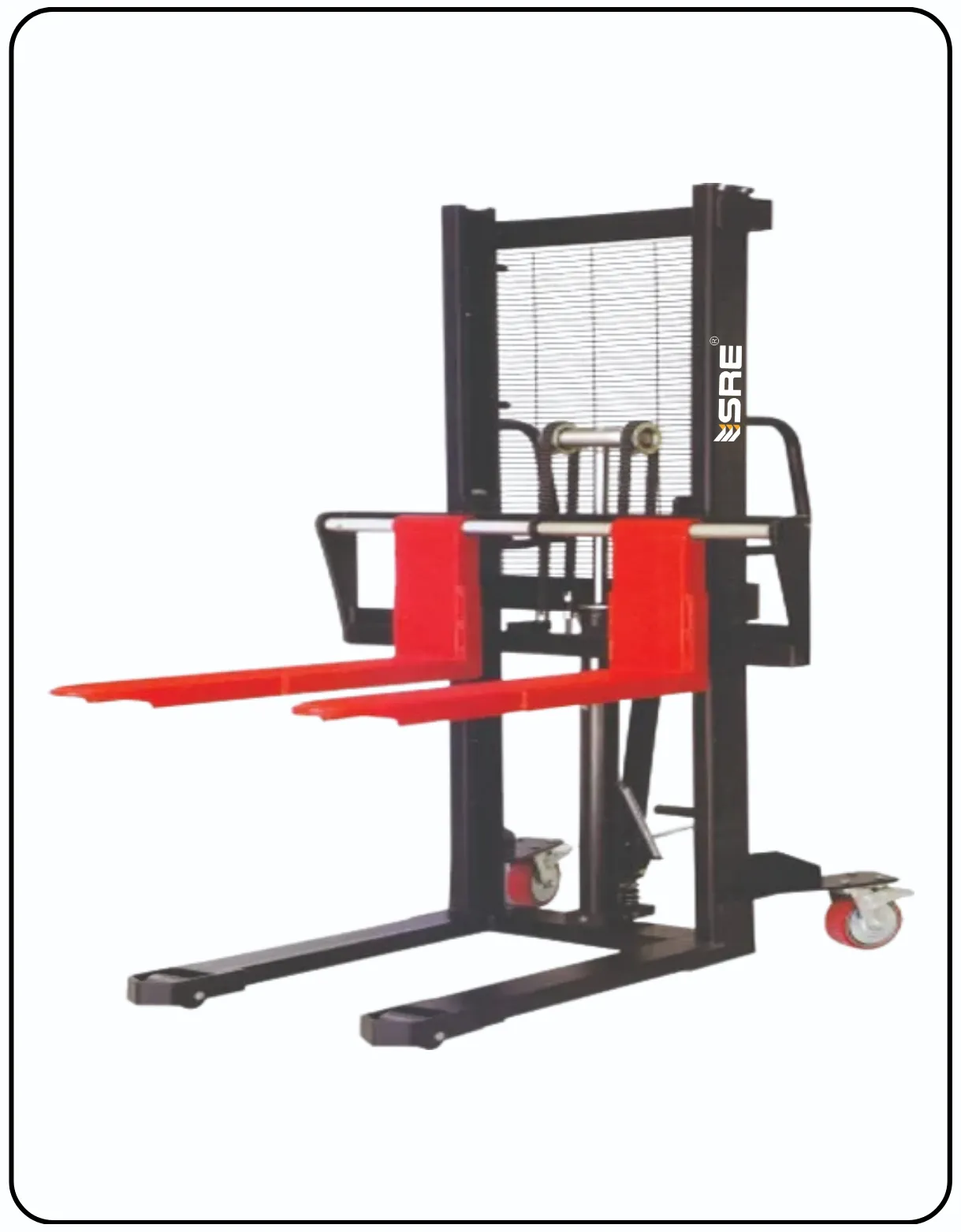
500 Kg × 1.6 Meter H (All Size Available)
Rs. 30000
(Taxes to be paid extra)
Brand: SRE
SKU: SRE 111
Min Order Qty: 1
Applications Of Manual Stacker And Key Features Of Manual Stacker in Mumbai
Factory store managers and small warehouse operators in Mumbai, Thane, and Navi Mumbai who manage daily pallet stacking requirements under 50 movements per shift often find themselves over-specified for an electric stacker that costs Rs. 95,000+ and requires daily battery charging, and simultaneously under-equipped with hand-lifting that damages goods and injures workers. There is a cost-effective middle ground. The Manual Stacker in Mumbai from SRE Material Handling Equipment Pvt. Ltd. — the SRE manual stacker (SKU: SRE 111) — is rated at 500 kg capacity with a 1.6-metre lift height, priced at Rs. 30,000, requires no electricity, no battery, and no charging infrastructure, and is ready to operate from day one in any factory store or warehouse in Mumbai, Bhiwandi, or Maharashtra without any site preparation.
How Manual Stackers Are Used in Factory Stores and Small Warehouses Across Mumbai, Pune, and Gujarat
A manual stacker uses a manual hydraulic pump mechanism — typically a foot pedal or hand lever — to raise the mast and forks through hydraulic pressure. The operator pushes the unit to the racking position, operates the pump to raise the load to the required shelf height (up to 1.6 metres), places the pallet or load on the rack beam, and releases the descent valve to lower the forks. In Mumbai’s SME manufacturing stores doing 20–50 pallet movements daily at heights under 1.6 metres, this is an entirely sustainable operational model. The absence of any electrical or battery system means zero downtime for charging, no battery replacement costs over the equipment’s 7–10 year service life, and full operational capability even during power cuts — a meaningful operational advantage in areas of Maharashtra and Gujarat with variable power supply.
Key Applications of Manual Stacker Across SME Industrial Sectors
- Factory Raw Material & Finished Goods Stores: Low-to-medium frequency pallet stacking in factory stores in Vatva, Kalol, and Mahesana GIDC units.
- Small Retail & Distribution Warehouses: Back-of-store pallet stacking in retail distribution centres in Mumbai, Pune, and Jaipur with under 50 daily movements.
- Cold Storage Facilities: Battery-free operation eliminates battery performance degradation in cold rooms in Gujarat and Maharashtra operating at 0°C to -15°C.
- Pharma & Lab Stores: Zero-emission stacking in pharma material stores in Ahmedabad and Hyderabad where electrical equipment requires special approvals.
- Construction Material Stores: Moving tile, hardware, and sanitary ware pallets in building material stores in Nashik, Indore, and Bhopal.
- Agricultural Produce Storage: Placing produce crates and packaged food pallets in cold chain and dry storage facilities in Gujarat and Rajasthan.
- Textile Showrooms & Godowns: Fabric bolt pallet storage in textile godowns in Surat, Bhavnagar, and Ahmedabad.
SRE Material Handling Equipment Pvt. Ltd., an ISO 9001:2015 certified, MSME-registered, Make in India manufacturer in Ahmedabad, supplies manual stackers in capacities from 500 kg to 1,500 kg and mast heights from 1.6 metres to 3 metres. In-stock standard models dispatch to Mumbai and across Maharashtra within 5–10 working days.
Key Technical Features of SRE Manual Stacker (SRE 111) That Purchase Managers in Ahmedabad and Rajasthan Must Verify
The SRE Manual Stacker (SRE 111) uses a foot-operated hydraulic pump as its standard lift mechanism — the operator’s body weight through the foot pedal provides the pump force, reducing arm fatigue compared to a lever-operated system. The mast is fabricated from IS 2062 Grade A MS steel with a welded duplex channel section rated for 500 kg dynamic load at 1.6-metre height. The safety descent valve limits controlled lowering speed to prevent sudden drop. Overload relief valve is factory-set at 110% of rated capacity preventing structural overload. Fork dimensions: 160 mm × 1150 mm standard, with 1200 mm × 150 mm option for Indian wooden pallets. Castor wheels: polyurethane (PU) standard, rubber for cold storage applications in Gujarat and Maharashtra.
Manual Stacker vs. Hydraulic Stacker: Is There a Difference?
In the Indian industrial market, manual stacker and hydraulic stacker are often used interchangeably by purchase managers in Mumbai, Noida, and Gurugram — they refer to the same product category: a manually-operated hydraulic pump stacking unit with no electric motor for either drive or lift. The SRE SRE 111 falls into both categories. The distinction that matters is from semi electric stacker (electric lift, manual push) and fully electric stacker (electric drive + lift). For operations in Ahmedabad, Jaipur, and Bhopal doing under 50 pallet cycles per day with no charging infrastructure, the manual/hydraulic stacker is the optimum specification. Related: Manual Stacker Pune blog. Explore Hydraulic Stackers, Electric Stackers, and Pallet Trucks. Per ISO 9001 standards. 📞 Call Now: +91 9316 208879 — Get Free Manual Stacker Quote. Send Bulk Inquiry to SRE. Make in India certified.
Frequently Asked Questions — Manual Stacker in Mumbai
What is the load capacity and lift height of a Manual Stacker for small warehouse operations in Mumbai?
The SRE Manual Stacker (SKU: SRE 111) handles 500 kg at a standard lift height of 1.6 metres. Custom capacities from 500 kg to 1,500 kg and mast heights up to 3 metres available for Mumbai, Bhiwandi, and Navi Mumbai operations. Fork dimensions: 160 mm × 1150 mm. The IS 2062 Grade A MS steel mast is factory load-tested. No electricity or battery required — operates anywhere including during power cuts.
What is the price of a Manual Stacker in Mumbai and how does its total cost of ownership compare to an Electric Stacker?
The Manual Stacker price in Mumbai is Rs. 30,000 per unit (taxes extra) for the standard 500 kg, 1.6-metre model (SRE 111). Total ownership cost over 7 years: approximately Rs. 35,000–38,000 (unit + maintenance). An Electric Stacker at Rs. 95,000 adds battery replacement, controller service, and charging costs — total 7-year cost Rs. 1,20,000–1,50,000. For under 50 daily cycles, the manual stacker wins on total cost.
What daily pallet cycle limit is appropriate for a Manual Stacker before operators in Mumbai and Bhiwandi warehouses experience fatigue-related productivity loss?
The SRE Manual Stacker is optimally rated for 30–50 pallet stacking cycles per day at 1.6-metre height. Each full cycle — push to position, pump to height, place on rack, descend, return — takes 3–5 minutes. Beyond 50 cycles per shift, operator fatigue reduces cycle speed and increases error risk. For Mumbai or Bhiwandi operations exceeding 50 cycles per day, a semi electric or fully electric stacker is the correct specification.
Why do cold storage facility managers in Gujarat and Maharashtra prefer a Manual Stacker over an Electric Stacker for low-temperature operations?
Manual stackers are preferred for cold storage in Gujarat and Maharashtra for two reasons: (1) no battery means no cold-temperature capacity degradation — electric stacker batteries lose 20–40% capacity below 0°C; (2) no electrical components means no moisture condensation damage risk when the unit moves between cold room (-15°C) and ambient loading dock. The SRE SRE 111 with rubber castor wheels operates reliably at -15°C to +40°C.
Mumbai ya Pune ke small factory store ke liye Manual Stacker ki delivery time aur ordering process kya hai?
Mumbai aur Pune ke liye SRE Material Handling Equipment Pvt. Ltd. in-stock standard models 5 se 10 working days mein deliver karta hai. Minimum order 1 unit. Rs. 30,000 mein foot-pump hydraulic assembly, safety descent valve, overload relief valve, aur PU castor wheels included hain. ISO 9001:2015 certified — quality inspection certificate included. No electricity or charging required.
Ahmedabad ya Gujarat ke cold storage ke liye Manual Stacker ka sahi castor type aur fork size kaun sa hoga?
Ahmedabad, Vatva, aur Gujarat ke cold storage facilities ke liye rubber castor wheels recommended hain — PU castors cold temperatures pe brittle ho sakte hain. Fork size: 160 mm × 1150 mm Euro pallets ke liye standard hai. Indian wooden pallets ke liye 1200 mm × 150 mm fork option available hai. Straddle leg clearance apne pallet height ke against verify karein.
Kya Manual Stacker ki maintenance service aur hydraulic spare parts Jaipur, Bhopal ya Rohtak mein available hain?
Haan — SRE Material Handling Equipment Pvt. Ltd. ka spare parts network Jaipur, Bhopal, Rohtak, aur Rajasthan ke sabhi industrial cities mein available hai. Hydraulic seal kits, pump assemblies, aur castor wheel sets 48 ghante mein available hain. Annual maintenance: hydraulic oil check (ISO VG 46) har 3 mahine, castor lubrication, descent valve inspection. Total annual cost under Rs. 2,000–3,000.