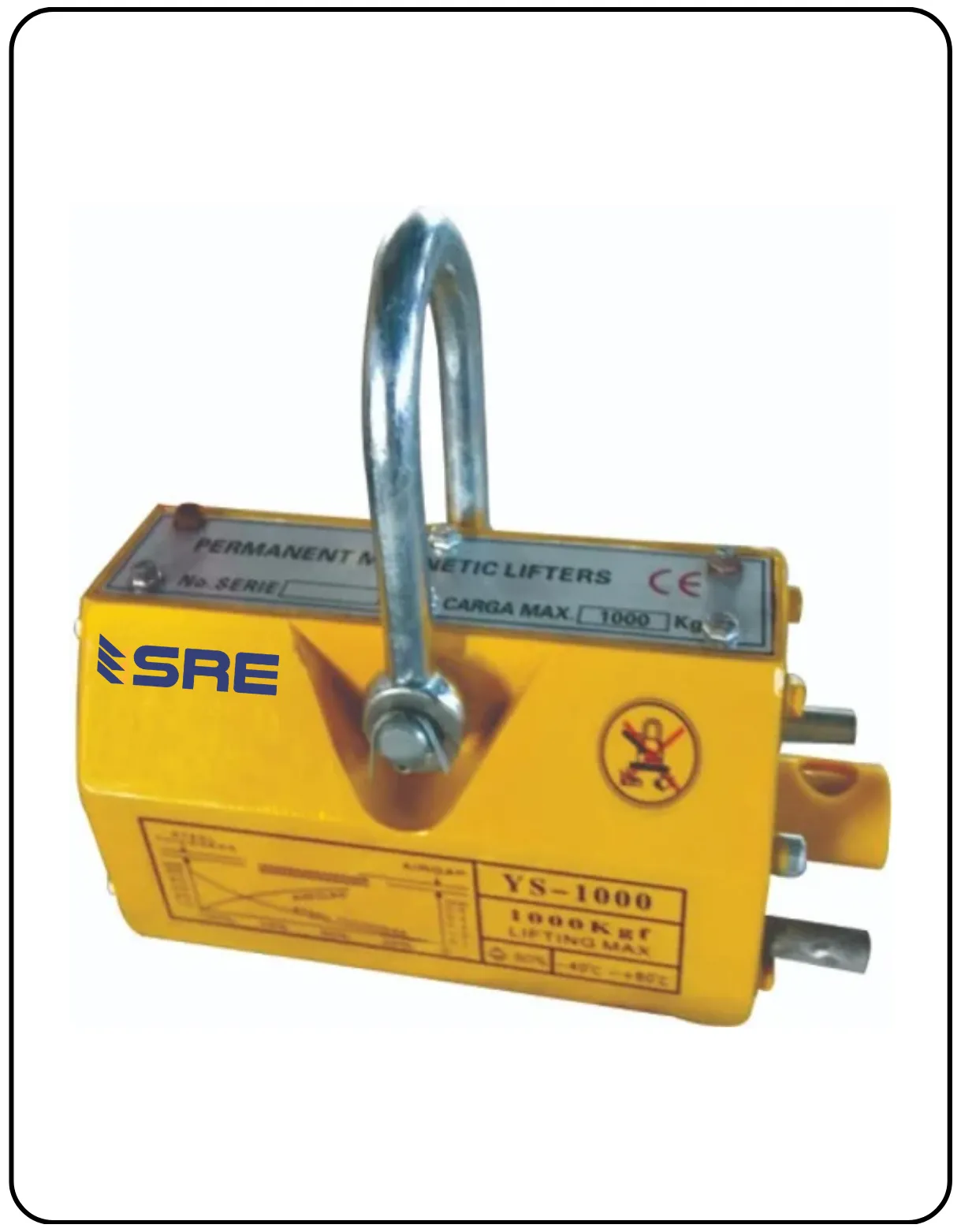
100 kg (All Size Available)
Rs. 6500
(Taxes to be paid extra)
Brand: SRE
SKU: SRE 161
Min Order Qty: 1
Applications Of Magnet Lifter And Key Features Of Magnet Lifter in Mumbai
Steel fabricators, machine shop operators, and press shop managers in Mumbai, Pune, and Ahmedabad who handle flat steel plates, rounds, and square bars daily know exactly how much time and risk is embedded in conventional sling-and-hook lifting of ferromagnetic materials. Rigging a sling around a 100 kg steel plate takes 5–8 minutes per lift, introduces two-point contact instability that causes plate rotation during crane travel, and requires a second worker to steady the load throughout the cycle. Over a 50-lift working day in a fabrication bay, that is 4–6 hours of rigging labour that adds zero value to the workpiece. The Magnet Lifter in Mumbai from SRE Material Handling Equipment Pvt. Ltd. eliminates all of this — the SRE Permanent Magnetic Lifter (SKU: SRE 161) grips a 100 kg steel plate in under 3 seconds, priced at just Rs. 6,500, with no power supply required, no sling damage risk, and a single operator completing the entire lift-and-place cycle safely.
How Magnetic Lifters Are Used in Steel Fabrication and Engineering Operations Across Mumbai, Pune, and Gujarat
A permanent magnetic lifter — also called a magnetic plate lifter or steel plate handling magnet — uses a rotating permanent magnet system inside an aluminium or cast iron housing to switch between ON (full magnetic field engagement) and OFF (internal field cancellation) states with a simple lever rotation of approximately 90 degrees. No electricity required, no battery, no external power source. The engagement is instantaneous — the SRE SRE 161 rated at 100 kg achieves full magnetic grip on any flat ferromagnetic surface within 2–3 seconds of lever turn. For steel service centres in Vatva and Bhavnagar handling 200–500 plate lifts per day, this reduces rigging time per lift from 5–8 minutes to under 15 seconds — the most dramatic productivity improvement available per rupee invested in any material handling tool category.
Key Applications of Magnet Lifter Across Industrial Sectors
- Steel Service Centres & Metal Warehouses: Handling steel plates, flats, and rounds in steel service centres in Vatva, Bhavnagar, and Kutch — from coil yard to cutting station to dispatch.
- Heavy Fabrication & Structural Steel: Loading steel plates onto cutting tables, moving weldments between stations, and placing sections in welding jigs in fabrication shops in Pune, Faridabad, and Ahmedabad.
- Press Shop & Stamping Operations: Loading steel blanks onto press dies in automotive press shops in Pune, Chennai, and Gurugram — faster and safer than manual or sling loading.
- Machine Shop & CNC Turning Centres: Placing raw steel billets and forgings onto CNC machine tables in precision engineering shops in Ahmedabad, Rajkot, and Jamnagar.
- Die & Mould Handling: Moving heavy steel dies and mould bases between storage and press bays in tool rooms in Pune, Ahmedabad, and Bangalore.
- Shipyard & Port Equipment Handling: Lifting steel plates and sections in shipbuilding and port construction facilities in Mumbai, Bhavnagar, and Ghandhidham.
- Construction & Infrastructure Projects: Placing structural steel sections and baseplate assemblies during steel structure erection at construction sites in Mumbai, Bangalore, and Hyderabad.
- Foundry & Casting Operations: Handling cast iron and steel casting rough parts between cooling stations and machining areas in foundries in Ahmedabad, Rajkot, and Coimbatore.
SRE Material Handling Equipment Pvt. Ltd., an ISO 9001:2015 certified, MSME-registered, Make in India manufacturer in Ahmedabad, supplies permanent magnetic lifters in capacities from 100 kg to 3,000 kg for all standard industrial steel handling applications. In-stock units ship to Mumbai, Pune, Bangalore, and all Gujarat and Maharashtra locations within 3–5 working days.
Key Technical Features of SRE Permanent Magnetic Lifter (SRE 161) That Purchase Managers in Ahmedabad and Rajasthan Must Evaluate
The SRE Permanent Magnetic Lifter (SRE 161) uses a high-energy permanent magnet core — typically NdFeB (Neodymium-Iron-Boron) magnets for the standard industrial variant — encased in an aluminium alloy housing that keeps the unit lightweight while maintaining the mechanical strength required for repeated industrial use. The rated capacity of 100 kg applies to a clean, flat ferromagnetic surface with a minimum material thickness of 8 mm — thinner materials reduce effective grip proportionally. The safety factor is a minimum of 3.5:1 — meaning the magnet holds at a minimum of 350 kg before release, providing the safety margin required by industrial lifting equipment standards for overhead use with a crane or hoist.
Operating Mechanism, Material Compatibility, and Safety Limits
The ON/OFF lever rotates the internal permanent magnet assembly 90 degrees — in the OFF position, the magnetic field is internally redirected and effectively cancelled at the contact face, releasing the load. This mechanism requires no electrical power, generating no heat and no electromagnetic interference — making the SRE magnetic lifter fully safe for use in CNC machine shop environments in Ahmedabad and Bangalore where electrical interference can cause machine faults. The lifter is compatible with all ferromagnetic materials: mild steel, cast iron, and magnetic-grade stainless steel. It does NOT work on non-ferromagnetic materials — aluminium, copper, austenitic stainless steel (SS 304, SS 316), and non-metallic materials. The BIS-compliant materials and ISO 9001-certified manufacturing process ensure consistent magnetic performance across every unit. Explore the full Magnetic Lifter range from SRE and the Magnet Lifter Pune blog for region-specific applications.
Permanent Magnetic Lifter vs. Electro Magnetic Lifter vs. Vacuum Lifter — Which One Is Right for Factory Buyers in Bangalore, Noida, and Faridabad?
The three main tool types for ferromagnetic and flat-material handling each have a specific use case. A permanent magnetic lifter — like the SRE SRE 161 — requires no power, no cables, and no compressor, making it the most operationally simple and lowest-maintenance tool. It is correct for steel plate, bar, and round handling in fabrication workshops, press shops, and steel service centres. An electro-magnetic lifter is needed when the release of the load must be remotely controlled — for automated crane systems or large-area contact where a lever-release isn’t practical. A vacuum lifter is used for non-ferromagnetic flat materials — glass, aluminium sheet, plastic panels — where magnetic attraction is not possible. For the vast majority of ferrous material handling in Indian engineering workshops in Noida, Faridabad, and Gurugram, the permanent magnetic lifter is the most cost-effective, reliable, and maintenance-free specification at Rs. 6,500 for the 100 kg model.
For bulk orders of 10–50 magnetic lifters — typical for large steel service centres, fabrication workshops, and press shop operations across Vatva, Kalol, Himmatnagar, and Chattral — SRE Material Handling Equipment Pvt. Ltd. offers volume pricing with in-stock availability and express dispatch. Explore Chain Block and Hoist solutions for overhead lifting systems and Pallet Trucks for floor-level material movement. 📞 Call Now: +91 9316 208879 — Get a Free Bulk Quote for Magnetic Lifters. The Make in India manufacturing model means rapid restocking for high-volume users. Send Bulk Inquiry for Magnetic Lifters to SRE Material Handling Equipment Pvt. Ltd.
Frequently Asked Questions — Magnet Lifter in Mumbai
What is the load capacity and material compatibility of a Permanent Magnetic Lifter for steel handling in Mumbai?
The SRE Permanent Magnetic Lifter (SKU: SRE 161) is rated at 100 kg on a clean, flat ferromagnetic surface with minimum 8 mm material thickness. Safety factor is 3.5:1 minimum — holds at 350 kg before release. Compatible with mild steel, cast iron, and magnetic-grade stainless steel. Does NOT work on aluminium, copper, SS 304/316, or non-metallic materials. Capacities from 100 kg to 3,000 kg available from SRE Material Handling Equipment Pvt. Ltd.
What is the price of a Magnetic Lifter in Mumbai and what are the ordering terms?
The Magnetic Lifter price in Mumbai starts at Rs. 6,500 per unit (taxes extra) for the standard 100 kg Permanent Magnetic Lifter (SRE 161). SRE Material Handling Equipment Pvt. Ltd., an ISO 9001:2015 certified Make in India manufacturer, dispatches in-stock units to Mumbai and Maharashtra within 3–5 working days. Minimum order quantity is 1 unit. Bulk pricing available for orders of 10 units and above.
How does a Permanent Magnetic Lifter reduce steel plate handling time in fabrication workshops in Pune and Ahmedabad?
A permanent magnetic lifter reduces steel plate attachment time from 5–8 minutes (sling rigging) to under 15 seconds (magnet engagement) per lift. In a fabrication workshop in Pune or Ahmedabad doing 50 plate lifts per day, this eliminates 4–6 hours of rigging labour per working day — freeing a full worker shift for value-adding production tasks. One operator handles the complete lift-and-place cycle safely without a second steadying worker.
What is the difference between a Permanent Magnetic Lifter and an Electro Magnetic Lifter for press shop applications in Faridabad and Gurugram?
A permanent magnetic lifter requires no power — ideal for press shops, fabrication bays, and steel service centres in Faridabad and Gurugram where operational simplicity and zero maintenance are priorities. An electro-magnetic lifter requires continuous power supply and cable connections — suited for automated crane systems where remote-controlled load release is needed. The permanent variant at Rs. 6,500 is the standard choice for manual overhead crane and hoist applications in Indian manufacturing.
Mumbai ya Pune ke fabrication unit ke liye Magnet Lifter ki delivery time aur minimum order kya hai?
Mumbai aur Pune ke liye SRE Material Handling Equipment Pvt. Ltd. in-stock units 3 se 5 working days mein deliver karta hai. Minimum order quantity 1 unit hai. Bulk orders (10+ units) ke liye volume pricing aur express dispatch available hai. ISO 9001:2015 certified manufacturer — har unit ke saath quality inspection report milti hai. Capacities 100 kg se 3,000 kg tak available hain.
Ahmedabad ya Gujarat ke steel service centre ke liye Magnet Lifter ka sahi capacity kaun sa hoga?
Ahmedabad, Vatva, aur Bhavnagar ke steel service centres jahan 50–200 kg steel plates daily handle hoti hain, ke liye 100 kg (SRE 161) aur 300 kg variants most popular choices hain. Heavy structural steel plates (500+ kg) ke liye 600 kg ya 1,000 kg variants available hain. Minimum plate thickness 8 mm required hai for full rated grip. NdFeB magnet core maximum grip ensure karta hai.
Kya Magnet Lifter ki spare parts ya replacement service Jaipur, Indore ya Bhopal mein milti hai?
Haan — SRE Material Handling Equipment Pvt. Ltd. ka spare parts network Jaipur, Indore, Bhopal, aur Rajasthan ke sabhi major industrial cities mein available hai. Permanent magnetic lifters virtually maintenance-free hote hain — koi moving electrical parts nahi. Wear items: contact face rubber pad aur lever assembly 48 ghante mein available hain. Annual inspection mein contact face flatness check aur lever torque verification shamil hai.