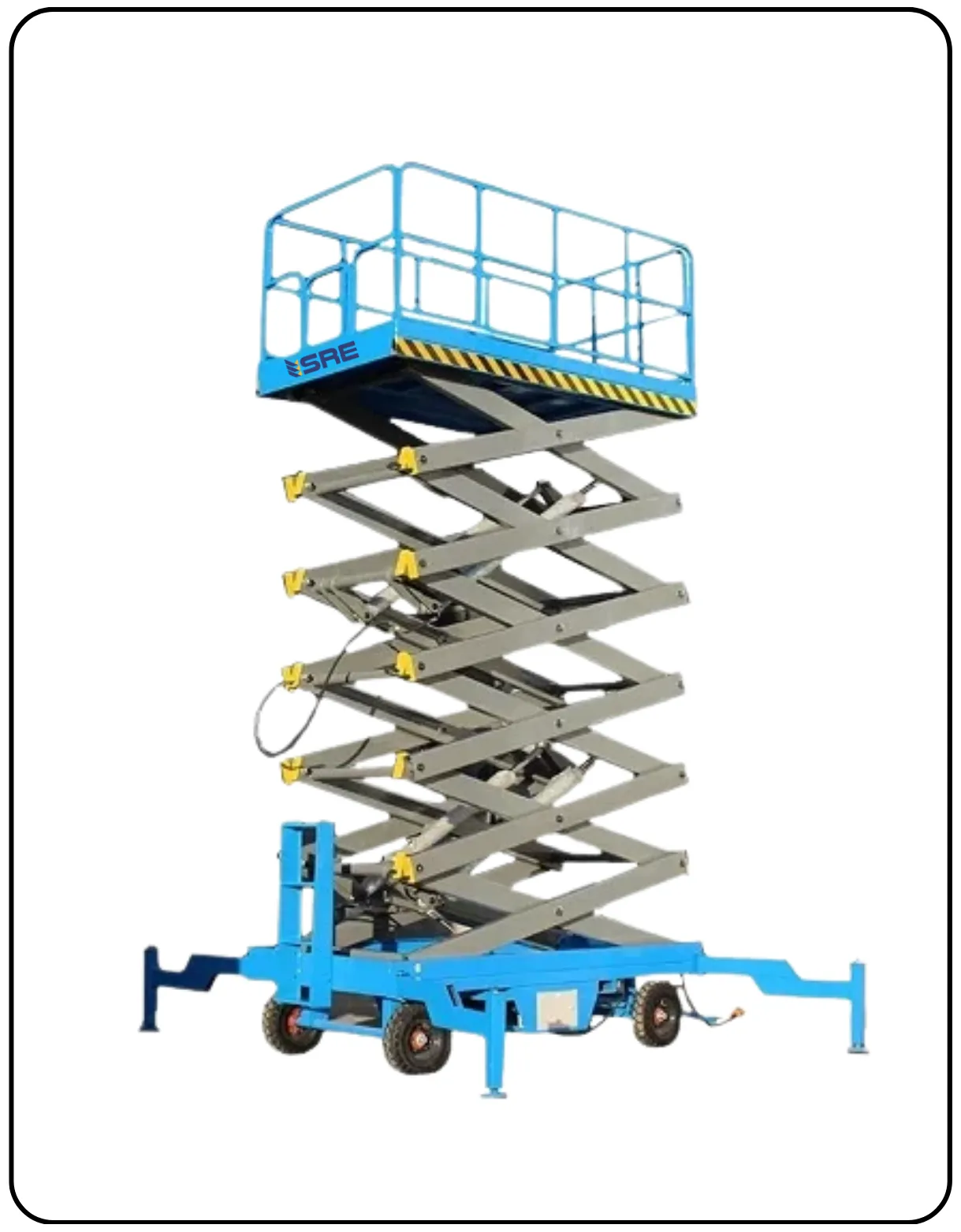
500 kg–900 mm (All Size Available)
Rs. 26000
(Taxes to be paid extra)
Brand: SRE
Min Order Qty: 1
Applications Of Scissor Lift Table And Key Features Of Scissor Lift Table in Mumbai
Production managers in Mumbai, Pune, and Ahmedabad dealing with ergonomic workstation problems know the cost directly — when an operator works repeatedly at a fixed bench height that doesn’t match the load or their posture, the result is cumulative musculoskeletal injuries that drive absenteeism, workers’ compensation claims, and throughput losses across an entire production shift. Adjusting workstation height manually is impractical at industrial scale. The Scissor Lift Table in Mumbai solves this precisely — the SRE hydraulic scissor lift table raises loads and workstations up to 900 mm with a 500 kg load capacity, priced at Rs. 26,000, and is deployed across assembly lines, packaging stations, die change bays, and pallet loading positions in Maharashtra, Gujarat, and every major industrial state. SRE Material Handling Equipment Pvt. Ltd., an ISO 9001:2015 certified, MSME-registered, Make in India manufacturer in Ahmedabad, produces this essential equipment for factory owners and purchase managers across Gujarat, Rajasthan, and Maharashtra.
How Scissor Lift Tables Are Used Across Production and Logistics Operations in Mumbai, Pune, and Gujarat
A scissor lift table — also called a hydraulic lifting table or lift platform — is a fixed or mobile platform that raises a load from floor level to a working height using a hydraulic scissor mechanism. In production facilities in Mumbai, Ahmedabad, and Bangalore, the primary operational benefit is workstation height adjustment: bringing the work to the optimal ergonomic level for the operator rather than forcing the operator to bend, reach, or strain. Studies consistently show that ergonomic workstation configuration reduces operator fatigue by 30–50% and cutting-related musculoskeletal injury claims by up to 60% in manufacturing environments. At Rs. 26,000 per unit, a scissor lift table delivers an ergonomics ROI that factory owners in Pune, Faridabad, and Gurugram consistently cite as among the fastest payback times of any production floor investment.
Key Applications of Scissor Lift Table Across Industrial Sectors
- Assembly Workstations: Height-adjusting component sub-assembly tables in automotive, electronics, and appliance manufacturing plants in Pune, Chennai, and Bangalore.
- Pallet Loading & Unloading: Elevating pallets to truck bed height for efficient hand-stacking of goods in dispatch areas in Mumbai, Noida, and Gurugram.
- Die Change Operations: Lifting press dies to bench height for maintenance and swap operations in press shops in Faridabad, Rohtak, and Pune.
- Packaging Lines: Positioning filled carton pallets at conveyor in-feed height in FMCG packaging lines in Ahmedabad, Vadodara, and Mumbai.
- Pharma & Cleanroom Workstations: Adjustable height dispensing and inspection tables in pharmaceutical manufacturing facilities in Ahmedabad, Hyderabad, and Bangalore.
- Machine Loading: Elevating heavy components to CNC machine table height in precision engineering workshops in Vatva, Kalol, and Pune.
- Warehouse Goods Receipt: Raising inbound pallets to check-desk height for visual inspection and barcode scanning in warehouse receiving areas in Bhiwandi and Noida.
- Food Processing Lines: Height-adjusting product trays and containers at processing stations in food manufacturing facilities in Gujarat and Maharashtra.
SRE Material Handling Equipment Pvt. Ltd. supplies scissor lift tables in standard capacities from 500 kg to 5,000 kg and platform sizes from 800 mm × 800 mm to 2000 mm × 1500 mm to facilities across Himmatnagar, Mahesana, Chattral, Kathwada, and all major Gujarat and Maharashtra industrial corridors with standard delivery within 7–15 working days.
Key Technical Features of SRE Scissor Lift Table That Factory Buyers in Ahmedabad and Rajasthan Must Verify
The SRE scissor lift table scissor arm assembly is fabricated from IS 2062 Grade A MS steel with full-penetration butt welds at all pivot points, rated for 500 kg uniform distributed load at full platform height of 900 mm. The single or double hydraulic cylinder (depending on capacity) operates on mineral hydraulic oil ISO VG 46 via a manual pump lever or optional electric hydraulic power unit, with a safety velocity fuse that prevents uncontrolled descent if a hydraulic line fails. The lowered platform height is 200 mm — allowing easy initial pallet placement at floor level — and the maximum height of 900 mm covers the standard workbench and conveyor interface heights used in Indian manufacturing. Platform surface is anti-slip chequerplate steel with optional rubber mat for vibration-sensitive work in precision engineering environments in Pune and Bangalore.
Safety Systems and Custom Configuration Options
The base frame includes four height-adjustable levelling feet for installation on uneven workshop floors — critical in older factory buildings in Mumbai, Faridabad, and Rohtak where floor conditions are variable. The mechanical safety lock engages at maximum height, preventing accidental lowering under load — meeting the working-at-height equipment safety guidelines referenced by EHS managers in Maharashtra and Gujarat manufacturing facilities. For pharmaceutical buyers in Ahmedabad and Hyderabad requiring ISO 9001-compliant documentation, SRE Material Handling Equipment Pvt. Ltd. provides material test certificates, weld inspection records, and hydraulic test reports. Explore the full product family: Mobile Scissor Lift and Dock Levelers for complete loading bay solutions.
Why Plant Managers in Vatva, Himmatnagar, Kalol, and Chattral Source Scissor Lift Tables from SRE
The combination of ISO 9001:2015 certification, MSME registration, and Make in India manufacturing makes SRE Material Handling Equipment Pvt. Ltd. the preferred procurement choice for engineering industries in Gujarat’s GIDC corridors — Vatva, Himmatnagar, Kalol, Chattral, and Mahesana. Bulk orders of 10–30 scissor lift tables for new production line setups are handled with phased delivery matched to installation schedules. Every unit ships with a factory load test certificate at 125% rated capacity and a 12-month hydraulic component warranty. The Make in India supply chain means spare seals, cylinders, and wheel assemblies reach Ghandhidham, Bhavnagar, and Kutch within 48 hours. 📞 Call Now: +91 9316 208879 — Get a Free Quote. View Pallet Trucks for floor-level material movement. Send Bulk Inquiry to SRE for Scissor Lift Tables.
Frequently Asked Questions — Scissor Lift Table in Mumbai
What is the load capacity and platform height of a Scissor Lift Table for production line use in Mumbai?
The standard SRE Scissor Lift Table handles 500 kg at a maximum platform height of 900 mm, with a lowered height of 200 mm — ideal for pallet loading, assembly workstations, and die change operations in Mumbai, Pune, and Navi Mumbai. Heavy-duty variants up to 5,000 kg and custom platform heights up to 1,500 mm are available for specialised operations.
What is the price of a Scissor Lift Table in Mumbai and what is included in the standard unit?
The Scissor Lift Table price in Mumbai is Rs. 26,000 per unit (taxes extra) for the standard 500 kg, 900 mm height model. SRE Material Handling Equipment Pvt. Ltd., an ISO 9001:2015 certified Make in India manufacturer, includes anti-slip platform, hydraulic cylinder with safety velocity fuse, mechanical height lock, and factory load test certificate. Dispatch in 7–15 working days.
What safety mechanisms does the SRE Scissor Lift Table have for factory EHS compliance in Pune and Bangalore?
The SRE Scissor Lift Table includes: safety velocity fuse (prevents uncontrolled descent on hydraulic line failure), mechanical height lock at full extension, overload protection at 110% rated capacity, and anti-slip chequerplate platform. Every unit is factory load-tested at 125% of rated capacity with documentation suitable for EHS compliance audits in Pune, Bangalore, and Mumbai.
Can a Scissor Lift Table be used in Pharma or Food Processing facilities in Ahmedabad requiring GMP documentation?
Yes — SRE Material Handling Equipment Pvt. Ltd. supplies GMP-compatible Scissor Lift Tables with SS 304 platform surfaces, electropolished frame options, and full documentation including material test certificates, weld inspection records, and hydraulic test reports for pharma and food processing buyers in Ahmedabad, Hyderabad, and Bangalore.
Mumbai ya Pune ki production line ke liye Scissor Lift Table ki delivery time kya hai?
Mumbai aur Pune ke liye SRE Material Handling Equipment Pvt. Ltd. standard models 7 se 15 working days mein deliver karta hai. Minimum order 1 unit. Anti-slip platform, hydraulic cylinder, aur height lock included hain. ISO 9001:2015 certified — har unit ke saath load test certificate milta hai. Bulk 10+ units pe volume pricing available.
Ahmedabad ya Gujarat ke engineering workshop ke liye Scissor Lift Table ka sahi capacity aur platform size kya hoga?
Ahmedabad, Vatva, aur Kalol ke general engineering workshops ke liye 500 kg capacity, 800 mm × 800 mm platform standard choice hai. Heavy press die handling ke liye 2,000–5,000 kg variants available hain. Die change operations ke liye low-profile 85 mm lowered height variant recommend kiya jaata hai.
Kya Scissor Lift Table ki maintenance service Jaipur, Indore ya Bhopal mein available hai?
Haan — SRE Material Handling Equipment Pvt. Ltd. ka service network Jaipur, Indore, Bhopal, aur Rajasthan ke industrial cities mein available hai. Maintenance mein hydraulic oil change (ISO VG 46), velocity fuse inspection, aur platform surface check shamil hai — recommended har 12 mahine. Spare seals aur cylinders 48 ghante mein available hain.