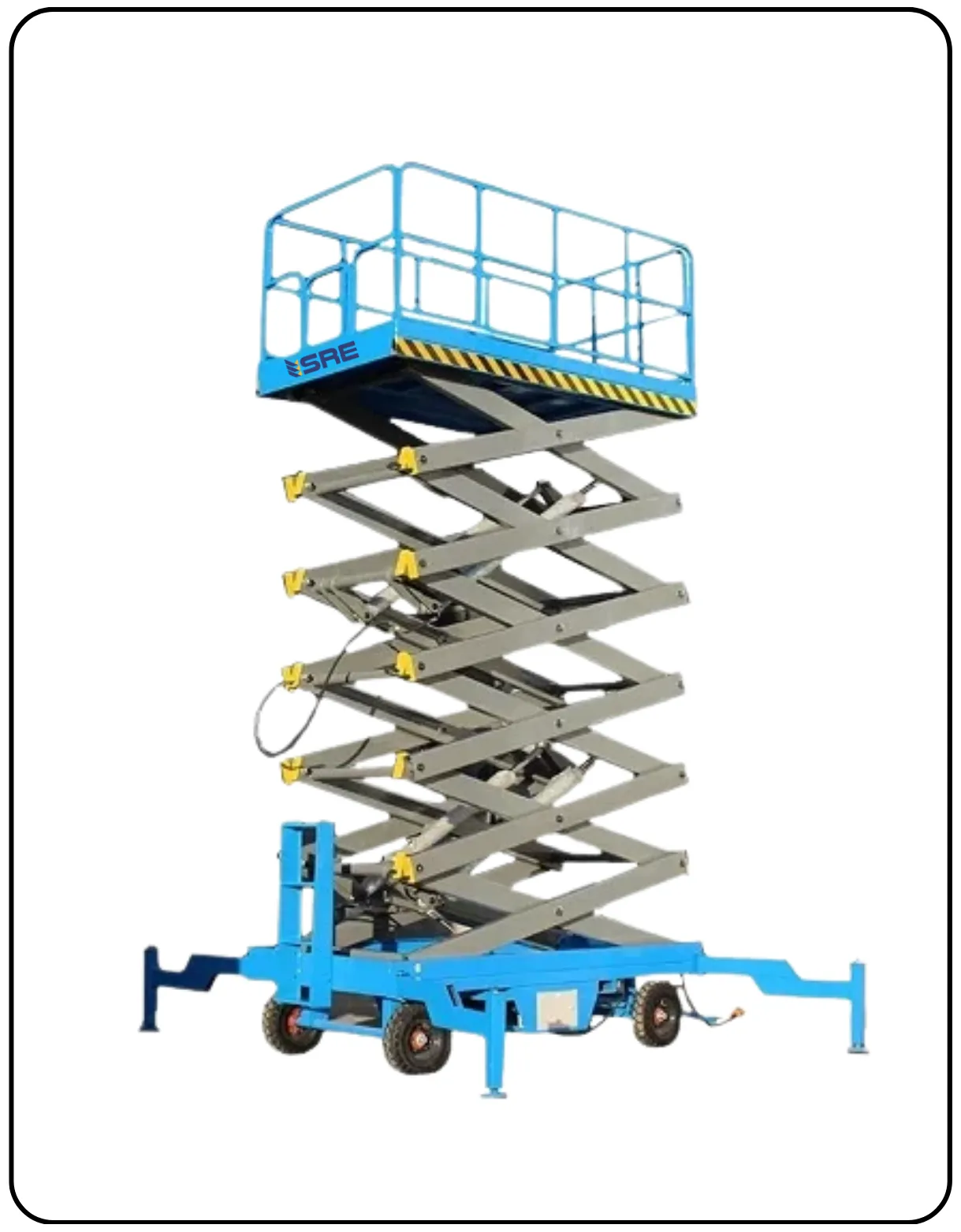
500 kg–900 mm (All Size Available)
Rs. 26000
(Taxes to be paid extra)
Brand: SRE
Min Order Qty: 1
Applications Of Roller Scissor Lift Table And Key Features Of Roller Scissor Lift Table in Mumbai
Production lines in Mumbai, Pune, and Ahmedabad that rely on manual lifting and positioning of heavy assemblies or palletised loads onto roller conveyor systems are silently absorbing two serious costs — repetitive strain injuries among floor workers and throughput losses caused by misaligned load transfers. When a 500 kg assembly needs to be lifted precisely to conveyor height and rolled forward without re-positioning by hand, you need a purpose-built solution. The Roller Scissor Lift Table in Mumbai — combining a hydraulic scissor lift mechanism with an integrated roller conveyor top surface — solves exactly this problem. At Rs. 26,000 per unit with a 500 kg capacity and 900 mm platform height, it is the most efficient ergonomic loading solution available for assembly lines, packaging stations, and dispatch bays across Maharashtra and Gujarat.
How Roller Scissor Lift Tables Are Used in Manufacturing and Packaging Operations Across Mumbai and Pune
The core problem on any production line where loads move between height levels — say, from a floor-level pallet to a waist-height roller conveyor line — is that manual lifting consumes time, risks injury, and introduces positional inaccuracy that slows downstream processes. A roller scissor lift table eliminates all three issues simultaneously. The hydraulic lift mechanism raises the platform from ground level to working height (up to 900 mm) with a single pump stroke, while the free-rolling conveyor rollers on the platform surface allow the operator to push the load forward onto an adjacent conveyor line with minimal force — typically under 5 kg of push force for a 500 kg load. This transforms a two-person manual task into a one-person, sub-30-second operation on lines across Pune, Aurangabad, and Nashik.
Key Applications of Roller Scissor Lift Table Across Industrial Sectors
Factory owners and plant managers in Mumbai, Vadodara, Bangalore, and Hyderabad deploy roller scissor lift tables wherever loads need to transfer between ground-level and elevated conveyor systems. Below are the primary industry applications:
- Automotive Assembly Plants: Lifting and rolling engine blocks, gearboxes, and body panels onto assembly conveyor lines in Pune and Chennai auto plants — reducing cycle time per station by 30–40%.
- Packaging & FMCG Lines: Feeding filled carton pallets onto shrink-wrap conveyor systems in FMCG factories across Mumbai, Ahmedabad, and Vadodara.
- Cold Chain & Food Processing: Transferring product trays and frozen food crates between floor level and processing conveyor heights in hygiene-sensitive facilities in Gujarat and Maharashtra.
- Pharmaceutical Manufacturing: Moving bulk drug cartons and equipment parts between floor and line height in GMP-compliant production areas in Ahmedabad, Bangalore, and Hyderabad.
- Warehouse & Distribution: Feeding pallets onto outbound conveyor sorters and automated dispatch lines in e-commerce fulfillment centres in Noida, Gurugram, and Faridabad.
- Heavy Engineering & Fabrication: Elevating fabricated weldments and machined components onto inspection conveyor tables in engineering workshops in Vatva, Kathwada, and Kalol.
- Printing & Paper Industry: Loading paper reels and carton blanks onto in-feed conveyor lines in printing plants in Mumbai, Indore, and Jaipur.
- Textile & Garment Units: Transferring fabric bolt pallets onto sorting conveyor tables in textile mills in Ahmedabad, Surat, and Bhavnagar.
SRE Material Handling Equipment Pvt. Ltd., an ISO 9001:2015 certified and MSME-registered manufacturer in Ahmedabad, produces roller scissor lift tables with customisable roller pitch, roller diameter, and platform dimensions to match the exact conveyor interface requirements of each client’s production line. Their Make in India production unit delivers standard units across Mumbai, Pune, Bangalore, and all Gujarat industrial corridors within 7–15 working days from order confirmation.
Key Technical Features of SRE Roller Scissor Lift Table That Purchase Managers in Ahmedabad, Vadodara, and Rajasthan Must Verify Before Buying
When procurement heads in Ahmedabad, Jaipur, and Udaipur evaluate roller scissor lift table specifications, the first specification to confirm is the roller surface material relative to your load type. The SRE roller scissor lift table is available with galvanised steel rollers (for general industrial loads), stainless steel SS 304 rollers (for food-grade and pharma environments), and PVC-coated rollers (for fragile or painted surface loads). Roller diameter typically ranges from 50 mm to 76 mm depending on load distribution requirements, with roller pitch (centre-to-centre spacing) customisable from 100 mm to 150 mm for the standard 500 kg platform.
Platform, Hydraulic System, and Structural Specifications
The base scissor mechanism is fabricated from IS 2062 Grade A MS steel with fully welded scissor arms, rated for 500 kg uniform distributed load at the maximum platform height of 900 mm. The hydraulic cylinder operates on mineral hydraulic oil ISO VG 46, driven by a manually operated pump lever with a safety overload relief valve set at 110% of rated capacity — preventing the unit from being pressurised beyond safe operating limits. The lowered platform height is 200 mm, keeping the roller surface close to floor level for easy initial load placement. A mechanical safety lock engages automatically when the platform reaches working height, preventing accidental lowering under load — a critical safety feature for pharma and food processing buyers in Ahmedabad and ISO 9001-compliant facilities across Maharashtra.
The platform frame perimeter includes welded side guards (optional removable) to prevent lateral load shift during elevation, and the base frame is fitted with 4 × swivel castors (lockable) as standard on the mobile variant — allowing the unit to be repositioned between production stations in under 60 seconds. For pit-mounted fixed installations in Mumbai, Pune, and Bangalore production facilities, the unit is supplied without castors with a reinforced base plate for anchor bolt fixing. Powder coat finish (standard) withstands industrial washing and mild chemical splash in food and pharma environments. Explore the full Scissor Lift Table range from SRE for all configurations.
Roller Scissor Lift Table vs. Standard Scissor Lift Table — Which One Is Right for Factory Owners in Bangalore, Chennai, and Hyderabad?
This is the most common specification question asked by plant managers in Bangalore, Chennai, and Noida. A standard scissor lift table has a flat steel or chequerplate platform — ideal for load positioning, die change operations, and workstation ergonomics where the load stays on the platform. A roller scissor lift table is the right choice when the load must transfer off the platform onto a conveyor, chute, or adjacent workstation. If your operation involves any form of inline production conveyor feeding — from packing lines in FMCG plants to assembly stations in auto component factories — the roller-top variant reduces transfer time by eliminating the need for a separate slide or push mechanism. View the Mobile Scissor Lift range for applications requiring repositionable platforms.
For operations in Gurugram, Faridabad, and Rohtak that process both inline conveyor transfers and standalone load positioning within the same facility, SRE Material Handling Equipment Pvt. Ltd. recommends a mixed deployment — roller scissor lift tables at conveyor interface points and hand pallet trucks for lateral load movement between stations. This combination consistently delivers the best cost-per-movement outcome for warehouses and plants running 2-shift operations. SRE Material Handling Equipment Pvt. Ltd., certified under ISO 9001:2015, can provide layout-specific fleet recommendations based on your floor plan and throughput data at zero cost before order placement. 📞 Call Now: +91 9316 208879 — Get a Free Consultation.
Why Logistics Heads and Engineering Industries in Vatva, Himmatnagar, Mahesana, and Chattral Source Roller Scissor Lift Tables from SRE
Plant managers in Vatva, Himmatnagar, Kalol, and Mahesana who have sourced roller scissor lift tables from SRE Material Handling Equipment Pvt. Ltd. consistently highlight three factors: fabrication precision, delivery reliability, and post-sale spares availability. Every unit undergoes a factory load test at 125% of rated capacity before dispatch — meaning a 500 kg rated unit is tested at 625 kg to verify structural integrity and hydraulic performance. This level of pre-delivery quality assurance is rarely available from unorganised suppliers, and it matters enormously to purchase managers in regulated industries like pharma, food processing, and chemical manufacturing in Gujarat who require equipment inspection records for compliance audits.
The Make in India manufacturing model means spare parts — hydraulic pump seals, roller replacement sets, castor wheel assemblies — are stocked locally in Ahmedabad and can reach facilities in Ghandhidham, Kutch, Bhavnagar, and across Rajasthan within 48–72 hours. For bulk procurement across Chattral, Kathwada, and other Gujarat GIDC industrial zones, SRE Material Handling Equipment Pvt. Ltd. offers volume pricing on orders of 5 units and above with staggered delivery scheduling to match installation timelines. Send an Inquiry for Bulk Pricing — SRE Material Handling Equipment Pvt. Ltd.
How to Order the Right Roller Scissor Lift Table for Your Production Line in Mumbai, Noida, or Bhopal
Procurement managers in Mumbai, Noida, and Bhopal placing orders for roller scissor lift tables should confirm five parameters before raising a purchase order: (1) Platform working height — must match the in-feed height of your existing conveyor; standard is 900 mm, custom heights from 500 mm to 1500 mm available; (2) Platform width and length — confirm against your maximum pallet or load footprint; (3) Roller type — galvanised, SS 304, or PVC coated based on load surface sensitivity; (4) Drive type — manual hydraulic pump (standard) or electric hydraulic power unit for high-frequency operations; (5) Installation type — mobile with castors or pit-mounted fixed base. For pharma buyers in Ahmedabad or Bangalore requiring GMP documentation, SRE Material Handling Equipment Pvt. Ltd. provides material test certificates, weld inspection records, and hydraulic test reports with every unit.
Ready to optimise your conveyor interface? Explore Dock Levelers and Mobile Ramps to complete your loading bay setup. 📞 Call Now: +91 9316 208879 | Get a Free Quote from SRE Material Handling Equipment Pvt. Ltd.
Frequently Asked Questions — Roller Scissor Lift Table in Mumbai
What is the maximum load capacity of a Roller Scissor Lift Table and what platform height is available in Mumbai?
The standard SRE Roller Scissor Lift Table is rated for a maximum load capacity of 500 kg with a working platform height of 900 mm. Custom capacities up to 3,000 kg and working heights up to 1,500 mm are available on request for heavy-duty operations in Mumbai, Pune, and Navi Mumbai production facilities. The lowered platform height is 200 mm, enabling easy pallet entry from ground level. All units are factory load-tested at 125% of rated capacity before dispatch.
What is the price of a Roller Scissor Lift Table in Mumbai and what specifications does the standard model include?
The Roller Scissor Lift Table price in Mumbai starts at Rs. 26,000 per unit (taxes extra) for the standard 500 kg capacity, 900 mm height model. SRE Material Handling Equipment Pvt. Ltd., an ISO 9001:2015 certified and Make in India manufacturer, includes the roller conveyor top surface, manual hydraulic pump, overload safety valve, and mechanical height lock as standard. Dispatch to Mumbai and Maharashtra locations takes 7–15 working days.
Can a Roller Scissor Lift Table be used in Pharma or Food Processing plants in Ahmedabad that require GMP-compliant equipment?
Yes — SRE Material Handling Equipment Pvt. Ltd. supplies GMP-compatible Roller Scissor Lift Tables with SS 304 stainless steel roller surfaces, electropolished platform frames, and complete documentation including material test certificates and hydraulic test reports. These are specifically designed for pharma and food processing buyers in Ahmedabad, Bangalore, and Hyderabad who need equipment that meets internal GMP and FSSAI facility compliance requirements.
What is the difference between a Roller Scissor Lift Table and a standard Scissor Lift Table for factory operations?
A standard scissor lift table has a flat steel platform — best for load positioning, die change, and workstation ergonomics where loads remain on the platform. A roller scissor lift table has a free-rolling conveyor roller surface that allows loads to transfer off the platform onto adjacent conveyor lines with push forces under 5 kg for a 500 kg load. For inline production conveyor feeding in automotive, FMCG, or packaging plants in Pune, Mumbai, and Bangalore, the roller-top variant is always the right specification.
Mumbai ya Pune ki production line ke liye Roller Scissor Lift Table ka delivery time aur minimum order kya hai?
Mumbai aur Pune ke liye SRE Material Handling Equipment Pvt. Ltd. ka standard delivery time 7 se 15 working days hai. Minimum order quantity 1 unit hai. Bulk orders (5 unit se upar) ke liye volume pricing available hai. ISO 9001:2015 certified manufacturer hone ki wajah se har unit ke saath load test certificate aur hydraulic pressure report milti hai. Custom platform height aur roller type specifications pe bhi order accept hote hain.
Ahmedabad ya Gujarat ke GIDC industrial zone ke liye Roller Scissor Lift Table mein kaun sa roller type select karna chahiye?
Ahmedabad, Vatva, Kalol, aur Kathwada ke general engineering aur FMCG units ke liye galvanised steel rollers sabse cost-effective option hai. Pharma aur food processing plants ke liye SS 304 stainless steel rollers recommended hain — jo GMP compliance aur hygiene standards ko satisfy karte hain. Painted ya sensitive surface loads ke liye PVC-coated rollers use kare. SRE ye teeno options provide karta hai at competitive pricing.
Kya Roller Scissor Lift Table ki after-sales service Jaipur, Indore, ya Bhopal mein available hai?
Haan — SRE Material Handling Equipment Pvt. Ltd. ka spare parts network Jaipur, Indore, Bhopal, aur Rajasthan ke saare major cities tak available hai. Hydraulic pump seal kits, roller replacement sets, aur castor wheel assemblies 48–72 ghante mein deliver ho jaate hain. Annual maintenance schedule mein hydraulic oil check (ISO VG 46), roller bearing lubrication, aur scissor arm joint inspection shamil hai — recommended har 12 mahine mein.