
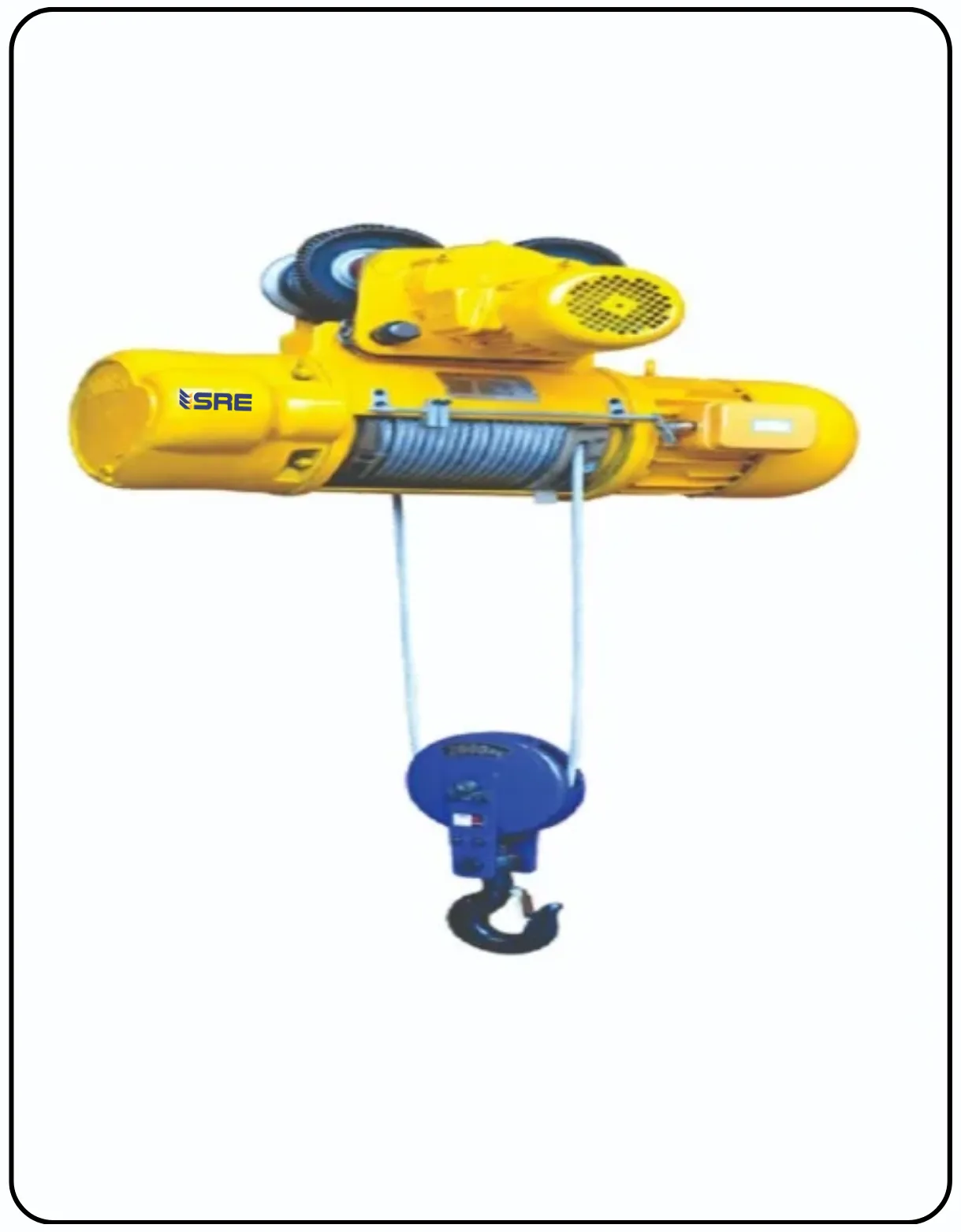
Applications of Electric Wire Rope Hoist and Key Features of Electric Wire Rope Hoist in Mumbai & Across India
250 – 500 kg x 20 Meter (All Size Available)
Rs. 7500
(Taxes to be paid extra)
Brand: SRE
SKU: SRE 173
Min Order Qty: 1
Construction sites, fabrication workshops, and manufacturing plants across Mumbai, Pune, and Ahmedabad that rely on manual chain blocks for overhead lifting are dealing with three persistent problems every shift: slow cycle times, inconsistent load positioning accuracy, and operator fatigue on heavy lifts above 200 kg. An Electric Wire Rope Hoist Mumbai eliminates all three simultaneously — electric motor power replaces manual effort, precise push-button control replaces guesswork, and a robust wire rope replaces chain for high-cycle overhead lifting applications. SRE Material Handling Equipment Pvt. Ltd., an ISO 9001:2015 certified manufacturer in Ahmedabad, supplies the SRE 173 Electric Wire Rope Hoist in 250–500 kg capacity with 20-meter rope travel, starting at Rs. 7,500 (taxes extra), with all capacities and rope lengths available.
Why Electric Wire Rope Hoists Are Replacing Manual Chain Blocks in Mumbai, Ahmedabad, and Pune Industrial Units
A production supervisor at a Mumbai steel fabrication shop or a Pune die casting plant operates on one critical metric: how many lift cycles per shift can the crew complete safely without fatigue-induced errors. A manual chain block rated at 500 kg requires 40–60 chain pulls to lift a load 3–4 meters — each pull demanding physical effort that accumulates over a shift and creates the most dangerous moment in lifting: the tired last pull when grip slips. The SRE 173 Electric Wire Rope Hoist replaces this entirely: single push-button raises the load at a controlled speed of 8 m/min (250 kg model) or 6 m/min (500 kg model), with a 20-meter rope drum covering the full height of multi-level manufacturing structures. SRE Material Handling Equipment Pvt. Ltd. builds the SRE 173 with a 3-phase or single-phase induction motor (0.4 kW for 250 kg / 0.8 kW for 500 kg), IP54-rated motor enclosure for dusty factory environments, and a 6 × 19 strand galvanized steel wire rope rated to 5:1 safety factor.
Technical Specifications of the SRE 173 Electric Wire Rope Hoist
For procurement heads in Noida, Faridabad, and Bangalore evaluating overhead hoists for a new plant installation, exact specifications determine whether a hoist meets structural and operational requirements. The SRE 173 specifications: motor power 0.4 kW (250 kg) / 0.8 kW (500 kg), voltage 415V 3-phase or 230V single-phase, lifting speed 8 m/min (250 kg) / 6 m/min (500 kg), rope length 20 meters standard (up to 50 m on order), wire rope diameter 6 mm (250 kg) / 8 mm (500 kg), rope construction 6 × 19 galvanized strand, hook type swivel safety hook with latch, control: low-voltage pendant control (24V DC) for operator safety, upper and lower limit switches factory-set to prevent over-travel. The unit mounts on I-beam or monorail beams from 65–125 mm flange width. All sizes up to 10 Ton capacity and 50 m rope length are available from SRE.
Electric Wire Rope Hoist vs. Electric Chain Hoist vs. Manual Chain Block — Comparison
| Parameter | Electric Wire Rope Hoist (SRE 173) | Electric Chain Hoist | Manual Chain Block |
|---|---|---|---|
| Lifting Medium | 6×19 galvanized wire rope | Grade 80 alloy chain | Grade 80 alloy chain |
| Best Lift Height | Up to 50 m | Up to 12 m typical | Up to 6 m typical |
| Duty Cycle | ED 40% (continuous use) | ED 20–30% | Manual – fatigue limited |
| Lifting Speed | 6–8 m/min | 4–6 m/min | 0.3–0.5 m/min (manual) |
| Control | Pendant push-button (24V DC) | Pendant push-button | Manual chain pull |
| Price Entry | Rs. 7,500 onwards | Rs. 12,000 onwards | Rs. 2,500 onwards |
| Best For | High-lift, high-cycle overhead lifting | Short-lift frequent cycles | Occasional spot lifts |
Industrial Applications of Electric Wire Rope Hoist Across Gujarat, Maharashtra, and Rajasthan
SRE Material Handling Equipment Pvt. Ltd. has supplied the SRE 173 Electric Wire Rope Hoist to a wide range of industries where lift height, cycle frequency, or load weight makes manual alternatives impractical. Below are the primary applications where the SRE 173 delivers the most operational impact:
- Steel Fabrication and Structural Workshops (Vatva, Kathwada, Rohtak, Ambala) — Lifting structural steel beams, columns, and welding sub-assemblies at roof beam level — heights of 5–15 m where chain blocks are impractical for 20–30 lifts per shift.
- Construction Sites and Building Projects (Mumbai, Pune, Ahmedabad, Jaipur) — Raising building materials — concrete blocks, steel sections, timber — to upper floors. The 20-meter rope travel covers 6–7 story heights in a single drum.
- Automotive Workshop and Assembly Plants (Pune, Faridabad, Gurugram) — Lifting engine blocks, gearboxes, and chassis frames during assembly and disassembly. The swivel safety hook and low-voltage pendant prevent damage to expensive powertrain components.
- Shipbuilding and Heavy Engineering (Kutch, Bhavnagar, Mumbai Port) — Moving hull sections, steel plate stacks, and heavy fabricated structures within shipyard bay areas where 20 m lift height is routinely required.
- Paper and Printing Industry (Noida, Ahmedabad, Hyderabad) — Loading heavy paper rolls (250–500 kg) onto printing machines and cutting tables, where safe controlled placement reduces paper damage and setup time.
- Cold Storage and Food Processing (Mumbai, Chennai, Bangalore) — Lifting frozen goods blocks, meat carcasses, and packaged food pallets at heights up to 8 m in temperature-controlled environments with the IP54 motor handling condensation effectively.
- Foundry and Casting Plants (Rajkot, Chattral, Indore) — Removing castings from sand molds and transferring them between cooling, cleaning, and machining stations at heights requiring more than a manual chain block can safely provide.
- Warehousing and High-Bay Racking (Ghandhidham, Mahesana, Hyderabad) — Loading and unloading from high-bay racking systems where lift heights exceed 8 m and repetitive cycling demands electric power.
Installation, Safety Compliance, and Pan-India Delivery of Electric Wire Rope Hoist from SRE
A plant manager in Rajasthan, Bhopal, or Indore installing an overhead electric wire rope hoist for the first time needs installation drawings, beam specification clearance, and electrical connection details before the unit arrives. SRE Material Handling Equipment Pvt. Ltd., certified under ISO 9001:2015, MSME, and Make in India, provides complete installation documentation: beam load calculation worksheets, electrical single-line diagrams, and limit switch setting guides with every order. Standard 250–500 kg, 20 m rope units are in stock for delivery within 5–7 working days to Mumbai, Pune, Ahmedabad, Vadodara, Bangalore, Mangalore, Gujarat, Maharashtra, Rajasthan, Jaipur, Udaipur, Chennai, Hyderabad, Noida, Bhopal, Faridabad, Indore, Rohtak, Ambala, Gurugram, Bhavnagar, Kutch, Himmatnagar, Vatva, Kathwada, Kalol, Ghandhidham, Mahesana, and Chattral. Larger capacities (1 Ton to 10 Ton) and extended rope lengths are manufactured to order within 18–25 working days. For complementary overhead lifting equipment, see the Chain Block and Hoist range for manual and electric chain hoist alternatives. For floor-level movement after lowering, the Hydraulic Pallet Truck integrates directly into the workflow. Request a quote today.
For hoist safety and inspection standards, procurement teams can reference OSHA Sling and Lifting Device Safety Requirements for overhead lifting best practices. The Bureau of Indian Standards (BIS) publishes IS 3938 for electric hoists. See also our blog on Permanent Magnetic Lifter India for complementary ferrous load handling used in the same overhead crane environments.
Need an Electric Wire Rope Hoist for your plant in Mumbai, Pune, or across India?
✉ Get Quote 📞 Call: +91 93162 08879Frequently Asked Questions – Electric Wire Rope Hoist
What is the lifting speed, capacity, and rope length of the SRE 173 Electric Wire Rope Hoist for industrial use in Mumbai and Pune?
The SRE 173 Electric Wire Rope Hoist is available in 250 kg and 500 kg capacities with a standard 20-meter rope length. Lifting speed is 8 m/min (250 kg model) and 6 m/min (500 kg model). Motor power is 0.4 kW (250 kg) / 0.8 kW (500 kg), suitable for 415V 3-phase or 230V single-phase supply. The 6×19 galvanized wire rope carries a 5:1 safety factor. All sizes from 250 kg to 10 Ton and rope lengths up to 50 m are available from SRE Material Handling Equipment Pvt. Ltd.
What is the price of an Electric Wire Rope Hoist in India and what safety features does the SRE 173 include?
The SRE 173 Electric Wire Rope Hoist starts at Rs. 7,500 (taxes extra) for the 250 kg model. Safety features include: low-voltage pendant control (24V DC) to protect operators from shock, upper and lower limit switches to prevent over-travel, swivel safety hook with latch, and IP54-rated motor enclosure for dusty factory environments. SRE Material Handling Equipment Pvt. Ltd., ISO 9001:2015 certified, includes a factory test certificate and GST invoice with every unit dispatched to Mumbai, Pune, and pan India.
What beam flange width is required to mount the SRE 173 Electric Wire Rope Hoist in a factory in Ahmedabad or Bangalore?
The SRE 173 Electric Wire Rope Hoist standard trolley fits I-beam or monorail flange widths of 65 mm to 125 mm. For beam widths outside this range, custom trolley attachments are available. Beam load capacity must be verified against the hoist rated load plus a dynamic load factor of 1.25 as per standard overhead crane design practice. SRE Material Handling Equipment Pvt. Ltd. provides beam load calculation assistance for new installations in Ahmedabad, Bangalore, and across India at no extra charge with confirmed orders.
How does an Electric Wire Rope Hoist compare to an Electric Chain Hoist for high-lift applications in Faridabad and Gurugram fabrication plants?
For lift heights exceeding 8–10 meters in Faridabad and Gurugram fabrication plants, an electric wire rope hoist is more practical — wire rope coils smoothly on a drum allowing 20–50 m travel, while chain hoists become impractical above 10–12 m due to chain bag weight. Wire rope hoists also have a higher ED 40% duty cycle versus ED 20–30% for chain hoists, making them better for high-frequency industrial lifting. For short lifts under 8 m with infrequent cycles, an electric chain hoist is a lower-cost alternative.
Mumbai aur Pune ke construction sites ke liye Electric Wire Rope Hoist ka capacity aur rope length kaisa hona chahiye?
Mumbai aur Pune ke construction sites ke liye generally 250–500 kg capacity wala hoist materials (bricks, cement, steel bars) raise karne ke liye best hai. 20-meter standard rope 6–7 story buildings cover karta hai. Zyada floors ke liye 30–50 m rope length custom order par available hai. SRE 173 sirf Rs. 7,500 se shuru hota hai aur 5–7 working days mein deliver hota hai. SRE Material Handling Equipment Pvt. Ltd. — ISO 9001:2015 certified — factory test certificate ke saath supply karta hai.
Gujarat aur Rajasthan ke fabrication aur foundry plants ke liye Electric Wire Rope Hoist ki maintenance kitni baar karni padti hai?
Electric Wire Rope Hoist ki maintenance schedule: monthly — wire rope visual inspection for broken wires, hook latch function check; 3-monthly — gear oil level check, limit switch test; annually — motor bearing lubrication, full rope inspection per IS 3938 norms, electrical insulation test. Gujarat aur Rajasthan ki extreme heat mein motor winding temperature ka dhyan rakhna zaroori hai — SRE 173 ka IP54 motor dust aur mild moisture se protected hai. Rope replacement typically 3–5 saal mein depending on usage intensity.
Hyderabad, Chennai aur Bangalore ke heavy engineering plants ke liye 500 kg se zyada capacity ka Wire Rope Hoist kya available hai?
Haan — SRE Material Handling Equipment Pvt. Ltd. Electric Wire Rope Hoists 1 Ton, 2 Ton, 3 Ton, 5 Ton, aur 10 Ton tak manufacture karta hai custom order par. Rope length 50 m tak available hai. Hyderabad, Chennai, aur Bangalore ke heavy engineering plants ke liye 3-phase 415V models standard hain. Larger capacity units ka manufacturing time 18–25 working days hai. Har unit ke saath load test certificate aur installation drawing include hota hai. Contact SRE for custom specifications.
Upgrade to Electric Wire Rope Hoist for faster, safer overhead lifting at your facility.
Get Quote Now 📞 +91 93162 08879