Applications of Hydraulic Scissor Lift Table and Key Features of Hydraulic Scissor Lift Table in Mumbai & Across India
500 kg x 900 mm size-820 x 500 (All Size Available)
Rs. 26000
(Taxes to be paid extra)
Brand: SRE
SKU: SRE 146
Min Order Qty: 1
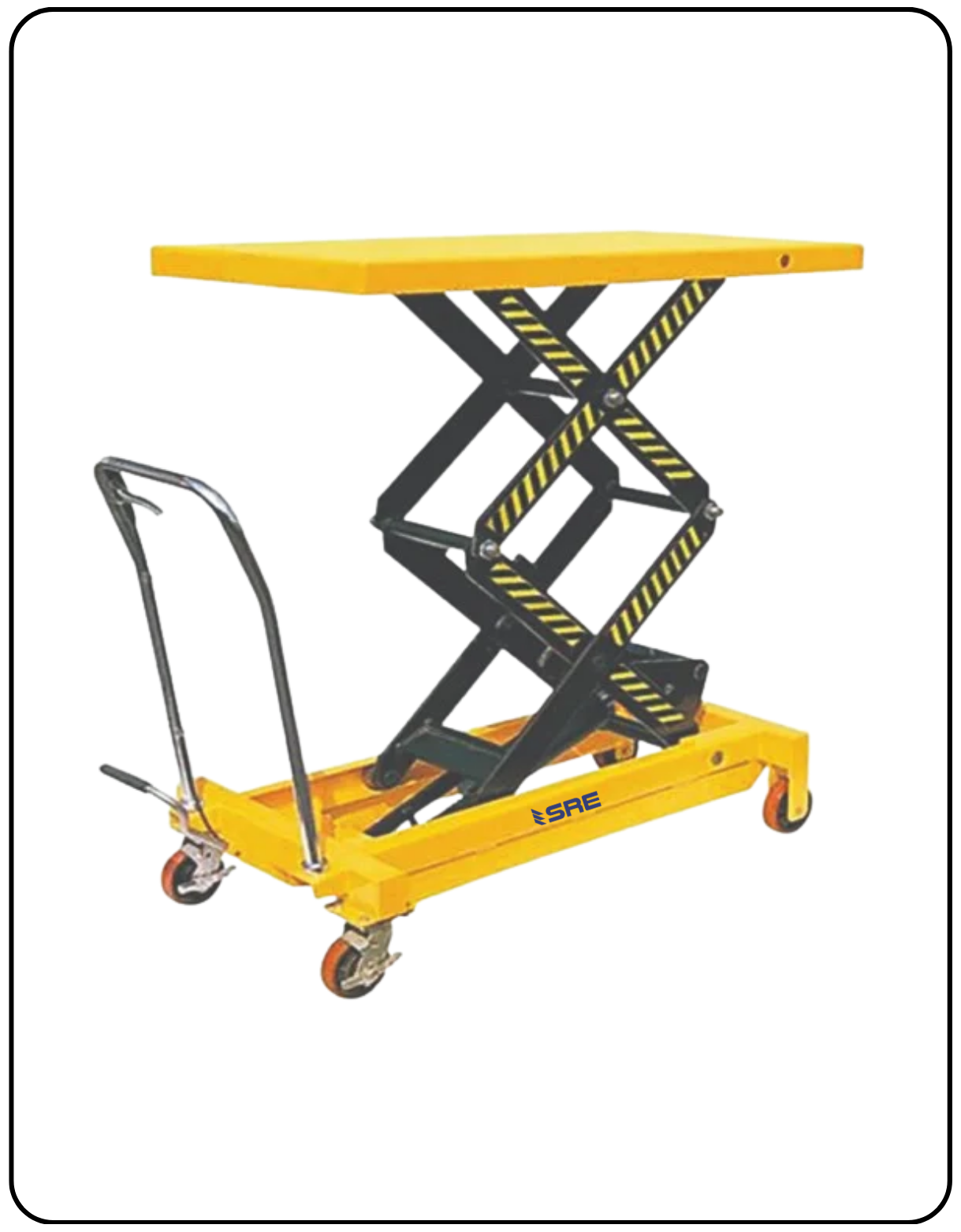
Assembly line workers and material handlers across Mumbai, Pune, and Ahmedabad spend a measurable portion of every shift bending, crouching, and awkwardly reaching for components placed at floor level — a direct cause of musculoskeletal fatigue, slower cycle times, and preventable injuries. A Hydraulic Scissor Lift Table Mumbai eliminates this by bringing the work to the worker at ergonomically correct height — no bending, no strain, no delay. SRE Material Handling Equipment Pvt. Ltd., an ISO 9001:2015 certified manufacturer in Ahmedabad, supplies the SRE 146 Hydraulic Scissor Lift Table — 500 kg capacity, 820 × 500 mm platform, 900 mm lift height — at Rs. 26,000 (taxes extra), with all sizes available.
How a Hydraulic Scissor Lift Table Reduces Ergonomic Injuries and Boosts Productivity in Mumbai, Pune, and Gujarat
In a Mumbai auto-component assembly plant or a Pune electronics manufacturing unit, operators working on benches that are too high or pallets sitting on the floor are constantly compensating with awkward postures. Research in industrial ergonomics consistently shows that incorrect working height accounts for 35–45% of repetitive strain injuries on the factory floor. The SRE 146 Hydraulic Scissor Lift Table resolves this with an infinitely adjustable lift range from floor level to 900 mm, powered by a foot-operated hydraulic pump — no electricity required. The operator simply pumps the foot pedal to raise the table to working height and releases the lowering valve to descend. The 500 kg capacity covers virtually all sub-assembly workpieces in automotive, electrical, pharmaceutical, and general engineering. SRE Material Handling Equipment Pvt. Ltd. builds the SRE 146 from 6-mm MS structural steel with a scissor mechanism using 40 × 40 mm square section steel arms for maximum stability under dynamic loads.
Key Technical Specifications of the SRE 146 Hydraulic Scissor Lift Table
A procurement head in Noida, Faridabad, or Indore evaluating scissor lift tables for a production line needs exact parameters to match the application. The SRE 146 specifications are: platform size 820 × 500 mm, minimum collapsed height 220 mm, maximum lift height 900 mm, load capacity 500 kg. The hydraulic cylinder is a double-acting chrome-plated bore cylinder with oil capacity of 1.5 litres, operating at 80–100 bar working pressure. The foot pump mechanism requires 15–20 strokes to reach maximum height under full load. The platform surface is fitted with a 3-mm MS chequer plate (anti-skid finish). The unit weighs approximately 55 kg, making it relocatable by two people without lifting equipment. All sizes from 200 kg to 2,000 kg and platform dimensions up to 2,000 × 1,200 mm are available against order.
Stationary vs. Mobile Scissor Lift Table – Which Suits Your Application?
| Parameter | Stationary Scissor Lift Table (SRE 146) | Mobile Scissor Lift (with castors) |
|---|---|---|
| Primary Use | Fixed work station height adjustment | Mobile platform / access at height |
| Load Capacity | Up to 2,000 kg | Up to 500 kg typical |
| Power Required | None (foot pump) | Electric (battery) |
| Stability | Floor-fixed, high stability | Castors – lower side load rating |
| Best For | Assembly, packing, welding stations | Order picking, maintenance access |
| Price Range | Rs. 26,000 onwards | Rs. 45,000 onwards |
Industrial Applications of Hydraulic Scissor Lift Table in Gujarat, Maharashtra, and Rajasthan Plants
The scissor lift table is one of the most versatile pieces of equipment on any production floor — it serves as a workbench height adjuster, a transfer station, a pallet positioner, and an assembly jig all in one. Below are the key applications where the SRE 146 delivers direct operational improvements:
- Assembly and Sub-Assembly Workstations (Pune, Faridabad, Bangalore) — Raising engine sub-assemblies, electrical panels, and mechanical components to the correct ergonomic working height, reducing operator bend cycles by 60–80% per shift.
- Pallet Positioner at Packing Lines (Mumbai, Ahmedabad, Chennai) — As a pallet gets filled layer by layer, the lift table lowers progressively, maintaining a consistent working height for the packing operator. This eliminates the overhead reach injury that occurs when stacking upper layers of tall pallets.
- Welding and Fabrication Shops (Vatva, Kathwada, Rohtak, Ambala) — Positioning steel plates, frames, and weldments at the welder’s ideal working height to maintain consistent weld quality and reduce back strain during long welding sessions.
- Pharmaceutical Packing Lines (Vadodara, Hyderabad, Ahmedabad) — Raising carton packing workstations to GMP-compliant ergonomic heights, reducing operator fatigue on high-volume packing lines in cleanroom environments.
- Printing and Press Industry (Mumbai, Noida, Indore) — Positioning paper rolls and printing substrates at the correct feed height for large-format printing machines, reducing setup time per job.
- Automotive Bodyshop and Repair (Gurugram, Chennai, Hyderabad) — Raising vehicle subframes and components to working height for body assembly operators, avoiding floor-level awkward posture that slows repair cycles.
- Warehouse Transfer Stations (Bhavnagar, Ghandhidham, Kalol) — Used as a height-bridge between conveyor levels, allowing cartons to transfer from a high conveyor to a lower one without dropping, reducing package damage.
- Electrical and Electronics Assembly (Bangalore, Noida, Pune) — Providing a stable, adjustable platform for PCB assembly, harness fitting, and control panel wiring where posture consistency directly affects quality.
Procurement, Custom Sizes, and Delivery of Hydraulic Scissor Lift Table to Mumbai, Bangalore, and All India
Factory owners in Rajasthan, Bhopal, and Chattral requesting a scissor lift table often need a size different from the standard 820 × 500 mm platform — a wider table for double-pallet positioning, or a taller lift for mezzanine-level transfers. SRE Material Handling Equipment Pvt. Ltd., backed by its ISO 9001:2015, MSME, and Make in India certifications, manufactures scissor lift tables in any combination of platform size, lift height, and load capacity. Standard SRE 146 (500 kg, 820 × 500 mm, 900 mm height) ships within 7–10 working days. Custom sizes are manufactured and dispatched within 18–25 working days. Every unit undergoes a 150% proof load test before dispatch, with a test certificate included. Pan-India delivery covers Mumbai, Pune, Ahmedabad, Vadodara, Bangalore, Chennai, Hyderabad, Noida, Bhopal, Faridabad, Indore, Rohtak, Ambala, Gurugram, Bhavnagar, Kutch, Himmatnagar, Vatva, Kathwada, Kalol, Ghandhidham, Mahesana, and Chattral. For related products, pair the scissor lift table with a Hydraulic Pallet Truck to complete a full floor-level material flow station, or see the full Scissor Lift range for larger platform and mobile variants. Contact SRE today for a custom size quote.
For ergonomic workstation design guidelines referenced in Indian manufacturing, see the Bureau of Indian Standards (BIS) for applicable ergonomics and lifting equipment standards. The ISO quality framework at ISO.org underpins SRE’s manufacturing quality system. Read our related blog on Permanent Magnetic Lifter India for handling solutions used alongside scissor lift tables in steel and fabrication applications.
Need a Hydraulic Scissor Lift Table for your assembly line in Mumbai, Pune, or across India?
✉ Get Custom Size Quote 📞 Call: +91 93162 08879Frequently Asked Questions – Hydraulic Scissor Lift Table
What is the load capacity and maximum lift height of the SRE 146 Hydraulic Scissor Lift Table for assembly and packing stations in Mumbai?
The SRE 146 Hydraulic Scissor Lift Table has a rated load capacity of 500 kg and a maximum lift height of 900 mm from a collapsed height of 220 mm. The platform size is 820 × 500 mm. It is powered by a foot-operated hydraulic pump requiring no electricity — ideal for assembly and packing stations in Mumbai, Pune, and Ahmedabad. Custom sizes up to 2,000 kg capacity and 2,000 × 1,200 mm platform are available from SRE Material Handling Equipment Pvt. Ltd.
Does the Hydraulic Scissor Lift Table require electricity and what maintenance is needed for industrial plants in Gujarat and Maharashtra?
The SRE 146 Hydraulic Scissor Lift Table requires no electricity — it operates on a foot-operated hydraulic pump with a 1.5-litre oil reservoir. Maintenance is minimal: hydraulic oil check every 6 months, annual inspection of scissor arm pivot pins and hydraulic seals. The chrome-plated hydraulic cylinder resists corrosion in humid factory environments in Gujarat and Maharashtra. Oil top-up takes under 5 minutes and requires no specialist. Expected service life is 8–12 years under regular 2-shift industrial use.
What is the price of a Hydraulic Scissor Lift Table in India and are custom sizes available for production lines in Noida and Faridabad?
The standard SRE 146 Hydraulic Scissor Lift Table (500 kg, 820 × 500 mm, 900 mm lift) is priced at Rs. 26,000 (taxes extra). SRE Material Handling Equipment Pvt. Ltd., ISO 9001:2015 and Make in India certified, offers fully custom sizes from 200 kg to 2,000 kg and platform dimensions up to 2,000 × 1,200 mm for Noida, Faridabad, and all India. Custom orders are delivered in 18–25 working days. Every unit comes with a 150% proof load test certificate and GST invoice.
How does a Hydraulic Scissor Lift Table compare to an electric-powered scissor lift for automotive assembly plants in Pune and Bangalore?
A hydraulic foot-pump scissor lift table like the SRE 146 requires zero power infrastructure, has near-zero operating cost, and is maintenance-simple — ideal for Pune and Bangalore assembly lines where power points are limited on the floor. An electric scissor lift offers power-assisted raising for heavier loads (1,000 kg+) or high-cycle applications where foot pumping becomes tiring. For 500 kg and below with moderate cycle frequency, the hydraulic foot-pump model delivers better cost-efficiency and lower total ownership cost over a 5-year period.
Mumbai aur Pune ke assembly aur packing lines ke liye Hydraulic Scissor Lift Table ka best model aur delivery time kya hai?
Mumbai aur Pune ke assembly aur packing lines ke liye SRE 146 (500 kg, 820×500 mm, 900 mm lift) best entry model hai, starting Rs. 26,000. Standard size ki delivery 7–10 working days mein hoti hai. Custom size ke liye 18–25 working days. SRE Material Handling Equipment Pvt. Ltd. — ISO 9001:2015 certified — har unit ke saath load test certificate aur GST invoice provide karta hai. Bulk orders par special pricing available hai.
Gujarat aur Rajasthan ke welding aur fabrication shops ke liye Hydraulic Scissor Lift Table ki capacity aur size kya honi chahiye?
Gujarat aur Rajasthan ke welding aur fabrication shops ke liye generally 500 kg se 1,000 kg capacity ke scissor lift tables suitable hote hain. Platform size workpiece ke dimensions par depend karta hai — typically 1,000 × 600 mm ya 1,200 × 800 mm fabrication ke liye better rehta hai. Lift height 900 mm–1,200 mm welder ki standing height ke liye comfortable hai. SRE sabhi custom sizes manufacture karta hai. Anti-skid MS chequer plate platform heavy steel workpieces ke liye safe aur stable hai.
Noida, Indore aur Hyderabad ke pharma aur electronics plants ke liye Scissor Lift Table mein kya special features chahiye?
Noida, Indore, aur Hyderabad ke pharma aur electronics plants ke liye Stainless Steel (SS 304) platform option available hai jo GMP cleaning standards meet karta hai. Clean-room compatible models mein sealed hydraulic system hota hai jo oil leakage prevent karta hai. Electronics assembly ke liye ESD-safe rubber surface option bhi available hai. SRE Material Handling Equipment Pvt. Ltd. — ISO 9001:2015 certified — application ke according custom specifications manufacture karta hai. Standard model se delivery 7–10 working days mein hoti hai.
Upgrade your workstation ergonomics with a Hydraulic Scissor Lift Table from SRE Material Handling Equipment Pvt. Ltd.
Get Quote Now 📞 +91 93162 08879