
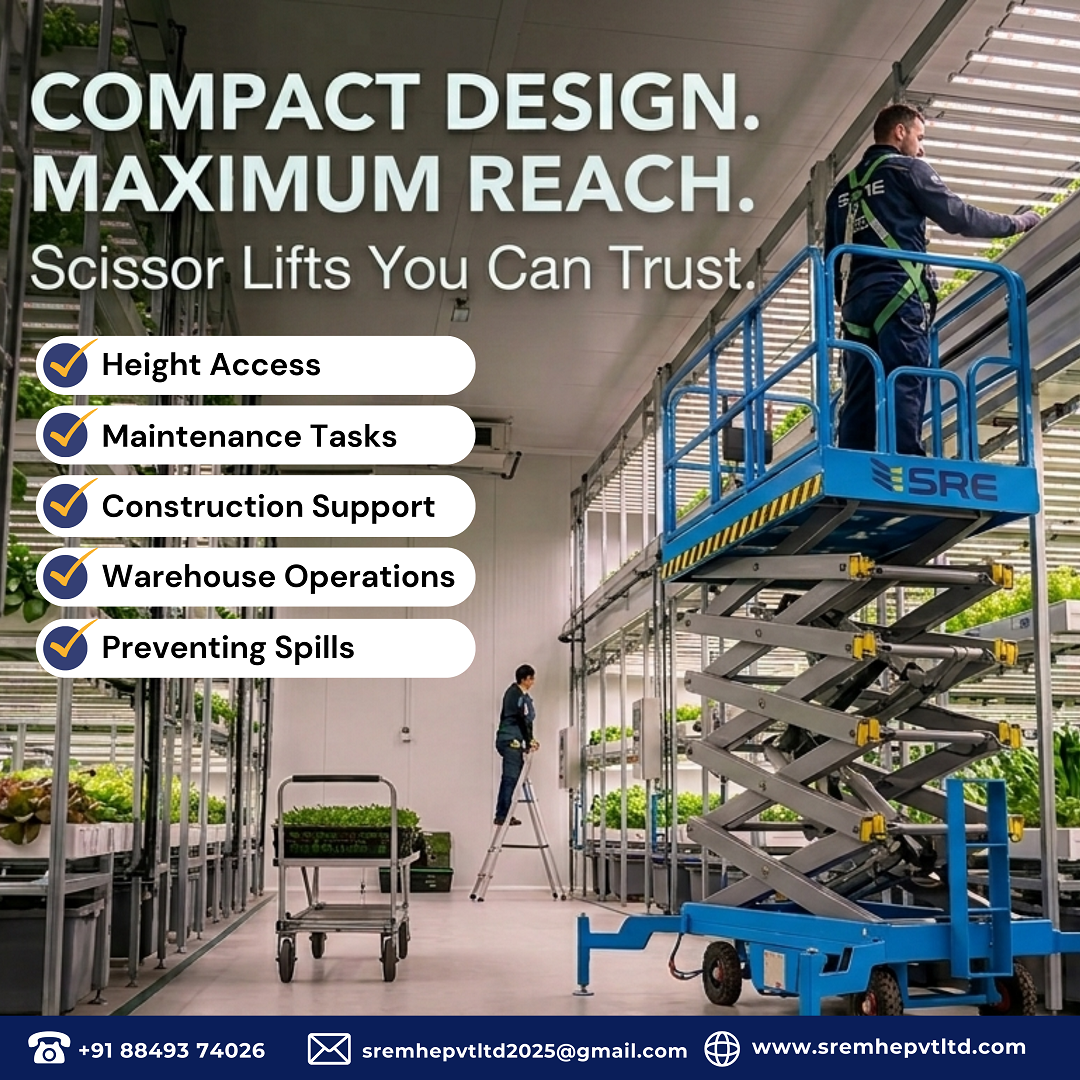
500 Kg Capacity – 900 mm Height (All Size Available)
Rs. 26000
(Taxes to be paid extra)
Brand: SRE
SKU: SRE 149
Min Order Qty: 1
Maximize Industrial Efficiency with Compact Scissor Lifts: SRE Material Handling Equipment Pvt. Ltd.
Boost productivity with innovative compact scissor lifts Warehouse and industrial operations have evolved dramatically over the past decade. What was once a relatively predictable environment is now driven by high-volume demand, faster turnaround expectations, and tighter delivery timelines. Today, teams are expected to move more goods in less time—without compromising safety or accuracy.
At the same time, businesses face practical challenges: labor fatigue, repetitive strain injuries, inconsistent output across shifts, and inefficient manual handling processes. These challenges directly affect productivity and increase operating costs.
This is where scissor lifts provide a practical, efficient solution. Instead of relying solely on manual lifting or outdated equipment, many warehouses and factories are adopting compact lifting systems to enhance workflow efficiency, safety, and operational consistency.
The Changing Needs of Modern Warehouses / Industries
Modern supply chains operate under constant pressure. E-commerce growth, just-in-time inventory systems, and global competition have reshaped expectations.
Warehouse managers now deal with:
- Higher SKU volumes
- Faster picking and packing cycles
- Increased pressure on dispatch timelines
- Limited floor space utilization
- Workforce fatigue and turnover
In real-world workflows, employees often need to lift, position, and transfer goods repeatedly throughout the day. Over time, this leads to slower operations and increased risk of injuries.
To maintain efficiency, industries are moving toward equipment that supports both productivity and worker well-being—without adding complexity to operations.
What Is a Scissor Lifts?
A Scissor Lifts is a material handling platform designed to raise or lower loads vertically using a crisscross (scissor-like) mechanism. It is commonly used in warehouses, factories, and logistics centers to position goods at an optimal working height.
Unlike forklifts or cranes, scissor lifts are typically used for controlled vertical movement in a fixed or limited area. They can be stationary or mobile, depending on operational needs.
Why Scissor Lifts Is Replacing Traditional / Manual Equipment?
Traditional manual handling methods—such as lifting, bending, or using basic tools—are still common in many facilities. However, these methods come with limitations.
Manual Handling Challenges:
- Physical strain and fatigue
- Inconsistent performance
- Higher risk of injury
- Slower cycle times
Improved Workplace Safety
Safety is a critical concern in industrial environments. Manual lifting is one of the leading causes of workplace injuries, particularly affecting the back, shoulders, and joints.
Scissor lifts contribute to safer operations by:
- Minimizing bending and overreaching
- Providing stable platforms for load handling
- Enabling controlled and precise movement
- Reducing sudden load shifts
Instead of relying solely on physical strength, workers can focus on accuracy and control. This creates a safer, more predictable, and efficient work environment.
To learn how our scissor lifts can enhance safety in your warehouse or factory, Contact Us today and speak with our experts.
Handling Heavier Loads with Ease
Modern warehouses handle a wide range of products—from lightweight packages to heavy industrial components.
Manual handling becomes inefficient and risky as load weight increases.
Scissor lifts address this by:
- Supporting higher load capacities
- Maintaining stability during lifting
- Allowing precise height adjustments
- Reducing dependency on multiple workers for a single task
This is especially useful in manufacturing units where materials need to be positioned accurately for processing or assembly.
Technology & Operational Efficiency
Today’s scissor lifts are designed with reliability and efficiency in mind.
Common features include:
- Electric or hydraulic lifting systems
- Battery-powered operation for mobility
- Smooth lifting and lowering mechanisms
- Low maintenance requirements
From an operational perspective, the focus is on uptime. Equipment that works consistently without frequent breakdowns helps maintain workflow continuity.
Space Optimization & Maneuverability
Space is often limited in warehouses, especially in urban or high-density industrial zones.
Compact scissor lifts are designed to operate efficiently in:
- Narrow aisles
- Confined workstations
- Assembly line environments
Their compact footprint allows businesses to optimize available space without compromising functionality. This becomes particularly important when scaling operations within existing infrastructure.
For more insights on optimizing warehouse space and operations, Indian Headline News.
Cost Efficiency Over Time
While initial investment is a consideration, long-term value is what matters most for industrial decision-makers.
Scissor lifts contribute to cost efficiency through:
- Reduced workplace injuries (lower compensation costs)
- Improved productivity (higher output per shift)
- Lower labor fatigue (better workforce retention)
- Minimal downtime (reliable operation)
Instead of focusing only on purchase cost, it’s important to evaluate total operational savings over time.
Sustainability & Compliance
Sustainability is becoming an important factor in industrial decision-making.
Modern lifting equipment supports:
- Energy-efficient operation (especially electric models)
- Reduced physical strain on workers
- Compliance with workplace safety standards
Using equipment that aligns with safety and environmental practices helps businesses stay compliant with regulations and industry expectations.
Integration with Warehouse / Factory Workflow
One of the key advantages of scissor lifts is their ability to fit seamlessly into existing workflows.
They can be used in:
- Packing stations
- Loading docks
- Assembly lines
- Quality inspection areas
Instead of redesigning operations, businesses can integrate lifting systems into current processes to enhance efficiency. This flexibility makes them suitable for both small and large-scale operations.
For more tips on optimizing your warehouse workflow, check out this News Economic India.
Training, Ease of Use & Maintenance
From a practical standpoint, equipment should be easy to operate and maintain.
Scissor lifts are generally:
- Simple to use with basic controls
- Quick to learn for new operators
- Designed for routine maintenance
- Built for long-term durability
Minimal training requirements mean faster adoption across teams, reducing implementation delays.
To stay updated on the latest news and major headlines from the Indian manufacturing sector, you can follow digital news portals. Visit News India Headline for daily reports on the industrial growth and material handling industry.
Electric & Hydraulic Scissor Lifts: Versatile Lifting Solutions for Modern Warehouses
Scissor lifts have revolutionized warehouse and industrial operations, offering efficiency, safety, and flexibility in material handling. Electric scissor lifts are ideal for indoor applications, powered by rechargeable batteries that produce zero emissions and minimal noise. Their precise controls allow smooth, accurate lifting, reducing the risk of accidents while enhancing workflow efficiency. With lower maintenance requirements and energy-efficient operation, electric lifts also help businesses save on long-term operational costs. Their compact design ensures easy maneuverability in narrow aisles, confined workstations, and assembly line environments, making them perfect for high-density industrial zones.
On the other hand, hydraulic scissor lifts provide robust lifting capabilities for heavier loads and outdoor or uneven surface applications. Using hydraulic cylinders, these lifts deliver smooth, controlled motion even under maximum weight. They can be electric-hydraulic or diesel-hydraulic, offering flexibility based on operational requirements. Hydraulic lifts are ideal for loading docks, construction sites, and industrial environments that demand heavy-duty lifting power.
By integrating both electric and hydraulic scissor lifts, warehouses and factories can achieve a balance of efficiency, precision, and strength. This combination ensures optimized workflow, enhanced safety, and maximum productivity across diverse operational scenarios. Whether it’s eco-friendly indoor lifting or heavy-duty outdoor handling, modern scissor lifts form the backbone of efficient material handling solutions, enabling businesses to scale operations effectively without compromising performance.
Why Choosing a Reliable Manufacturer Matters?
Not all equipment delivers the same level of performance or reliability.
When selecting a supplier, businesses should consider:
- Manufacturing quality standards
- After-sales support
- Availability of spare parts
- Industry experience
- Compliance with safety norms
Choosing a reliable manufacturer ensures consistent performance and reduces long-term operational risks.
For businesses exploring advanced lifting solutions, you can learn more about SRE MATERIAL HANDLING EQUIPMENT PRIVATE LIMITED and their offerings here: 👉 https://www.sremhepvtltd.com/
Conclusion:
As industrial operations continue to evolve, the need for efficient, safe, and reliable material handling solutions becomes more critical.
Scissor lifts offer a practical way to improve productivity while addressing real-world challenges such as labor fatigue, safety risks, and workflow inefficiencies. Rather than being just another piece of equipment, they play a functional role in optimizing daily operations.
If you’re evaluating ways to enhance operational efficiency, exploring compact lifting solutions could be a step in the right direction.
Ready to upgrade your material handling operations? Contact Us today to learn how our scissor lifts can transform your workflow.
Key Takeaways
- Productivity: Faster operations and consistent output across shifts
- Safety: Reduced risk of injuries and better ergonomic handling
- Load Handling: Efficient handling of heavy and repetitive tasks
- Cost Efficiency: Long-term savings through reduced downtime and labor strain
- Industry Trend: Increasing adoption of smart material handling solutions
FAQS
Q1. Where are scissor lifts commonly used?
- They are widely used in warehouses, manufacturing units, logistics hubs, and assembly lines for vertical lifting and positioning tasks.
Q2. Are scissor lifts suitable for small warehouses?
- Yes, compact models are specifically designed for limited spaces and narrow aisles.
Q3. How do scissor lifts improve safety?
- They reduce manual lifting, improve posture, and provide stable platforms for handling loads.
Q4. What is the maintenance requirement?
- Routine checks and basic servicing are usually sufficient for long-term performance. Equipment and support provided by SRE Material Handling Equipment Pvt. Ltd are designed to ensure durability, reliability, and consistent operation with proper maintenance.
Q5. Are electric scissor lifts better than manual ones?
- Electric models offer better efficiency, smoother operation, and reduced physical effort.
#ScissorLifts #MaterialHandling #WarehouseEfficiency #IndustrialAutomation #ErgonomicSolutions #SupplyChainOptimization #FactoryOperations #LogisticsManagement #CompactEquipment #SREMHEquipment