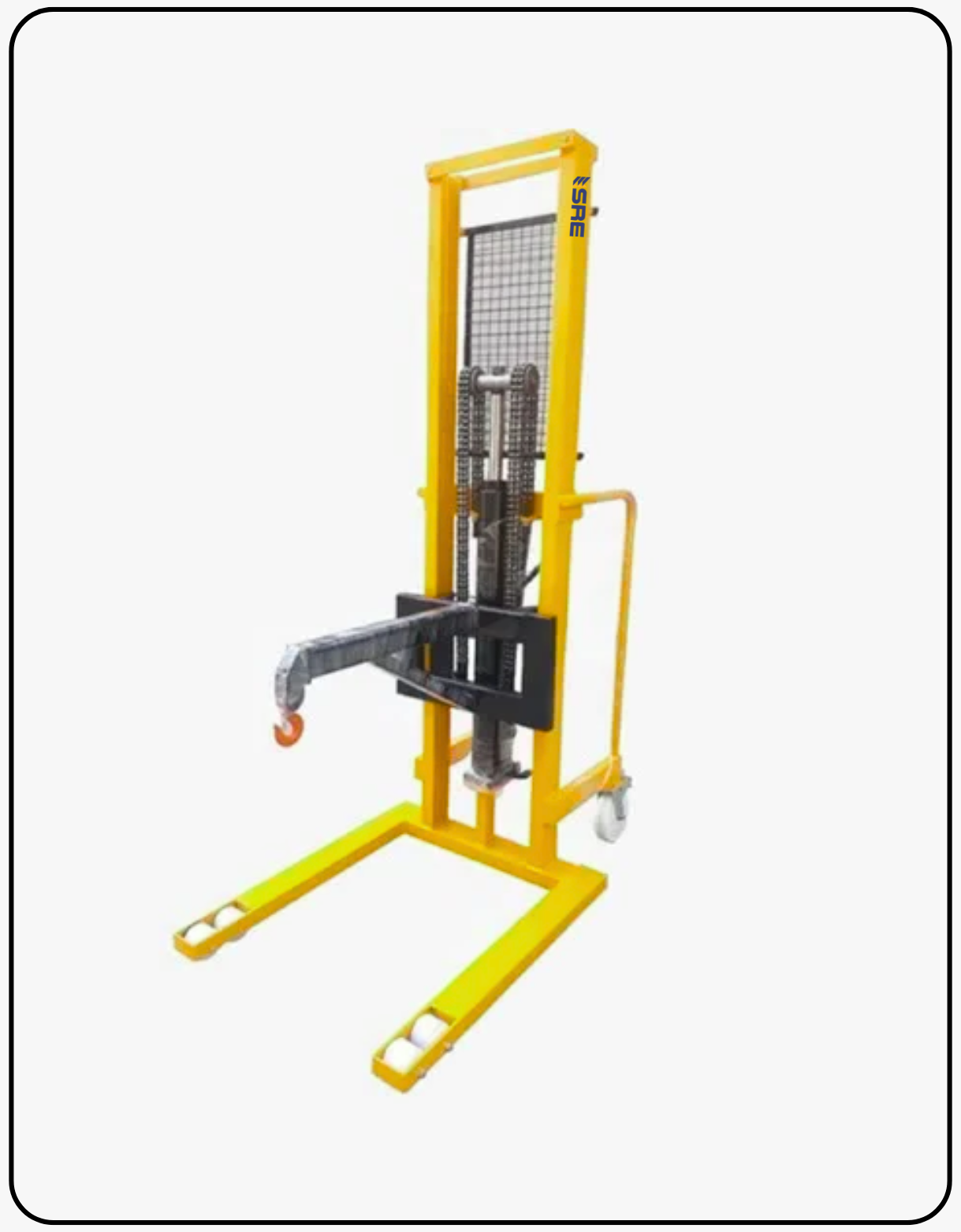
Hook Stacker — All Capacities & Heights Available
Price: Contact for Quote
(Taxes to be paid extra)
Brand: SRE
Min Order Qty: 1
Hook Stacker Manufacturer in Vadodara — Applications, Key Features & Bulk Supply Across Gujarat & India
Key Applications of Hook Stacker in Automotive, Engineering and Logistics Operations Across Vadodara, Ahmedabad and Gujarat
The most common application driving demand for hook stackers in Gujarat and Maharashtra automotive and engineering plants is wire mesh box stacking. Wire mesh boxes (also called KLT containers or returnable packaging containers) are widely used across Pune, Bangalore, Gurugram, and Faridabad automotive supply chains for storing and transporting machined parts, pressings, and sub-assemblies. These containers have a bottom cross-bar or rail frame that cannot be entered by flat forks without floor clearance. The hook stacker’s lifting arms engage the top cross-bar, lifting the box from above — allowing stacking 2 to 3 boxes high in Vatva, Kathwada, and Himmatnagar GIDC plants without pallet handling infrastructure.SRE Material Handling Equipment Pvt. Ltd., an ISO 9001:2015 certified manufacturer in Gujarat, supplies hook stackers to automotive OEMs, tier-1 and tier-2 suppliers, pharmaceutical container operations, and food-grade IBC handling facilities across Pune, Bangalore, Chennai, Hyderabad, and Noida. The hook geometry is application-specific — SRE Material Handling Equipment Pvt. Ltd. designs and fabricates the hook arm profile to match the container’s actual cross-bar or lip dimension, ensuring positive engagement without slippage or deformation across the full rated lifting range. This custom engineering approach is documented under the company’s ISO 9001:2015 QMS product development protocol.Industries That Use Hook Stackers Daily in Gujarat, Maharashtra and Across India
- Automotive Tier-1 and Tier-2 Manufacturing — Stacking wire mesh boxes (KLT and VDA containers) loaded with machined castings, forgings, and pressings in Pune, Bangalore, Gurugram, and Faridabad automotive parts plants.
- Returnables and Packaging Container Management — Stacking empty and loaded returnable packaging containers in buffer storage areas of Vadodara, Ahmedabad, and Kalol GIDC plants that participate in milk-run logistics programmes.
- Pharmaceutical and Chemical IBC Handling — Lifting and positioning intermediate bulk containers (IBCs) with forklift-entry-incompatible bottom frames in Vadodara, Kutch, and Pune chemical and pharma manufacturing zones.
- Food Grade Container Stacking — Handling GMP-certified food-grade totes and crates with hook-lip profiles in Gujarat and Maharashtra food processing facilities where floor-level cross-contamination risk prevents flat-fork entry.
- Metal Fabrication and Press Shops — Stacking heavy gauge perforated or mesh panels in fabrication containers in Bhavnagar, Ahmedabad, and Faridabad press shops where containers are used for work-in-process buffering.
- Textile and Garment Industry — Moving and stacking hanging garment racks and roll cages with hook engagement points in Surat, Bhavnagar, and Chattral textile export warehouses.
- E-Commerce and 3PL Warehousing — Stacking roll cages and mesh trolleys in Noida, Hyderabad, and Bangalore fulfilment centres where floor density requires vertical stacking of wheeled containers during off-peak periods.
- Steel and Engineering Components — Vertical stacking of customised open-top metal containers with hook ledges in Jaipur, Indore, and Rohtak engineering and steel component supply chain warehouses.
Hook Stacker vs Fork Stacker — Why Container Type Determines the Correct Specification
For plant managers and purchase managers in Noida, Indore, and Bhopal who are evaluating whether to buy a standard fork stacker or a hook stacker for their container-handling operation, the decision is determined entirely by the container’s bottom geometry. If the container has a flat, unobstructed bottom that accepts standard forks at floor level, a conventional fork stacker is correct. If the container has a bottom rail, cross-member, or closed base without fork entry clearance — or if the lifting point is at the container’s top cross-bar or frame lip — then a hook stacker is the only correct tool. Using flat forks on hook-engagement containers causes container deformation, load instability, and operator injury risk — all of which represent a far greater cost than the price difference between a standard stacker and a purpose-built hook stacker from SRE Material Handling Equipment Pvt. Ltd.Key Features of SRE Hook Stacker That Plant Buyers in Pune, Bangalore and Maharashtra Specify
A key quality concern for logistics heads in Pune and Bangalore automotive and engineering plants is hook arm deformation under repeated loading and unloading cycles. Undersized or poorly heat-treated hook arms on budget stackers develop permanent set (bending deformation) after 3 to 6 months of continuous use — creating unsafe engagement geometry and triggering early replacement. SRE Material Handling Equipment Pvt. Ltd. fabricates hook arms from IS 2062 Grade A MS steel with a minimum section modulus sized for 150% of rated load, with full-penetration welds on all load-carrying joints inspected per IS 816 visual and dimensional standards. Each hook arm is proof-loaded at 125% of rated capacity before dispatch — documented per the company’s ISO 9001:2015 QMS test record.For engineering industries and procurement heads in Chennai, Hyderabad, and Noida asking about hook geometry customisation for non-standard containers, SRE Material Handling Equipment Pvt. Ltd. conducts a pre-order container measurement assessment — the buyer provides the container cross-bar or lip profile (dimension, material, coating) and the company engineers the hook arm engagement geometry to achieve a minimum 20 mm positive engagement depth with no side-play under load. This application-matched engineering approach, backed by ISO 9001:2015 QMS documentation, means every hook stacker supplied to buyers in Jaipur, Udaipur, Bhopal, Gurugram, Faridabad, Himmatnagar, Vatva, Kathwada, Ghandhidham, and Mahesana is verified for the specific container type before delivery. Contact now with your container dimensions and receive a design confirmation and quotation within 48 hours.Why SRE Material Handling Equipment Pvt. Ltd. Is the Preferred Hook Stacker Manufacturer for Custom Orders in Jaipur, Rajasthan and Across India
OEM sourcing managers in Jaipur, Udaipur, and across Rajasthan automotive supply chains that are standardising on hook stackers for wire mesh box handling across multiple plant sites need a manufacturer who can replicate hook arm geometry consistently across batch orders. SRE Material Handling Equipment Pvt. Ltd.‘s ISO 9001:2015 QMS includes a controlled drawing register for all custom hook arm profiles — meaning a batch order of 5 units placed 6 months after the first trial unit will have identical hook geometry to the original specification, without remeasurement or tolerance drift.The company is MSME registered under the Make in India framework, qualifying for preferential procurement on the GeM portal — relevant for automotive PSUs, government engineering facilities, and state-owned storage corporations in Rajasthan, Maharashtra, and Gujarat that are standardising on domestically manufactured handling equipment. For stacking applications that use standard flat-bottom pallets alongside hook-engagement containers, SRE Material Handling Equipment Pvt. Ltd. also offers combination fork-and-hook attachment designs that support both load types on a single stacker chassis. Browse the Hydraulic Stacker range and the Electric Stacker range for related stacking equipment. For guidance on Pune and Maharashtra stacker applications, see our Hydraulic Stacker Pune guide.Safety Standards, Maintenance and Selection Guide for Hook Stackers in Gurugram, Bhavnagar and Across India
A critical safety requirement for factory buyers in Gurugram, Faridabad, and Rohtak automotive plants running ISO 45001-audited operations is that hook stacker load engagement must be verified before each lift. The SRE hook stacker incorporates a positive visual engagement indicator on the hook arm — a colour-coded depth marker that confirms minimum 20 mm hook-to-cross-bar engagement is achieved before the operator initiates lift — eliminating the leading cause of hook stacker load drops caused by shallow engagement in fast-paced operations in Maharashtra, Karnataka, and Tamil Nadu plants. Refer to ISO 22915 industrial truck stability standards for the design reference applicable to hook-type lifting equipment.Preventive maintenance for the SRE hook stacker follows the same schedule as the hydraulic stacker range: hydraulic oil check every 6 months, hook arm surface inspection for wear and engagement depth verification annually, and mast rail lubrication every 3 months under high-cycle use. The hook arms are designed as replaceable field assemblies — bolted to the carriage rather than welded — enabling hook replacement without returning the complete unit to the manufacturer, which directly minimises downtime for operations in Noida, Indore, Ambala, and Bhopal with limited on-site maintenance capability. SRE Material Handling Equipment Pvt. Ltd. stocks replacement hook arm sets for same-week dispatch. Call Now to discuss your hook stacker requirement and get a customised quotation within 48 hours.Handling wire mesh boxes, IBC cages, or hook-engagement containers? Contact Us Now or call +91 93162 08879 / +91 97247 22404 — SRE Material Handling Equipment Pvt. Ltd. designs and supplies custom Hook Stackers across Vadodara, Ahmedabad, Pune, Bangalore, and PAN India.