
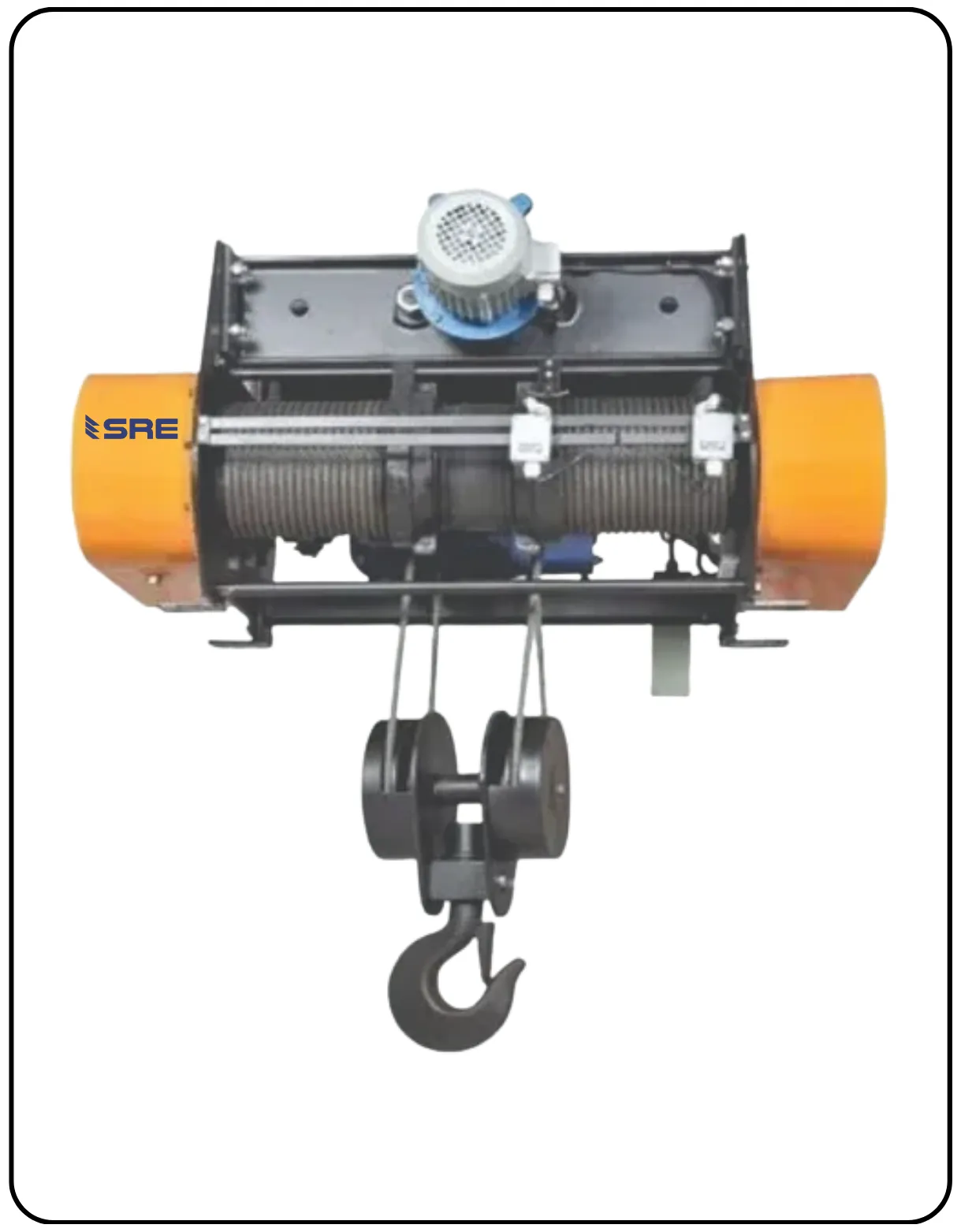
Electric Wire Rope Hoist in Pune — Applications, Key Features & What Every Plant Manager Needs to Know Before Buying
In fabrication shops, machine workshops, and overhead crane installations across Pune, one operational problem comes up repeatedly: a chain block or manual hoist that worked fine at 250 kg is now too slow, too operator-dependent, and too unreliable for a production line running two or three shifts per day. The physical strain on workers, the inconsistent lift speeds, and the maintenance cost of worn chain links add up — and they add up fast when your throughput depends on precise, repeated lifting cycles. The Electric Wire Rope Hoist is the engineered answer: a motor-driven, wire rope-wound lifting unit rated for 250–500 kg at lift heights up to 20 metres, built for high-cycle industrial service at a starting price of Rs. 7,500 (SKU: SRE 173). Whether your crane runway is in a steel fabrication plant in Pune, a pharma plant in Ahmedabad, or a machine tool facility in Gujarat — this is the hoist category that eliminates the manual effort, the injury risk, and the inconsistent cycle times of older lifting methods.
What Is an Electric Wire Rope Hoist and How Does It Differ from a Chain Hoist in Pune and Maharashtra?
The most frequent sourcing question from plant managers and purchase managers in Pune, Nagpur, and Maharashtra is straightforward: what does a wire rope hoist do that an electric chain hoist doesn’t? The core difference is in the lifting medium and the duty cycle it supports. A chain hoist uses a precision steel link chain running over a pocket wheel — reliable for light to medium duty, but chain links wear, stretch, and require lubrication at shorter intervals under repeated heavy-load cycles. A wire rope hoist uses a multi-strand galvanized steel wire rope wound onto a precision-grooved drum — designed specifically for higher duty cycles, heavier loads per lift, and longer rope lengths. At 20-metre lift height, a chain would be impractical to manage; a wire rope drum handles this effortlessly with consistent speed control across the full travel range.
The SRE Electric Wire Rope Hoist (SKU: SRE 173) operates on a three-phase 415V AC motor with a Class F insulated winding that tolerates the ambient heat common in fabrication bays and casting shops across Pune, Vadodara, and Ahmedabad. The gearbox is oil-bath lubricated in a cast iron housing, providing smooth, silent transmission at the rated lift speed — typically 4–8 metres per minute depending on the duty class selected. An electromagnetic disc brake rated at 150% of hoist load engages instantly on power loss or emergency stop, preventing any uncontrolled descent of the suspended load. This is not an optional safety feature — it is a fundamental design requirement for any hoist installed on a crane in a production environment.
Wire Rope Specification, Drum Design, and Reeving Configuration
The structural integrity of a wire rope hoist ultimately depends on two components: the rope itself and the drum it winds onto. The SRE wire rope hoist uses 6 × 19 construction galvanized wire rope conforming to IS 2365, with a safety factor of 5:1 against the rated working load. For a 500 kg hoist, the rope diameter is typically 8 mm — providing a breaking strength well above the 2,500 kg minimum safety factor requirement. The drum is precision-machined with helical grooves that guide each wrap of rope without overlap or chafing, which is the primary cause of premature rope failure in poor-quality hoist designs. Rope end anchorage uses a wedge-and-socket or dead-end clamp arrangement — not a simple knot or clip — ensuring the connection integrity matches the rope’s rated breaking load. For engineering industries in Vatva, Kathwada, and Pune‘s manufacturing corridors, this specification detail matters at every procurement stage.
Motor Power, Duty Class, and Control System Options
Selecting the right duty class is the technical decision that most affects long-term reliability — and the one most often overlooked by procurement heads who focus only on capacity and price. Electric wire rope hoists are classified by their operating duty cycle: from M3 (light duty — up to 25% running time) to M5 or M6 (medium-to-heavy duty — up to 60% running time). A steel plant or a shipyard running three shifts needs at minimum an M5 duty class hoist; a toolroom doing die changes 5–8 times per shift can be well-served by an M3 unit. The SRE wire rope hoist is available in M3 to M5 duty classes, with motor power ranging from 0.75 kW (250 kg model) to 1.5 kW (500 kg model), all on three-phase 415V / 50 Hz supply. The pendant control offers two-speed operation — a slow-speed creep mode at 25% of full lift speed for precise load positioning and a full-speed mode for fast travel — a feature that significantly reduces positioning errors in assembly and machining applications across Ahmedabad, Bangalore, and Chennai.
Key Applications of Electric Wire Rope Hoist Across Industries in Ahmedabad, Vadodara, Pune, Bangalore, and Hyderabad
The electric wire rope hoist is the standard lifting unit for any overhead crane installation — EOT crane, monorail system, jib crane, or gantry crane — where motorized lifting is required with precision control and high-cycle reliability. Below are the primary operational applications where SRE wire rope hoists are deployed at customer facilities across Ahmedabad, Vadodara, Pune, Bangalore, Chennai, Hyderabad, Noida, Jaipur, and Gujarat:
- Steel Fabrication and Structural Work: Lifting and positioning cut plates, beams, and welded sub-assemblies in fabrication shops — where repeated lifts of 300–500 kg across a 10–15 metre span are the standard operating cycle in Vatva, Kathwada, and Pune fabrication yards.
- Machine Tool and Press Shop: Die and tooling changes in pressing and stamping facilities — where a 500 kg wire rope hoist on a jib crane positions dies at machine bed height with the slow-speed creep function for ±5 mm placement accuracy.
- Foundry and Casting Plants: Lifting ladles, casting moulds, and heat-treated components in foundry environments where ambient temperatures exceed 60°C — the Class F motor winding tolerates this without derating.
- Pharma and Chemical Manufacturing: Lifting reactor vessels, IBC containers, and process equipment during installation and maintenance at pharma plants in Ahmedabad, Hyderabad, and Bangalore — where explosion-proof variants are available on request.
- Automobile Assembly Plants: Engine block lifting, sub-frame handling, and body transfer operations on assembly lines in Pune‘s automotive cluster and in Rohtak and Gurugram.
- Shipbuilding and Port Operations: Lifting of hull sections, marine equipment, and cargo handling in port-adjacent fabrication facilities near Mangalore and Gandhidham.
- Construction and Infrastructure: Hoisting of rebar bundles, precast sections, and equipment during civil construction and industrial building projects across Noida, Faridabad, and Bhopal.
- Textile Machinery Maintenance: Lifting of loom frames, beam creel assemblies, and warping machinery during maintenance shutdowns at textile mills in Kutch, Mahesana, and Bhavnagar.
- Cold Storage and Food Processing: Movement of heavy processing equipment and refrigeration units during installation and servicing in cold chain facilities.
- Power and Utilities: Lifting of transformer cores, switchgear panels, and heavy electrical equipment during substation construction and maintenance in Rajasthan, Udaipur, and Jaipur.
Electric Wire Rope Hoist vs. Electric Chain Hoist vs. Manual Chain Block — Specification Comparison for Pune and Gujarat Buyers
Before committing to a procurement decision, engineering industries and factory owners in Pune, Ahmedabad, Vadodara, and Indore need a clear side-by-side view of lifting options for the 250–500 kg load range. The differences in duty cycle tolerance, rope/chain type, lift height, and operating cost make this a technical decision — not just a price comparison. Below is a direct specification comparison across the three most common options in this load class:
| Feature | Electric Wire Rope Hoist (SRE 173) | Electric Chain Hoist | Manual Chain Block |
|---|---|---|---|
| Capacity Range | 250–500 kg (standard); up to 50 ton (custom) | 250 kg – 5 ton | 500 kg – 20 ton |
| Max Lift Height | Up to 20 m (standard); 30+ m custom | 3–12 m typical | 3–6 m practical |
| Lifting Medium | 6×19 galvanized wire rope (IS 2365) | Grade 80 alloy link chain | Grade 80 alloy link chain |
| Duty Class | M3 to M5 (light to medium-heavy) | M3 to M4 (light to medium) | Intermittent manual |
| Power Supply | 3-Phase 415V / 50 Hz | Single or 3-Phase | None — manual effort |
| Speed Control | Two-speed: creep + full speed | Single speed (most models) | Operator-controlled (slow) |
| Brake System | Electromagnetic disc brake (150% rated load) | Mechanical disc brake | Friction pawl ratchet |
| Starting Price (Rs.) | 7,500 | 4,500 (chain hoist) | 850–2,500 |
| Best Suited For | High cycle, long travel, overhead crane mount | Medium cycle, moderate height | Low cycle, emergency, no power |
*All SRE hoist products available from SRE Material Handling Equipment Pvt. Ltd., Ahmedabad. For chain hoist and chain block options, see the Chain Block and Hoist product range. Contact the sales team for exact pricing on specific duty class, rope length, and crane interface requirements.
Why Purchase Managers and Engineering Industries Across Jaipur, Udaipur, Indore, Bhopal, and Gurugram Source from SRE Material Handling Equipment Pvt. Ltd.
At Rs. 7,500 for the entry model, the SRE Electric Wire Rope Hoist (SRE 173) sits at the value end of its specification class — but the price point does not compromise the technical specification. SRE Material Handling Equipment Pvt. Ltd., founded in 2011 under the leadership of Mr. Gaurang Patel in Ahmedabad, holds ISO 9001:2015 certification and is registered as an MSME manufacturer under the Make in India initiative. The hoist assembly process at the Ahmedabad facility follows documented production controls that include electrical insulation testing of the motor winding at 1,000V DC for one minute, no-load running test verifying correct brake engagement and release, and a load test at 125% of rated capacity for each production batch. These are not aspirational quality claims — they are the standard production sign-off checks that the ISO 9001:2015 quality management system mandates.
For procurement heads in Jaipur, Udaipur, Bhopal, Indore, Rohtak, Ambala, Faridabad, and Gurugram who are sourcing hoists for EOT crane installations or monorail systems on a project basis, SRE Material Handling Equipment Pvt. Ltd. handles bulk procurement requirements with consistent lead times of 7–15 working days for standard models, and 3–4 weeks for custom rope lengths or duty class upgrades. Pan-India logistics is coordinated from the Ahmedabad base to reach Bangalore, Chennai, Hyderabad, Noida, Pune, Gandhidham, Mahesana, Bhavnagar, Kutch, Himmatnagar, Vatva, Kathwada, Kalol, and Chattral. For installations in Gujarat, deliveries within the state are consistently shorter — often completed in 3–5 working days from order confirmation.
Client Experience — Steel Fabrication Plant, Pune MIDC:
“We replaced four manual chain blocks on our overhead gantry with SRE 500 kg wire rope hoists about two years ago. The difference was immediate — our crane operator handles the same lift cycle in about 90 seconds that previously took 8–10 minutes of manual effort. In a three-shift operation, that time saving compounds into a significant daily throughput gain. The hoists have run with zero electrical failures in 24 months; we only performed one routine brake pad inspection at 18 months.”
— Maintenance Manager, Steel Fabrication Plant, Pune (Name withheld per company policy)
For crane system design reference and safe working load standards applicable to wire rope hoists in Indian industrial installations, the Bureau of Indian Standards (BIS) IS 3938 and IS 2365 are the governing standards for wire rope quality and hoist design. For international quality management framework reference, the ISO 9001 Quality Management System standard certified at SRE Material Handling Equipment Pvt. Ltd. ensures documented process control at every production stage. For workplace lifting safety requirements in Indian factories, The Factories Act 1948 — lifting appliance provisions governs safe working load marking, periodic testing, and operator certification requirements that apply to every electric wire rope hoist installed in a scheduled factory in India.
Installation, Crane Interface, and Safety Requirements for Electric Wire Rope Hoist in Ahmedabad, Vadodara, and Pune Facilities
A common gap in procurement planning for factory owners in Ahmedabad, Vadodara, and Pune is treating the hoist as a standalone purchase rather than a component in a crane system. The electric wire rope hoist mounts onto a crab unit (the cross-travel trolley) that runs on the crane bridge girder or monorail beam — and the interface dimensions between the hoist, crab, and beam must be engineered together. The SRE wire rope hoist is available with a standard monorail push-travel trolley for single-girder configurations, or a motorized crab unit for double-girder EOT crane integration. The end approach dimension — the horizontal distance from the crane end carriage to the hook centre — is a critical parameter that affects how close to a column or wall the hoist can lift, directly impacting the usable floor area of your bay. Standard end approach for the 250–500 kg SRE hoist is 250–350 mm, allowing installation in bays with tight column spacing common in Pune, Bangalore, and Hyderabad older-build industrial sheds.
From a safety compliance standpoint, every electric hoist installed in a factory covered under The Factories Act 1948 must carry a rated safe working load (SWL) marking, be tested at 125% of SWL at installation, and be re-inspected periodically as per the state factory inspector’s schedule — typically every 12 months. The SRE wire rope hoist ships with a factory-issue test certificate documenting the pre-dispatch load test, which simplifies the initial inspection compliance process for your factory safety officer. Additional safety devices standard on the SRE unit include an upper limit switch that cuts power before the hook block contacts the drum casing, and an overload protection relay in the pendant control circuit that trips the motor if the load exceeds 110% of rated capacity — protecting both the rope and the structure. For logistics heads and facility managers in Noida, Faridabad, Indore, and Gujarat, these built-in safety features directly reduce the compliance documentation burden at first inspection.
Frequently Asked Questions — Electric Wire Rope Hoist in Pune
Q1. What is the load capacity and maximum lift height of the Electric Wire Rope Hoist available for industrial plants in Pune and Maharashtra?
The standard SRE Electric Wire Rope Hoist (SKU: SRE 173) is available in 250 kg and 500 kg rated safe working load, with a standard maximum lift height of 20 metres. Custom rope lengths beyond 20 metres are available for high-bay applications. The hoist motor operates on three-phase 415V / 50 Hz supply. SRE Material Handling Equipment Pvt. Ltd., an ISO 9001:2015 certified manufacturer in Ahmedabad, supplies these units to plants across Pune, Maharashtra, and pan-India. Minimum order quantity is 1 unit; price starts at Rs. 7,500 (taxes extra).
Q2. What is the difference between an Electric Wire Rope Hoist and an Electric Chain Hoist for high-cycle factory applications in Ahmedabad and Gujarat?
The core difference is in the lifting medium and duty cycle tolerance. An electric wire rope hoist uses a 6×19 galvanized wire rope (IS 2365) wound on a grooved drum — suited for M3 to M5 duty class, higher lift heights (up to 20+ metres), and high-frequency lift cycles without chain stretch or wear issues. An electric chain hoist is practical for lift heights up to 12 metres at lighter duty. For fabrication shops and foundries in Ahmedabad, Gujarat, and Pune running multi-shift operations, the wire rope hoist delivers lower maintenance cost and longer service life per duty cycle requirement.
Q3. What safety certifications and standards should a procurement manager verify before buying an Electric Wire Rope Hoist for a factory covered under the Factories Act in India?
Before procurement, verify: the hoist carries a marked safe working load (SWL) per IS 3938; the wire rope conforms to IS 2365 with a 5:1 safety factor; a factory load-test certificate at 125% of SWL accompanies the unit; and the motor winding is Class F insulated for thermal protection. Additionally, confirm the manufacturer holds ISO 9001:2015 certification — SRE Material Handling Equipment Pvt. Ltd. does — as this ensures documented quality controls at every production stage. The Factories Act 1948 requires periodic re-testing at the installation site; the SRE pre-dispatch test certificate simplifies this initial compliance step.
Q4. Can the Electric Wire Rope Hoist from SRE be integrated with an existing EOT crane or monorail system in Bangalore, Chennai, or Hyderabad factories?
Yes. The SRE Electric Wire Rope Hoist (SRE 173) is designed for both EOT crane (double-girder) and monorail / single-girder overhead crane integration. It is supplied with a standard push-travel trolley (manual cross-travel) or a motorized crab unit depending on your crane type. The end approach dimension for the standard 250–500 kg model is 250–350 mm. For exact interface dimensions matching your existing crane beam profile in Bangalore, Chennai, or Hyderabad, share your beam flange width and span with the SRE technical team for a confirmed fit assessment before ordering.
Q5. Pune ke manufacturing plant ke liye Electric Wire Rope Hoist ki price aur delivery time kya hai?
Pune ke factories ke liye Electric Wire Rope Hoist (SRE 173) ki starting price Rs. 7,500 hai — taxes alag se applicable hain. Yeh 250–500 kg capacity, 20 metre lift height standard configuration ke liye hai. SRE Material Handling Equipment Pvt. Ltd. ka delivery time Pune tak standard models ke liye 7–15 working days hai. Custom rope length ya duty class upgrade wale orders ke liye 3–4 weeks ka lead time hai. Bulk procurement (5+ units) ke liye priority scheduling aur quantity-based pricing available hai — sales team se contact karein.
Q6. Ahmedabad aur Gujarat ke fabrication plants ke liye Electric Wire Rope Hoist ka konsa model best rahega — 250 kg ya 500 kg?
Ahmedabad, Vatva, Kathwada, aur Kalol ke steel fabrication aur engineering plants ke liye model selection load requirement par depend karta hai. Agar regular lift cycle mein load 200 kg tak rehta hai, toh 250 kg model (0.75 kW motor) adequate hai. Agar press dies, machine components ya castings lift karte hain jo 300–500 kg tak jaate hain, toh 500 kg model (1.5 kW motor, M4/M5 duty class) recommend kiya jata hai. Gujarat ke customers ko delivery 3–7 working days mein milti hai kyunki manufacturing Ahmedabad mein hi hoti hai.
Q7. Kya Electric Wire Rope Hoist ki maintenance service aur spare parts Rajasthan, Karnataka, aur Noida mein available hain?
Electric Wire Rope Hoist ka maintenance schedule simple hai: har 6 months mein wire rope ki visual inspection aur lubrication (wire rope grease), har 12 months mein brake pad check aur electromagnetic brake air gap adjustment, aur gearbox oil change 2,000 operating hours par. Jaipur, Bangalore, Noida, aur Hyderabad mein spare parts — brake pads, wire rope spools, limit switch assembly — locally available hain ya Ahmedabad se courier ke through 2–3 days mein reach ho jaate hain. Technical support ke liye +91 9316 208879 par call karein.