
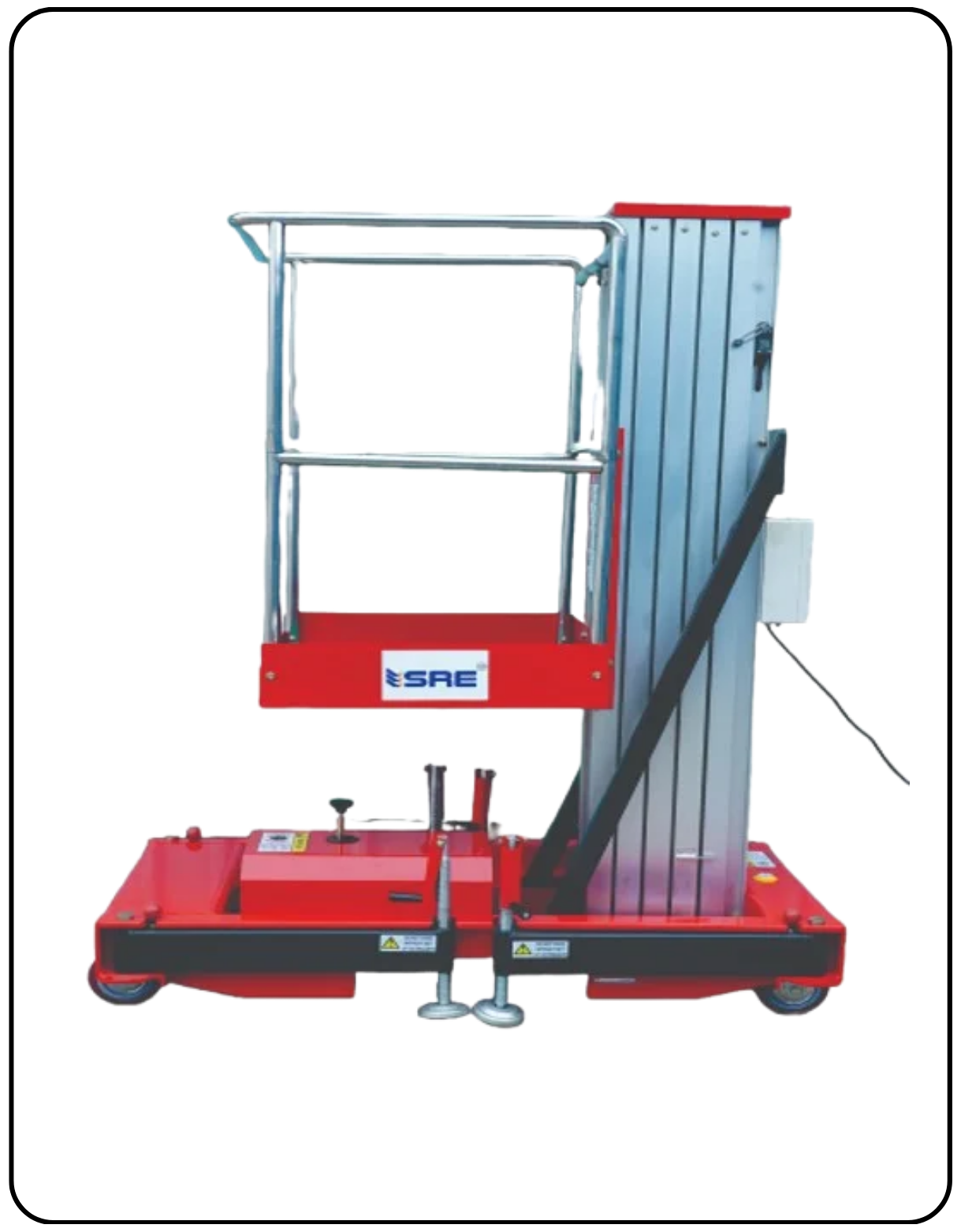
Maintenance teams and technicians who work at height in factories and warehouses in Vadodara, Ahmedabad, and Pune face a daily choice between ladders — which are fast to deploy but inherently unstable at height above 4 metres — and fixed scaffolding — which is safe but takes hours to erect and dismantle for each job. Neither solution is acceptable when maintenance tasks at 5–6 metres need to be done daily across multiple locations in a production facility. The Single Mast Aerial Work Platform in Vadodara (SKU: SRE 151) closes this gap: a battery-powered, single-mast, self-propelled elevated work platform rated at 130 kg capacity with a 6-metre maximum working height, priced at Rs. 1,75,000, that a single technician can deploy from floor level to 6-metre working height in under 45 seconds — and manoeuvre through factory aisles as narrow as 1.5 metres to any work location without scaffolding erection.
Key Applications of Single Mast Aerial Work Platforms in Vadodara, Ahmedabad, and Gujarat Industrial Facilities
The single mast aerial work platform (AWP) is the lightest, most compact category of self-elevating personnel platform — designed for a single operator working at heights of 4–8 metres in confined indoor environments. In Vadodara‘s manufacturing and warehouse facilities, the most common applications are: overhead electrical and lighting maintenance in production halls (reaching light fittings, cable trays, and conduit runs at 5–7 metre ceiling heights); HVAC duct inspection and filter replacement at roof-level air handling units; fire sprinkler head inspection and testing; rack system installation and labelling in high-bay warehouses; and painting and surface treatment at building interior heights inaccessible by standard ladders. Each of these tasks was previously done from extension ladders — exposing maintenance technicians to fall risk from an unsecured, non-self-levelling platform, and reducing work quality because both hands were needed for ladder stabilisation rather than tool use.
In pharmaceutical manufacturing and cleanroom facility management in Ahmedabad and Hyderabad, the single mast AWP replaces ladders in gowning areas and manufacturing suites where contamination control rules prohibit traditional step ladders (which import particles from floor surfaces to elevated clean zones). The SRE 151‘s electrostatic-discharge-safe, powder-coated aluminium mast and sealed battery pack minimise particle generation — making it the preferred height-access tool in GMP-classified environments on confirmed facility compliance review. For high-bay warehouses in Noida, Gurugram, and Bangalore with 6–8 metre racking systems, the AWP allows rack-label placement, top-shelf picking, and rack-bolt inspection by a single operator without a separate spotter — reducing height-work team sizes from 2 to 1 per task.
Applications Across Industry Sectors
- Factory Maintenance: Overhead electrical, lighting, HVAC, and fire systems maintenance in production halls in Vadodara, Ahmedabad, Pune, and Faridabad.
- Warehouse Operations: Top-shelf picking, rack labelling, and beam inspection in high-bay warehouses in Noida, Gurugram, Bangalore, and Chennai.
- Pharma & Cleanroom Facilities: Height maintenance in GMP zones in Ahmedabad, Vadodara, and Hyderabad.
- Retail & Commercial: Display fitting, signage installation, and facade maintenance in commercial buildings in Vadodara, Jaipur, and Bangalore.
- Chemical & Process Plants: Overhead pipe inspection, insulation repair, and instrument maintenance in process plants in Ghandhidham, Kutch, and Vatva.
- Construction & Fit-Out: Interior ceiling work, MEP installation, and surface finishing at heights of 4–6 metres in Bhopal, Indore, and Jaipur construction projects.
- Power & Utilities: Overhead cable and equipment access in switchyards and power distribution buildings across Gujarat and Rajasthan.
Single Mast AWP vs. Ladder vs. Scaffolding — The Safety and Productivity Comparison
For plant managers and safety officers in Vadodara, Pune, and Bangalore evaluating height-access equipment, the comparison across the three common options is decisive for tasks above 4 metres. A standard extension ladder at 6 metres provides no stabilisation for the operator — any load shift (a heavy tool, a pull force) creates a tip risk classified as high-hazard under Indian height safety guidelines. Fixed scaffolding eliminates tip risk but requires 2–4 hours of erection and dismantling per use point, and is impractical for multi-point maintenance schedules. The SRE 151 single mast AWP provides a guarded platform with safety cage, self-levelling base, and battery-powered vertical travel — deployable in 45 seconds to any height between floor and 6 metres, repositionable between tasks in under 2 minutes, and operable by a single certified technician without a spotter. Under Factory Act height safety requirements, the SRE 151 satisfies all documented platform stability, guarding, and emergency descent requirements for personnel working at heights above 2 metres.
Deploy certified Single Mast Aerial Work Platforms for safe at-height operations in your Vadodara or Gujarat facility.
Get a Quote for Bulk Orders 📞 Call Now: +91 93162 08879Technical Specifications of SRE 151 Single Mast Aerial Work Platform — Key Parameters for Procurement in Gujarat and Nationwide
| Specification | SRE 151 Single Mast AWP |
|---|---|
| Platform Load Capacity | 130 kg (1 operator + tools) |
| Maximum Working Height | 6 metres |
| Platform Floor Height | Approx. 4 metres (at max elevation) |
| Mast Configuration | Single vertical mast (compact footprint) |
| Drive System | Battery-powered electric drive |
| Battery | 24V/225 Ah deep-cycle (8-hr operational charge) |
| Machine Width | 770 mm (fits 1.5m aisle) |
| Platform Guardrails | Full-perimeter safety guardrails (Factory Act compliant) |
| Ascent/Descent Speed | 0.18 m/s (smooth, controlled) |
| Emergency Descent | Manual override, battery-independent |
| Price | Rs. 1,75,000 (taxes extra), SKU: SRE 151 |
The SRE 151‘s narrow machine width of 770 mm is a key advantage for deployment in production halls with established equipment layouts and aisle widths as narrow as 1.5 metres — common in Vadodara GIDC factories built to older floor plans. The emergency manual descent is battery-independent — operated by a mechanical valve accessible from both the platform and the ground — ensuring the operator can descend safely in the event of battery failure or electrical fault. SRE Material Handling Equipment Pvt. Ltd., an ISO 9001:2015 certified manufacturer, provides operator training documentation and platform safety inspection checklists with every unit — essential for Factory Act compliance records at registered manufacturing facilities in Gujarat, Maharashtra, Rajasthan, and NCR.
A 3PL logistics company in Ahmedabad with a 9-metre high-bay racking warehouse deployed 3 SRE 151 single mast AWPs for rack labelling, top-bay inspection, and annual sprinkler head testing. Before deployment, all top-bay work required hired scaffold teams at Rs. 12,000–18,000 per day. After AWP deployment, the same work is done by in-house maintenance staff. Annual scaffold hire elimination: Rs. 2.4 lakh per year. Total investment in 3 units: Rs. 5,25,000. Break-even on scaffold cost saving alone: 26 months. Ongoing annual saving for the full equipment life: Rs. 2.4 lakh per year.
Procurement and Safety Compliance Guide for Single Mast AWPs in Vadodara, Gujarat, and Nationwide
For plant safety officers and purchase managers in Vadodara, Noida, Mangalore, and Bangalore procuring aerial work platforms, the compliance checklist includes: platform capacity certification at rated load with safety certificate, guardrail height compliance (minimum 1,000 mm from platform floor), emergency descent mechanism (battery-independent), tilt sensor or outrigger stability system for safe deployment on non-level factory floors, and operator manual in Hindi and English. All SRE 151 units are supplied with these features as standard. For facilities requiring documentation for factory safety audits, SRE provides a platform inspection checklist, operator training guide, and conformity declaration — sufficient for most State Factory Inspectorate compliance requirements.
For operations requiring greater working height — above 6 metres — SRE Material Handling Equipment Pvt. Ltd. supplies the double mast aerial work platform (SKU: SRE 152, 220 kg x 10 metre, Rs. 3,10,000) — see the companion blog for Double Mast AWP in Vadodara for specifications and applications. For facility managers looking to complement the AWP fleet with complete material handling coverage, the SRE mobile floor crane provides heavy-load overhead lifting capability without permanent beam infrastructure, completing the height-access and height-lift equipment set for most factory maintenance requirements across Vadodara, Ahmedabad, Bhavnagar, and Gujarat.
Get certified Single Mast Aerial Work Platforms with full safety documentation from SRE — Factory Act compliant delivery to Vadodara and all of India.
Request Bulk Order Quote 📞 Call: +91 97247 22404Frequently Asked Questions (FAQ)
What is the maximum working height and load capacity of SRE’s Single Mast Aerial Work Platform, and is it Factory Act compliant for Vadodara facilities?
The SRE 151 Single Mast AWP has a 6-metre maximum working height and a 130 kg platform capacity (1 operator + tools). The unit includes full-perimeter guardrails (1,000 mm height), emergency manual descent (battery-independent), and tilt stability sensing — satisfying Factory Act height safety compliance requirements for aerial work platforms used at registered manufacturing facilities in Vadodara, Ahmedabad, and across Gujarat. SRE Material Handling Equipment Pvt. Ltd. provides conformity declaration and operator training documentation with every unit.
What is the price of a Single Mast Aerial Work Platform in Vadodara and what is included in the standard delivery?
The SRE 151 Single Mast AWP is priced at Rs. 1,75,000 (taxes extra) in Vadodara for the 130 kg, 6-metre standard configuration. Standard delivery includes the complete AWP with battery (24V/225 Ah), charger, platform guardrail assembly, emergency descent mechanism, operator manual (Hindi + English), and safety inspection checklist. SRE Material Handling Equipment Pvt. Ltd. — ISO 9001:2015 certified — delivers to Vadodara, Ahmedabad, Gujarat, and all industrial zones across India.
Can a Single Mast AWP replace ladders for overhead maintenance in a Vadodara chemical or pharma facility?
Yes — and this is the primary application. A single mast AWP provides a guarded, self-stabilising platform at 6 metres where extension ladders are unstable and non-compliant with Factory Act height safety guidelines. For chemical plants in Vadodara‘s Petrochemicals Complex, the SRE 151’s sealed battery pack and powder-coated frame reduce chemical splash exposure risk. For pharma GMP zones in Ahmedabad, the enclosed platform design prevents particulate shedding at height. Specific zone requirements (ATEX classification for chemical plants) should be confirmed before deployment in classified hazardous areas.
What is the typical ROI period for a Single Mast AWP deployed at a warehouse or factory in Ahmedabad or Bangalore?
The ROI on a Single Mast AWP (Rs. 1,75,000) depends on the current height-access method being replaced. Replacing scaffold hire: facilities spending Rs. 10,000–18,000 per scaffold day recover the investment in 10–18 scaffold days eliminated. Replacing ladders: the direct ROI is through injury claim elimination (a single fall-from-height injury at 5–6 metres typically costs Rs. 3–8 lakh in medical, insurance, and productivity loss) and maintenance time efficiency (AWP tasks completed 40–60% faster than ladder equivalents at the same height). Most facilities recover the investment within 12–18 months.
Vadodara ke factory mein Single Mast Aerial Work Platform ki price kya hai aur kya ye Factory Act ke under compliant hai?
Vadodara factories ke liye SRE 151 Single Mast AWP ki price Rs. 1,75,000 (taxes extra) hai — 130 kg capacity, 6 metre maximum height. Factory Act compliance ke liye unit mein full-perimeter guardrails (1000mm height), battery-independent emergency descent, aur tilt stability sensing standard hai. SRE Material Handling Equipment Pvt. Ltd. — ISO 9001:2015 certified — conformity declaration aur operator training guide provide karta hai factory safety audit ke liye.
Gujarat ke high-bay warehouse ke liye Single Mast AWP aur hired scaffolding mein kaunsa financially better option hai?
Gujarat ke high-bay warehouses ke liye: agar scaffold hire Rs. 10,000–18,000 per day hai aur 10+ scaffold days per year ki zaroorat hai, toh SRE 151 Single Mast AWP (Rs. 1,75,000) financially better hai — investment 10–18 scaffold days mein recover hota hai. Ongoing annual scaffold cost elimination Rs. 1–2 lakh per year possible hai. SRE Material Handling Equipment Pvt. Ltd. case-by-case ROI calculation provide karta hai consultation call pe free mein.
Pune ya Bangalore ke factory ke liye Single Mast AWP ki delivery kitne time mein milegi aur kya operator training support available hai?
Pune aur Bangalore ke factories ke liye SRE 151 Single Mast AWP delivery standard 10–15 working days mein hoti hai. Delivery ke saath: operator training manual (Hindi + English), safety inspection checklist, battery charger, aur conformity declaration. On-site operator familiarisation support (half-day) arrange kiya ja sakta hai Gujarat near locations ke liye. SRE Material Handling Equipment Pvt. Ltd. — MSME registered, Make in India manufacturer — after-sales service aur spare parts (battery, charger, guardrail components) bhi provide karta hai.