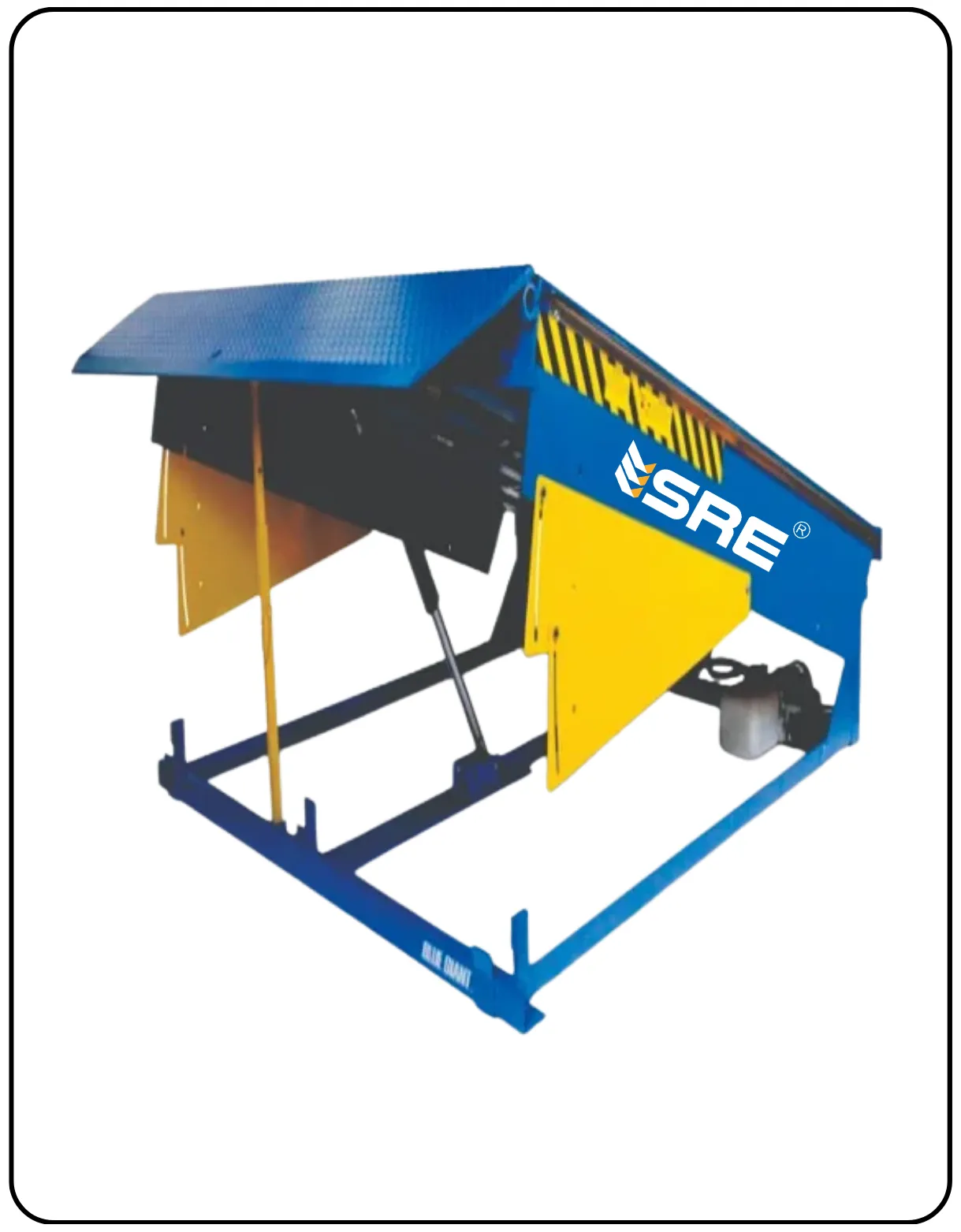
This guide is written for warehouse owners, logistics managers, and purchase heads in Vadodara, Ahmedabad, Pune, and across India who are evaluating a dock leveler installation for the first time — or who are replacing an existing system and want to make the right procurement decision. We cover what a dock leveler does, which type is right for which operation, how to calculate ROI, how to specify the right size, what the maintenance schedule looks like, and how to evaluate suppliers. The Dock Leveler in Vadodara from SRE Material Handling Equipment Pvt. Ltd. — SKU SRE 163, rated at 10 tonnes x 1.6 metres, priced at Rs. 2,30,000 — is the reference product throughout this guide.
What Is a Dock Leveler and Who Needs One in Vadodara?
A dock leveler is a mechanical or hydraulic platform installed flush with the warehouse floor at a loading bay that compensates for the height gap between the warehouse floor and the truck bed. Without it, every truck presents a different floor-to-bed height gap — ranging from 100 mm to 450 mm depending on truck type and load state — that workers must bridge using improvised ramps, wooden boards, or manual effort. These workarounds are slow (adding 10–20 minutes per truck), physically strenuous, and a persistent cause of slip, trip, and handling injuries at loading docks.
In Vadodara, the facilities that benefit most from dock levelers are those with 10 or more truck movements per loading bay per day. At lower frequencies, a mobile loading ramp may be sufficient. At 10+ daily movements, the cumulative time and injury cost of ramp management justifies the dock leveler investment within weeks. The benchmark users in Vadodara‘s industrial economy include: FMCG distribution centres (15–40 trucks/bay/day), pharmaceutical dispatch hubs (8–25 trucks/bay/day), auto-component logistics yards (10–30 trucks/bay/day), and export packaging facilities (5–15 trucks/bay/day). SRE Material Handling Equipment Pvt. Ltd. — an ISO 9001:2015 certified, MSME registered manufacturer — has supplied and installed dock levelers across all these facility types in Vadodara, Ahmedabad, Bhavnagar, Ghandhidham, Pune, Bangalore, Noida, and Chennai.
Dock Leveler Types — Which One Is Right for Your Vadodara Facility
| Type | Deployment Speed | Best For | Approximate Cost |
|---|---|---|---|
| Hydraulic Dock Leveler | 8–12 seconds (automatic) | 20+ trucks/bay/day, forklifts, 24/7 operations | Rs. 2,30,000+ (SRE 163) |
| Mechanical Dock Leveler | 45–90 seconds (manual pull) | 5–15 trucks/bay/day, occasional forklift use | Rs. 90,000–1,40,000 |
| Air-Powered Dock Leveler | 10–15 seconds (air bag) | Clean rooms, pharma facilities, food-grade docks | Rs. 1,60,000–2,20,000 |
| Mobile Loading Ramp | 5–10 minutes (manual setup) | Under 5 trucks/bay/day, occasional access | Rs. 45,000–85,000 |
Step-by-Step: How to Calculate Dock Leveler ROI for Your Vadodara Facility
Here is the ROI model used by logistics consultants across Gujarat and Maharashtra to justify dock leveler investments to facility management teams. Step 1 — Baseline dock time: Count your current minutes spent on ramp setup, adjustment, and removal per truck (typically 12–18 minutes). Step 2 — With dock leveler: Subtract deployment time (approximately 1–2 minutes including truck positioning and leveler activation), giving time saved per truck cycle. Step 3 — Annual saving: Multiply time saved per truck × trucks per bay per year × Rs. value per minute (logistics labour + truck wait cost, typically Rs. 8–15 per minute total). Step 4 — ROI: Divide Rs. 2,30,000 investment by annual saving. At 20 trucks/day per bay at Rs. 10/min saved for 15 minutes, annual saving = Rs. 10.95 lakh; ROI period = under 8 weeks.
Get your Dock Leveler ROI calculation confirmed by SRE’s technical team before committing — free site survey for Vadodara and Gujarat facilities.
Request Free Site Survey 📞 Call Now: +91 93162 08879Dock Leveler Maintenance Guide — Keeping Your SRE 163 Running for 10+ Years in Vadodara
A properly maintained hydraulic dock leveler from a quality manufacturer should deliver 10–15 years of service life in a standard distribution facility. The maintenance schedule for the SRE 163 is straightforward and can be performed by in-house maintenance teams with minimal specialised tooling. The full schedule is as follows:
Monthly (1–2 hours per bay): Check hydraulic oil level (top up to dipstick mark with ISO VG 46 oil), inspect lip hinge pins for wear (replace if clearance exceeds 1 mm), check lip seal condition (replace if cracked or peeling), visually inspect structural welds for cracks (especially at main beam-to-frame joints under heavy-forklift operations), lubricate all hinge points with lithium-based grease (NLGI Grade 2).
6-Monthly (half-day per bay): Drain and flush hydraulic reservoir, refill with fresh ISO VG 46 hydraulic oil, inspect hydraulic cylinder seals and rod surface for scoring, test overload relief valve by attempting to actuate under a confirmed 110% load, check platform structural deflection under rated load (should not exceed ±2 mm at centre-span). SRE Material Handling Equipment Pvt. Ltd. recommends that the 6-monthly service be performed by their trained technicians for the first 2 years — SRE’s service network covers Vadodara, Ahmedabad, Bhavnagar, Ghandhidham, and all major Gujarat industrial zones.
Annual: Structural thickness check (ultrasonic or visual) of platform main beams, full hydraulic system pressure test at 150% rated load, replacement of all external fasteners if showing corrosion, complete repaint of structural frame with zinc-phosphate primer + epoxy topcoat. The annual maintenance cost for a standard SRE 163 unit under this schedule is typically Rs. 8,000–14,000 per bay per year, including materials and service labour — making the 10-year total cost of ownership approximately Rs. 3,10,000–3,70,000 (capital + maintenance) for a dock leveler that handles 7,000–10,000 truck cycles per year. Against the operational value delivered, this is one of the highest-ROI capital investments available in logistics infrastructure. Pair with an SRE hydraulic pallet truck fleet for complete dock-to-rack material handling efficiency.
A pharmaceutical distributor in Vadodara operating under GDP guidelines needed dock levelers that met both structural load requirements (8-tonne loaded pallet trucks) and contamination-control requirements (sealed dock interface). SRE Material Handling Equipment Pvt. Ltd. installed 6 SRE 163 units with custom dock seal systems at the bay perimeter. Two years of operation: zero hydraulic failures, zero structural issues. Annual maintenance cost across all 6 bays: Rs. 72,000 — under Rs. 12,000 per bay. GDP audit passed all 3 cycles without dock-related observations.
10-Point Procurement Checklist for Dock Levelers in Vadodara, Gujarat, and PAN India
This checklist is for purchase managers and project engineers in Vadodara, Jaipur, Indore, and Rohtak evaluating dock leveler suppliers for a new installation or replacement project.
- 1. Load Rating: Confirm static and dynamic load ratings match your actual equipment (loaded forklift weight, not just pallet load).
- 2. Platform Width: Confirm 1.6 m covers your narrowest vehicle width with 200 mm clearance each side.
- 3. Steel Grade: Require IS 2062 Grade A MS documentation — not just a verbal claim.
- 4. Load Test Certificate: Require pre-dispatch load test at 120% rated capacity with signed certificate.
- 5. Structural Drawings: Require pit dimension drawings and structural calculation records for Factory Act compliance filing.
- 6. Hydraulic Duty Cycle: Confirm the power pack is rated for your expected daily cycles (specify your daily truck count).
- 7. Lip Extension: Confirm powered lip reaches your truck fleet’s deepest bed without manual adjustment.
- 8. Spare Parts Availability: Confirm hydraulic seals, cylinder rod, power pack components, and lip cylinder spares are stocked by the supplier.
- 9. After-Sales Service: Confirm service coverage at your facility location — particularly for locations like Bhavnagar, Himmatnagar, and Ghandhidham where third-party hydraulic technicians are scarce.
- 10. Supplier Certification: Require ISO 9001:2015 certificate and MSME registration — not just a quote.
SRE Material Handling Equipment Pvt. Ltd. satisfies all 10 checklist points for Vadodara and Gujarat installations. For multi-bay projects and national rollouts, SRE coordinates regional installation teams, provides a single commercial point of contact, and supplies consolidated documentation for all bays in a GST-compliant project invoice format. For facilities combining dock leveler installation with forklift loading bay upgrades, also review SRE’s hydraulic stacker range for storage bay integration.
Start your Dock Leveler project with SRE’s certified team — free site survey, ROI calculation, and pit specification drawings provided.
Request Project Consultation 📞 Call: +91 97247 22404Frequently Asked Questions (FAQ)
What is a dock leveler and at what daily truck volume does it become necessary for a Vadodara warehouse?
A dock leveler is a hydraulic or mechanical platform installed at a loading bay that bridges the height gap between warehouse floor and truck beds of varying heights. For Vadodara warehouses, a dock leveler becomes operationally necessary at 10 or more truck movements per loading bay per day — the threshold at which cumulative ramp-management time and injury risk consistently exceeds the annualised cost of the Rs. 2,30,000 investment. Below 10 trucks/day, a mobile ramp is typically sufficient. At 20+ trucks/day, the dock leveler typically pays for itself within 2–4 weeks of operation.
What is the complete 10-year cost of ownership for an SRE dock leveler installed in a Vadodara or Ahmedabad distribution centre?
The 10-year TCO for an SRE 163 Hydraulic Dock Leveler in a standard Vadodara or Ahmedabad distribution centre is approximately Rs. 3,10,000–3,70,000: capital cost Rs. 2,30,000 + annual maintenance Rs. 8,000–14,000 x 10 years = Rs. 80,000–1,40,000. Against an annual operational value of Rs. 5–15 lakh per bay (depending on truck throughput), the TCO is recovered within the first 3–6 months of operation. SRE Material Handling Equipment Pvt. Ltd. provides a detailed TCO analysis for project justification to management on request.
What annual maintenance does a hydraulic dock leveler require, and can it be done by in-house maintenance staff at a Gujarat plant?
Yes, the standard monthly maintenance (hydraulic oil level check, hinge pin lubrication, lip seal inspection) can be performed by in-house maintenance staff with basic hydraulic knowledge. The 6-monthly hydraulic flush and pressure test and annual structural inspection are best performed by trained technicians. SRE Material Handling Equipment Pvt. Ltd. provides a maintenance manual with every installation, offers trained technician service across Gujarat industrial zones, and stocks all spare components — hydraulic seals, cylinder rods, lip cylinders — for prompt field service.
Can a dock leveler be installed at an existing warehouse in Vadodara without major structural renovation?
Yes, in most cases. Retrofitting requires excavating a pit approximately 2.5 m long x 1.7 m wide x 600 mm deep at the loading bay — a civil construction scope that typically takes 3–5 days and does not require the warehouse to cease operations if bays are done sequentially. SRE Material Handling Equipment Pvt. Ltd. provides pit specification drawings with precise dimensions and structural requirements for the civil contractor, and coordinates the hydraulic installation and commissioning after pit completion. Full retrofit project duration (civil + installation + commissioning) is typically 7–10 working days per bay.
Vadodara ke warehouse ke liye Dock Leveler ka ROI kaise calculate karte hain aur kitne time mein payback milta hai?
ROI calculation: Time saved per truck cycle (typically 12–15 minutes) × trucks per day per bay × working days per year × Rs. value per minute (Rs. 8–15 for labour + truck wait cost). Example: 20 trucks/day × 15 minutes saved × 300 days × Rs. 10/min = Rs. 9 lakh annual saving per bay. Rs. 2,30,000 investment recovers in under 10 weeks. SRE Material Handling Equipment Pvt. Ltd. free ROI calculation provide karta hai Vadodara site survey ke saath — call karein ya contact form fill karein.
Gujarat ke warehouse mein Dock Leveler ke liye supplier select karte waqt kya 10 checklist points verify karni chahiye?
Gujarat ke warehouses mein supplier evaluation ke liye: (1) load rating confirmation with forklift weight (2) IS 2062 steel documentation (3) 120% load test certificate (4) structural drawings for Factory Act compliance (5) hydraulic duty cycle rating (6) powered lip extension confirmation (7) spare parts availability (8) after-sales service coverage in your city (9) ISO 9001:2015 certificate (10) MSME registration. SRE Material Handling Equipment Pvt. Ltd. sabhi 10 points satisfy karta hai — documentation on request available hai vendor qualification ke liye.
Pune ya Maharashtra ke distribution centre mein Dock Leveler installation project mein kitna time aur total cost lagta hai?
Pune aur Maharashtra ke distribution centres mein dock leveler installation: civil pit work 3–5 days (civil contractor scope) + SRE installation 2–3 days per bay. Total project cost per bay: dock leveler unit Rs. 2,30,000 + installation and commissioning approximately Rs. 15,000–25,000 (depending on location and number of bays) = approximately Rs. 2,45,000–2,55,000 per bay all-in (taxes extra). Multi-bay projects receive package pricing. SRE Material Handling Equipment Pvt. Ltd. manages complete project coordination from site survey to commissioning.