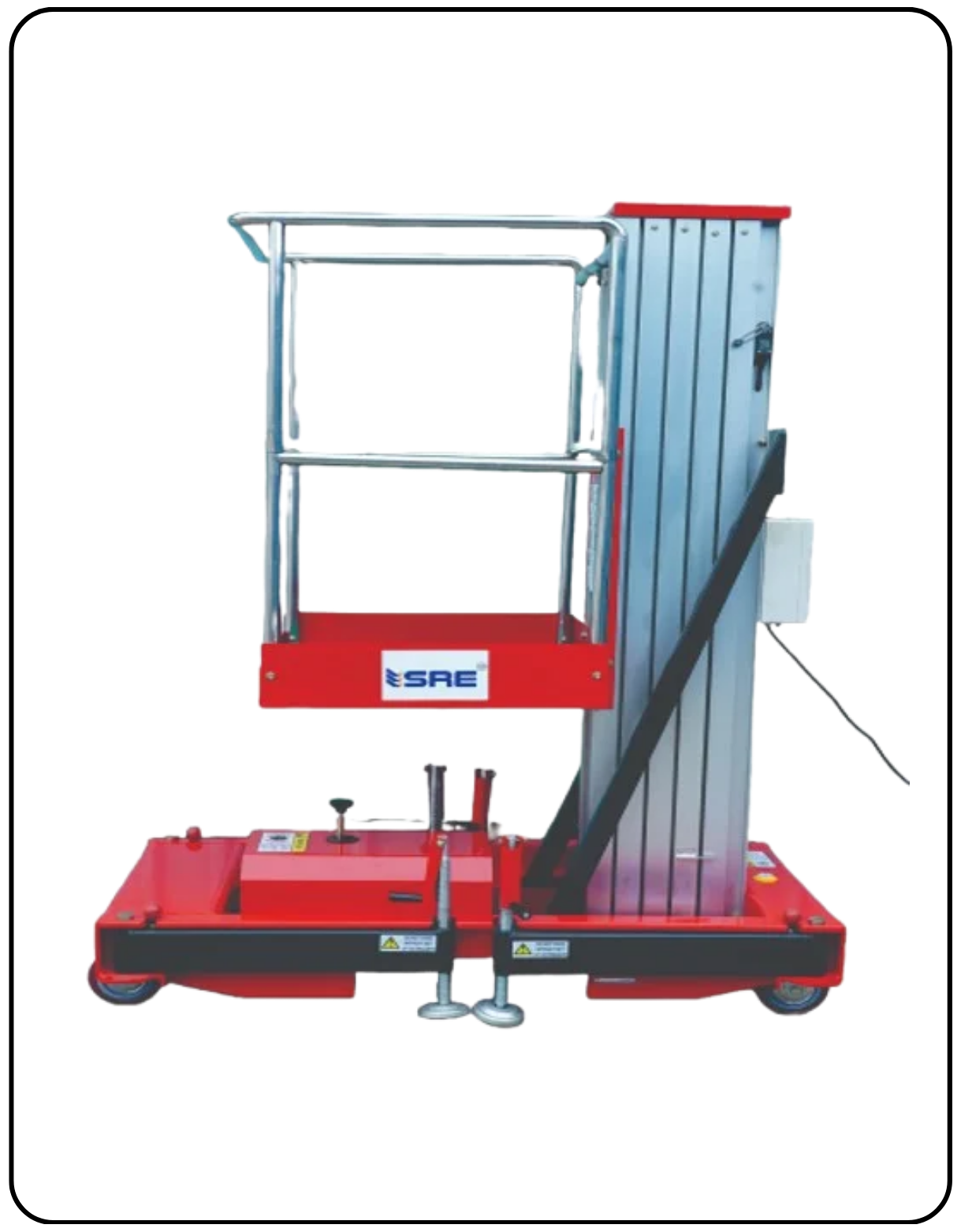
130 Kg-6 Meter (All Size Available)
Rs. 175000
(Taxes to be paid extra)
Brand: SRE
SKU: SRE 151
Min Order Qty: 1
Every warehouse manager and factory supervisor in Vadodara reaches a point where the facility’s height — not its floor space — becomes the limiting factor for productivity. Overhead conveyor maintenance, ceiling-level inventory access, elevated equipment servicing: these are daily tasks that expose the gap between what a ladder can safely deliver and what the job actually demands. The solution is not more ladders or temporary scaffold — it is a purpose-built Aerial Work Platform in Vadodara that provides a stable, guardrail-protected working deck at exactly the height required, repositionable across the facility floor in under two minutes. SRE Material Handling Equipment Pvt. Ltd., an ISO 9001:2015 certified manufacturer founded in 2011 and based in Ahmedabad, supplies the full AWP range — from 130 kg / 6-metre units at Rs. 1,75,000 to 220 kg / 10-metre configurations — across Vadodara, Gujarat, Maharashtra, Rajasthan, and PAN India.
Key Applications of Aerial Work Platform in Industrial Operations Across Vadodara and Gujarat
The most common misconception about an Aerial Work Platform (AWP) among first-time buyers in Gujarat‘s MSME sector is that it is a specialised tool for construction sites only. In practice, an AWP in Vadodara‘s manufacturing corridor is used daily for tasks that have nothing to do with construction — routine overhead maintenance, inventory management, and facility upkeep that would otherwise require contractor-based scaffold access at a recurring monthly cost of Rs. 6,000–12,000 per site. A single AWP purchase at Rs. 1,75,000 eliminates this recurring cost from month one and simultaneously reduces the safety risk associated with improvised ladder access. The calculation is straightforward for any purchase manager evaluating the total cost of ownership over a 5-year horizon.
Industry-Specific Application Breakdown for AWP in Vadodara and Surrounding Regions
- Petrochemical and refinery maintenance — Valve inspection, pipe rack access, and pressure gauge servicing at 4–8 metre heights in Vadodara‘s GIDC and Nandesari industrial zones
- Pharmaceutical and biotech facilities — Overhead clean utility servicing, HEPA filter access, and bio-safety cabinet clearance in GMP-certified plants across Ahmedabad and Hyderabad
- Automotive assembly plants — Overhead weld jig servicing, paint booth equipment maintenance, and body-shop conveyor upkeep in Pune, Faridabad, and Bangalore OEM facilities
- FMCG and food processing warehouses — Top-rack inventory management, overhead sanitation, and evaporator access in temperature-controlled environments across Gujarat and Maharashtra
- Textile and synthetic fibre plants — Overhead loom frame inspection, drive shaft lubrication, and ceiling-mount fan maintenance in mills across Rajasthan and Gujarat
- E-commerce and 3PL warehousing — Top-bay picking, barcode system servicing, and sprinkler system inspection in large distribution centres in Noida, Gurugram, and Bhavnagar
- Engineering and fabrication workshops — Overhead crane rail inspection, roof truss checking, and structural steel painting in heavy engineering units across Kutch and Kalol
- Power plants and substations — Bus-bar inspection, transformer overhead access, and cable tray maintenance in power infrastructure projects in Bhopal and Indore
- Shipbuilding and marine engineering — Hull welding access, deck equipment servicing, and interior fit-out work in enclosed vessel sections
- Retail and commercial construction — False ceiling installation, AV system fitting, and decorative facade work in shopping complexes across Chennai, Bangalore, and Ahmedabad
The unifying characteristic across all these applications is height access repeatability — the need to reach an overhead point safely, not once, but dozens of times per week across a facility with multiple height zones. A well-specified aerial work platform, such as the SRE 151 with its manual push castor mobility and 6-metre maximum working height, addresses this requirement across the full breadth of industries that SRE Material Handling Equipment Pvt. Ltd. serves — from Himmatnagar‘s steel processing clusters to Chattral‘s chemical manufacturing zones.
Need an Aerial Work Platform for Your Factory or Warehouse in Vadodara?
SRE delivers ISO 9001:2015 certified AWPs with full documentation across Vadodara, Gujarat, Maharashtra and PAN India. Bulk orders for 10+ units accepted with 21-day dispatch.
Get a Quote for Bulk Orders 📞 Call Now: +91 93162 08879Key Features of Aerial Work Platform That Procurement Managers in Pune, Bangalore, and Noida Must Evaluate
An aerial work platform purchase decision for an industrial facility is not a commodity buy — it is a safety-critical capital investment that will be used under real operational conditions, often daily, by rotating personnel. Procurement managers in Pune‘s auto-cluster and Bangalore‘s aerospace manufacturing zone have learned — often through costly experience with inferior equipment — that the evaluation must go well beyond price per unit. The five features that determine whether an AWP performs reliably over a 5–7 year lifecycle are: structural frame material grade, hydraulic cylinder cycle rating, guardrail system compliance, platform deck anti-slip treatment, and castor wheel load rating. SRE’s SRE 151 is specified to meet or exceed industry benchmarks on all five parameters — with documentation available for each.
SRE Aerial Work Platform — Technical Specification Summary
| Specification | SRE 151 — 6 Metre AWP | SRE 152 — 10 Metre AWP | Industry Minimum Standard |
|---|---|---|---|
| Safe Working Load (SWL) | 130 kg | 220 kg | 100 kg (unverified market) |
| Maximum Working Height | 6 Metres | 10 Metres | 4–6 Metres |
| Frame Material | MS Structural Steel, 3mm wall | MS Structural Steel, 3mm wall | Thin gauge / unknown |
| Platform Surface | MS Chequered Anti-Slip Plate | MS Chequered Anti-Slip Plate | Plain sheet / none |
| Guardrail Height | 1,000 mm, 3-side MS tubular | 1,000 mm, 4-side MS tubular | Partial / none |
| Hydraulic Cylinder Cycles | 10,000+ rated | 10,000+ rated | Unspecified |
| Pre-dispatch Load Test | 125% SWL + certificate | 125% SWL + certificate | Rarely performed |
| Mobility System | Manual push, swivel castors | Self-propelled / manual push | Fixed or limited |
| Manufacturer Certification | ISO 9001:2015 | ISO 9001:2015 | None stated |
| Price (ex-works) | Rs. 1,75,000 | Rs. 3,10,000 | Rs. 80,000–1,20,000 |
| After-sales Parts Dispatch | 48–72 hours PAN India | 48–72 hours PAN India | Weeks / unavailable |
The table makes clear why engineering industries across Rajasthan, Gujarat, and North India consistently choose SRE over lower-price alternatives. A Rs. 40,000–50,000 price difference on a unit that will perform 2,000–3,000 lift cycles per year represents less than Rs. 20 per cycle in additional investment — a fraction of what a single maintenance delay or safety incident costs a plant manager running a double-shift operation in Faridabad, Ambala, or Rohtak.
Aerial Work Platform vs Scissor Lift Table vs Goods Lift — Choosing the Right Height Solution for Ahmedabad, Indore, and Bhopal Facilities
One of the most frequent pre-purchase questions from factory owners in Ahmedabad and Indore is: “Should I buy an Aerial Work Platform, a Scissor Lift Table, or a Goods Lift?” The answer depends on three factors: whether the task involves people or materials, whether the equipment needs to move across the floor, and whether the load goes up repeatedly in the same location or across multiple points. An AWP is for personnel access — one operator, tools, mobile use. A Scissor Lift Table is for heavy stationary load transfer — up to 500 kg, fixed position. A Goods Lift is for vertical inter-floor material movement — pallets, cartons, bulk goods between production levels. Most facilities above a certain scale need at least two of these three — and sourcing all from the same ISO 9001:2015 certified manufacturer like SRE Material Handling Equipment Pvt. Ltd. simplifies specification, warranty, and after-sales coordination significantly.
Challenge: A Vadodara-based precision engineering workshop needed overhead access for CNC machine gantry inspection and crane rail lubrication at heights of 4.5 to 5.8 metres across a 3,500 sq. ft. shop floor. Existing scaffold required 2 workers per setup and 45 minutes repositioning time between machines.
Solution: SRE Material Handling Equipment Pvt. Ltd. supplied 2 units of the SRE 151 Aerial Work Platform (130 kg / 6M), allowing each machine to have dedicated overhead access without waiting for scaffold repositioning.
Result: Preventive maintenance cycle time reduced by 60%. Worker overtime for maintenance shifts eliminated. The dual-unit investment of Rs. 3,50,000 recovered within 8 months through reduced scaffold rental and overtime costs alone.
SRE Material Handling Equipment Pvt. Ltd. also supplies the Electric Stacker for warehouse pallet handling and the Mobile Scissor Lift for repositionable heavy-load platforms — both of which complement the AWP range for facilities in Bhopal, Gurugram, Jaipur, Udaipur, Mahesana, Gandhidham, and Chattral.
Bulk Procurement of Aerial Work Platform — How SRE Supports Logistics Heads and OEM Sourcing Managers Across Chennai, Hyderabad, and Rajasthan
For OEM sourcing managers and logistics heads procuring aerial work platforms for 5 or more facilities simultaneously — across states like Rajasthan, Gujarat, Maharashtra, and Andhra Pradesh — the procurement challenge is not finding a supplier; it is finding a supplier who can deliver consistent specification, centralised documentation, and reliable after-sales support across all delivery locations. SRE Material Handling Equipment Pvt. Ltd., with its ISO 9001:2015 certified manufacturing process, a dedicated bulk order production line, and a spare-parts dispatch network covering PAN India within 48–72 hours, is structured specifically for this kind of multi-site procurement. The sales team at SRE handles single-point quotation for multi-location bulk orders, covering Hyderabad, Chennai, Noida, Ambala, Rohtak, Bhavnagar, Kutch, Himmatnagar, Vatva, Kathwada, Kalol, and all other delivery destinations — with consolidated invoicing available for accounts teams managing multi-GSTIN procurement.
The compliance documentation included with every bulk order — load test certificate, operation and maintenance manual, and manufacturer’s declaration of conformity — satisfies the documentary requirements of Factories Act, 1948 at all registered industrial facilities. For multinational clients who additionally require alignment with international standards, SRE’s AWP range is benchmarked against ISO 18893 (Mobile Elevating Work Platforms — Safety). Reach out to SRE’s sales team with your quantity, site locations, and height/capacity requirement for a multi-site consolidated quotation within 24 hours.
Get a Consolidated Quote for Aerial Work Platforms Across Multiple Sites
One inquiry covers all your locations — Vadodara, Pune, Bangalore, Noida, Chennai and beyond. SRE’s sales team responds within 24 hours with full specs and pricing.
Send Multi-Site Inquiry Now 📞 +91 97247 22404Related Products
- Scissor Lift — Fixed-point heavy-load platform for assembly and maintenance bays.
- Mobile Scissor Lift — Repositionable 500 kg / 4M platform for heavy overhead material positioning.
- Goods Lift — Vertical inter-floor material transfer for textile and garment factories.
- Electric Stacker — Powered stacking for logistics and e-commerce warehouse operations.
- Hydraulic Stacker — Manual pump stacking solution for SME facilities across Rajasthan and MP.
Further Reading
- Permanent Magnetic Lifter in Gujarat — Applications and procurement guide for ferrous material handling.
- Permanent Magnetic Lifter in Ahmedabad — Key features and factory use cases.
- Permanent Magnetic Lifter — Complete buyer’s guide for bulk and OEM procurement.
Frequently Asked Questions — Aerial Work Platform in Vadodara
What is the price and capacity of the Aerial Work Platform available in Vadodara from SRE?
The SRE Aerial Work Platform (SKU: SRE 151) for Vadodara delivery is priced at Rs. 1,75,000 (taxes extra) with a 130 kg safe working load and 6-metre maximum working height. The 220 kg / 10-metre model (SKU: SRE 152) is available at Rs. 3,10,000. All sizes are available on custom order. SRE Material Handling Equipment Pvt. Ltd., ISO 9001:2015 certified, provides a 125% SWL load test certificate with every unit. Contact SRE for a customised quote.
What is the difference between an Aerial Work Platform and a Scissor Lift Table for factory buyers in Gujarat and Maharashtra?
An Aerial Work Platform is designed for personnel access at height — one operator with tools, mobile across the facility floor. A Scissor Lift Table (up to 500 kg) is designed for stationary heavy load positioning at a fixed point. For factory buyers in Gujarat and Maharashtra with overhead maintenance needs across multiple floor zones, the AWP is the correct choice. For assembly line component positioning at a fixed station, the scissor lift table is more appropriate. Many facilities use both.
Does SRE supply Aerial Work Platforms in bulk quantities with multi-location delivery to logistics companies in Noida and Gurugram?
Yes. SRE Material Handling Equipment Pvt. Ltd. accepts bulk orders of 10+ units with a 21-working-day production and dispatch window. For logistics companies in Noida, Gurugram, Faridabad, and Ambala, SRE provides centralised billing, multi-location delivery coordination, and a dedicated after-sales contact. Full compliance documentation — load test certificate, operation manual, declaration of conformity — is included with every unit as standard.
What safety certifications and documentation should procurement managers in Chennai and Hyderabad verify before accepting an AWP delivery?
Procurement managers in Chennai and Hyderabad must verify three documents before accepting an AWP into a registered facility: a 125% SWL load test certificate from the manufacturer, an operation and maintenance manual, and a declaration of conformity from an ISO 9001:2015 certified manufacturer. Under the Factories Act, 1948, accepting non-compliant height-access equipment creates direct liability for the plant manager and facility owner. SRE provides all three documents with every unit dispatched.
Vadodara mein Aerial Work Platform ki delivery time kitni hai aur kya PAN India delivery available hai?
Vadodara ke liye Aerial Work Platform delivery 7 se 10 working days mein milti hai single unit par. Bulk orders (10+ units) ke liye 21 working days ka production window hai. SRE Material Handling Equipment Pvt. Ltd. PAN India deliver karta hai — Rajasthan, Maharashtra, Noida, Bangalore, Chennai, Bhavnagar, Kutch sab jagah. Exact quote aur delivery timeline ke liye contact karein.
Ahmedabad aur Gujarat mein factory ke liye kaunsa AWP model best rahega — 6 metre ya 10 metre wala?
Ahmedabad aur Gujarat ki factories jahan ceiling height 4 se 6 metre ke beech ho, unke liye SRE 151 (130 kg / 6M, Rs. 1,75,000) best choice hai — compact, manual push mobile, anti-slip platform. Agar facility ki ceiling 8 metre ya zyada ho — jaise large warehouses ya power plants — toh SRE 152 (220 kg / 10M) recommend kiya jaata hai. Apni actual ceiling height measure karke order confirm karein taaki right unit milta rahe.
Kya Aerial Work Platform ki maintenance aur spare parts service Surat, Rajasthan aur Vadodara mein available hai?
Haan. SRE Material Handling Equipment Pvt. Ltd. ka spare parts network Surat, Vadodara, Rajasthan, aur PAN India mein active hai. Hydraulic seal kits, cylinder assemblies, castor wheel sets — sabhi 48 se 72 ghante mein dispatch hote hain. Vatva, Kathwada, Kalol, Mahesana, Gandhidham, Bhavnagar, aur Kutch mein bhi service available hai. Annual Maintenance Contract (AMC) ke liye SRE se contact karein.