
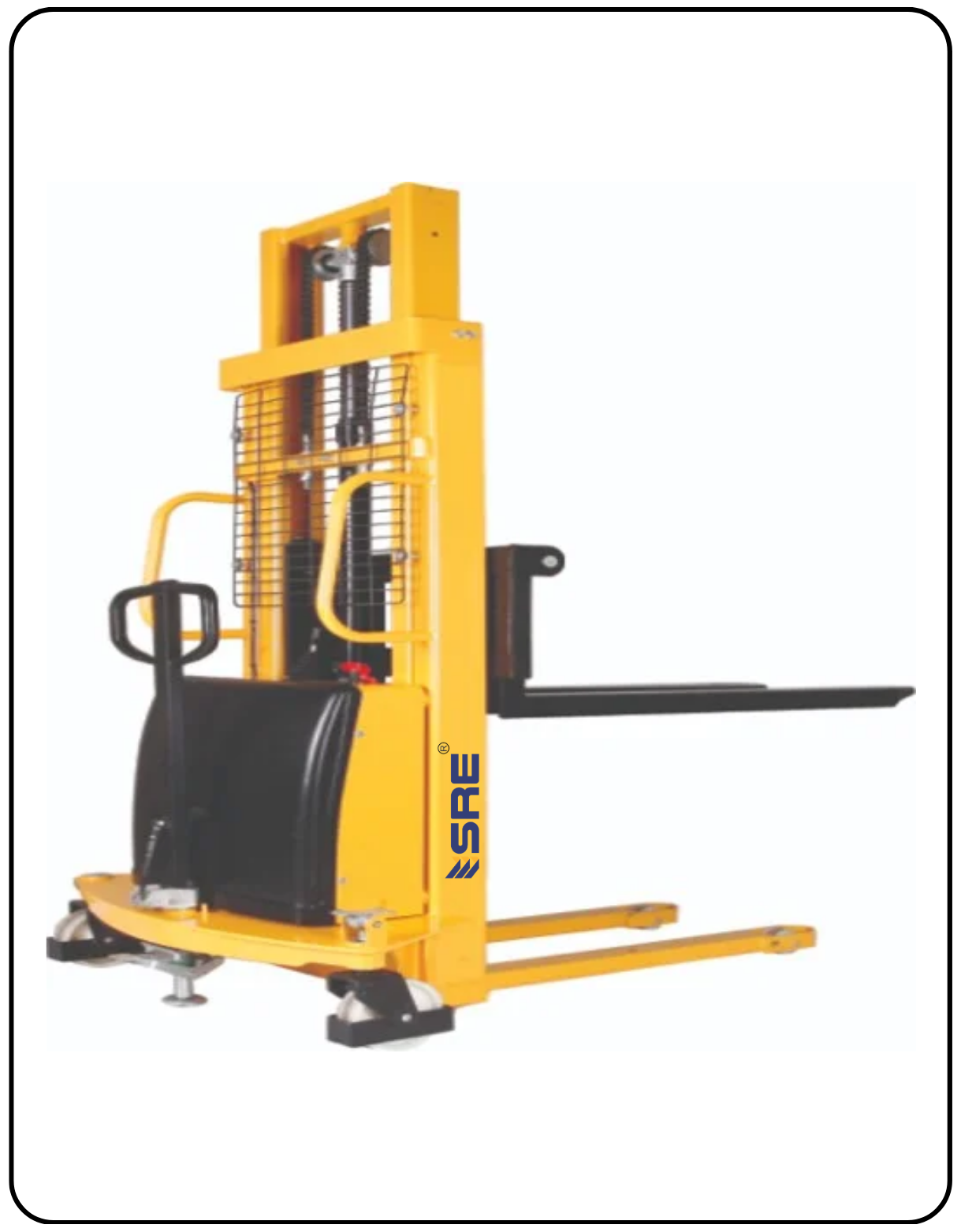
Applications Of Semi Electric Stacker And Key Features Of Semi Electric Stacker in Rajkot
Warehouses and light manufacturing units in Rajkot — from auto-component suppliers in Aji GIDC to textile and packaging units across Gujarat — consistently face the same stacking bottleneck: workers manually pushing fully loaded stacker masts to racking heights of 1.6 m or more, resulting in operator fatigue, slower cycle times, and recurring back-strain injury claims. The Semi Electric Stacker in Rajkot addresses this directly — an electrically powered lift mechanism combined with manual travel gives operators 500 kg rated capacity at lift heights up to 1.6 m (all sizes available), cutting per-pallet stacking effort by over 60% compared to fully manual hydraulic stackers. If your facility in Rajkot, Ahmedabad, Vadodara, or anywhere across Gujarat runs more than 20 lift cycles per shift, this is the equipment that pays back its procurement cost within 3–4 months of deployment.
What Is a Semi Electric Stacker and How Does It Solve Daily Lifting Problems in Rajkot and Gujarat Warehouses?
Many small and mid-size factory owners in Rajkot, Bhavnagar, and Kutch are running fully manual hydraulic stackers and paying the cost in slow throughput and injured operators. A semi electric stacker (also called a battery-operated stacker or semi-powered stacker) uses a 24V DC electric motor with a built-in hydraulic pump to raise and lower the forks automatically at the press of a button, while the operator manually steers and moves the unit on the floor. This design eliminates the effort of repeated foot-pump actuation at high lift heights — where a manual stacker requires 40–60 pump strokes to reach 1.6 m — replacing it with a single button press that completes the lift in under 12 seconds.
Drive System and Battery Specifications
The biggest concern purchase managers in Rajkot and Ahmedabad raise about battery-operated equipment is charging downtime disrupting shift operations. The semi electric stacker from SRE Material Handling Equipment Pvt. Ltd., an ISO 9001:2015 certified manufacturer, uses a maintenance-free 24V / 45Ah sealed lead-acid battery that delivers 6–8 hours of continuous lift operation on a single charge — sufficient for a full double shift in most Gujarat and Maharashtra facilities. The on-board charger (24V / 10A) completes a full recharge in 8 hours from a standard 230V single-phase supply, meaning overnight charging keeps the unit ready for the next day with zero disruption.
Mast Design and Fork Geometry
A frequent sourcing complaint from logistics heads in Vatva, Kathwada, and Kalol is that stackers purchased from unverified suppliers have mast sway at full lift height — a direct safety risk when stacking near standard Euro-pallet racking at 1.4–1.6 m. SRE Material Handling Equipment Pvt. Ltd.‘s semi electric stacker uses a full free-lift duplex mast fabricated from MS C-channel section with PTFE-coated mast rollers for smooth, jerk-free elevation. Fork width is adjustable from 540 mm to 680 mm to accommodate standard 800 mm × 1200 mm and 1000 mm × 1200 mm pallets, making it immediately compatible with existing racking systems across Rajkot, Jaipur, Indore, and Pune distribution centers.
Looking for a Semi Electric Stacker in Rajkot or anywhere in Gujarat?
Get a Free Quote for Bulk Orders →Key Applications of Semi Electric Stacker Across Rajkot, Ahmedabad, Pune and Major Industrial Sectors
Before a factory owner or procurement head in Rajkot or Bhavnagar commits budget to a stacker, the first question is always: “Will it work across all our storage and dispatch zones, or only in one area?” The semi electric stacker is one of the most application-versatile pieces of material handling equipment for mid-size operations — here’s where it performs with measurable impact across industries in Gujarat, Maharashtra, Rajasthan, and beyond.
- Automotive Components (Rajkot, Pune, Faridabad): Stacking pressed metal parts, gearbox castings, and engine sub-assemblies on racking up to 1.6 m height — replacing manual handling on lines where loads range from 200 to 500 kg per pallet.
- Textile and Apparel (Rajkot, Ahmedabad, Surat): Moving large fabric rolls, finished garment boxes, and bale stacks in narrow warehouse aisles — the semi electric drive reduces floor navigation effort while the electric lift prevents operator strain at elevated fabric-roll heights.
- Pharmaceutical Packaging (Ahmedabad, Vadodara, Hyderabad): Loading and unloading bulk packaging material and finished carton pallets in pharma & healthcare cold-chain and ambient warehouses where GMP-level hygiene and low-vibration handling are required.
- FMCG and Food Processing (Bangalore, Chennai, Pune): Stacking finished goods pallets, ingredient drums, and packaging supplies in ambient and temperature-controlled storage — with SS 304 platform options available for FSSAI-compliant facilities.
- Engineering and Fabrication (Vatva, Himmatnagar, Kalol): Feeding steel sheet stacks, machined component pallets, and weld-assembly sub-units to elevated conveyor or press-feed heights, cutting loading preparation time by 25–35% per shift.
- Cold Storage and Logistics (Mahesana, Ghandhidham): Battery-powered lift operation in refrigerated environments (down to 5°C rated variants), where manual pumping stiffens and operator fatigue accelerates faster than in ambient conditions.
- Retail Distribution Centers (Noida, Gurugram, Indore): Fast-cycle order fulfillment picking and replenishment stacking in high-SKU warehouses — the compact chassis (overall width ≤800 mm) navigates standard 2.5 m aisle widths without modification.
- Chemical and Polymer Plants (Gujarat, Vadodara): Moving polymer granule sacks, HDPE drum pallets, and raw-material stacks in chemical warehouses — the explosion-proof motor variant is available for Zone II hazardous areas.
- Paper and Printing (Bhopal, Rohtak, Ambala): Elevating large paper reel pallets and finished print-product skids to racking height without fork shock — critical for avoiding paper-edge damage on precision print-run stocks.
- E-Commerce Fulfillment (Bangalore, Noida, Hyderabad): High-frequency bin replenishment and outbound pallet stacking in fulfillment centers where cycle count targets require 50+ stacker operations per shift per operator.
Client Experience — Rajkot Auto-Component Manufacturer, Aji GIDC:
“We had three manual hydraulic stackers running across two shifts. By the second hour of each shift, operators were visibly fatigued from pumping loads to 1.4 m repeatedly. After deploying two Semi Electric Stackers (500 kg, 1.6 m) from SRE Material Handling Equipment Pvt. Ltd., our average stack cycle time dropped from 4.5 minutes to under 2 minutes. Zero lift-related injury incidents in the first six months. The after-sales team responded to a battery query within 24 hours.”
— Operations Manager, Auto-Component Tier-2 Supplier, Rajkot
Key Features of Semi Electric Stacker That Factory Owners and Warehouse Managers in Gujarat and Maharashtra Must Know
The most common procurement regret in Rajkot and Ahmedabad is selecting a semi electric stacker based on price alone without confirming structural quality, safety certification, and battery warranty terms. SRE Material Handling Equipment Pvt. Ltd., operating under ISO 9001:2015 quality management and MSME registration, builds verified features into every unit shipped to Gujarat, Rajasthan, Maharashtra, and across PAN India.
| Model | Load Capacity | Lift Height | Battery | Motor Power | Fork Width | Overall Width |
|---|---|---|---|---|---|---|
| SRE-SES-500-16 | 500 kg | 1600 mm | 24V / 45Ah | 1.0 kW | 540–680 mm | 760 mm |
| SRE-SES-500-20 | 500 kg | 2000 mm | 24V / 55Ah | 1.0 kW | 540–680 mm | 760 mm |
| SRE-SES-1000-16 | 1000 kg | 1600 mm | 24V / 80Ah | 1.5 kW | 540–685 mm | 800 mm |
| SRE-SES-1000-30 | 1000 kg | 3000 mm | 24V / 100Ah | 1.5 kW | 540–685 mm | 820 mm |
| SRE-SES-1500-30 | 1500 kg | 3000 mm | 48V / 100Ah | 2.2 kW | 560–685 mm | 860 mm |
Safety Features and Structural Certification
Plant managers in Faridabad, Gurugram, and Noida increasingly require documented safety compliance from their material handling equipment vendors before approving capital expenditure. Every semi electric stacker from SRE Material Handling Equipment Pvt. Ltd. includes a hydraulic lowering safety valve that prevents free-drop if a hydraulic line fails, a battery discharge indicator with audible warning at 20% remaining charge, and an emergency lowering valve for manual descent during power failure. The mast chain is a Grade 80 duplex lifting chain tested at 2× rated working load before dispatch — with test certificates available to OEM sourcing managers upon request.
For reference on international stacker safety standards, the ISO 3691 standard for industrial trucks defines the design, safety, and testing requirements that quality semi electric stacker manufacturers follow globally. Procurement heads across Rajasthan, Maharashtra, and Karnataka can benchmark their vendor qualification checklist against this standard.
Semi Electric Stacker vs. Manual Stacker vs. Fully Electric Stacker — Best Choice for Rajkot, Jaipur, and Indore Operations
Procurement managers in Jaipur, Udaipur, and Indore frequently shortlist all three stacker types before finalizing a purchase order. The decision comes down to load frequency, floor layout, and total cost of ownership. A manual stacker suits facilities with fewer than 15 lift cycles per shift — no running cost but high operator fatigue beyond that threshold. A fully electric stacker provides powered travel and lift, ideal for large warehouse floors above 2000 sqm, but carries a higher capital cost (₹1,20,000+) and requires a driving-certified operator. The fully electric stacker is the right choice for high-cycle logistics operations, while the semi electric stacker at ₹30,000 hits the optimal value point for 20–50 cycles per shift in facilities across Rajkot, Bhavnagar, and Kutch.
| Parameter | Semi Electric Stacker | Manual Stacker | Fully Electric Stacker |
|---|---|---|---|
| Lift Mechanism | Electric (battery) | Manual foot pump | Electric (battery) |
| Travel | Manual push | Manual push | Electric powered |
| Max Capacity | Up to 1500 kg | Up to 1000 kg | Up to 2000 kg |
| Max Lift Height | Up to 3000 mm | Up to 3000 mm | Up to 5000 mm |
| Operator Effort | Low (lift only) | High (lift + push) | Very low (all powered) |
| Starting Price (INR) | ₹30,000 onwards | ₹25,000 onwards | ₹1,20,000 onwards |
| Best For | 20–50 cycles/shift, mid-floor | <15 cycles/shift, light duty | High-cycle, large-floor ops |
| Running Cost | Low (electricity only) | Zero | Low (electricity) |
For racking operations requiring lift heights above 3 m, explore SRE Material Handling Equipment Pvt. Ltd.‘s electric stacker range and the hydraulic stacker series for manual-travel applications with higher lift height requirements across Rajkot, Ahmedabad, and Pune. Also review our pallet truck range for ground-level load movement that often pairs with stackers in the same procurement bundle. For guidelines on safe forklift and stacker operation in industrial settings, the OSHA Powered Industrial Trucks safety program provides the benchmark framework for operator training and floor safety compliance.
Ready to eliminate manual lifting fatigue at your Rajkot or Gujarat facility?
📞 Call Now / Request Bulk Order QuoteWhy SRE Material Handling Equipment Pvt. Ltd. Is the Trusted Semi Electric Stacker Supplier for Rajkot, Gujarat, and PAN India Buyers
Factory owners and procurement heads in Rajkot, Ghandhidham, Mahesana, and Chattral often deal with distributors who cannot provide consistent quality documentation, spare parts availability, or any post-sales response beyond 90 days. SRE Material Handling Equipment Pvt. Ltd., founded in 2011 by Mr. Gaurang Patel and headquartered in Ahmedabad, operates under ISO 9001:2015 certified production controls and MSME registration — ensuring traceable quality documentation from raw material procurement through final dispatch. Units shipped to Rajkot, Bhavnagar, Kutch, Himmatnagar, Vatva, Kathwada, Kalol, Rohtak, Ambala, Faridabad, Noida, and all major PAN India industrial cities come with a pre-delivery inspection report and a standard 12-month warranty on manufacturing defects.
The Make in India aligned manufacturing process at SRE Material Handling Equipment Pvt. Ltd. uses domestically sourced MS structural steel sections, locally manufactured hydraulic cylinders, and IS/IEC-compliant electrical components — keeping lead times predictable at 5–10 working days for standard models and 12–18 days for custom configurations. For bulk purchase orders from OEM sourcing managers in Pune, Bangalore, Hyderabad, Chennai, and Jaipur, production scheduling can be aligned to rolling quarterly supply contracts with fixed pricing. Further reading on related stacking equipment: our blog on Manual Stacker in Pune and Electric Stacker Pune cover adjacent categories commonly procured alongside the semi electric stacker. For a third-party supplier credibility check, buyers can review the SRE MHE profile on IndiaMart. Reach our team directly via the inquiry and contact page for same-day response on pricing, availability, and dispatch schedules.
Frequently Asked Questions — Semi Electric Stacker
Q1. What load capacity and lift height is recommended for a Semi Electric Stacker used in a warehouse or factory in Rajkot?
For most warehousing and light manufacturing applications in Rajkot and Gujarat, a 500 kg capacity with 1.6 m lift height covers standard pallet-racking heights and load weights. For heavier automotive or engineering loads, the 1000 kg × 3000 mm model is the correct specification. SRE Material Handling Equipment Pvt. Ltd. offers all sizes with a factory load test at 125% rated capacity, with test certificates available to procurement teams before order confirmation. Starting price is ₹30,000 for the 500 kg model.
Q2. How many lift cycles per charge does a Semi Electric Stacker battery support, and what is the charging time?
A standard 24V / 45Ah sealed lead-acid battery in a semi electric stacker supports approximately 200–250 full lift cycles at rated load on a single charge — sufficient for 6–8 hours of operation across one full shift. Recharge time on a standard 230V single-phase supply via the on-board charger is 8 hours, making overnight charging the standard protocol for facilities in Rajkot, Ahmedabad, Pune, and Bangalore running single-shift operations.
Q3. What certifications and safety features should procurement managers verify before buying a Semi Electric Stacker in bulk?
Before bulk procurement of a semi electric stacker, verify ISO 9001:2015 certification and MSME registration from the manufacturer. Confirm the unit has a hydraulic lowering safety valve, battery discharge indicator, emergency lowering valve, and that the mast chain is a Grade 80 duplex lifting chain tested at 2× rated working load. Request a factory test report showing 125% overload test. These checks apply to any supplier in Gujarat, Maharashtra, Rajasthan, or North India.
Q4. Can a Semi Electric Stacker be used in narrow-aisle warehouses, and what is the minimum aisle width required?
Yes. The compact design of a semi electric stacker — overall chassis width of 760–820 mm depending on model — allows operation in aisles as narrow as 2.0–2.3 m (measured between racking uprights), which is standard in most mid-size Gujarat and Maharashtra warehouse layouts. SRE Material Handling Equipment Pvt. Ltd. also offers reach-type stacker variants for even narrower aisle applications where outrigger-to-rack clearance is the binding constraint. Confirm your floor plan dimensions before finalizing the model configuration.
Q5. Rajkot aur Gujarat mein Semi Electric Stacker ki delivery time kitni hai aur bulk order par koi discount milta hai?
Rajkot aur Gujarat ke kisi bhi location mein semi electric stacker ki standard delivery 5 se 10 working days mein hoti hai. Bulk orders — jaise 5 units ya usse zyada — ke liye special pricing aur priority dispatch available hai. SRE Material Handling Equipment Pvt. Ltd. Ahmedabad, Rajkot, Bhavnagar, Kutch, Himmatnagar, Vatva, Ghandhidham aur surrounding areas mein direct supply karta hai. Quarterly supply contracts bhi available hain regular procurement ke liye.
Q6. Ahmedabad ya Rajkot ke textile warehouse ke liye konsa Semi Electric Stacker model sahi rahega — 500 kg ya 1000 kg?
Ahmedabad ya Rajkot ke textile warehouses mein jahan fabric rolls, baled goods, aur finished garment pallets handle kiye jaate hain, 500 kg × 1.6 m semi electric stacker zyada tar operations ke liye sufficient hai. Lekin agar bale weights 300–400 kg se zyada hain ya lift height 2 meter se above chahiye, to 1000 kg model recommend kiya jaata hai. SRE Material Handling Equipment Pvt. Ltd. site requirement ke basis par free model recommendation bhi deta hai.
Q7. Kya Pune, Bangalore ya Noida mein Semi Electric Stacker ka spare parts aur service support available hai?
Haan, semi electric stacker ke liye spare parts — jaise battery, hydraulic seal kit, mast rollers, control card — Pune, Bangalore, Noida, Hyderabad, Chennai aur anya major cities mein available hain. Service support ke liye SRE Material Handling Equipment Pvt. Ltd. ka pan-India network active hai. Standard spare parts ki delivery 3–5 working days mein hoti hai. Emergency breakdown ke case mein telephonic troubleshooting aur on-site service scheduling bhi available hai.