
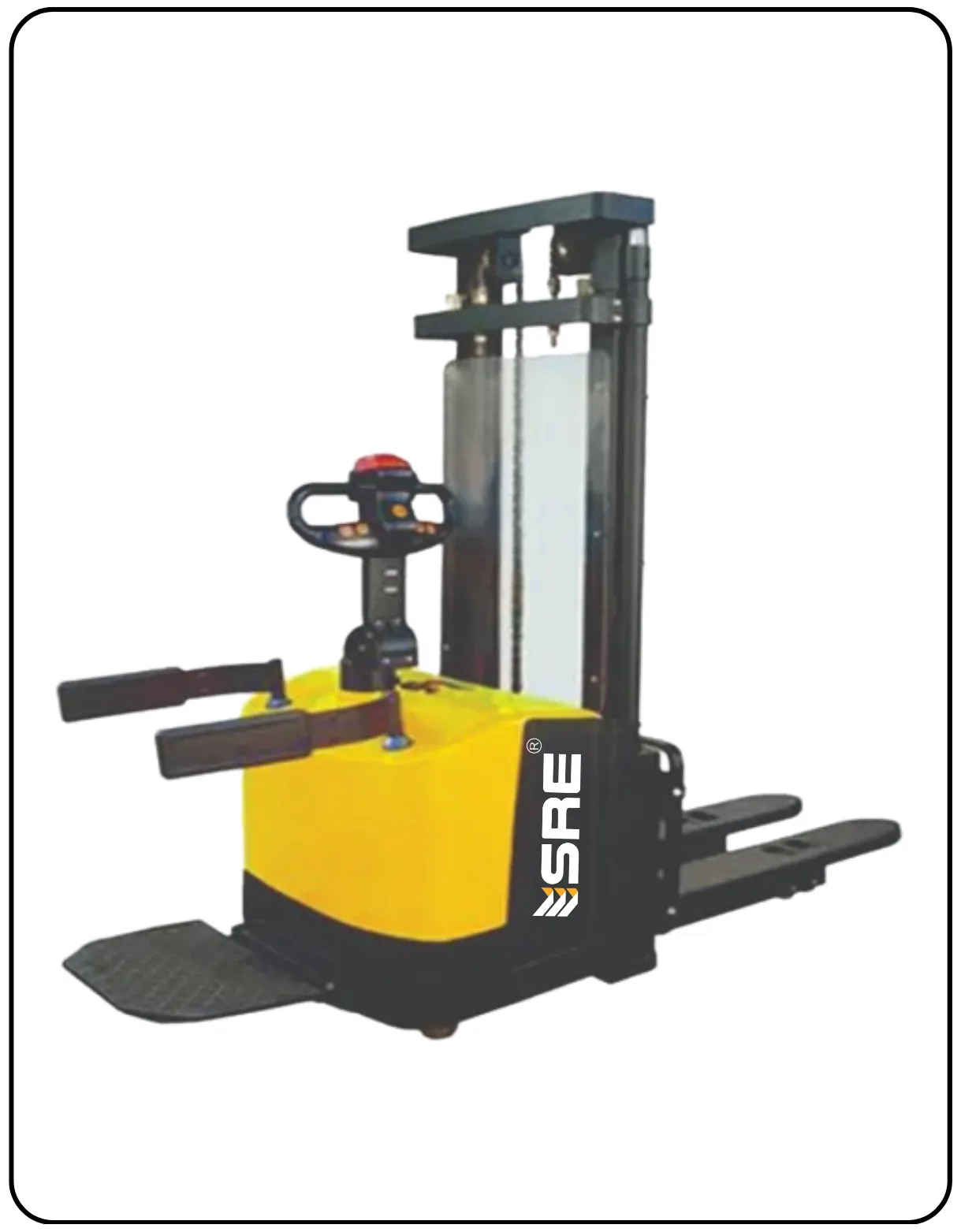
Electric Stacker in Rajkot — Applications, Key Features & Manual vs Electric Stacking Guide
Warehouse supervisors and store managers in Rajkot’s manufacturing and trading sector consistently identify vertical storage productivity as the first thing that improves when they upgrade from a manual hydraulic stacker to an electric stacker. With a manual hydraulic stacker, lifting 1000 kg to 1.6 metres requires 25–35 pump strokes — each generating operator arm fatigue, particularly in the 6th and 7th hour of a shift. When the same lift cycle repeats 30–60 times per shift for warehouse stock replenishment or order picking, the cumulative operator fatigue measurably slows throughput in the afternoon session. The Electric Stacker in Rajkot from SRE Material Handling Equipment Pvt. Ltd., an ISO 9001:2015 certified manufacturer in Ahmedabad, Gujarat, eliminates this fatigue cycle — the SRE 116 at Rs. 95,000 lifts 1 Ton (1000 kg) to 1.6 metre height at push-button speed across Rajkot, Gujarat, and PAN India.
How the Electric Stacker Solves Vertical Storage Productivity and Safety Problems at Rajkot, Ahmedabad, and Gujarat Warehouses
The SRE 116 electric stacker uses a 24V DC electric mast lift motor to raise and lower loads at a consistent speed — approximately 6–8 cm per second at rated load. The operator does not pump a handle — they press the up/down button on the tiller head control. This means the lift speed and accuracy are identical at load cycle 1 and load cycle 60 in the same shift. For Rajkot warehouse operations doing high-cycle stacking — ceramic tiles, FMCG boxes, engineering component bins — this consistency directly translates into throughput predictability. The SRE 116 mast is a single-mast duplex configuration with IS 2062 MS steel main uprights, providing the structural rigidity that prevents mast sway under 1000 kg at 1.6 m elevated position — a common failure mode in budget electric stackers with undersized mast sections.
The SRE 116 electric stacker operates on a 24V sealed lead-acid or Li-ion battery providing 6–8 hours of normal single-shift operation. The drive wheels are polyurethane-tyred for floor protection — important in Rajkot and Gujarat warehouses with epoxy-coated floors where rubber wheels or steel rollers cause floor damage. Load capacity is 1000 kg rated at the 1.6 metre standard lift height — the capacity does not derate across the lift range in the standard single-mast configuration, unlike some imported models that publish a derating table above 1.2 m height. SRE Material Handling Equipment Pvt. Ltd., MSME and Make in India certified, delivers the SRE 116 within 15–21 working days to Rajkot and across Gujarat.
Manual Stacker vs. Electric Stacker — When the Rs. 65,000 Upgrade Premium is Justified
Purchase managers in Rajkot, Vadodara, Bhavnagar, and Kutch evaluating electric stacker (Rs. 95,000) versus manual stacker (Rs. 30,000) need a clear productivity calculation. For operations doing below 15 stacking cycles per shift, the manual stacker’s pump effort is manageable and the Rs. 65,000 premium is rarely justified. For operations doing 25+ stacking cycles per shift — the typical threshold in active warehouse environments — the electric stacker maintains consistent speed across the shift, directly improving throughput and reducing injury risk. The payback on the premium, calculated from throughput improvement alone, typically falls within 6–12 months in high-cycle Rajkot warehouse operations.
| Parameter | Electric Stacker (SRE 116) | Manual Hydraulic Stacker (SRE 111) | Semi Electric Stacker |
|---|---|---|---|
| Load Capacity | 1000 kg (1 Ton) | 500 kg | 500–1000 kg |
| Lift Height | 1.6 m | 1.6 m | 1.6 m |
| Lift Mechanism | Electric motor (push button) | Manual pump (25–35 strokes) | Electric lift / manual push |
| Drive | Electric (walk-behind) | Manual push | Manual push (drive varies) |
| Shift Throughput (cycles) | 30–60+ cycles consistent | 15–25 before fatigue | 25–40 cycles |
| Starting Price (SRE) | Rs. 95,000 | Rs. 30,000 | On request |
Get a Quote for Electric Stackers — Rajkot, Gujarat & PAN India
Get a Bulk Quote NowCall: +91 9316 208879Key Applications of Electric Stackers Across Rajkot, Gujarat, and PAN India Warehouse and Factory Operations
Factory owners and logistics heads in Rajkot, Himmatnagar, Kalol, Vatva, Kathwada, and Chattral deploy electric stackers wherever consistent, high-cycle vertical stacking is required without the capital cost of a ride-on counterbalance forklift. SRE Material Handling Equipment Pvt. Ltd. has supplied SRE 116 electric stackers to ceramic, FMCG, pharmaceutical, automotive component, and textile operations across Gujarat and Maharashtra.
- Ceramic Tile Warehouse (Rajkot): Stacking heavy ceramic carton pallets to 1.6 m racking height — electric lift maintains consistency across the full shift without operator fatigue.
- FMCG Warehouse (Ahmedabad, Gujarat): Fast-cycle order replenishment stacking — push-button lift allows operator to focus on pallet positioning accuracy rather than pump effort.
- Pharma Raw Material Store (Hyderabad, Pune): Stacking raw material drums and cartons on pharma GMP racking — clean electric operation, no hydraulic oil contamination risk on GMP floor.
- Automotive Component Store (Rajkot, Pune): Stacking component bins and kitted pallets for production line feed — consistent lift speed supports JIT supply timing.
- Textile Yarn Store (Rajkot, Surat): Stacking yarn cone boxes on vertical racking — single-mast compact width fits textile store aisle widths below 1.5 m.
- Cold Store (Bangalore, Chennai): Battery-powered stacking in cold store environments — no exhaust emissions, clean operation in food-adjacent cold areas.
- Steel Service Centre (Jaipur, Rohtak): Stacking coil and plate skids to racking height — 1000 kg rated capacity covers standard steel product pallet weights at this stacking height.
- E-Commerce DC (Noida, Faridabad): High-cycle order buffer stacking in distribution centres — electric lift handles peak-season 50+ cycles per shift without productivity decline.
Battery Maintenance and Charging Infrastructure for Electric Stackers in Rajkot and Gujarat
Engineering managers in Rajkot, Mahesana, Ghandhidham, and Indore commissioning electric stackers for the first time need to plan one simple infrastructure element: a dedicated charging point near the unit’s parking position. The SRE 116 charges from a standard 16A, 230V power outlet — the onboard charger converts AC to the correct DC charging profile for the 24V sealed lead-acid battery. Charge time: 8–10 hours overnight for a fully discharged battery. For 2-shift operations, a Li-ion battery upgrade is available with 3-hour fast-charge capability during the inter-shift break. Battery longevity in Gujarat’s climate: lead-acid batteries in the SRE 116 use nitrile sealed cells that perform consistently at ambient temperatures up to 45°C — the summer storage condition common in Rajkot factory floors. Complementary: Hydraulic Stacker for lower-cost manual stacking, Pallet Truck for horizontal transport, and Dock Leveler for loading bay integration. Blogs: Electric Stacker Pune, Semi Electric Stacker Pune, Manual Stacker Pune.
Upgrade from manual to electric stacking — contact SRE for a project quote today.
Request an Electric Stacker QuoteCall: +91 97247 22404Frequently Asked Questions — Electric Stacker in Rajkot
What is the capacity, lift height, and price of the SRE 116 Electric Stacker for Rajkot and Gujarat warehouse operations?
The SRE 116 electric stacker in Rajkot has 1000 kg (1 Ton) rated capacity and 1.6 metre standard lift height. Lift: 24V DC electric motor — push-button, 6–8 cm per second at rated load. Mast: IS 2062 MS steel single-mast duplex. Drive wheels: polyurethane — floor-safe. Battery: 24V sealed lead-acid (Li-ion upgrade available), 6–8 hours per charge. Starting price: Rs. 95,000 (taxes extra). SRE Material Handling Equipment Pvt. Ltd., ISO 9001:2015. Delivery to Rajkot: 15–21 working days.
At what stacking cycle frequency does an Electric Stacker become more cost-effective than a Manual Stacker for Rajkot warehouse operations?
In Rajkot warehouses, an electric stacker (SRE 116, Rs. 95,000) becomes clearly cost-effective over a manual stacker (Rs. 30,000) when operations reach 25+ stacking cycles per shift. Below 15 cycles per shift, manual is adequate. At 25+ cycles, operator fatigue accumulation measurably reduces afternoon throughput with a manual unit — the electric stacker maintains consistent push-button lift speed from cycle 1 to cycle 60. Payback on the Rs. 65,000 premium typically completes within 6–12 months in high-cycle Gujarat operations.
What charging infrastructure does the SRE 116 Electric Stacker require at Rajkot and Gujarat warehouse facilities?
The SRE 116 electric stacker charges from a standard 16A, 230V power outlet — the onboard charger handles the charging profile. Overnight charge time: 8–10 hours for a fully discharged 24V lead-acid battery. For 2-shift operations in Rajkot and Gujarat, a Li-ion battery upgrade is available with 3-hour fast-charge capability. No special electrical panel is required — a standard wall socket near the parking position is sufficient. Battery performance in Gujarat summer (45°C ambient) is maintained by the nitrile sealed lead-acid cell specification.
Can OEM buyers in Rajkot and Gujarat order fleet quantities of SRE 116 Electric Stackers with Li-ion battery for 2-shift operations?
SRE Material Handling Equipment Pvt. Ltd. accepts fleet orders of 2+ SRE 116 electric stackers with Li-ion battery configuration for 2-shift operations across Rajkot and Gujarat. Delivery: 21–28 working days for fleet orders. MSME and Make in India certified — qualifies for government and institutional procurement. Custom lift heights above 1.6 m (up to 3 m on request) also available. Spare parts — battery packs, mast roller sets, drive wheel assemblies — stocked at Ahmedabad for next-day dispatch.
Rajkot ke ceramic warehouse ke liye Electric Stacker ki battery life aur stacking output kya hoti hai?
Rajkot ke ceramic tile warehouses mein SRE 116 electric stacker ki 24V lead-acid battery 6–8 hours per shift chalta hai — standard single-shift operations ke liye adequate. Stacking output: 30–60 cycles per shift consistently — manual stacker se 25% zyada throughput high-cycle operations mein. Starting price Rs. 95,000 (taxes extra). SRE Material Handling Equipment Pvt. Ltd. direct dispatch Ahmedabad se karta hai. Bhavnagar aur Kutch ke warehouses ke liye bhi same specs available hai.
Ahmedabad aur Gujarat ke FMCG warehouse ke liye Manual Stacker aur Electric Stacker mein kaunsa choose karein?
Ahmedabad aur Gujarat ke FMCG warehouses mein agar daily stacking cycles 25 se zyada hain, toh electric stacker (SRE 116, Rs. 95,000) best choice hai — operator fatigue eliminate hoti hai aur throughput consistent rehti hai. Agar cycles 15 se kam hain, toh manual hydraulic stacker (Rs. 30,000) adequate hai. Vatva, Kathwada, aur Kalol ke high-volume FMCG operations mein electric stacker preferred choice hai consistent output ke liye.
Kya Electric Stacker ke battery aur mast spare parts Rajkot aur Gujarat mein available hain?
Haan — SRE Material Handling Equipment Pvt. Ltd. ke SRE 116 electric stacker ke liye 24V battery packs, mast roller assemblies, drive wheel sets (PU), lift motor assemblies, aur tiller head control units spare parts Ahmedabad warehouse se available hain. Rajkot aur Gujarat ke buyers ke liye 48-hour dispatch hota hai. Annual maintenance — battery electrolyte check, mast lubrication, roller inspection — recommended hai. AMC bhi available hai fleet operations ke liye.
Standards References
Quality: ISO 9001:2015. Steel: BIS — IS 2062. Factory safety: Factories Act, 1948.