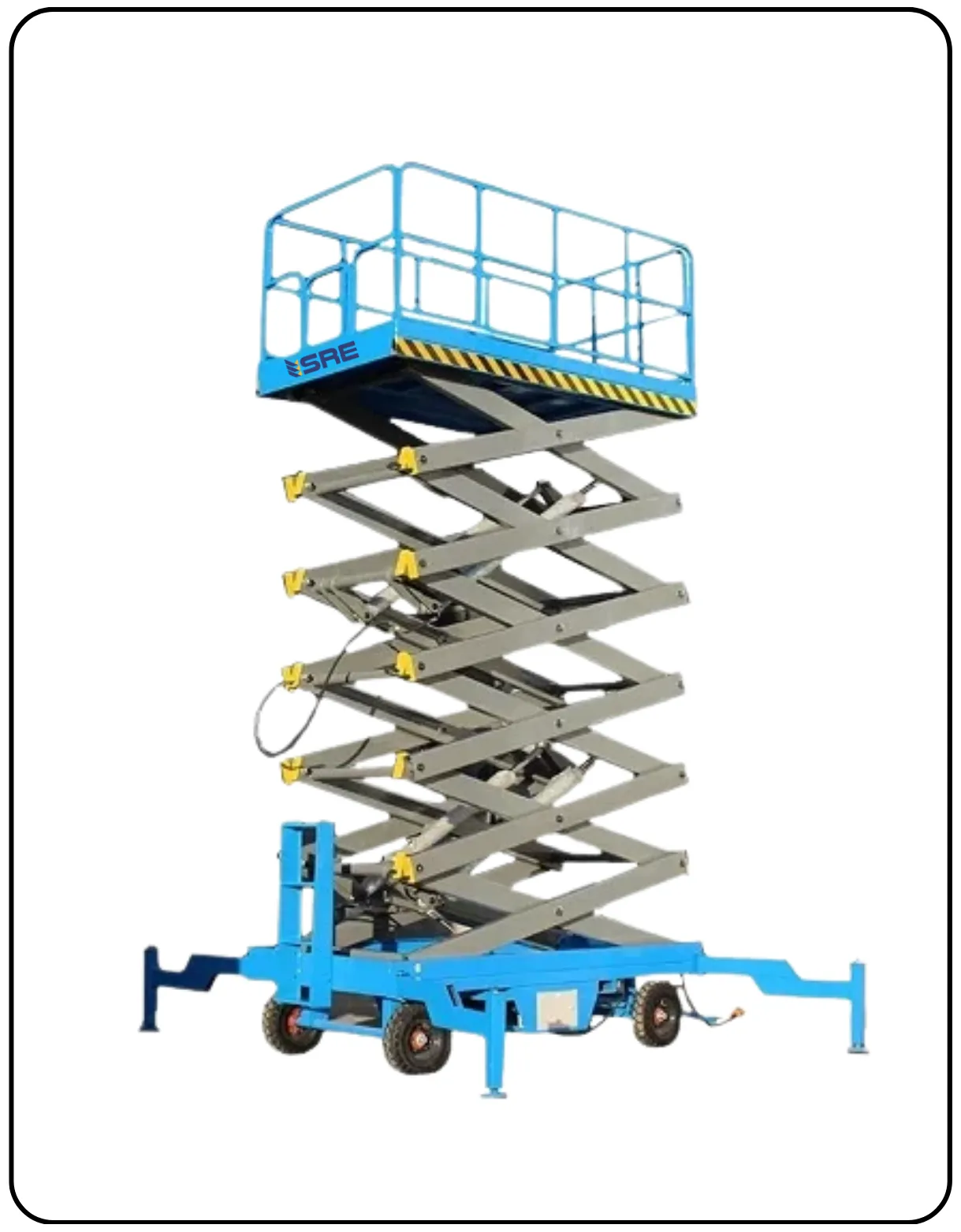
500 kg – 900 mm (All Size Available)
Rs. 26,000
(Taxes to be paid extra)
Brand: SRE
Min Order Qty: 1
Scissor Lift Table in Chakan — Applications, Key Features & Workstation Selection Guide
Fixed-height workbenches, inspection tables, and loading platforms across Chakan’s assembly and packing operations create a single consistent problem: the height that works for one operator, one component, or one task does not work for the next. Operators compensate by bending, reaching, or improvising platform steps — all of which generate ergonomic injuries, slow work pace, and increase rework rates from posture-induced precision errors. The hydraulic solution that converts a fixed-height surface into an operator-adjustable ergonomic workstation is the Scissor Lift Table in Chakan. SRE Material Handling Equipment Pvt. Ltd., an ISO 9001:2015 certified manufacturer, supplies scissor lift tables at Rs. 26,000 with 500 kg capacity and 900 mm maximum height for assembly, packing, loading, and inspection applications across Chakan, Pune, Maharashtra, and PAN India.
Why Scissor Lift Tables Are the Go-To Ergonomic Workstation Upgrade at Chakan, Pune, and Maharashtra Assembly Operations
The ergonomic business case for replacing fixed-height workstations with scissor lift tables in Chakan’s precision assembly, electronics, pharma, and automotive sub-assembly operations is well-established: a 10 cm deviation from neutral wrist height increases RSI risk measurably over a shift, and most fixed-height benches cannot accommodate the 15–25 cm height variation in the operator population without compromise. The SRE scissor lift table uses a manual foot-pedal hydraulic pump — no electrical connection — to raise from 250 mm collapsed height to 900 mm maximum in approximately 25–35 foot strokes (taking 20–30 seconds). The spring-loaded descent valve provides controlled lowering. The IS 2062 MS steel scissor arms and 8 mm base frame carry 500 kg uniform distributed load with 5 mm chequered plate platform.
The SRE scissor lift table distinguishes itself from the hydraulic scissor lift table (SRE 146) and the roller top variants by serving as the primary general-purpose workstation height adjustment platform — flat top, no roller inserts, no specialised surface configuration — suitable for assembly, inspection, packing, die setting, and machine maintenance positioning applications. SRE Material Handling Equipment Pvt. Ltd. supplies this platform in standard size 820 mm × 500 mm and custom sizes up to 2000 mm × 3000 mm with load ratings up to 3000 kg for heavy-duty industrial applications across Gujarat, Maharashtra, and Rajasthan.
Scissor Lift Table vs. Fixed Bench vs. Roller Top Table — Choosing the Right Platform Configuration
Purchase managers in Noida, Faridabad, Indore, and Ambala need to match platform configuration to application. A flat-top scissor lift table suits applications where the load stays stationary on the platform — assembly, inspection, die setting, precision packing. A roller top scissor lift table suits conveyor-to-conveyor height bridging where loads roll laterally off the platform onto an adjacent conveyor. The flat-top configuration at Rs. 26,000 is the highest-volume selection for general-purpose height adjustment — it doesn’t require a specific downstream interface and serves the widest range of workstation applications.
| Application | Scissor Lift Table (Flat Top) | Roller Top Scissor Lift | Electric Scissor Lift Table |
|---|---|---|---|
| Workstation Ergonomics | ✓ Ideal | Possible but roller surface not ideal for assembly | ✓ Ideal — faster adjustment |
| Conveyor Height Bridging | Manual slide required | ✓ Ideal — loads roll off | Manual slide required |
| Die Setting | ✓ Ideal | Not suitable | ✓ Ideal |
| Loading Dock Height Match | ✓ Suitable | ✓ Better with roller | ✓ Suitable |
| Power Required | None — manual hydraulic | None — manual hydraulic | 220V electric |
| Starting Price (SRE) | Rs. 26,000 | Rs. 26,000 | Rs. 1,50,000+ |
Get a Quote for Scissor Lift Tables — Chakan, Pune & PAN India Bulk Orders
Key Applications of Scissor Lift Tables in Chakan, Gujarat, and PAN India Manufacturing
SRE Material Handling Equipment Pvt. Ltd., MSME and Make in India certified, has supplied scissor lift tables across electronics, pharma, automotive, steel fabrication, FMCG, and logistics operations in Chakan, Pune, Ahmedabad, Bangalore, Hyderabad, and Jaipur. The unified need is height-adjustable flat platform work surfaces that eliminate fixed-height ergonomic constraints.
- PCB and Electronics Assembly (Chakan): Adjustable height for delicate SMD and THT assembly operations — neutral wrist height for 6–8 hour assembly shifts reduces error rates and RSI incidents.
- Automotive Sub-Assembly (Pune): Raising component sub-assemblies to ergonomic working height for operators of varying stature on mixed-model assembly lines.
- Pharmaceutical Dispensing (Hyderabad, Pune): SS 304 platform variant for GMP dispensing stations — adjustable height for different container sizes and operator heights.
- Inspection Tables (Ahmedabad, Gujarat): Quality inspection at neutral ergonomic height — reduces inspector fatigue and improves inspection consistency across a shift.
- Die Setting (Jaipur, Rajasthan): Raising press tool components to machine table height during die change operations — eliminates manual lifting of heavy tools during setup.
- Machine Maintenance (Noida, Gurugram): Raising components or tools to equipment access height during scheduled maintenance operations.
- Packing Stations (Faridabad, Rohtak): Adjustable height for cardboard packing operations — box folding, taping, and labelling at correct wrist height.
- Welding Positioners (Indore, Bhopal): Supporting welded components at correct working height during fabrication — operator maintains neutral posture across the weld bead run.
Scissor Lift Table Specification and Custom Options from SRE
Procurement managers in Vatva, Kathwada, Kalol, Himmatnagar, and Mahesana sourcing fleet quantities need verified specifications. Standard SRE scissor lift table: capacity 500 kg, collapsed height 250 mm, maximum height 900 mm, platform 820 mm × 500 mm (custom up to 2000 mm × 3000 mm). Frame: IS 2062 MS steel, 8 mm base plate, 6 mm scissor arms. Platform: 5 mm chequered plate. Hydraulic oil: ISO VG 46. Seals: nitrile 60°C. Safety: mechanical lock pin + spring-loaded descent valve. Load tested at 125% rated capacity. Finish: 2-coat epoxy powder coat. SS 304 platform, heavy-duty variants to 3000 kg, and turntable top options available.
Complementary Products and Supply Details from SRE Material Handling Equipment Pvt. Ltd. for Chakan and PAN India
SRE Material Handling Equipment Pvt. Ltd. dispatches standard scissor lift tables from Ahmedabad to Chakan and Pune within 7–10 working days. Bulk orders of 5+ units: 15–21 working days. Hydraulic seal kits, safety lock assemblies, and platform surface plates are stocked for next-day spare parts dispatch. Complementary products: Mobile Scissor Lift for elevated personnel access, Dock Leveler for loading bay height bridging, and Platform Trolley for component transport between lift table stations. Blog guides: Pit Mounted Scissor Lift Table Mumbai and Hydraulic Stacker Pune.
Contact our team to configure the right scissor lift table for your Chakan production line.
Frequently Asked Questions — Scissor Lift Table in Chakan
What capacity, platform size, lift height, and price does the SRE Scissor Lift Table offer for Chakan and Pune assembly operations?
The SRE scissor lift table in Chakan has 500 kg rated capacity, platform 820 mm × 500 mm (standard), collapsed height 250 mm, maximum lift height 900 mm. Frame: IS 2062 MS steel, 8 mm plate. Seals: nitrile 60°C. Platform: 5 mm chequered plate. Load tested at 125%. Starting price: Rs. 26,000 (taxes extra). SRE Material Handling Equipment Pvt. Ltd., ISO 9001:2015 certified, delivers within 7–10 working days to Pune and Maharashtra.
How does a Scissor Lift Table reduce assembly errors and ergonomic injuries at Pune and Gujarat manufacturing plants?
At Pune and Gujarat assembly plants, a scissor lift table allows operators to adjust working height to their neutral wrist position — typically within ±5 cm of individual ergonomic optimal — in 20–30 seconds. A 10 cm deviation from neutral wrist height measurably increases RSI risk over a full shift. Facilities report 10–20% reduction in posture-related assembly errors and a measurable drop in RSI complaints within the first 4 weeks of deployment across adjusted workstations.
What safety mechanisms are included in SRE Scissor Lift Tables for industrial workstation use across Noida and Bangalore factories?
Every SRE scissor lift table includes a mechanical safety lock pin for secure hold at any height during maintenance or die setting, a spring-loaded descent safety valve preventing uncontrolled lowering on hydraulic failure, and a 5 mm chequered plate platform preventing work-piece sliding. Load tested at 125% rated capacity before dispatch. Optional safety rails and toe guards for elevated configurations are available for Noida and Bangalore facilities.
Can OEM buyers in Gujarat and Maharashtra order Scissor Lift Tables with custom platform sizes, SS 304 surfaces, or heavy-duty capacities?
Yes — SRE Material Handling Equipment Pvt. Ltd. accepts OEM orders with custom platform sizes up to 2000 mm × 3000 mm, SS 304 stainless platforms for pharma/food use, and heavy-duty load ratings up to 3000 kg. Turntable top and roller top configurations are also available. Standard bulk delivery: 15–21 working days. MSME and Make in India certified — eligible for government procurement in Gujarat and Maharashtra.
Chakan aur Pune ke assembly plant ke liye Scissor Lift Table ki price aur delivery time kya hai?
Chakan aur Pune ke assembly operations ke liye SRE scissor lift table ki starting price Rs. 26,000 (taxes extra) hai 500 kg / 900 mm standard model ke liye. Standard delivery 7–10 working days mein hoti hai. Custom platform sizes ya SS 304 variant ke liye 15–21 working days. Maharashtra aur Gujarat ke clients ke liye direct factory dispatch Ahmedabad se hoti hai. Fleet orders ke liye preferential pricing available hai.
Ahmedabad aur Gujarat ke electronics assembly ke liye Scissor Lift Table ki height adjustment speed kya hai?
Ahmedabad aur Gujarat ke electronics assembly lines mein scissor lift table ko 0 se 900 mm height tak raise karne mein 25–35 foot pump strokes lagte hain — approximately 20–30 seconds. Ye operator ko shift start mein ek baar height set karne ke liye adequate hai. Agar more frequent adjustment (20+ per shift) chahiye, toh electric scissor lift table consider karein. Vatva, Kathwada, aur Kalol ke electronics assembly units mein manual hydraulic variant most commonly used hai.
Kya Scissor Lift Table ke hydraulic seal aur platform spare parts Chakan aur Pune mein available hain?
Haan — SRE ke scissor lift table ke liye hydraulic seal kits, safety lock assemblies, aur platform surface plates spare parts ke roop mein stocked hain Ahmedabad warehouse mein. Chakan aur Pune ke liye next-day dispatch available hai. Seal replacement 30–45 minutes mein ek mechanic kar sakta hai. AMC (Annual Maintenance Contract) bhi available hai fleet installations ke liye across Maharashtra aur Gujarat.
Standards References
Quality: ISO 9001:2015. Steel: BIS — IS 2062. Factory safety: Factories Act, 1948.