
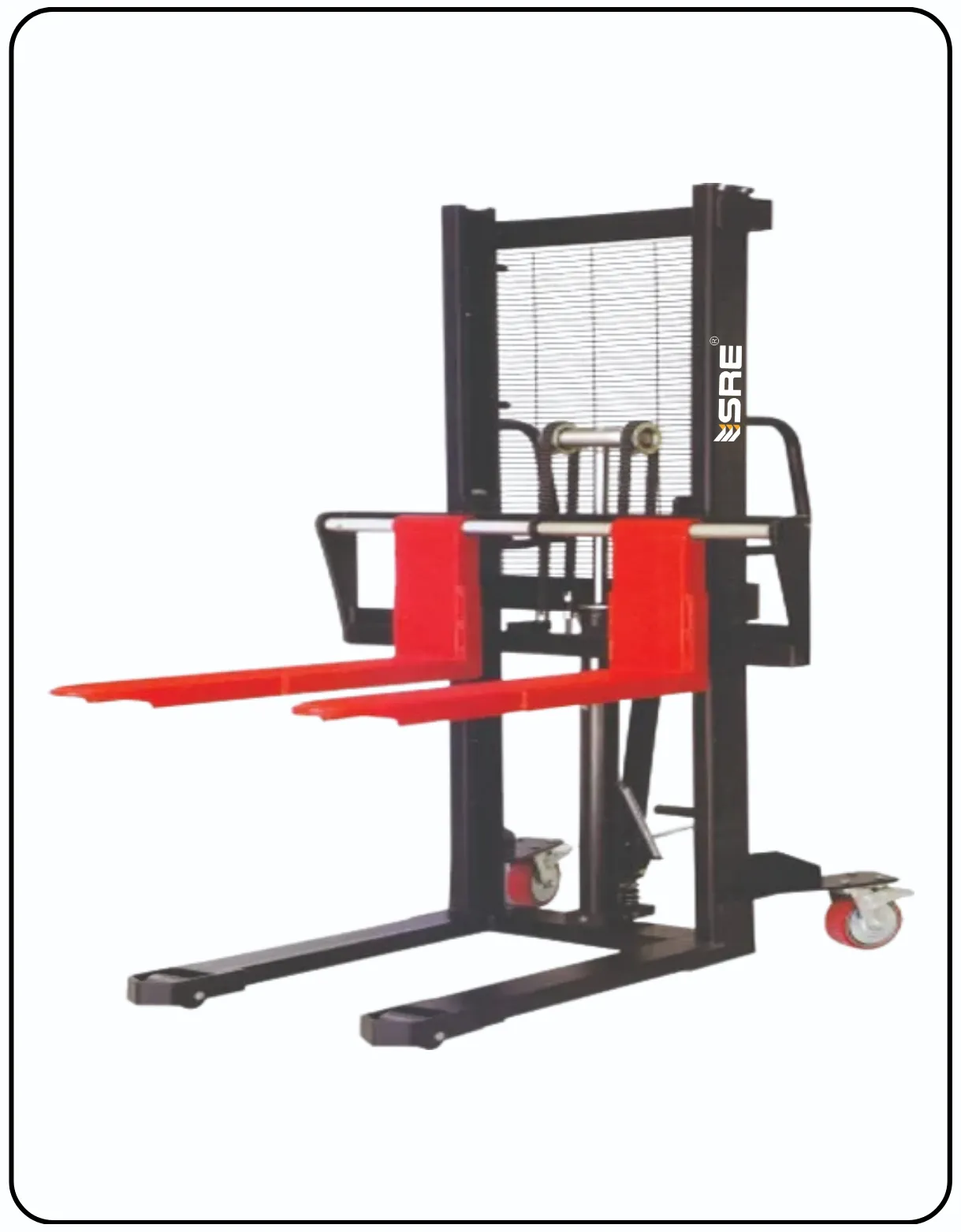
500 Kg x 1.6 Meter H (All Size Available)
Rs. 30,000
(Taxes to be paid extra)
Brand: SRE
SKU: SRE 111
Min Order Qty: 1
Operations managers and procurement officers at warehouse, storage, and godown facilities across Bhosri MIDC, rural Gujarat, and remote Rajasthan and Madhya Pradesh locations regularly face a basic material stacking requirement — lifting packed goods, bags, or boxes to rack heights of 800–1,600 mm at loads of 300–500 kg per pallet — in facilities where the electricity supply is unreliable, absent, or where no single-phase outlet exists near the stacking area. A battery-powered stacker is immediately ruled out when there is no reliable power for overnight charging. A hydraulic foot-pump stacker still requires the operator’s foot interaction with the pump pedal — manageable but the hand-lever pump of a manual stacker provides a practical alternative where the operator’s upper body strength is the full power source — no electricity, no battery, no hydraulic pump motor — just operator and hydraulics. The Manual Stacker in Bhosri — the SRE 111 from SRE Material Handling Equipment Pvt. Ltd., rated at 500 kg capacity and 1.6 metre lift height with a hand-lever hydraulic pump mechanism, priced at Rs. 30,000 (taxes extra) — is the zero-electricity, zero-infrastructure material stacking solution for Bhosri and any facility without reliable power access.
Key Features Of SRE 111 Manual Stacker That Enable Zero-Infrastructure Pallet Stacking In Bhosri And Remote India
Hand-Lever Hydraulic Pump — Lifts 500 kg to 1.6 Metres With No Power, No Charging, No Infrastructure
Store managers and facility operators at remote manufacturing locations, agricultural cooperative godowns in Gujarat (Kalol, Himmatnagar, Mahesana), and construction site stores in Rajasthan who require powered vertical pallet lifting without access to reliable electrical supply know that a battery-powered stacker is simply not deployable at their location: the battery must be charged daily, and if a single-phase power supply is unavailable or load-shedding prevents overnight charging, the stacker is unusable the next day. The SRE 111 Manual Stacker requires absolutely no external power source of any kind. The operator presses and releases the hand-lever pump handle — each full pump stroke raises the mast approximately 40–50 mm at 500 kg load, reaching 1,600 mm in approximately 35–45 pump strokes. Descent is controlled by a hand-operated needle release valve at 0.05–0.08 m/s. The complete power source is the operator’s arm effort — repeatable, reliable, and completely independent of any utility infrastructure. At Rs. 30,000, the SRE 111 is the most affordable operational stacking solution available for Bhosri MSME stores and remote facility operations. SRE Material Handling Equipment Pvt. Ltd., an ISO 9001:2015 certified manufacturer, delivers to Bhosri and any PAN India location in 7–15 working days.
MS IS 2062 Heavy-Duty Frame — 500 kg Rated Capacity With 125% Factory Load Test in MSME Manufacturing Facilities
Small and medium enterprise procurement managers at Bhosri MIDC, Vatva, and Kathwada industrial estates who purchase goods handling equipment on a limited capital budget frequently face a quality reliability concern: at the lower price point of Rs. 25,000–35,000 for manual stackers, structural frame quality varies significantly between manufacturers — some use thin-wall tube frames that deform under sustained loading, and hydraulic seals fail within 12–18 months of regular use due to inferior polyurethane compound. The SRE 111 Manual Stacker from SRE Material Handling Equipment Pvt. Ltd. uses a full-section MS IS 2062 Grade B frame for the mast channels, straddle legs, and fork carriage — the same structural steel specification used in SRE’s heavier electric stackers. The hydraulic cylinder is chrome-bore with triple-lip industrial polyurethane seals, factory-tested at 125% rated load (625 kg) before dispatch. This structural and hydraulic quality at Rs. 30,000 gives Bhosri MIDC MSME procurement teams a stacker designed for 15–20+ years of daily service — not a 2-year consumable item.
Applications Of Manual Stacker At Bhosri, Gujarat, And Remote PAN India Locations
- MSME factory stores at Bhosri MIDC small and medium light engineering units: Ground-to-first-level rack pallet stacking at factory stores where power point proximity to stacking aisle is not available — no extension cord needed
- Agricultural cooperative seed, fertiliser, and grain storage in Gujarat (Kalol, Himmatnagar, Mahesana): 50 kg bag pallet stacking at cooperative storage godowns in locations with load-shedding or absent single-phase supply — manual stacker needs no power connection
- Construction site stores at project sites in Rajasthan (Jaipur, Udaipur) and Bhopal: Cement, tile, and building material pallet stacking at construction project site stores where temporary power supply is insufficient for battery stacker charging
- Rural retail and FMCG wholesale godown in Himmatnagar, Chattral, and Mahesana: FMCG carton pallet stacking at rural wholesale godowns without continuous power supply — manual stacker always ready, regardless of power availability
- Pharmaceutical cold chain distribution in remote Gujarat and Rajasthan towns: Medicine carton pallet stacking at cold chain distribution points in semi-urban locations with unreliable power — manual stacker operates without power in ambient store area
- Defence and border area logistics stores in Rajasthan and Ambala: Equipment and material pallet stacking at remote logistics stores where generator power is limited — manual stacker draws zero power
- Export packing house and cold storage at Bhavnagar and Gandhidham: Pre-shipment packed goods stacking at export packing houses where portable stacking equipment is needed in multiple locations across the facility
- Hospital emergency supply stores in smaller cities (Rohtak, Ambala, Mahesana): Medical supply pallet stacking at district hospital stores where equipment certification for electrically-powered industrial equipment may present delays
- Mining and quarry field stores in Rajasthan and Gujarat: Explosive, liner, and spare part pallet stacking at mine site field stores where battery stacker ignition risk is prohibited and power supply absent
- Textile and cotton ginning cooperative stores in Gujarat (Kutch, Bhavnagar, Gandhidham): Cotton bale and packed textile roll pallet stacking at cooperative ginning facility stores
🏭 Field Application — Rural Gujarat Agri-Cooperative Store, Mahesana, 2025
A Mahesana district agricultural cooperative managing a 1,500 sqm seed and fertiliser storage facility with 10–12 hours daily load-shedding evaluated battery stackers but found overnight charging impossible during the active sowing season when load-shedding is at its peak. The SRE 111 Manual Stacker at Rs. 30,000 was ordered from SRE Material Handling Equipment Pvt. Ltd.‘s Ahmedabad plant, delivered in 7 days. The stacker now handles 30–40 pallet movements per day of 50 kg fertiliser bags in 500 kg pallet loads — entirely on operator effort, regardless of power availability. Two years after installation, the only maintenance cost has been a single hydraulic oil top-up of 200 ml at Rs. 40.
Manual Stacker SRE 111 — Specification For Bhosri And Remote India Procurement
| Specification | SRE 111 Standard | Options |
|---|---|---|
| SKU | SRE 111 | Standard |
| Rated Capacity | 500 kg | 1,000 kg, 1,500 kg options |
| Max Lift Height | 1,600 mm | 2,000 mm, 2,500 mm options |
| Lift Mechanism | Hand-lever double-acting hydraulic pump | No electrical connection at any stage |
| Pump Strokes to Full Height | ~35–45 at 500 kg rated load | ~40 mm lift per stroke |
| Descent Control | Hand-operated needle release valve — 0.05–0.08 m/s | Governed — load cannot free-fall |
| Frame Material | MS IS 2062 Grade B — full section | SS 304 option — pharma/food grade |
| Hydraulic Oil | ISO VG 46 — 500 ml total fill | Available at any hardware outlet |
| Load Test | 125% factory tested (625 kg) | Certificate provided |
| Annual Maintenance Cost | Rs. 40–200 (oil check only) | No battery, no electrical servicing |
| Price | Rs. 30,000 (taxes extra) | Fleet: contact SRE |
Manual Stacker vs Hydraulic Foot-Pump vs Hand Pallet Truck — Choosing The Correct Solution For Bhosri And Maharashtra
| Feature | Hand Pallet Truck | Hydraulic Stacker (Foot Pump) | SRE 111 Manual Stacker (Hand Pump) |
|---|---|---|---|
| Vertical Lift Capability | 200 mm (pallet jack only) | Up to 1,600–3,500 mm | Up to 1,600–3,500 mm |
| Lift Mechanism | Foot pump — 200 mm max | Foot pump — both hands free | Hand lever — upper body effort |
| Electricity Required | No | No | No — complete zero-power operation |
| Remote/Off-Grid Use | Yes | Yes | Yes — primary use case |
| Stacking to Rack Height | No — floor level only | Yes — to 1.6–3.5 m | Yes — to 1.6–3.5 m |
| Operator Hand-Free During Lift | No | Yes (foot pump frees hands) | No — hand lever during lift |
| Annual Maintenance (INR) | Rs. 200–500 | Rs. 200–500 | Rs. 40–200 (oil check only) |
| Price (INR) | Rs. 13,500–15,000 | Rs. 30,000 (SRE 111) | Rs. 30,000 (SRE 111) |
For any facility in Bhosri MIDC, remote Gujarat, Rajasthan, or Madhya Pradesh where vertical pallet stacking to rack height is required and electrical infrastructure is absent, unreliable, or prohibited, the SRE 111 Manual Stacker at Rs. 30,000 provides a complete, lowest-infrastructure solution. For related products: Pallet Truck, Hydraulic Stacker, and Platform Trolley. Related blog: Manual Stacker Pune and Hydraulic Stacker Pune. Submit an inquiry for straddle width, capacity, and lift height requirements.
Stack pallets anywhere — no power, no charging, no infrastructure — SRE 111, Rs. 30,000.
📞 Call Now — +91 9316 208879 or +91 97247 22404
500 kg · 1.6 m lift · Hand pump · Zero electricity · 125% load tested · ISO 9001:2015 · Delivery 7–15 days
For the ISO quality management standard applicable to manual stacker manufacturers, see ISO 9001:2015 Quality Management System. For IS standards governing hydraulic manual stackers in India, visit Bureau of Indian Standards (BIS). For ergonomic and safety guidelines on manual hydraulic stacker operation, refer to OSHA Ergonomics and Materials Handling safety guidance.
FAQs — Manual Stacker For Bhosri And Remote India Buyers
Q1. How many hand-pump strokes and time does the SRE 111 Manual Stacker need to lift a 500 kg load to 1,600 mm at Bhosri MIDC MSME and remote rural warehouse operations?
The SRE 111 Manual Stacker’s hand-lever pump lifts approximately 40 mm per full pump stroke at 500 kg rated load. Reaching 1,600 mm from ground requires approximately 35–45 complete pump strokes — taking approximately 90–120 seconds at a steady operator pace. This cycle time is well within acceptable range for operations handling 15–40 pallet stacking cycles per shift. For higher-frequency applications requiring faster lift cycles (60+ pallet movements per shift), a battery-powered stacker or hydraulic foot-pump type is recommended.
Q2. What makes the SRE 111 Manual Stacker the specifically correct solution for remote agricultural cooperative stores in Gujarat (Mahesana, Kalol, Himmatnagar) with persistent load-shedding or absent electricity?
The SRE 111 Manual Stacker requires absolutely no electrical supply at any stage of its operation — no charging station, no power outlet, no electrical connection. For Gujarat agricultural cooperative stores in Mahesana, Kalol, and Himmatnagar that experience 8–12 hours of daily load-shedding during peak agricultural storage seasons, a battery stacker is unusable when power is absent for overnight charging. The SRE 111 operates identically whether power is available or not — making it the only reliable stacking solution for these locations.
Q3. What is the structural quality and expected service life of the SRE 111 Manual Stacker versus cheaper unbranded manual stackers in the Bhosri MIDC and Maharashtra market?
The SRE 111 Manual Stacker uses MS IS 2062 Grade B full-section structural steel for the mast channels, straddle legs, and fork carriage — the same structural specification as SRE’s electric stacker range. The hydraulic cylinder is chrome-bore with triple-lip industrial polyurethane seals, factory-tested at 125% rated load (625 kg). SRE Material Handling Equipment Pvt. Ltd., ISO 9001:2015 certified, provides a 12-month structural warranty. Expected service life: 15–20+ years at normal use — versus 2–4 years typically seen with unbranded thin-tube-frame manual stackers purchased at lower price points in Bhosri and Maharashtra markets.
Q4. What is the delivery lead time, warranty, and annual maintenance specification for the SRE 111 Manual Stacker for bulk orders from Bhosri MIDC and Gujarat MSME buyers?
SRE Material Handling Equipment Pvt. Ltd., an ISO 9001:2015 certified Make in India manufacturer, delivers the SRE 111 Manual Stacker to Bhosri and any PAN India location in 7–15 working days. Fleet orders (5+ units) for Gujarat MSME and cooperative procurement teams receive quantity pricing. Warranty: 12 months structural. Annual maintenance: hydraulic oil level check (ISO VG 46), descent valve calibration check, mast channel lubrication — estimated Rs. 40–200 total per year — the lowest annual maintenance cost of any powered stacking equipment.
Q5. Bhosri ya Gujarat ke remote location mein Manual Stacker SRE 111 ki delivery aur commissioning mein kitna time lagta hai — kya electrician ki zarurat hai?
Bhosri aur Gujarat ke remote locations ke liye SRE 111 Manual Stacker ki delivery 7 se 15 working days mein hoti hai. Koi electrician required nahi — stacker mein koi electrical component nahi hai. Unit ready-to-use condition mein deliver hota hai — hydraulic oil pre-filled, forks attached, straddle legs bolted. Commissioning: fork carriage lower position check, hand pump function test, descent valve smoothness check — approximately 15–20 minutes. Operator training: hand pump operation, descent control, load capacity limits — approximately 30 minutes. No infrastructure setup of any kind required.
Q6. Rajasthan (Jaipur, Udaipur) ya Madhya Pradesh (Indore, Bhopal) ke construction site store ke liye Manual Stacker SRE 111 ka koi power requirement hai?
Rajasthan aur Madhya Pradesh ke construction site stores ke liye SRE 111 Manual Stacker ki complete power requirement: zero — absolutely nil. No single-phase socket, no three-phase connection, no generator connection, no battery charging station required at any point. The stacker operates entirely on operator hand-lever pump effort and hydraulic oil (ISO VG 46 — Rs. 40–80 per litre at any hardware outlet). This makes the SRE 111 the only material stacking solution that can be deployed at Jaipur, Udaipur, and Bhopal construction sites immediately, without any site electrical works.
Q7. Kya Manual Stacker SRE 111 ki hydraulic seal kit aur spare parts Noida, Hyderabad, ya remote Rajasthan locations mein available hain?
Haan. SRE Material Handling Equipment Pvt. Ltd. ke Ahmedabad plant se spare parts — hydraulic cylinder triple-lip PU seal kits, chrome-bore pump assembly, descent needle valve sets, ISO VG 46 hydraulic oil 500 ml packs, mast channel roller sets, hand lever pump handle kits, aur fork tip rubber pad sets — Noida, Hyderabad, remote Rajasthan locations, aur PAN India ke liye 3–10 working days mein courier dispatch hote hain. Hydraulic oil top-up (200–500 ml per year maximum) annual maintenance ka typically single cost item hai — estimated Rs. 40–200 total per year.