Which Industries Benefit Most from Warehouse Dock Levelers?
How To Improve Warehouse Safety Using Dock Levelers is essential for industries such as warehousing, logistics, manufacturing, retail distribution, pharmaceuticals, food processing, cold storage, and e-commerce.
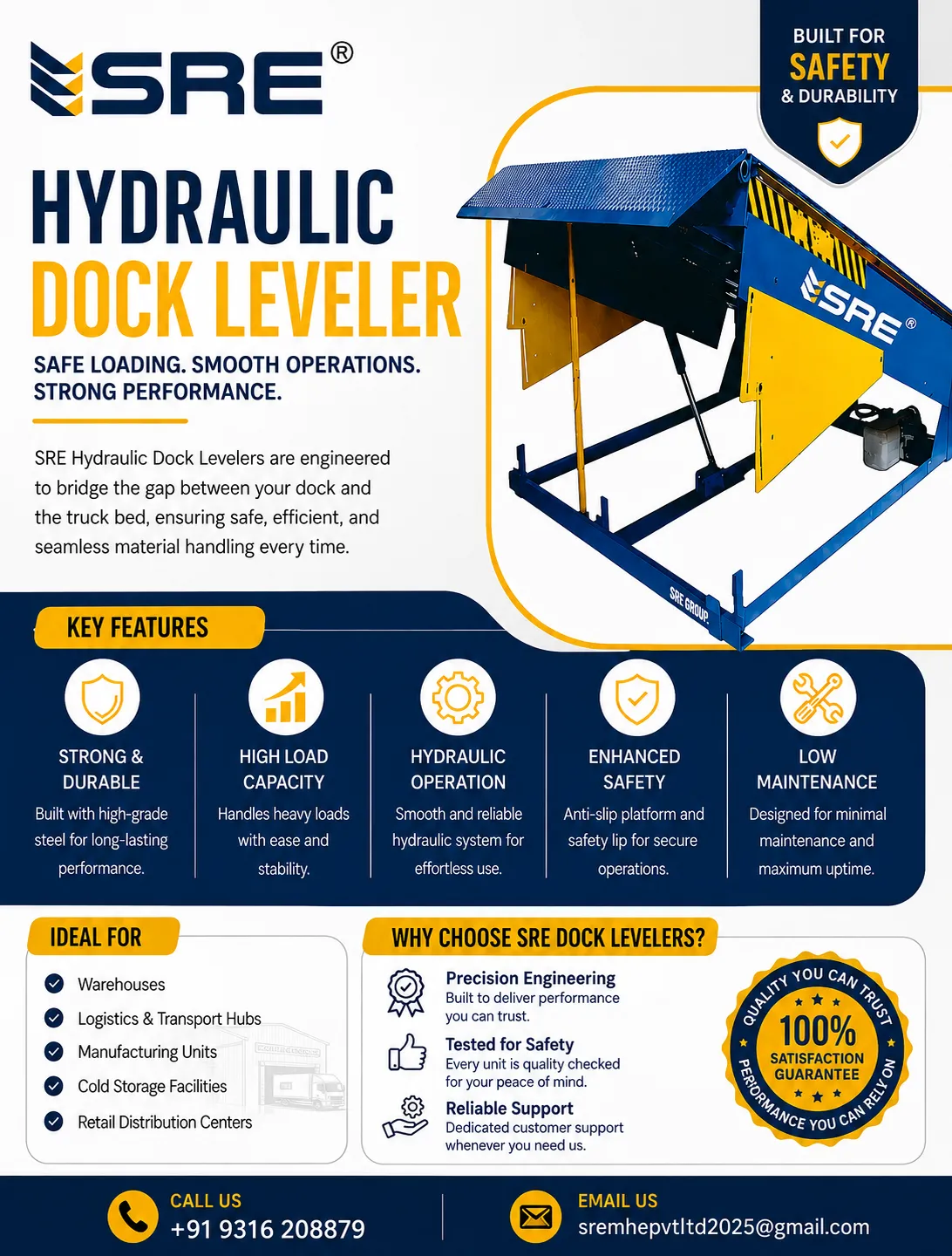
Dock levelers create a safe, stable bridge between loading docks and vehicles, reducing accidents and improving productivity. SRE Material Handling Equipment Private Limited provides high-quality hydraulic dock levelers engineered to enhance safety, operational efficiency, and reliable material handling across diverse industrial applications. With over a decade of hands-on manufacturing experience, the company has seen firsthand how a single overlooked dock component can disrupt an entire shift’s productivity — and how the right equipment, installed correctly, quietly prevents that from happening.
How To Improve Warehouse Safety Using Dock Levelers
Every year, Indian warehouses lose thousands of working hours to loading bay accidents — a forklift misjudging the gap, a pallet truck tipping at the truck edge, or a worker slipping on an uneven bay surface. Most of these incidents trace back to one overlooked component: the dock leveler. Getting this right isn’t just about compliance — it directly protects your people, your goods, and your bottom line. This article walks through practical, field-tested ways to improve warehouse safety using dock levelers, based on real installation experience across Indian logistics hubs.
Why Dock Leveler Safety Matters More Than Most Warehouses Realize
A dock leveler bridges the gap between your warehouse floor and the trailer bed — and that gap, if mismanaged, is where most loading-bay accidents happen. In cities like Mumbai, Pune, and Ahmedabad, where warehouses often run multiple shifts with tight turnaround times, a poorly maintained or wrongly specified leveler creates a bottleneck and a hazard at the same time.
Common risk points include:
- Uneven leveler-to-trailer transition causing pallet trucks or electric stacker units to jolt
- Trailer creep during loading, when the truck isn’t properly chocked
- Overloaded platforms beyond rated capacity
- Worn hinge pins or hydraulic seals leading to sudden platform drop
- Lack of toe guards, exposing feet to crush hazards
Addressing these isn’t about buying the most expensive equipment — it’s about matching the leveler type (hydraulic, mechanical, or air-powered) to your actual dock traffic and training staff on correct operating sequence.
Our Dock Leveler Manufacturing Capabilities
SRE Material Handling Equipment engineers dock levelers designed for the load patterns typical of Indian warehousing — mixed pallet sizes, frequent container unloading, and dock heights that vary from unit to unit within the same facility. As material handling equipment manufacturers, the focus stays on structural rigidity, anti-slip decking, and hydraulic systems that hold position under load rather than drift.
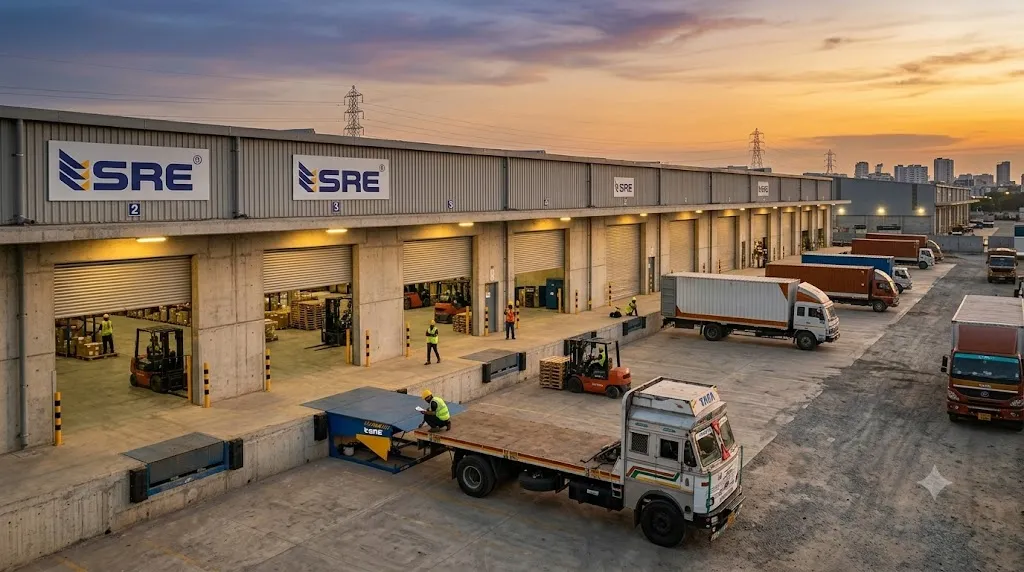
Alongside dock levelers, the same engineering approach carries into related equipment — hydraulic stacker units for staging goods near the dock, goods lift manufacturers-grade platforms for vertical movement between floors, and mobile floor crane solutions for handling awkward loads that don’t suit a standard pallet. For facilities running mixed operations, this is detailed further on the Dock Leveler product page, alongside vertical movement options via the Good Lift range.
A dock safety upgrade rarely stays isolated — most plant heads in Hyderabad and Chennai end up reviewing their entire bay layout, including scissor lift access for maintenance crews and drum handling equipment for chemical or oil drum transfers near the same loading zone.
Navigating Quality Standards & ISO 9001-2015 Certification
Safety-critical equipment needs a manufacturing discipline behind it, not just a product spec sheet. SRE Material Handling Equipment operates under ISO 9001-2015 certification, which governs the quality management process from raw material selection through to final load testing. This matters practically — hydraulic seals, load-bearing plates, and hinge assemblies on a dock leveler go through documented checks rather than one-off inspection.
For buyers evaluating vendors, it’s worth asking directly: does the manufacturer test each unit at rated capacity before dispatch, and is there a documented maintenance schedule handed over post-installation? These questions separate a compliant purchase from a liability waiting to surface six months down the line.
Local Manufacturers vs SRE Material Handling Equipment
| Parameter | Typical Local Fabricator | SRE Material Handling Equipment |
|---|---|---|
| Load Testing | Often skipped or verbal claim only | Documented pre-dispatch load testing |
| Certification | Not always ISO-backed | ISO 9001-2015 certified process |
| Toe Guard & Safety Lip Design | Variable, sometimes omitted | Standard on all installations |
| Post-Installation Support | Limited or none | Structured maintenance guidance |
| Custom Engineering | Fixed sizes only | Custom material handling solutions India-based sizing |
Step-by-Step Process – How We Deliver Safer Dock Systems
Here’s how SRE Material Handling Equipment typically approaches a dock safety upgrade:
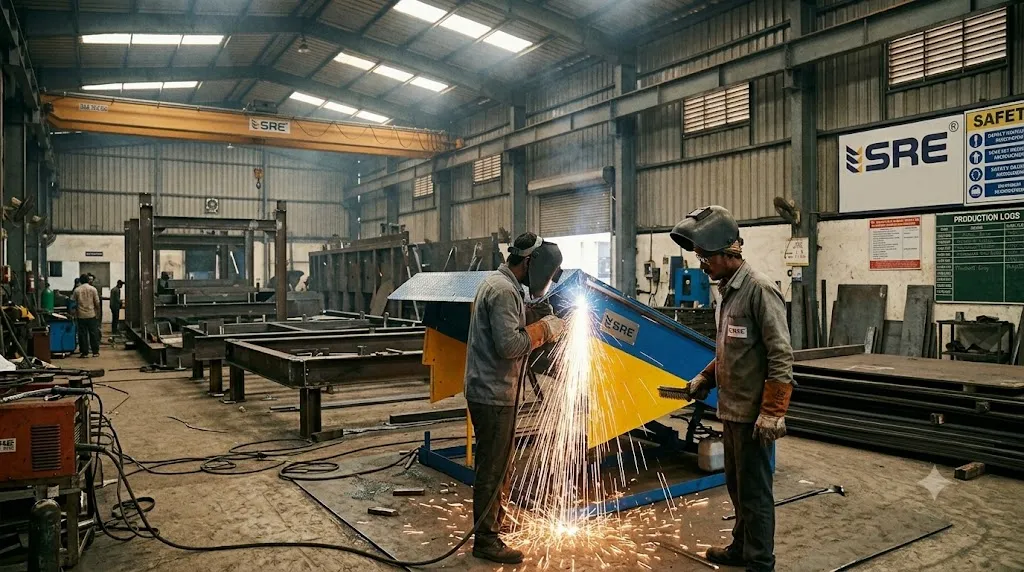
- Site assessment – dock height, trailer types, and daily load frequency are measured on-site, not estimated over a call.
- Equipment specification – leveler capacity, lip length, and hydraulic vs mechanical mechanism are matched to actual usage, whether it’s a warehouse equipment supplier contract for a 3PL or a single-dock factory setup.
- Manufacturing & quality checks – units are built and tested against ISO 9001-2015 protocols before leaving the facility.
- Installation – carried out with structural anchoring appropriate for the dock’s concrete rating, common practice across projects in Surat, Jaipur, and Chandigarh.
- Operator briefing – dock and forklift operators are walked through safe operating sequence, including chock placement and load limits.
- Maintenance follow-up – scheduled checks on hydraulic seals and hinge wear, since a leveler’s safety performance degrades quietly if ignored.
For businesses also reviewing broader equipment needs during this process, the Material Handling Equipment Supplier Ahmedabad page and Buy Material Handling Equipment page cover the wider product range typically bundled into a dock upgrade.
Real Client Case Study
A mid-sized FMCG distribution center in Vadodara — we’ll refer to them as “Client A” — was seeing repeated near-miss incidents where pallet trucks jolted while crossing from the leveler onto trailers with mismatched bed heights. After a site assessment, SRE Material Handling Equipment recommended a hydraulic dock leveler with an extended lip and adjustable range suited to their mixed trailer fleet, replacing an aging mechanical unit that had developed play in its hinge assembly.
Post-installation, the client reported smoother pallet truck transitions and no further near-miss reports logged over the following two quarters. A smaller anecdote worth mentioning: a similar issue came up with a Kolkata-based logistics operator, where simply correcting the leveler’s resting angle — rather than replacing the unit — resolved most of the jolting complaints, showing that sometimes the fix is calibration, not capital expense.
Frequently Asked Questions
Q1. Dock Levelers ke saath sabse bada safety risk kya hota hai?
- Sabse bada safety risk dock leveler aur trailer bed ke beech uneven gap ya height difference hota hai. Isse forklift ya material handling equipment jhatka kha sakta hai, balance lose kar sakta hai aur loading-unloading ke dauran accident ka risk badh jata hai.
Q2. Dock Leveler ki inspection kitni baar karni chahiye?
- Hydraulic system aur hinges ki inspection har 3 mahine (quarterly) karni chahiye. Iske alawa, equipment ka full load test saal me ek baar karna recommended hota hai taaki safe aur reliable performance bani rahe.
Q3. Kya Dock Levelers ko uneven dock heights ke liye customize kiya ja sakta hai?
- Haan, SRE Material Handling Equipment Private Limited alag-alag dock heights aur industrial requirements ke hisaab se customized hydraulic dock leveler solutions provide karta hai, jisse loading aur unloading safe aur efficient ho jati hai.
Q4. Kya ISO 9001:2015 certification Dock Leveler ki safety ke liye important hai?
- Haan, ISO 9001:2015 certification manufacturing quality standards ko ensure karta hai. Isme material selection, production process aur load testing shamil hote hain, jo dock leveler ki safety, quality aur reliability ko improve karte hain.
Q5. Hydraulic aur Mechanical Dock Levelers me kya difference hai?
- Hydraulic Dock Levelers powered operation ke saath smooth aur easy loading provide karte hain aur manual effort kam lagta hai. Mechanical Dock Levelers spring-assisted manual system par kaam karte hain, jinki initial cost kam hoti hai lekin operation me zyada manual effort lagta hai.
Q6. Kya Dock Levelers me Toe Guards zaroori hote hain?
- Haan, Toe Guards dock leveler ka ek important safety feature hai. Ye leveler ke moving parts aur pivot points par pair ya body ke crush injuries se workers ko bachate hain aur workplace safety ko improve karte hain.
For related vertical and access equipment often reviewed alongside dock safety upgrades, see the Heavy Duty Industrial Equipment range and the Mobile Scissor Lift page.
For a Free Equipment Consultation on your dock safety setup, or to Download the Material Handling Cost Guide, reach SRE Material Handling Equipment at +91 9316 208879 or sremhepvtltd2025@gmail.com. WhatsApp queries are also welcome for quick response — mention your dock height and trailer type for a faster assessment.