
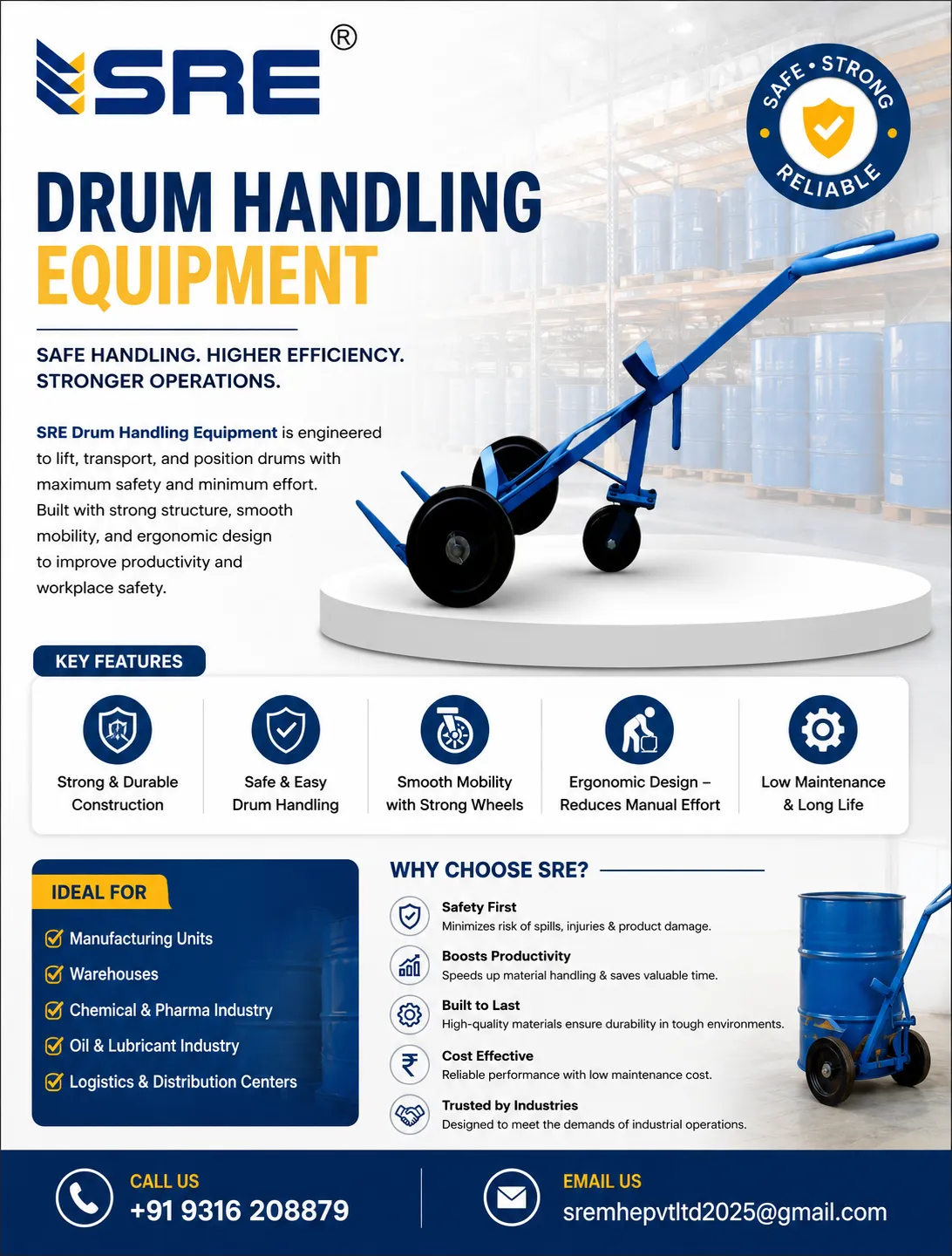
How Does Drum Handling Improve Workplace Safety?
How Warehouses Improve Drum Handling Efficiency starts with using the right equipment to reduce manual lifting, prevent spills, and minimize workplace injuries.
SRE MATERIAL HANDLING EQUIPMENT PRIVATE LIMITED manufactures reliable drum handling solutions designed for safe transportation, lifting, and positioning of industrial drums. These ergonomic systems improve operational efficiency, protect workers, reduce downtime, and help warehouses maintain safer, more productive, and compliant material handling operations.
How Warehouses Improve Drum Handling Efficiency
Drum handling is one of those jobs that looks simple on paper and turns messy on the shop floor. A 200-litre drum full of chemicals, oil, or paint is heavy, awkward, and one bad lift away from a spill, a back injury, or a full shift lost to cleanup. Warehouses across India are now rethinking how drums move from truck to rack to production line, and the improvement almost always comes down to the same three things: the right equipment, a trained team, and a process that doesn’t depend on brute force. This article walks through what actually works on the floor, based on what we’ve seen installing and servicing drum handling equipment in warehouses from Ahmedabad to Chennai.
Why Choose SRE Material Handling Equipment for Drum Handling Efficiency
SRE Material Handling Equipment has been building material handling solutions since 2011, and drum handling is a category we get asked about constantly — usually after a warehouse has already had one too many near-misses with manual drum rolling. Founded by Mr. Gaurang Patel, the company has delivered 15,000+ equipment solutions across India with a 95% client satisfaction rate, and that track record has been built largely on solving exactly this kind of “small but dangerous” handling problem.
The honest answer to “how do warehouses improve drum handling efficiency” starts with removing manual lifting altogether. Drum trolleys, hydraulic drum lifters, and drum rotators cut the physical strain out of the job, but the equipment only helps if it’s matched to the actual drum size, weight, and floor layout in your facility. That’s where a lot of warehouses go wrong — they buy generic equipment instead of getting a proper site assessment first. Our team looks at load frequency, aisle width, and racking height before recommending anything, which is part of why we’re often approached as material handling equipment manufacturers for facilities that tried the cheaper route once and didn’t want to repeat it.
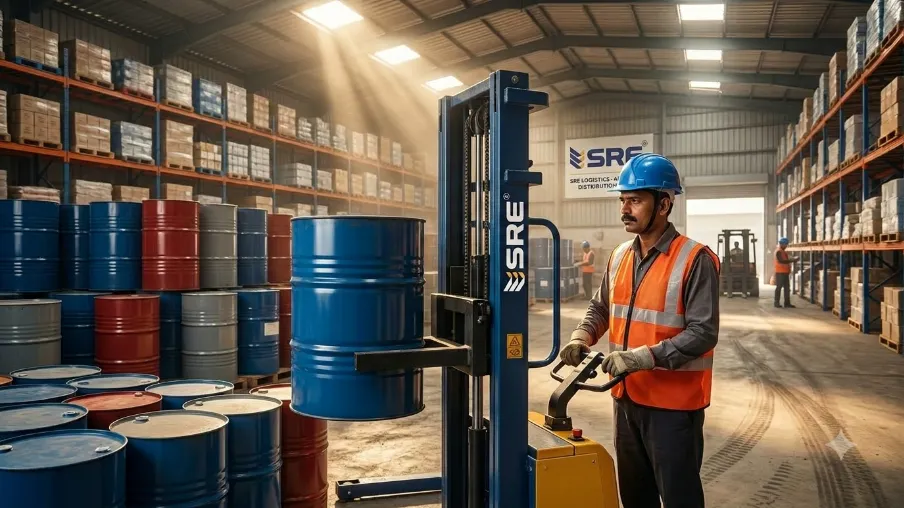
Warehouse Stacker Supplier India equipment often works alongside drum handling attachments in the same facility, since most Indian warehouses aren’t moving drums in isolation — they’re stacking pallets, staging goods, and handling drums all in the same aisle. A Surat-based chemical distributor we worked with last year had exactly this setup: drums stacked two-high with no dedicated lifting gear, and their team was manually rolling drums onto pallet jacks. Within six weeks of introducing a hydraulic drum lifter and a compact electric stacker, their internal transfer time dropped noticeably and, more importantly, the near-miss reports stopped almost entirely.
Contact UsOur Drum Handling Equipment Manufacturing Capabilities
How SRE Material Handling Equipment approaches drum handling from a manufacturing standpoint. We don’t just build a lifter and call it done — the drum clamp geometry, the hydraulic seal quality, and the base stability all get engineered around Indian factory floor conditions, which are rarely as flat or as climate-controlled as export-spec equipment assumes.
Our core drum and material handling range includes electric stacker manufacturers-grade lifting platforms, hydraulic stacker units for heavier loads, drum rotators for viscosity-sensitive liquids, and goods lift integration for multi-floor warehouses. A Hydraulic Equipment Manufacturer approach means every hydraulic drum lifter we ship goes through pressure testing before it leaves the floor — not an optional step, a mandatory one, because a hydraulic failure mid-lift with a full drum is not something any warehouse manager wants to explain to their safety officer.
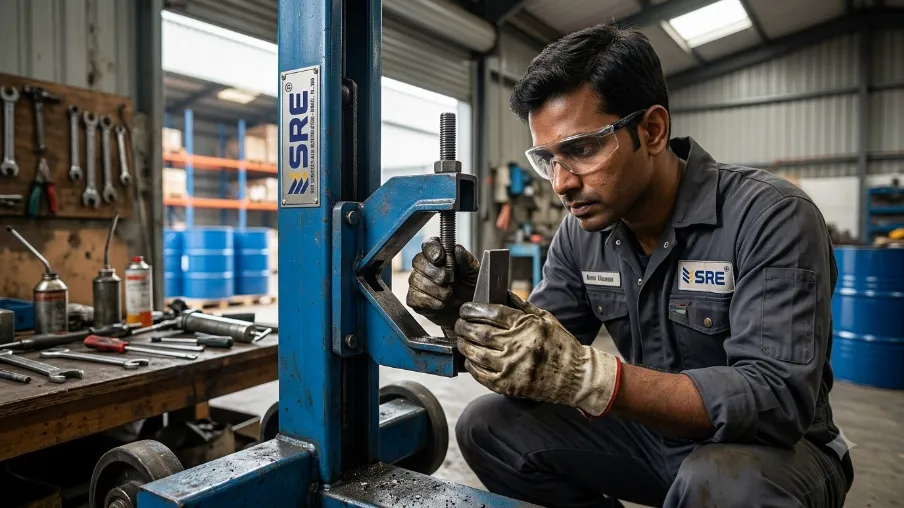
For facilities running high-throughput operations — think Mumbai’s port-adjacent warehouses or Pune’s auto-component clusters — we also supply mobile floor cranes and scissor lifts that support drum staging at height. Industrial Stackers Manufacturers India category buyers usually come to us once they’ve outgrown manual pallet trucks, and drum handling attachments are frequently the next logical addition once the base stacker fleet is in place.
Custom fabrication is a big part of this too. Drum sizes and neck fittings vary a fair bit between industries — pharma drums aren’t shaped like paint drums, and paint drums aren’t shaped like the steel drums used in Chandigarh’s engineering units. Our OEM Material Handling Equipment Manufacturer work covers custom drum clamp attachments built to a client’s exact drum specification rather than forcing a standard clamp to fit an odd-shaped container.
Navigating Quality Standards & ISO 9001:2015 Certification
Quality isn’t a marketing line in drum handling — it’s the difference between a controlled lift and a spilled load of hazardous liquid on a warehouse floor. SRE Material Handling Equipment is ISO 9001:2015 certified, and that certification governs how we document design specifications, test load capacities, and track component traceability across every unit that leaves our facility.
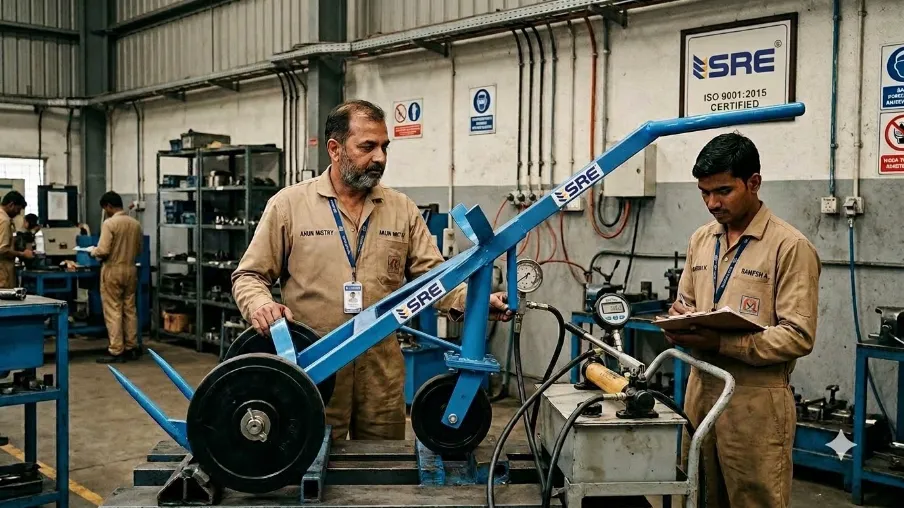
ISO 9001:2015 is an internationally recognised quality management standard, and for material handling equipment specifically, it means the manufacturing process is repeatable and auditable — not something built differently every time depending on who’s on the shop floor that day. For a Bangalore-based pharmaceutical warehouse handling temperature-sensitive drums, that consistency matters as much as the equipment specs themselves, because a batch of inconsistent drum lifters is a compliance headache nobody wants during an audit.
Local Manufacturers vs SRE Material Handling Equipment
Warehouse managers evaluating drum handling equipment usually compare a handful of local fabricators against a certified manufacturer before deciding. Here’s how that comparison typically plays out, based on what our clients tell us after they’ve done the shopping around.
| Parameter | Typical Local Fabricator | SRE Material Handling Equipment |
|---|---|---|
| Quality Certification | Rarely certified | ISO 9001:2015 Certified |
| Custom Drum Attachment Design | Limited or standard-fit only | Custom-engineered to drum specification |
| Hydraulic Load Testing | Inconsistent | Mandatory pre-dispatch testing |
| After-Sales Support | Limited service network | Pan-India service and spares |
| Track Record | Varies by workshop | 15,000+ equipment units delivered since 2011 |
| Safety Documentation | Often missing | Load charts, manuals, maintenance schedules included |
This isn’t to say every local fabricator does poor work — some do solid welding and honest business. But drum handling involves hazardous or heavy liquids often enough that the documentation and testing gap matters more here than in, say, general pallet handling.
Step-by-Step Process – How We Deliver Drum Handling Solutions
The best drum handling improvements come from a process, not a single purchase. Here’s roughly how a project moves from enquiry to installed equipment.
First, we do a site visit or a detailed remote assessment — drum type, weight, floor condition, aisle width, and how many lifts happen per shift. A Hyderabad electronics manufacturer we assessed last year was moving drums only four or five times a day, so a full electric drum handling system wasn’t worth the investment; a manual hydraulic lifter did the job at a fraction of the cost. That’s the kind of judgment call that only comes from actually looking at the operation instead of pushing the most expensive unit available.
Second, we recommend equipment based on that assessment — this might include a Pallet Truck for combined drum-and-pallet movement, a dedicated drum rotator, or a mobile floor crane for staging.
Third comes fabrication and testing at our Ahmedabad facility, followed by delivery and on-site commissioning. We don’t just drop equipment at the gate — our technicians walk the operator team through safe lifting angles, weight limits, and daily inspection checks, because most drum handling accidents happen from operator shortcuts, not equipment failure.
Fourth, we schedule follow-up maintenance visits, because hydraulic seals and clamp mechanisms wear over time, especially in humid coastal facilities like those in Chennai or Kolkata where corrosion sets in faster than inland warehouses.
For warehouses also managing loading-bay traffic, a Dock Leveler fitted at the receiving bay reduces the number of manual transfers drums go through before they even reach storage, which on its own cuts handling incidents down measurably.
Real Client Case Study
A mid-sized industrial chemicals distributor operating out of Vadodara — we’ll call them Client V for confidentiality — came to us in early 2025 with a specific problem: their team was manually rolling 180-litre drums off delivery trucks and across an uneven yard to the storage shed, roughly 40 to 50 drums a day. They’d had two minor injuries in the previous year and were losing an estimated two hours daily to slow, careful manual handling.
We assessed their yard, dock height, and drum specifications, then supplied a combination of hydraulic drum lifters and a compact electric stacker fitted with a drum clamp attachment. Installation and operator training took four days. Within the first month, Client V reported their daily drum transfer time had dropped by close to 60%, and there were zero manual-handling injuries in the following six months. Their warehouse supervisor specifically noted that the operators felt more confident on the equipment than they’d expected, which cut down on the informal “let’s just do it by hand, it’s faster” workaround that often undermines new equipment rollouts.
That last point is worth repeating for any Delhi, Jaipur, or Indore warehouse considering a similar upgrade: the equipment only works if operators actually trust it enough to use it every time, which is why training is never an optional add-on in our delivery process.
For warehouses researching material handling equipment manufacturers near me, it’s worth checking certification and testing documentation before certification claims are taken at face value — not every supplier documents load testing the way ISO 9001:2015 requires.
Frequently Asked Questions (FAQs)
1. Warehouse me heavy drum ko bina manually roll kiye safely kaise lift karein?
Heavy drum ko safely lift karne ke liye hydraulic drum lifter ya drum clamp stacker best option hai. Isse manual rolling, tilting aur heavy lifting ki zarurat nahi padti, jisse worker safety badhti hai aur accident ka risk kam hota hai.
2. India me Drum Handling Equipment ki price kitni hoti hai?
Drum Handling Equipment ki price uski capacity, model aur manual ya electric operation par depend karti hai. Exact cost ke liye site requirement aur application ko samajhna zaroori hota hai. Isliye final budget se pehle expert consultation lena sabse accha rahta hai.
3. Kya Drum Handling Equipment ko custom drum size ke liye banaya ja sakta hai?
Haan, bilkul. Agar aapke drum ka size ya design standard nahi hai, to uske hisaab se custom clamp aur cradle attachment design kiye ja sakte hain. Isse drum securely grip hota hai aur handling aur bhi safe ho jaati hai.
4. Kya Material Handling Equipment ke liye ISO 9001:2015 certification zaroori hai?
Ye legally mandatory nahi hai, lekin ISO 9001:2015 certification batata hai ki manufacturer quality standards aur proper testing process follow karta hai. Heavy aur hazardous load handle karne wale equipment ke liye certified manufacturer choose karna better rehta hai.
5. Hydraulic Drum Lifter ki servicing kitni baar karani chahiye?
Generally 3 se 6 mahine ke interval me servicing recommend ki jaati hai. Agar equipment humid ya coastal area me use ho raha hai, to hydraulic seals aur components ki condition maintain rakhne ke liye aur bhi frequent inspection karna chahiye.
6. Kya warehouse me drums aur pallets ke liye alag-alag equipment ki zarurat hoti hai?
Har baar nahi. Kai stackers aur pallet trucks interchangeable attachments ke saath aate hain, jisse ek hi machine se drums aur standard pallets dono ko efficiently handle kiya ja sakta hai.
For a Free Equipment Consultation on your dock safety setup, or to Download the Material Handling Cost Guide, reach SRE Material Handling Equipment at +91 9316 208879 or sremhepvtltd2025@gmail.com. WhatsApp queries are also welcome for quick response — mention your dock height and trailer type for a faster assessment.
Contact Us