What Are the Benefits of Using a Hydraulic Stacker Instead of a Forklift?
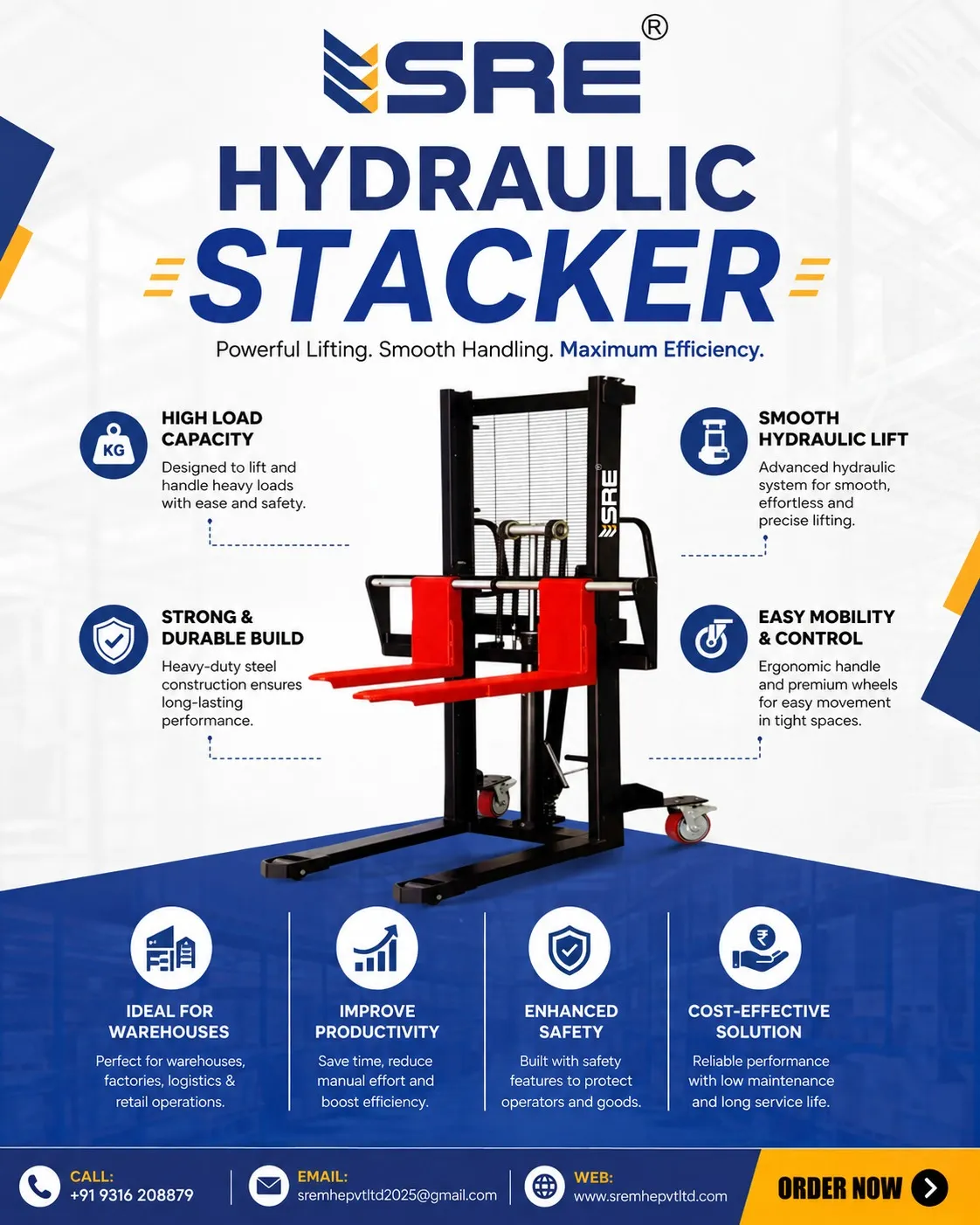
A Hydraulic Stacker Vs Forklift comparison shows that hydraulic stackers offer a practical solution for warehouses requiring efficient pallet lifting, stacking, and movement. They are generally more compact, cost-effective, and easier to operate in limited spaces.
SRE MATERIAL HANDLING EQUIPMENT PRIVATE LIMITED provides reliable hydraulic stackers designed to reduce manual handling, improve workplace safety, and increase productivity.
For businesses seeking a space-saving material handling solution, a hydraulic stacker can be an efficient alternative to forklifts for suitable lifting and stacking applications.
Hydraulic Stacker Vs Forklift: Which One Actually Fits Your Warehouse Floor?
Choosing between a “hydraulic stacker vs forklift ” is a decision that shapes daily throughput, safety records, and five-year running costs — not just the upfront purchase price. Warehouse managers across India often make this call under time pressure, comparing quotes without weighing aisle width, floor load limits, or long-term maintenance. This article breaks down the real operating differences, cost comparisons, and use-case fit, so the decision is based on facts rather than sales pitches. SRE Material Handling Equipment, an ISO 9001:2015 certified manufacturer based in Ahmedabad, has supplied stackers and lifting equipment to warehouses across India since 2011, and this guide draws on that field experience.
Key Takeaways
- A hydraulic or electric stacker is best suited for narrow-aisle, indoor pallet lifting up to moderate heights, while a forklift handles heavier loads and outdoor or mixed-terrain movement.
- Stackers generally cost less to buy and run, with lower five-year maintenance costs than diesel forklifts.
- Aisle width and floor type are often the deciding factors — not just budget.
- Electric stackers reduce emissions and noise, making them suitable for enclosed warehouse floors.
- Matching equipment to the actual workflow (not the cheapest option) reduces downtime and long-term cost per pallet moved.
What Is an Electric/Hydraulic Stacker and Why Indian Warehouses Need One
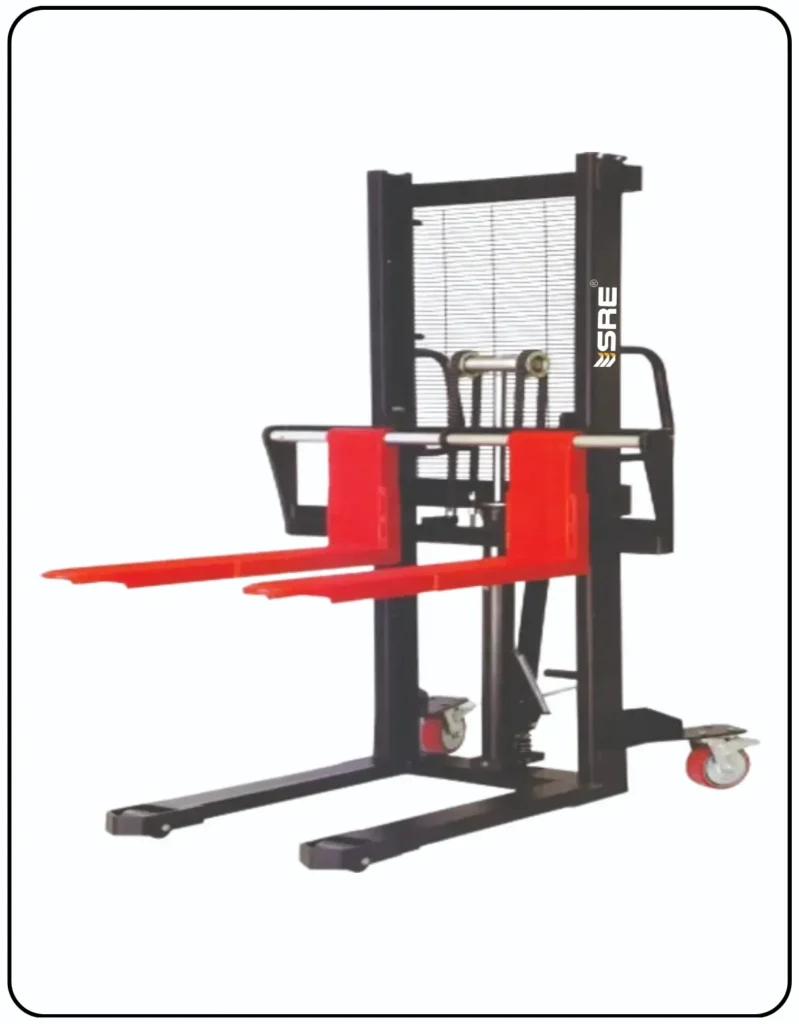
A stacker is a compact lifting machine used to raise, lower, and move palletized loads within tight warehouse spaces. Unlike a forklift, it is built around a mast-and-fork mechanism rather than a full drive-and-lift chassis, which keeps its footprint small.
- Semi-electric stackers use manual push movement with electric/hydraulic lift — suited for lower-volume operations.
- Fully electric stackers power both movement and lifting, ideal for multi-shift warehouses.
- Hydraulic hand stackers rely on manual hydraulic pumping for lift, used in smaller storage areas or workshops.
Indian warehouses — particularly in dense industrial belts around Ahmedabad, Surat, and Pune — often operate in aisles narrower than what a standard forklift can manoeuvre. This is precisely the gap a stacker is designed to fill, especially where racking height exceeds what manual handling can safely reach.
Types of Electric & Hydraulic Stackers We Manufacture
SRE Material Handling Equipment produces stackers across multiple configurations to match different warehouse layouts and load requirements:
- Semi-electric stackers — capacity range typically 1,000–1,500 kg, lift height up to 3 metres
- Fully electric stackers — capacity range 1,000–2,000 kg, lift height up to 4.5–5 metres, battery-operated drive
- Hydraulic hand stackers — capacity range 500–1,000 kg, manual pump lift, no electrical dependency
- Heavy-duty electric stackers — built for cold storage, food processing, and multi-shift industrial use
Each configuration is manufactured to ISO 9001:2015 quality parameters, with fork width, mast height, and battery specification customised to the buyer’s racking system.
Key Factors to Consider Before Choosing a Stacker
Before comparing prices, warehouse operators should assess a few operational realities first:
- Aisle width — narrow aisles (under 2 metres) generally rule out forklifts entirely
- Lift height requirement — stackers typically top out around 5–6 metres; taller racking may need a reach truck or forklift
- Floor surface — uneven or outdoor terrain favours forklifts with pneumatic tyres
- Load frequency — high-frequency, repetitive indoor lifting favours electric stackers
- Budget for upkeep, not just purchase price — diesel forklifts carry higher recurring fuel and servicing costs
| Comparison Point | Hydraulic Stacker | Forklift |
|---|---|---|
| Core operating difference | Mast-based vertical lift with manual push or electric drive; no engine chassis | Self-propelled truck with engine or battery drive, front-mounted forks, full chassis |
| Typical price range in India | Approx. ₹45,000 – ₹2,50,000 depending on capacity and drive type | Approx. ₹4,00,000 – ₹15,00,000+ depending on tonnage and fuel type |
| Operational efficiency (aisle width, indoor use, speed) | Works in aisles as narrow as 1.8–2.2 metres; ideal for indoor, low-to-moderate speed pallet movement | Needs aisle widths of 3–3.5 metres or more; faster over longer, open distances |
| Maintenance cost — electric stacker vs diesel forklift (5-year view) | Lower — fewer moving parts, no engine servicing, battery replacement is the main recurring cost | Higher — engine servicing, fuel costs, hydraulic system upkeep, and tyre replacement add up over time |
| Best-fit use case | Narrow-aisle warehouses, retail back-stock, light-to-medium industrial storage | Outdoor yards, heavy pallet loads, construction material yards, container loading |
Contact Us
How the Right Stacker Improves Daily Warehouse Operations
Equipment mismatch is one of the most common causes of avoidable downtime on Indian warehouse floors. A few patterns show up repeatedly:
- In Mumbai and Delhi distribution hubs, narrow-aisle layouts mean forklifts often can’t reach the last row of racking without repositioning stock — a stacker resolves this directly.
- In Bangalore and Hyderabad electronics and component warehouses, load frequency is high but weights are moderate, which is exactly where electric stackers outperform forklifts on cost per lift.
- In Chennai and Surat textile and export units, multi-shift operations benefit from battery-swap electric stackers that keep running without fuel refilling delays.
- In Ahmedabad, Jaipur, Pune, and Vadodara industrial estates, mixed-use facilities often deploy both — stackers for indoor racking, forklifts for yard and loading-bay work.
This is why buyers exploring material handling equipment manufacturers should size equipment around actual floor conditions, not a generic checklist. You can review layout-specific recommendations on our warehouse safety and layout blog or browse our full stacker range.
Pricing & Cost Factors for Stackers in India
Purchase price is only one part of the equation. The real cost comparison plays out over years of use:
- Upfront cost — hydraulic and semi-electric stackers are significantly cheaper to purchase than forklifts of comparable lift capacity.
- Energy cost — electric stacker manufacturers design units around battery consumption, which typically costs less per shift than diesel.
- Servicing frequency — stackers have simpler hydraulics and fewer wear parts than forklift engines and transmissions.
- Downtime cost — a forklift breakdown in a tight aisle can halt an entire pick line; stacker downtime is usually easier to route around.
- Resale and depreciation — well-maintained electric stackers hold value reasonably well due to lower usage-hour wear.
Buyers comparing an electric stacker price India quote against a forklift quote should request a landed five-year cost estimate, not just the sticker price, from any hydraulic stacker manufacturers in Ahmedabad they approach. Our pricing and specification page breaks this down by capacity tier.
ISO 9001:2015 & Quality Standards
Every stacker manufactured by SRE Material Handling Equipment is built under an ISO 9001:2015-certified quality management system, covering raw material selection, weld integrity, hydraulic seal testing, and load-capacity verification before dispatch. This certification framework is maintained in line with the ISO 9000 family of quality management standards, and equipment specifications are documented in line with national safety expectations set out by the Bureau of Indian Standards. Quality checks include:
- Load testing at rated and overload capacity
- Hydraulic pressure and leak testing
- Mast weld and structural inspection
- Battery and motor performance verification (electric models)
Why Choose SRE Material Handling Equipment
Founded in 2011 by Mr. Gaurang Patel, SRE Material Handling Equipment Private Limited (formerly Shree Ram Enterprise) has grown from a regional Ahmedabad manufacturer into a supplier trusted by warehouses across India. The company has delivered over 15,000 units, maintains a 95% client satisfaction record, and has received 13 industry awards for manufacturing quality and service reliability.
- Manufacturing capability — in-house fabrication, hydraulic assembly, and quality testing at the Vastral, Ahmedabad facility
- Custom builds — fork width, mast height, and battery type adjusted to each buyer’s racking system
- After-sales network — service support extended to clients in Mumbai, Delhi, Bangalore, Hyderabad, Chennai, Surat, Jaipur, Pune, and Vadodara
| Comparison Point | Typical Local Manufacturer | SRE Material Handling Equipment |
|---|---|---|
| Certification | Often unverified or self-declared | ISO 9001:2015 certified manufacturing process |
| Track record | Varies, limited delivery history | 15,000+ units delivered since 2011 |
| Customisation | Limited to standard catalogue models | Fork, mast, and battery specs built to order |
| After-sales service | Regional coverage only | Multi-city service support across India |
For direct specifications, visit our product catalogue or reach our team to discuss your floor plan.\
Real Client Case Study
A mid-sized packaging distributor operating out of a warehouse near Vadodara was running two diesel forklifts for internal pallet movement across a facility with aisles averaging 2.1 metres wide. Frequent rack-face collisions and high fuel spend prompted a review. After switching internal movement to two fully electric stackers from SRE Material Handling Equipment — while retaining one forklift for yard loading — the client reported fewer rack-face incidents and a noticeably lower monthly running cost within the first two quarters. The forklift was redeployed exclusively to outdoor container loading, where its higher speed and load capacity remained the better fit. Read more operational examples on our case studies and downtime reduction blog.
Conclusion
The hydraulic stacker vs forklift decision ultimately comes down to floor conditions: aisle width, load frequency, indoor versus outdoor use, and the real five-year cost of ownership rather than just the purchase price. Stackers suit narrow-aisle, indoor, moderate-load environments, while forklifts remain the better fit for heavy, outdoor, or high-speed material movement. Many Indian warehouses — including operations across Mumbai, Bangalore, Chennai, and Ahmedabad — end up running both, matched to specific zones within the same facility. SRE Material Handling Equipment, ISO 9001:2015 certified and operating since 2011, can help assess your floor layout and recommend the right mix of equipment.
FAQs
1. What are the main differences between hydraulic stackers and forklifts?
- The main difference is structural: a “hydraulic stacker” uses a mast-and-fork lift mechanism with manual or electric drive, while a forklift is a self-propelled truck with an engine or battery chassis. Stackers suit narrow aisles and indoor lifting; forklifts handle heavier loads and outdoor terrain.
2. Where can I buy affordable hydraulic stackers in India?
- SRE Material Handling Equipment, based in Ahmedabad, manufactures hydraulic stacker manufacturers in India -grade equipment directly, cutting distributor markup. Buyers across Mumbai/Delhi/Pune and other cities can request quotes and specifications directly through the company’s contact page.
3. Can you compare the price ranges of hydraulic stackers versus forklifts?
- Yes, hydraulic and “semi-electric stackers” in India typically range from ₹45,000 to ₹2,50,000 depending on capacity, while forklifts range from roughly ₹4,00,000 to over ₹15,00,000 depending on tonnage and fuel type. Stackers cost significantly less upfront for equivalent indoor lifting needs.
4. What are the key differences in operational efficiency between a hydraulic stacker and a forklift?
- Stackers work in aisles as narrow as 1.8–2.2 metres and suit slower, indoor pallet handling, while forklifts need wider aisles (3–3.5 metres) but move faster over longer, open distances. Efficiency depends on matching the equipment to actual floor layout.
5. What are the maintenance costs associated with electric stackers versus diesel forklifts over five years?
- “Electric stackers” generally cost less to maintain over five years due to fewer moving parts and no engine servicing — battery replacement is the main recurring expense. Diesel forklifts carry higher costs from fuel, engine servicing, and tyre wear.
6. Which companies offer the best hydraulic stackers and forklifts in India?
- Multiple manufacturers operate across India, and buyers should compare ISO certification, delivery track record, and after-sales coverage. SRE Material Handling Equipment, ISO 9001:2015 certified with 15,000+ units delivered since 2011, is one such manufacturer serving clients nationwide.
For a Free Equipment Consultation on your dock safety setup, or to Download the Material Handling Cost Guide, reach SRE Material Handling Equipment at +91 9316 208879 or sremhepvtltd2025@gmail.com. WhatsApp queries are also welcome for quick response — mention your dock height and trailer type for a faster assessment.
Contact Us