
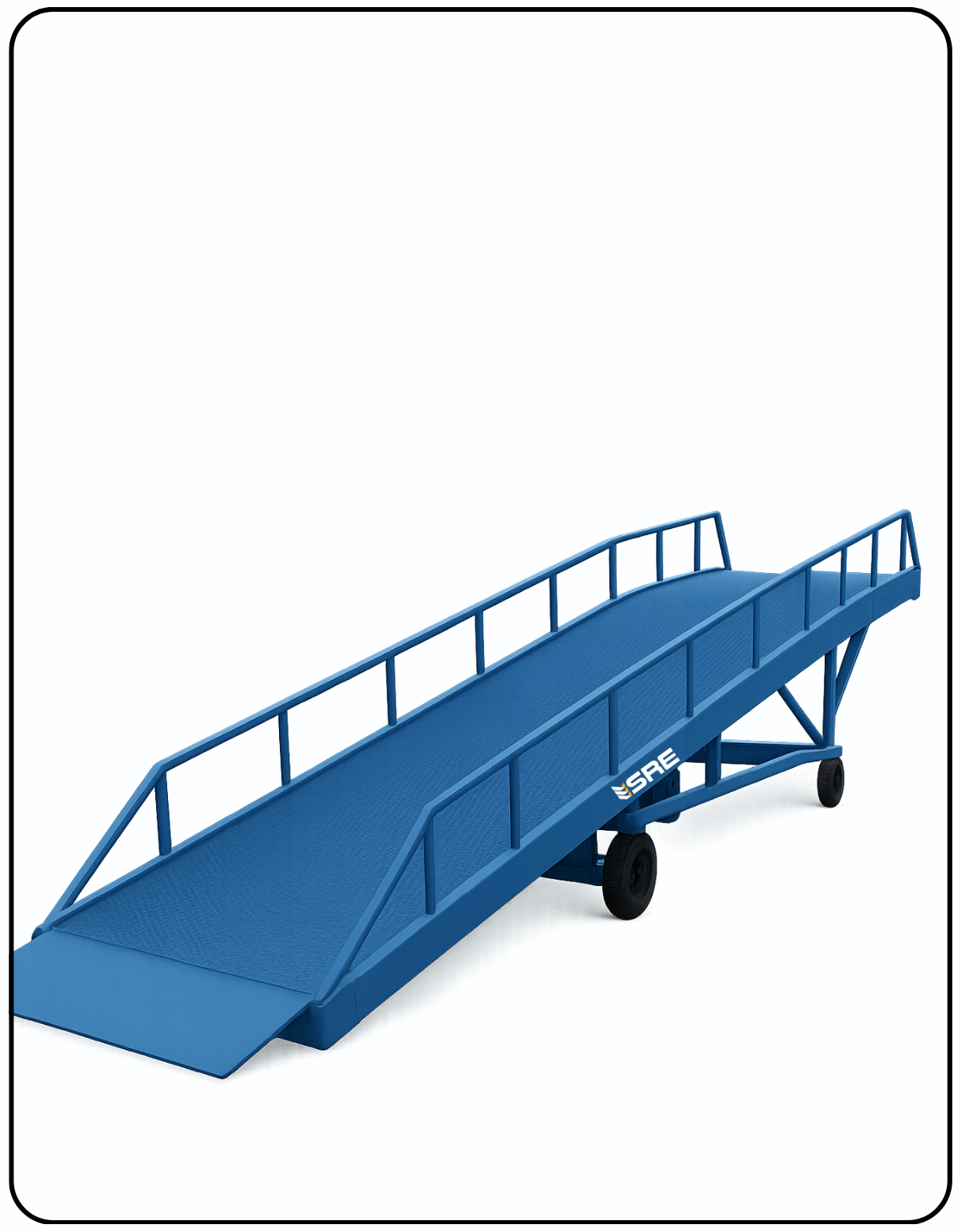
10 Ton x 1.6 Meter H (All Size Available)
Rs. 425000
(Taxes to be paid extra)
SKU: SRE162
Brand: SRE
Min Order Qty: 1
Every warehouse and factory floor in Vadodara, Ahmedabad, and across Gujarat faces the same costly bottleneck: height mismatches between truck beds and loading bay floors. When a high-bed truck pulls up and there is no proper bridging solution, forklifts stall, workers improvise with wooden planks, and productivity collapses — sometimes along with the merchandise. The Mobile Ramp, also called a portable loading ramp or yard ramp, eliminates this daily operational risk with a single, deployable piece of heavy-duty equipment. With a rated capacity of 10 tonnes and a platform height of 1.6 metres (custom sizes available), it is the fastest fix for dock-to-vehicle level transitions — no civil work, no permits, no downtime waiting for construction.
How Mobile Ramp Is Used in Warehouse and Factory Loading Operations Across Vadodara and Ahmedabad
Core Applications of Mobile Ramp in Industrial Facilities
Loading dock operations in Pune, Bangalore, and Vadodara deal with a wide variety of vehicle heights — from low-floor transit trucks at 900 mm to high-bed trailers at 1,400 mm. When your fixed dock infrastructure cannot accommodate that variance, every truck becomes a time-loss event. The mobile dock ramp solves this precisely because it is not fixed. It rides on heavy-duty swivel castors with foot-lock brakes, so it can be repositioned between three different bays within minutes. Plants running two-shift operations in Vatva and Kathwada industrial zones report 40–50% reduction in per-truck turnaround time after deploying a 10-ton portable loading ramp versus improvised ramp setups.
The Mobile Ramp is built for repeated, heavy-duty cycles — not occasional use. The working surface uses MS (mild steel) chequered plate for anti-slip traction under forklift tyres, even on wet or oily floors. Structural members are fabricated from MS rectangular hollow section (RHS) tubes, welded to ±1 mm tolerance at SRE’s Ahmedabad manufacturing facility. The ramp angle is engineered to stay within 8–12 degrees under full load — the operational sweet spot for a counterbalance forklift or pallet truck to climb safely without tipping risk. For facilities in Noida, Faridabad, and Gurugram where multi-shift operations are standard, this mechanical reliability translates directly to fewer work stoppages.
SRE Material Handling Equipment Pvt. Ltd., an ISO 9001:2015 certified manufacturer headquartered in Ahmedabad, supplies heavy-duty mobile loading ramps to factory owners, plant managers, and procurement heads across Vadodara, Pune, Bangalore, Hyderabad, Chennai, Indore, Bhopal, Jaipur, Udaipur, Rohtak, Ambala, and all major industrial corridors in Maharashtra, Rajasthan, and Gujarat. Their production capacity supports bulk procurement timelines — critical for logistics companies placing orders for 5–20 units across multiple depots simultaneously.
Key application areas where Mobile Ramp delivers proven operational value:
- Warehousing & E-Commerce Fulfilment Centres — Rapid truck loading/unloading across varying vehicle heights at multi-dock facilities in Ahmedabad, Pune, and Noida
- Automotive Component Plants — Moving engine blocks, chassis parts, and sub-assemblies via forklift from ground-level staging into high-bed trailers in Vadodara and Bangalore
- FMCG & Consumer Goods Distribution — High-frequency, low-damage loading of palletised goods at Indore, Bhopal, and Gurugram regional distribution centres
- Pharma & Healthcare Logistics — Temperature-sensitive cargo handling where speed and stability are both non-negotiable; widely deployed in Ahmedabad‘s pharmaceutical corridor and Hyderabad‘s life sciences parks
- Steel & Heavy Manufacturing — Loading of structural steel, plates, and coils onto flatbed trailers in Kutch, Bhavnagar, and Gandhidham port-adjacent industrial areas
- Construction Material Yards — On-site ramps for loading aggregates, blocks, and equipment at project sites in Jaipur, Udaipur, and Faridabad
- Cold Chain & Food Processing — Hygienic, rust-resistant surface variants for food-grade facilities in Mangalore, Chennai, and Pune
- Chemical & Agrochemical Plants — Sealed surface options for drum and IBC loading at facilities in Vadodara‘s Nandesari and Gujarat‘s GIDC zones
- Logistics Parks & Multi-User Warehouses — Shared mobile ramp pools deployed across multiple bays in Himmatnagar, Kalol, and Mahesana logistics hubs
- Retail & General Merchandise Distribution — Fast, safe goods transfer at Rohtak, Ambala, and Chattral regional warehouses
📋 Client Case Study — Automotive Ancillary Plant, Vadodara GIDC
A mid-sized automotive component manufacturer in Vadodara‘s GIDC area was losing approximately 90 minutes per shift on loading delays caused by floor-to-trailer height mismatches (difference: 580 mm). After deploying two units of SRE’s 10-ton mobile loading ramp (SKU: SRE162), the plant reduced truck dwell time from 45 minutes to under 18 minutes per vehicle. The ramp’s MS chequered plate surface and hydraulic height adjustment allowed the same unit to service both low-bed domestic trucks and high-bed export trailers. Production dispatch efficiency improved by 34% within the first two months of deployment, with zero dock-related injuries recorded post-installation.
Planning a bulk procurement of Mobile Ramps for your warehouse or factory fleet? Get a customized quote from India’s trusted manufacturer.
Get a Quote for Bulk Orders Call Now: +91 93162 08879Key Features and Technical Specifications of Mobile Ramp for Heavy-Duty Use in Pune, Bangalore, and Gujarat
Engineering Specifications That Matter to Purchase Managers
When a procurement head in Pune or a logistics head in Bangalore evaluates a portable loading ramp, the first question is always: will this hold under full production loads, day after day? The SRE Mobile Ramp is engineered to 10-ton (10,000 kg) rated capacity with a design safety factor of 2:1 — meaning the structural frame is load-tested to 20 tonnes before it leaves the factory. The main frame uses IS 2062 grade MS steel, which offers a minimum yield strength of 250 MPa, ensuring no permanent deformation under sustained forklift traffic. The hot-dip galvanized or epoxy-primer + enamel finish protects against rust in humid coastal environments like Mangalore and Bhavnagar port areas.
Mobility is engineered in, not bolted on as an afterthought. Each unit rides on four 200 mm diameter heavy-duty swivel castors with lockable brakes, allowing two operators to reposition a 10-ton-capacity ramp across a flat concrete floor without mechanical assistance. The ramp lip (approach plate) uses a 10 mm thick MS plate beveled at 15 degrees to prevent wheel hang-up when a forklift transitions from truck floor to ramp surface. Safety chains on both sides of the ramp top prevent accidental over-travel of the forklift. Facilities in Himmatnagar, Kalol, and Mahesana operating multi-shift loading schedules have confirmed that these design details reduce near-miss incidents by eliminating the top three dock injury causes: lip hang-up, uncontrolled ramp movement, and forklift fall-off.
The hydraulic height adjustment system is what separates a professional mobile dock ramp from a basic yard ramp. Using a manual or powered hydraulic pump, the operator adjusts ramp platform height to match any vehicle floor between 800 mm and 1,600 mm above ground — covering 95% of all truck types operating on Indian roads. Once set, a hydraulic lock maintains position without drift, eliminating the risk of the ramp settling under load mid-operation. For pharma and healthcare logistics operations in Ahmedabad and Hyderabad where product integrity is as important as loading speed, this stability is a compliance necessity, not just a convenience.
| Model / SKU | Capacity | Platform Height | Ramp Length | Surface Material | Castors | Price (Excl. Tax) |
|---|---|---|---|---|---|---|
| SRE162 (Standard) | 10 Ton | 1.6 Metre | ~5.5 Metre | MS Chequered Plate | 200 mm Heavy-Duty Swivel | Rs. 4,25,000 |
| SRE-MR-08T | 8 Ton | 1.4 Metre | ~4.8 Metre | MS Chequered Plate | 180 mm Swivel + Lock | On Request |
| SRE-MR-06T | 6 Ton | 1.2 Metre | ~4.0 Metre | MS Chequered Plate | 150 mm Swivel + Lock | On Request |
| SRE-MR-SS | 5 Ton | 1.0 Metre | ~3.5 Metre | SS 304 (Food/Pharma Grade) | 150 mm SS Swivel | On Request |
| Custom Size | Up to 15 Ton | As Required | Custom | MS / SS 304 | As per Design | On Request |
* All sizes and custom specifications are available. Contact SRE Material Handling Equipment Pvt. Ltd. for project-specific quotations.
Why Vadodara, Gujarat, and Maharashtra Industrial Buyers Choose SRE Mobile Ramp Over Imported or Unbranded Alternatives
Industrial buyers in Vadodara and across Gujarat know the real cost of buying on price alone. An unbranded or under-specified loading dock ramp may fail its rated capacity within 18–24 months under daily forklift cycles, leading to repair costs that exceed the original purchase price and, more critically, creating liability exposure when a dock accident occurs. SRE Material Handling Equipment Pvt. Ltd. addresses this risk directly: every mobile ramp leaves the factory with a load test certificate, production inspection record, and material traceability documentation — aligning with ISO 9001:2015 quality management requirements that procurement departments in Pune, Bangalore, and Noida increasingly demand from vendors.
Import lead times of 8–14 weeks and spare-parts unavailability make imported ramps a poor fit for operations across Rajasthan, Jaipur, and Bhopal where plant managers cannot afford equipment sitting idle waiting for a replacement hydraulic seal. SRE’s Ahmedabad-based manufacturing and service team ensures spare parts are stocked and field service is available within 48–72 hours across major cities including Vadodara, Surat, Indore, Faridabad, Rohtak, Ambala, and Gurugram. The MSME and Make in India registration also means that government-linked procurement and PSU buyers can list SRE equipment under domestic procurement preference policies without any compliance complexity.
Comparing Mobile Ramp with Related Loading Equipment — What Procurement Managers in Hyderabad, Chennai, and Noida Need to Know
A common question from plant managers in Hyderabad and Chennai evaluating dock equipment is: should we install a dock leveler or buy a mobile ramp? The answer depends on operational flexibility. A dock leveler is permanently installed in one bay, offering faster per-truck cycle times at that bay but zero flexibility. A mobile dock ramp serves multiple bays, multiple vehicle types, and can be redeployed to a new facility if your logistics network changes. For operations in Ghandhidham, Bhavnagar, and Kutch port areas where truck types and cargo volumes fluctuate seasonally, the mobile ramp offers a lower total cost of ownership over a 5-year horizon.
Similarly, a scissor lift table handles vertical elevation within a facility — moving goods between floor levels or from ground to mezzanine — while a portable loading ramp handles the horizontal-to-vertical transition between a truck and a building floor. Both may be needed in the same facility, but they solve different problems. For facilities in Vatva, Kathwada, and Chattral GIDC zones operating integrated inbound-outbound docks, pairing a mobile ramp at the dock face with a hydraulic stacker or electric stacker inside the warehouse delivers the most efficient end-to-end material flow.
For operations that require workers to work at height — on top of truck beds, in racking systems, or during maintenance — a mobile scissor lift is the right companion. And for internal pallet movement between loading zones and storage racks, the pallet truck remains the most cost-efficient choice. SRE Material Handling Equipment Pvt. Ltd., with its full product range spanning ramps, stackers, lifts, and handling accessories, allows Gujarat, Maharashtra, and Rajasthan industrial buyers to source their entire dock and warehouse equipment portfolio from a single ISO 9001:2015 certified vendor — simplifying procurement, warranty management, and after-sales coordination.
Ready to eliminate dock bottlenecks? Get expert guidance on the right Mobile Ramp model for your facility and volume.
Request a Free Consultation Enquire for Bulk PricingMaintenance, Safety Standards, and Long-Term Ownership Costs for Mobile Ramp in Jaipur, Indore, and Faridabad Plants
Long-term maintenance cost is the number a purchase manager in Jaipur or Indore should be calculating, not just the invoice price. SRE’s mobile dock ramp is engineered with maintenance simplicity as a design goal. The hydraulic system uses food-grade compatible hydraulic oil (ISO VG 46), and the cylinder seals are rated for a minimum of 5,000 full load cycles before scheduled replacement — translating to 3–5 years of daily use before the first major service intervention under normal operating conditions. Greasing nipples on all pivot points are accessible without disassembly, reducing a full preventive maintenance cycle to under 45 minutes by an in-house technician.
Safety compliance is not optional for industrial buyers in Faridabad, Gurugram, Rohtak, and Ambala operating under factory act inspections. SRE’s mobile loading ramp is designed in alignment with ISO 45001 occupational health and safety principles — incorporating anti-slip surfaces, load-rated safety chains, hydraulic pressure relief valves to prevent overload, and wheel stops on the ramp deck. The anti-slip chequered plate surface maintains traction coefficient above 0.6 even under wet conditions — a critical specification for monsoon-season operations in Mangalore, Pune, and Chennai. Every unit ships with a user safety manual and operator training checklist as standard.
Surface protection is a long-term investment decision. The standard epoxy primer plus polyurethane top coat applied at SRE’s factory is tested to 1,000 hours salt spray resistance per ISO 9227 corrosion testing standards — giving buyers in coastal Gujarat (Bhavnagar, Kutch, Ghandhidham) and Mangalore confidence that surface rust will not degrade structural integrity within the operational lifespan. For food and pharma applications in Ahmedabad and Hyderabad, a full SS 304 stainless steel surface variant is available at custom quotation — meeting FSSAI food safety equipment guidelines for surface material compatibility.
Frequently Asked Questions — Mobile Ramp in Vadodara & Across India
Q1. What is the load capacity and platform height range of the Mobile Ramp available from SRE for heavy-duty warehouse use in Vadodara and Ahmedabad?
The standard mobile dock ramp from SRE Material Handling Equipment Pvt. Ltd. is rated at 10 tonnes (10,000 kg) with a platform height of 1.6 metres (SKU: SRE162, priced at Rs. 4,25,000 ex-tax). Custom sizes are available up to 15 tonnes capacity and heights matching specific vehicle types. The hydraulic height adjustment covers truck floors from 800 mm to 1,600 mm — suitable for the full range of vehicles operating at Vadodara, Ahmedabad, and Pune loading docks.
Q2. What is the difference between a Mobile Ramp and a Dock Leveler, and which is better for a multi-bay logistics facility in Pune or Bangalore?
A dock leveler is permanently fixed to one loading bay, offering fast single-point operation. A portable mobile ramp is relocatable — one unit can serve three to four bays in rotation, handles multiple vehicle heights via hydraulic adjustment, and can be redeployed to a new site entirely. For multi-bay logistics facilities in Pune, Bangalore, and Hyderabad where truck types and volumes vary daily, the mobile loading ramp delivers lower total cost of ownership and greater operational flexibility over a 5-year lifecycle.
Q3. What certifications and quality standards does the SRE Mobile Ramp comply with for procurement by pharma and automotive OEM buyers in Gujarat and Maharashtra?
SRE Material Handling Equipment Pvt. Ltd. is certified under ISO 9001:2015 quality management standards and registered under MSME and Make in India programs. Every heavy-duty mobile ramp is fabricated using IS 2062 grade MS steel, load-tested at 125% rated capacity, and ships with a load test certificate and material traceability report. For pharma and food-grade applications in Ahmedabad and Hyderabad, an SS 304 stainless steel surface variant is available on custom order, meeting FSSAI equipment compatibility requirements.
Q4. What is the typical maintenance schedule and expected service life of an SRE industrial mobile loading ramp for factory operations in Noida, Faridabad, or Gurugram?
The SRE mobile dock ramp is engineered for 5,000 full hydraulic cycles before first major service — typically 3–5 years of daily warehouse use. Routine preventive maintenance requires greasing all pivot points and checking hydraulic oil level (ISO VG 46), completable in under 45 minutes by an in-house technician. The epoxy + polyurethane surface coating provides 1,000 hours of salt spray resistance. Spare parts and field service are available within 48–72 hours across Noida, Faridabad, Gurugram, Indore, Rohtak, and Ambala.
Q5. Vadodara aur Ahmedabad ke liye Mobile Ramp ki delivery time kitni hai aur kya bulk order pe discount milta hai?
SRE Material Handling Equipment Pvt. Ltd. Vadodara aur Ahmedabad ke liye standard 10-ton mobile dock ramp (SKU: SRE162) ki delivery 7 se 14 working days mein kar deta hai. Bulk orders (5 ya usse zyada units) ke liye special pricing aur priority dispatch available hai. Gujarat ke GIDC zones jaise Vatva, Kathwada, aur Kalol mein same-state delivery aur faster installation support bhi milta hai. Quote ke liye direct contact karo.
Q6. Pune ya Bangalore warehouse ke liye kaunsa Mobile Ramp model best rahega — standard 10 ton ya custom size?
Pune aur Bangalore ke warehouses mein jahan high-bed trailers aur domestic trucks dono aate hain, wahan hydraulic height adjustment wala 10-ton mobile loading ramp (SRE162, Rs. 4,25,000) sabse suitable hai kyunki yeh 800 mm se 1,600 mm tak ki vehicle height handle karta hai. Agar forklift heavy (5-ton+) hai ya ramp pe continuous traffic hai, toh custom 12-ton ya 15-ton model recommend kiya jayega. Free technical consultation ke liye SRE ke engineers se contact karo.
Q7. Kya Jaipur, Indore ya Bhopal mein Mobile Ramp ki after-sales maintenance service available hai, aur spare parts kitni jaldi milte hain?
SRE Material Handling Equipment Pvt. Ltd. ka service network Jaipur, Indore, Bhopal, Udaipur aur Rajasthan–Maharashtra ke sabhi major industrial cities mein available hai. Hydraulic cylinder seals, castors, aur ramp lip plates jaise critical spare parts 48 se 72 ghante mein dispatch ho jaate hain. ISO 9001:2015 certified production process ke karan har part traceable aur replaceable hota hai, jo long-term operational reliability ensure karta hai even 5-7 saal baad bhi.